.svg)


.svg)
Trust forms the foundation of every successful claims payout operation, yet research shows that claim rates in consumer class actions can be as low as 9% according to Federal Trade Commission analysis, often due to poor communication and opaque processes. Modern settlement administration platforms equipped with real-time tracking capabilities can improve claimant satisfaction by providing instant visibility into payment status, automated notifications, and complete transparency throughout the disbursement lifecycle. For claims teams managing thousands of recipients, implementing clear tracking systems isn't just a nice-to-have feature—it's the difference between frustrated claimants flooding support lines and satisfied recipients who complete the payout process without intervention.
Key Takeaways
- Clear tracking systems directly impact claimant experience by eliminating uncertainty about payment status and timing
- Real-time dashboards enable administrators to monitor delivery, completion, and engagement metrics across entire settlement campaigns
- Automated notifications via SMS and email reduce support inquiries while keeping claimants informed at every stage
- Redemption rates improve when claimants can track their payout progress independently
- Compliance requirements including KYC, OFAC screening, and audit logs integrate seamlessly with modern tracking platforms
- Flexible payment options combined with transparent tracking ensure claimants complete the process regardless of banking status
- High-volume payouts require scalable tracking infrastructure that maintains consistency across thousands of recipients
Understanding the Foundation of Trust in Claims Payouts
Trust between claims administrators and claimants develops through consistent, transparent communication throughout the settlement process. When claimants submit their information and wait for payment, every day without updates erodes confidence in the system. This erosion manifests as increased support calls, negative sentiment, and ultimately lower completion rates.
The psychological impact of payment uncertainty affects claimant behavior in measurable ways:
- Increased anxiety leads to repeated status inquiries that burden support teams
- Skepticism about legitimacy causes some claimants to abandon the process entirely
- Negative word-of-mouth impacts participation in future settlements
- Lost trust makes claimants less responsive to follow-up communications
- Reduced engagement with reminder messages decreases redemption rates
Clear tracking systems address these trust barriers by providing claimants with continuous visibility into their payment journey. Rather than waiting in uncertainty, claimants can check their status at any time, receiving confirmation that their submission was received, processed, and is progressing toward payment.
The foundation of trust rests on setting and meeting expectations. When claimants understand what happens next and can verify progress independently, they develop confidence in the administration process. This confidence translates directly into higher completion rates and reduced operational burden on claims teams.
The Role of Real-Time Tracking in Enhancing Claimant Confidence
Instant Updates: Keeping Claimants Informed
Real-time tracking transforms the claimant experience from passive waiting to active engagement. Instead of submitting information into a black box, claimants receive immediate confirmation and ongoing updates as their payment moves through each stage.
Effective real-time tracking systems provide:
- Submission confirmation with timestamp and reference number
- Verification status showing when identity checks complete
- Processing updates as payment is prepared
- Disbursement notification when funds are released
- Delivery confirmation when payment reaches the claimant
Each status update reinforces that the system is working and their payment is progressing. This visibility eliminates the uncertainty that drives support inquiries and abandonment.
Modern claims payout platforms integrate real-time tracking as a core feature rather than an afterthought. Claimants receive a secure link via SMS or email that provides instant access to their payment status without creating accounts or remembering passwords.
Reducing Anxiety Through Visibility
Payment anxiety peaks during periods of silence. When days pass without communication, claimants naturally assume something went wrong. Real-time tracking eliminates these anxiety-inducing gaps by providing continuous visibility.
The psychological benefits extend beyond individual claimants to the entire settlement population. When claimants feel confident about their payment status, they:
- Respond faster to any required actions
- Provide accurate information without rushing
- Complete verification steps thoroughly
- Accept payment choices appropriate to their needs
- Share positive experiences with other potential claimants
Visibility also enables claimants to plan around their expected payment. Knowing when funds will arrive helps them make financial decisions and demonstrates respect for their time and circumstances.
Streamlining Communication with Automated Tracking Notifications
Leveraging SMS and Email for Proactive Updates
Proactive communication prevents problems before they occur. Rather than waiting for claimants to seek status updates, automated notifications push information to them at each meaningful milestone.
Effective notification strategies balance frequency with relevance:
- Initial confirmation immediately after submission
- Verification complete when identity checks pass
- Payment processing when disbursement is initiated
- Funds available when payment can be accessed
- Reminder nudges if action is required
SMS notifications achieve higher open rates than email, making them ideal for time-sensitive updates. Email provides more detailed information and serves as a searchable record for claimants. The combination ensures messages reach claimants through their preferred channel.
Customer support efficiency improves dramatically when proactive notifications reduce inbound inquiries. Support teams can focus on complex issues rather than answering repetitive status questions.
Automating Status Changes for Efficiency
Manual status updates create bottlenecks and delays that undermine trust. Automation helps ensure claimants receive timely notification when their payment status changes, regardless of time or administrator availability.
Automated tracking systems trigger notifications based on:
- System events like successful verification or payment release
- Time-based rules for scheduled processing milestones
- Exception handling when issues require claimant attention
- Completion confirmation when funds are successfully delivered
- Engagement metrics to identify unresponsive claimants
This automation extends beyond simple notifications to smart follow-ups that help claimants complete the payout process. Reminders escalate appropriately, increasing urgency without becoming intrusive.
Ensuring Security and Compliance Throughout the Tracking Process
Protecting Claimant Data and Funds
Transparency in tracking must never compromise security. Claimants need confidence that their personal information and payment data remain protected while still accessing meaningful status updates.
Secure tracking systems implement multiple protection layers:
- Secure links that expire after use or time limits
- Two-factor authentication for sensitive information access
- Encrypted data transmission for all communications
- Tokenized payment information that prevents exposure
- Access logging that creates audit trails
Compliance requirements integrate with tracking functionality to ensure every interaction meets regulatory standards. KYC verification status updates confirm identity checks without exposing sensitive details.
Meeting Regulatory Demands with Transparent Tracking
Settlement administration operates within strict regulatory frameworks that mandate documentation and audit capabilities. Tracking systems must satisfy these requirements while maintaining claimant-friendly interfaces.
Key compliance integrations include:
- KYC verification with status visibility for claimants
- OFAC screening that flags issues requiring resolution
- W-9 collection tracked through completion
- Fraud mitigation with transparent verification steps
- Audit logs documenting every status change
OFAC compliance requires screening against sanctions lists before disbursement. Tracking systems should communicate screening status without alarming legitimate claimants, providing clear next steps when additional verification is needed.
Complete fund segregation ensures settlement funds remain separate from operational accounts. Tracking visibility extends to fund status, confirming that money is available and properly allocated for each claimant's payment.
Providing Flexible Payout Options and Tracking Claimant Redemption
Empowering Claimants with Payment Choices
Payment flexibility directly impacts redemption rates. When claimants can choose their preferred payment method, more complete the process successfully. Tracking systems must accommodate multiple payment types while providing consistent visibility across all options.
Common payment choices include:
- Direct bank transfer for claimants with established accounts
- Digital wallet integration for mobile-first recipients
- Prepaid card options for immediate access without banking
- Gift cards for specific merchant redemption
- Physical checks for those preferring traditional methods
Each payment type requires different tracking approaches. Bank transfers show pending and cleared status. Digital wallets confirm delivery instantly. Prepaid cards track activation and first use. Effective platforms unify these diverse payment journeys into consistent tracking experiences.
Recipient payment redemption improves when claimants control their payment method. No bank account required options to expand accessibility to unbanked populations who might otherwise abandon the process.
Tracking Redemption: From Payout to Received Funds
Disbursement initiation doesn't guarantee claimant receipt. Tracking must extend through the complete journey from payment release to successful redemption.
Comprehensive redemption tracking monitors:
- Payment initiation when funds leave the settlement account
- Delivery status as payment reaches the destination
- Activation events for prepaid cards and digital wallets
- First use confirmation proving claimant access
- Escheatment timelines for unredeemed funds
Unclaimed funds statistics demonstrate the importance of tracking beyond initial disbursement. When administrators can identify unredeemed payments, they can initiate targeted follow-up to improve completion rates.
Redemption tracking also supports regulatory reporting requirements. Administrators must demonstrate due diligence in reaching claimants and document unredeemed fund handling.
The Administrator's Advantage: Dashboards for Total Control and Visibility
Centralized Monitoring for Claims Teams
While claimant-facing tracking builds trust, administrator dashboards enable operational excellence. Centralized monitoring provides claims teams with complete visibility into settlement progress across all recipients.
Effective dashboards display
- Overall completion rates compared to targets
- Stage-by-stage breakdowns identifying bottlenecks
- Payment method distribution across the claimant population
- Support inquiry volumes and common issues
- Compliance status for verification requirements
Claims team efficiency improves when dashboards surface actionable insights. Rather than pulling manual reports, administrators access real-time data that informs immediate decisions.
Dashboards also support stakeholder communication. Settlement counsel, courts, and other parties require regular updates on distribution progress. Automated reporting from dashboard data satisfies these requirements without manual compilation.
Making Informed Decisions with Real-Time Data
Data-driven decision making requires timely, accurate information. Real-time dashboards transform settlement administration from reactive problem-solving to proactive optimization.
Administrators use real-time data to:
- Identify struggling claimant segments for targeted intervention
- Adjust notification timing based on response patterns
- Reallocate support resources to high-need periods
- Predict completion timelines with greater accuracy
- Document performance for future settlement planning
Reconciliation and reporting capabilities integrate with tracking dashboards to provide complete financial visibility. Every dollar is accounted for from fund receipt through final disbursement.
The ability to sync real-time payout data to CRM systems extends dashboard value beyond the settlement platform. Administrators maintain comprehensive records without duplicate data entry.
Achieving Higher Take-Up Rates Through Smart Follow-Ups and Tracking
Nudging Claimants Towards Completion
Not all claimants complete the payout process on the first attempt. Smart follow-up strategies use tracking data to identify incomplete submissions and deliver targeted reminders that drive completion.
Effective nudge strategies include:
- Abandoned process reminders when claimants stop mid-submission
- Verification pending alerts when additional information is needed
- Payment selection prompts for claimants who haven't chosen a method
- Expiration warnings as deadlines approach
- Success confirmation requests to verify receipt
Redemption rate benchmarks demonstrate meaningful improvement when administrators implement systematic follow-up. What used to take weeks now takes minutes with automated reminder campaigns.
The key is relevance. Generic reminders get ignored. Tracking data enables personalized messages that address each claimant's specific situation and required next steps.
Tracking Engagement to Maximize Payout Redemptions
Engagement tracking reveals how claimants interact with settlement communications. This behavioral data informs optimization strategies that increase overall redemption rates.
Engagement metrics worth tracking include:
- Email open rates across notification types
- SMS response rates for different message formats
- Link click-through rates from status notifications
- Portal login frequency for claimants checking status
- Support contact patterns indicating confusion points
Less chasing and more redemptions becomes achievable when tracking identifies what works. A/B testing different notification approaches using engagement data continuously improves results.
Settlement campaign statistics show that engagement optimization compounds over time. Lessons learned from each settlement improve performance on subsequent distributions.
Scaling Payouts with Consistent Tracking Across Any Size
Managing Thousands of Payouts with Ease
Settlement sizes vary dramatically, from hundreds of claimants to hundreds of thousands. Tracking systems must scale seamlessly without degrading claimant experience or administrator visibility.
Scalability requirements include:
- Batch processing that handles high-volume submissions
- Concurrent user support for peak access periods
- Automated workflows that don't require manual intervention
- Performance consistency regardless of settlement size
- Infrastructure elasticity that expands with demand
Mass payout statistics reveal the challenges of high-volume distribution. Manual processes that work for small settlements collapse under the weight of large claimant populations.
Whether it's 1,000 or 100,000 recipients, consistent tracking ensures every claimant receives the same quality experience. Automation prevents the service degradation that occurs when volume exceeds manual capacity.
Ensuring Uniform Tracking for All Claimants
Consistency builds trust at scale. Every claimant should receive the same tracking experience regardless of when they submit, which payment method they choose, or how the settlement progresses.
Uniform tracking requires:
- Standardized status definitions across all payment types
- Consistent notification timing for similar events
- Equal access to status information for all claimants
- Identical support quality regardless of volume
- Predictable processing timelines that match communications
High-volume payout infrastructure must maintain uniformity even during peak periods. Claimants submitting during high-traffic windows shouldn't experience slower tracking updates or delayed notifications.
This consistency extends to compliance. Every claimant undergoes the same verification process with the same tracking visibility, ensuring fair treatment and regulatory adherence across the entire settlement population.
Why Talli Delivers Superior Tracking for Claims Administrators
Talli addresses the tracking challenges that undermine claimant trust with an AI-driven payment platform built specifically for legal payouts and claims administration.
Talli's tracking capabilities include:
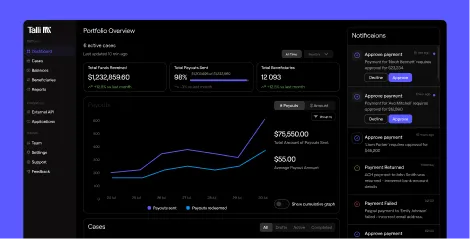
- Real-time dashboard providing total control and visibility over every payout status and completion rate
- Smart reminders across email, SMS, and more that help claimants complete the process fast
- Secure links via SMS or email requiring no account creation for claimants to check status
- Complete fund segregation preserving QSF ownership with dedicated accounts for every settlement
- Built-in compliance with KYC, OFAC, W-9 collection, fraud mitigation, and audit logs
Unlike generic payment processors, Talli was built for the claims industry with features addressing the specific trust and transparency requirements of settlement administration. The platform handles settlements from 1,000 to 100,000 recipients with consistent tracking quality.
Transparency in settlement reflects Talli's core philosophy. Claimants receive a seamless experience from submission through payment receipt, while administrators maintain complete visibility through reconciliation and reporting tools.
Flexible payout options including digital wallet integration, prepaid cards such as the Easy Prepaid Mastercard issued by Patriot Bank, N.A., Member FDIC, and gift card options ensure claimants can pick what payment method works best. No bank account required options expand accessibility while tracking monitors redemption across all payment types.
For claims teams ready to build trust through clear tracking systems, Talli provides infrastructure designed to launch, fund, and track payouts faster than ever—without losing control over compliance or claimant experience.
Frequently Asked Questions
Why is clear tracking so important for building trust with claimants?
Clear tracking reduces the uncertainty that erodes claimant confidence during the payout process. When claimants can independently verify their payment status at any time, they develop trust in the administration process. This trust translates into higher completion rates, fewer support inquiries, and positive sentiment toward the settlement. Without tracking visibility, claimants assume the worst during periods of silence, leading to abandonment and frustration. Claimant satisfaction metrics consistently show correlation between tracking transparency and overall experience ratings.
How does real-time tracking benefit both administrators and claimants?
Claimants gain peace of mind through instant visibility into their payment status, reducing anxiety and encouraging completion. Administrators benefit from reduced support volume, better completion rates, and comprehensive data for decision-making. Real-time dashboards enable administrators to identify bottlenecks, optimize notification timing, and demonstrate progress to stakeholders. The combination creates efficiency gains that reduce operational costs while improving claimant outcomes. Claims team efficiency improves measurably when tracking systems handle routine status inquiries automatically.
What security measures protect claimant data in tracking systems?
Secure tracking systems implement multiple protection layers including encrypted data transmission, secure links that expire after use, tokenized payment information, and comprehensive access logging. Claimants access their status through authenticated sessions without exposing sensitive personal or financial data. Compliance requirements mandate these security measures, ensuring tracking transparency never compromises data protection. Audit trails document every access and status change for regulatory reporting.
Can claimants choose payment methods with full tracking?
Yes, modern settlement platforms offer multiple payment options including bank transfers, digital wallets, prepaid cards, and gift cards—all with comprehensive tracking. Claimants select their preferred method during the payout process and receive consistent status updates regardless of choice. Payment redemption statistics demonstrate that flexible options combined with clear tracking significantly improve completion rates. Tracking extends through actual redemption, confirming claimants successfully accessed their funds.
How do tracking systems improve payout completion rates?
Tracking systems improve completion rates through proactive communication, smart follow-ups, and reduced abandonment. Automated notifications keep claimants informed without administrator intervention. Engagement tracking identifies claimants who need additional outreach. Deadline reminders prevent unintentional expiration. Redemption rate benchmarks show substantial improvement when administrators implement comprehensive tracking with automated follow-up capabilities. The visibility and reassurance tracking encourages claimants to complete the process rather than abandoning due to uncertainty.