.svg)


.svg)
Selecting the right class action disbursement platform API determines whether your settlement funds reach claimants in days or months—and whether you save millions or waste them on inefficient processes. Traditional paper check methods carry an average 30% failure rate that drains settlement funds through reissuance costs, while modern digital disbursement platforms achieve 98% payment success rates through automated compliance, multi-channel delivery, and real-time tracking.
Key Takeaways
- Digital disbursement APIs can achieve 98%+ payment delivery success rates, compared to materially lower completion rates for paper checks (often driven by returned mail and uncashed checks).
- Traditional checks can cost $7–20 per payment all-in (print, postage, handling, support), versus roughly $0.25–$3 for many digital transactions depending on rail and provider.
- Settlement distributions can launch in 2–7 days for basic implementations (for example, CSV/bulk upload plus standard notification flows), versus weeks for check-centric workflows that require printing, mailing, and reissuance handling.
- A $10M settlement can save $2.35M+ in operational costs when you account for printing/mailing, reissuance, and reconciliation labor that digital workflows reduce.
- AI-powered fraud prevention programs flagged or blocked 723M+ suspicious or fraudulent claim attempts in 2024
- 80% of claimants prefer digital payment options over checks
What Are the Core Needs of a Class Action Disbursement API?
Class action disbursement APIs serve as the technical backbone connecting legal case management systems to payment infrastructure. Unlike standard payment gateways designed for merchant transactions, these APIs distribute funds FROM a central pool TO numerous recipients while maintaining strict legal compliance, audit trails, and fund segregation requirements.
Automated compliance screening: Built-in KYC verification, OFAC screening, W-9 collection, and 1099 generation can reduce manual compliance work and shorten processing time compared to fully manual workflows.
Multi-channel payment distribution: Support for ACH transfers, prepaid cards, digital wallets (PayPal, Venmo, Cash App), wire transfers, and gift cards through a single API integration reaches claimants regardless of banking status.
Real-time tracking capabilities: Complete visibility into payment status, redemption rates, and completion percentages with webhooks for instant event notifications keeps administrators informed.
QSF integration: Dedicated account structures maintaining fund segregation and legal compliance throughout the disbursement lifecycle preserve QSF ownership and simplify reporting.
Court-ready reporting: Automated reporting can significantly reduce manual preparation time by producing distribution documentation aligned with common court oversight and audit needs.
What Capabilities Are Essential for Efficient Payouts?
The difference between generic payment processors and legal-specific disbursement platforms lies in specialized workflows. Standard tools like Stripe or PayPal are built for merchant payments and may not cover settlement-specific needs like QSF-style fund segregation, distribution-phase audit reporting, escheatment/unclaimed property workflows, and fee allocation logic that settlement administrators often require.
How Should You Approach API Integration for Seamless Implementation?
API integration for class action disbursements follows a structured sequence that balances speed with thorough testing. Most platforms offer 2-7 day implementation timelines, extending to 2-4 weeks for complex multi-jurisdictional distributions.
Account setup and credential access (2-5 days): Submit business application with legal entity documentation, settlement agreement, and banking information to receive sandbox and production API credentials.
Sandbox testing and data preparation (3-7 days): Upload test claimant data in CSV format with required fields: name, address, email, payment amount, and unique ID. Process test payouts to validate workflow before going live.
Production integration and fund transfer (1-3 days): Switch to production credentials, initiate fund transfer to segregated settlement account, and upload actual claimant roster via bulk API endpoint.
Campaign launch and monitoring (ongoing): Activate settlement campaign, triggering automatic secure payment links via email/SMS to claimants with instructions for verification and payout method selection.
What Technical Prerequisites Should You Prepare?
Before API implementation begins, ensure you have a legal business entity (law firm or authorized claims administrator), approved settlement agreement, claimant roster with payment amounts, and banking relationship for QSF account. Platform-provided banking services, such as Talli's partnership with Patriot Bank, N.A., Member FDIC, can simplify this requirement.
Why Is Compliance, Security, and Fraud Mitigation Critical in Legal Payouts?
Manual settlement disbursements introduce substantial compliance vulnerabilities that expose organizations to regulatory penalties. OFAC screening gaps, tax reporting errors, and audit trail deficiencies create legal exposure that automated platforms eliminate.
KYC and identity verification: Automated identity verification catches fraudulent claims at rates far exceeding manual review processes, protecting settlement funds from bad actors.
OFAC sanctions screening: Real-time screening against government sanctions lists ensures compliance with federal requirements without manual intervention.
Tax documentation automation: Automatic W-9 collection and 1099 generation eliminates the 6-8% error rate typical in manually processed payments.
Immutable audit trails: Every transaction generates complete documentation for regulatory compliance and court review, providing defensible records throughout the disbursement lifecycle.
How Do AI-Powered Fraud Prevention Systems Protect Settlements?
No-proof-of-purchase settlements attract substantial fraud risk. AI-powered platforms deploy device fingerprinting, duplicate detection algorithms, and behavioral analysis to combat settlement fraud. Industry data shows 723M+ fraudulent claims blocked in 2024, with platforms achieving 40%+ fraud reduction through automated detection.
How Can You Optimize Claimant Experience and Payment Flexibility?
Claimant experience directly impacts redemption rates and overall settlement success. Research indicates many claimants prefer digital payment options over checks, especially when offered multiple choice, while 22% of adults with income below $25,000 are unbanked—requiring diverse payment methods to reach all recipients.
Multiple payment method choices: Offering ACH, prepaid cards, digital wallets, and checks as fallback accommodates diverse banking situations and preferences across demographic groups.
Mobile-first delivery: Claimants receive secure links via SMS or email with no accounts to create, enabling convenient phone-based redemption.
Smart reminder campaigns: Automated follow-ups across email, SMS, and additional channels help claimants complete the payout process fast, driving higher redemption rates.
Self-service portals: Recipients track payment status and update information without administrator intervention, reducing support burden while improving satisfaction.
What Payment Options Should Modern Platforms Offer?
Leading disbursement platforms provide claimants multiple redemption choices including thousands of gift card retailers and support for hundreds of payment rails across multiple countries. This flexibility significantly improves fund accessibility—settlements using diverse payment options achieve 91% redemption rates versus 75% industry average.
What Real-Time Visibility and Reporting Features Should You Expect?
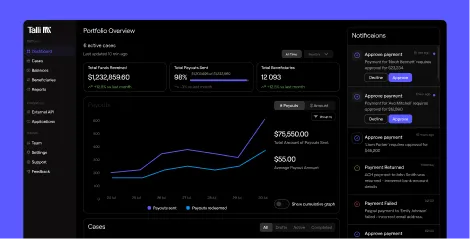
Real-time dashboards transform settlement administration from reactive firefighting to proactive management. Transparency in settlement distribution eliminates weekly status meetings and provides instant answers to stakeholder inquiries.
Live payment status tracking: Monitor delivery, completion, and engagement metrics in real-time rather than waiting for batch reports.
Fund flow visualization: See every dollar move through the distribution process with full transparency on completion rates and remaining balances.
CRM synchronization: Sync real-time payout data to platforms like Litify, Filevine, or Salesforce for unified case management.
Stakeholder reporting: Generate court-ready documentation and opposing counsel reports on demand without manual data compilation.
Exception queue management: Identify and resolve failed payments, compliance holds, and verification issues through centralized dashboards.
How Do Webhooks Enable Real-Time Updates?
Webhook-based event notifications alert your systems instantly when payment status changes—completed, failed, or requiring verification. Standard events include payment_completed, payment_failed, and document_submitted, with HMAC signature verification ensuring security. Platforms typically retry failed webhook deliveries automatically with exponential backoff.
How Do You Ensure Scalability and Performance for Any Payout Size?
Settlement sizes vary dramatically, from 1,000 claimants in employment disputes to millions in national data breach cases. Your API platform must handle both extremes without architectural changes or performance degradation.
High-volume processing capacity: Leading platforms process high volumes of payments daily, handling substantial transaction volumes across hundreds of thousands of payees—demonstrating enterprise-grade capacity.
Consistent API latency: Transaction processing times should remain stable regardless of concurrent volume, ensuring predictable performance during peak distribution periods.
Elastic infrastructure: Cloud-based platforms scale automatically to accommodate high-volume payouts without requiring capacity planning or infrastructure provisioning.
Disaster recovery: Leading platforms maintain continuous backups with less than 24-hour recovery time objectives, protecting against data loss during critical distribution periods.
What Happens During Peak Distribution Periods?
When courts approve major settlements, thousands of claimants may attempt redemption simultaneously. Enterprise platforms handle this surge through load balancing and distributed architecture, with proven capacity for processing hundreds of millions in settlement distributions across thousands of cases to millions of claimants during peak demand.
What Pricing Models Determine Cost-Effectiveness?
Understanding total cost requires looking beyond per-transaction fees to evaluate the complete financial picture. Traditional methods appear cheaper superficially but carry hidden costs that digital platforms eliminate.
Transaction-based fees: Digital payments range from $0.25-$0.50 for ACH to $2-5 for prepaid cards and $15-45 for international wires—all dramatically lower than paper alternatives.
Check reissuance elimination: Traditional checks require $150 per reissuance when lost, damaged, or returned. With 30% failure rates, reissuance costs alone can exceed total digital platform fees.
Administrative overhead reduction: Automation cuts processing costs by eliminating manual reconciliation, address verification, and compliance screening labor.
Time-to-value acceleration: Faster distribution means faster case closure, reducing ongoing administrative burden and accelerating fee recovery for law firms.
How Do You Calculate Total Cost of Ownership?
For a $10M settlement with 50,000 claimants, traditional check distribution costs approximately $2.7-3.4M including printing ($350K-$1M), reissuance ($2.25M at 30% failure), and reconciliation ($90K). Digital platform costs for the same settlement total approximately $103K—a 97% cost reduction.
How Do You Evaluate Vendor Support and Partnership Potential?
The right vendor relationship extends beyond software licensing to genuine partnership in settlement success. Technical support quality, onboarding assistance, and ongoing account management significantly impact implementation outcomes.
Dedicated account management: Enterprise platforms assign dedicated teams for complex settlements, providing single points of contact for issue resolution.
Technical documentation quality: Comprehensive API documentation, sandbox environments, and integration guides reduce implementation friction and accelerate time-to-launch.
Onboarding support: Hands-on assistance during first settlement implementation builds internal expertise for future cases.
Service level agreements: Defined uptime guarantees, response times, and escalation procedures protect against critical failures during distribution periods.
Talli delivers unrivaled customer support specifically designed for legal settlement workflows, ensuring claims teams receive guidance throughout the disbursement lifecycle. Banking services provided by Patriot Bank, N.A., Member FDIC.
Frequently Asked Questions
What security certifications should a disbursement platform have?
Leading platforms maintain SOC 2 Type II certification confirming security controls operate effectively, PCI DSS Level 1 compliance for payment card handling, and GDPR compliance for international settlements. Request recent audit reports during vendor evaluation to verify current certification status.
How do platforms handle international settlements with claimants in multiple countries?
Global disbursement capabilities vary significantly between platforms. Advanced platforms support hundreds of payment rails across 190+ countries including mobile money options for emerging markets. International wire fees typically range from $15-45 per transaction, with currency conversion adding 2-4% to exchange rates.
What happens if a claimant disputes their payment amount?
Digital platforms maintain immutable audit trails documenting every transaction from initiation through completion. Self-service portals allow claimants to view payment details, while administrator dashboards provide complete transaction history for dispute resolution. Most platforms include escalation workflows for exception handling.
Can platforms integrate with existing case management systems?
REST API integrations enable connection with platforms like Clio, Litify, and Filevine, though most require custom development or middleware rather than native connectors. Many firms successfully launch first settlements via CSV batch upload while building API integration for future cases.
How long does it take to switch from a traditional check-based system to digital disbursement?
Basic implementation takes 2-7 days for straightforward settlements, extending to 2-4 weeks for complex multi-jurisdictional distributions. Most platforms offer parallel operation during transition, allowing teams to gain confidence with digital methods while maintaining check capability as backup.