.svg)


.svg)
Cross-border digital payouts require settlement administrators to manage a complex web of regulatory frameworks spanning AML/KYC compliance, data privacy laws like GDPR and CCPA, payment regulations including PSD2 and FinCEN requirements, and sanctions screening protocols. With 86% of FinTech companies paying fines exceeding $50,000, compliance isn't optional—it's foundational to market access and operational speed. Modern AI-driven payment platforms automate and safeguard every claims payout, enabling teams to meet tight deadlines without sacrificing compliance or claimant experience.
Key Takeaways
- Cross-border payouts span 130+ countries with jurisdiction-specific regulations requiring configurable compliance frameworks
- Automated KYC/AML screening can reduce manual review workload by up to 68% and cut false positive rates by up to 88%
- A significant portion of compliance failures stem from human error, making staff training and automation critical
- Organizations implementing automation can achieve up to 80% faster onboarding compared to manual workflows
- First-year compliance implementation costs approximately $143,000 with break-even at 4-5 months
- TD Bank’s ~$3B AML penalty announced Oct 10, 2024 demonstrates the cost of inadequate cross-border compliance controls
What Does the Cross-Border Payment Regulatory Landscape Look Like?
The regulatory environment for international digital payouts encompasses multiple overlapping frameworks that vary by jurisdiction, payment type, and recipient classification. Claims administrators must understand these frameworks before processing a single cross-border transaction.
- Financial Action Task Force (FATF) standards — Global AML/CFT recommendations that countries implement through local laws and supervisory regimes.
- OFAC sanctions screening — U.S. Treasury requirements for screening all parties against prohibited persons lists.
- GDPR and CCPA data privacy — Regulations governing how recipient personal data is collected, stored, and transferred across borders.
- PSD2 payment regulations — EU requirements for payment service providers including strong customer authentication.
- Local licensing requirements — MSB registration in the U.S., FCA authorization in the UK, and MAS licensing in Singapore.
Understanding OFAC screening requirements is essential for any organization processing international settlement payments.
Why Do Regulations Vary So Dramatically by Corridor?
Each payment corridor presents unique compliance challenges based on local regulatory bodies, financial intelligence units, and enforcement priorities. Africa alone contains 54 countries with distinct regulatory frameworks, making a one-size-fits-all approach impossible.
What Are the Key Compliance Requirements for International Digital Payouts?
Effective cross-border payout compliance requires implementing multiple verification and monitoring processes throughout the payment lifecycle. Legal payout compliance demands attention to KYC verification, tax reporting, and beneficiary identification.
- KYC/KYB verification — Identity confirmation for individuals and beneficial ownership verification for business entities.
- W-9 collection — Tax documentation requirements for U.S. payees to ensure accurate 1099 reporting.
- Source of funds documentation — Evidence that settlement funds originate from legitimate legal proceedings.
- Sanctions list screening — Real-time checks against OFAC, UN, EU, and local watchlists before payment release.
- Ongoing transaction monitoring — Continuous surveillance for suspicious activity patterns requiring SAR filing.
Organizations that fail to implement these controls face severe consequences. Binance paid $4.3 billion in penalties for AML violations, while BitMEX settled for $100 million in 2021 over similar compliance failures.
How Do You Build a Risk-Based Compliance Approach?
FATF recommends risk-based compliance where verification intensity matches the risk profile of each transaction and recipient. High-risk corridors involving FATF-listed countries require enhanced due diligence, while lower-risk domestic payments may use simplified verification.
Talli automates KYC, OFAC, and W-9 collection with fraud mitigation and audit logs baked into every transaction, eliminating manual verification bottlenecks while maintaining regulatory compliance.
How Can You Implement Robust Fraud Prevention and Security Measures?
Cross-border transactions present elevated fraud risks due to jurisdictional complexity, making security infrastructure critical. Settlement administrators must implement multiple defensive layers to protect both funds and recipient data.
- Multi-factor authentication — Requiring multiple verification factors before authorizing payment releases.
- Data encryption — AES-256 encryption for data at rest and TLS 1.3 for data in transit.
- Real-time anomaly detection — Machine learning algorithms identifying suspicious transaction patterns.
- Secure payment gateways — PCI DSS Level 1 compliant infrastructure for card-based disbursements.
- Anti-phishing protocols — Email authentication and claimant education to prevent social engineering attacks.
Research indicates a significant portion of compliance failures stem from human error, making automated security controls essential for handling fraud risks at scale.
What Security Certifications Should You Require?
Verify that your payment provider maintains SOC 2 Type II certification, GDPR compliance, and relevant financial licenses (MSB, FCA, MAS) for each jurisdiction where you send payouts. Request certificate copies during vendor selection.
How Do You Streamline Cross-Border Fund Distribution for Efficiency?
Efficient cross-border distribution requires integrating payment rails, compliance screening, and recipient communication into a unified workflow. Manual processes that work for domestic payouts collapse under international complexity.
- API integration — Connect case management systems directly to payment platforms for automated payout initiation.
- Batch processing capabilities — Handle thousands of international payments simultaneously with configurable approval workflows.
- Digital wallet integration — Support for PayPal, and local mobile money platforms across recipient jurisdictions.
- Real-time tracking — Monitor payment status from initiation through final delivery with instant status updates.
- Automated reconciliation — Match payments to claimant records without manual spreadsheet management.
Organizations implementing digital disbursement platforms report significant reductions in manual claims processing work compared to legacy systems.
Talli streamlines fund distribution with secure settlement payment methods and digital wallet integration, enabling claims teams to launch, fund, and track payouts faster than ever without losing control.
Why Is Complete Fund Segregation Essential for Transparent Reporting?
Settlement funds require complete segregation from operating accounts to preserve legal ownership structures and simplify regulatory reporting. Qualified Settlement Fund requirements mandate clear separation and documentation.
- Dedicated settlement accounts — Individual accounts for each settlement preserving QSF ownership throughout the distribution lifecycle.
- Immutable audit trails — Timestamped logs documenting every fund movement from receipt through final disbursement.
- Real-time reporting dashboards — Visibility into completion rates, fund flows, and outstanding distributions.
- CRM synchronization — Automatic updates to case management systems eliminating duplicate data entry.
- Multi-year record retention — Compliance documentation maintained for regulatory audit requirements.
Organizations emphasizing transparency in settlement distribution build trust with courts, claimants, and regulatory bodies.
Talli supports dedicated accounts for every settlement, preserving QSF ownership, simplifying reporting, and ensuring legal compliance through complete fund segregation throughout the disbursement lifecycle.
What Payout Options Work Best for Global Recipients?
International claimants require flexible payment methods accommodating diverse banking situations, local preferences, and currency requirements. Offering limited options dramatically reduces redemption rates.
- ACH and wire transfers — Direct bank deposits for recipients with established banking relationships.
- Prepaid debit cards — Mastercard or Visa cards accessible without traditional bank accounts.
- Digital wallets — PayPal, Venmo, and regional platforms like M-Pesa for mobile-first markets.
- Gift cards — Merchant-specific options for recipients preferring retail redemption.
- Local currency conversion — Payments delivered in recipient's preferred currency at transparent exchange rates.
Providers supporting 80-140 currencies across 130+ countries ensure settlement administrators can reach claimants regardless of location or banking status.
How Do You Serve Unbanked Recipients?
Approximately 1.4 billion adults globally lack bank accounts, making alternative payment methods essential for inclusive settlement distribution. Prepaid cards, mobile money, and cash pickup options ensure no claimant is excluded from receiving their entitled funds.
Talli offers flexible payout options including digital wallet integration and the Easy Prepaid Mastercard, ensuring more claimants complete the process without requiring a bank account. Banking services are provided by Patriot Bank, N.A., Member FDIC.
How Does Technology Enable Automated Compliance and Speed?
AI-driven platforms transform compliance from a manual bottleneck into an automated accelerator. Technology handles verification, screening, and documentation while humans focus on exception management and strategic decisions.
- Automated KYC verification — AI-powered document scanning and biometric authentication reducing manual review workload significantly.
- Real-time sanctions screening — Instant checks against global watchlists with 88% reduction in false positives.
- Machine learning monitoring — Adaptive algorithms identifying suspicious patterns human reviewers miss.
- Automated tax reporting — 1099 generation and distribution without manual data compilation.
- API-first architecture — Seamless integration with existing case management and accounting systems.
Organizations implementing automation can achieve up to 80% faster onboarding compared to manual workflows.
What ROI Can You Expect from Compliance Automation?
First-year implementation typically costs approximately $143,000 including platform subscriptions, RegTech tools, legal counsel, and integration. Organizations report break-even at 4-5 months with 3-year ROI reaching 739% through labor savings, FX optimization, and faster settlement cycles.
Talli's AI-driven payment platform automates and safeguards every claims payout, enabling teams to meet tight deadlines with compliance, speed, and total visibility.
How Can You Enhance Claimant Experience in Cross-Border Payouts?
Regulatory compliance and claimant experience aren't competing priorities—they reinforce each other. Streamlined verification processes reduce friction while maintaining security.
- Secure SMS/email links — Claimants receive payment notifications with one-click access to select their preferred method.
- No account creation required — Recipients complete the payout process without creating platform credentials.
- Smart reminders — Automated follow-ups across email and SMS increasing completion rates.
- Multilingual support — Communication in claimant's preferred language reducing confusion.
- Real-time status tracking — Recipients monitor their payment progress without contacting support.
Understanding KYC false positive rates helps administrators balance security requirements with claimant convenience.
Talli offers a seamless experience for every claimant with secure links via SMS or email and smart reminders to help claimants complete the payout process fast—driving higher take-up rates.
Why Is Real-Time Tracking Critical for Full Control and Visibility?
Settlement administrators need instant visibility into every transaction across multiple jurisdictions, payment methods, and recipient statuses. Delayed reporting creates compliance gaps and operational blind spots.
- Real-time dashboards — Monitor delivery, completion, and engagement as payments progress through each stage.
- Completion rate tracking — Identify redemption bottlenecks before they impact settlement timelines.
- Fund flow visualization — See exactly where every dollar sits at any moment during distribution.
- Built-in reporting — Generate audit-ready documentation for stakeholders and regulators without manual compilation.
- Alert workflows — Immediate notification of failed payments, compliance flags, or unusual patterns.
Organizations implementing real-time monitoring report substantial reductions in audit preparation time compared to manual documentation gathering.
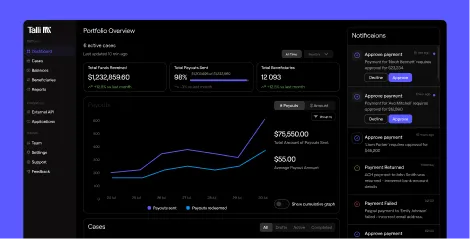
Talli provides a real-time dashboard for total control and visibility, allowing teams to create payout distribution campaigns, track every payout status, and monitor completion rates. See every dollar with full transparency on fund flows and sync real-time payout data to your CRM.
Ready to speed up your payouts while maintaining cross-border compliance? Talli automates KYC, OFAC, W-9 collection, fraud mitigation, and audit logs—so you can meet tight deadlines without losing control.
Frequently Asked Questions
How long does it take to implement a cross-border compliant payout system?
Realistic implementation timelines range from 16-24 weeks from vendor selection to full cutover. The critical path includes legal contract negotiation (6-8 weeks) and data cleansing (4-6 weeks), with API integration running parallel to compliance framework documentation.
What are the primary regulatory bodies overseeing cross-border payouts?
Key regulatory bodies include FATF for global AML standards, FinCEN in the United States, the FCA in the United Kingdom, MAS in Singapore, and ACPR in France. Each jurisdiction where you send payments may have additional local requirements from financial intelligence units and central banks.
Can you process cross-border payouts without MSB registration?
Operating without required licenses exposes organizations to significant regulatory risk. In the United States, money services businesses must register with FinCEN and obtain state-level licenses. Partnering with a licensed payment provider allows you to leverage their regulatory infrastructure while maintaining compliance.
How do Travel Rule requirements affect cross-border settlement payments?
The FATF Travel Rule requires financial institutions to share originator and beneficiary information for transactions above certain thresholds. For crypto and digital asset payouts, this requires additional technical infrastructure to transmit required data between providers.
What happens when a cross-border payment fails compliance screening?
Failed screenings trigger enhanced due diligence workflows where compliance analysts review flagged transactions. False positives—legitimate payments incorrectly flagged—require manual clearance before processing. Platforms with AI-powered screening reduce false positive rates significantly, minimizing these delays.