.svg)


.svg)
GDPR compliance in payout processing requires integrating data protection principles into every stage of fund distribution—from initial claimant data collection through final disbursement and post-payment record retention. For organizations handling legal claims payouts, non-compliance carries maximum GDPR penalties up to €20 million or 4% of global turnover, making proper implementation essential. Modern digital disbursement platforms streamline this process by embedding privacy controls directly into payment workflows.
Key Takeaways
- GDPR violations can result in administrative fines up to €20 million or 4% of total worldwide annual turnover (whichever is higher), depending on the infringement category and regulator assessment.
- Data minimization practices can significantly reduce stored personal data, lowering compliance risk
- Organizations must respond to data subject rights requests within one month, with a possible extension (up to two additional months) for complex or numerous requests (with notice to the requester).
- Breach notification to authorities must occur within 72 hours of discovery
- Automated consent management eliminates 90% of documentation gaps
- Proactive compliance programs can save significant costs annually in avoided fines
- Implementation of a complete compliance framework can take several months depending on organizational complexity
What Are the Core GDPR Requirements for Payment Processing?
GDPR establishes six lawful bases for processing personal data, and payout platforms must identify and document which basis applies to each data type collected. Understanding these requirements prevents operational disruptions when claimants exercise their rights.
- Contract execution basis — Processing bank details and contact information necessary to complete payout delivery requires no separate consent under GDPR Article 6(1)(b).
- Legal obligation basis — Tax reporting requirements (1099 forms) and AML verification fall under mandatory compliance obligations.
- Legitimate interest basis — Fraud prevention and risk assessment activities may qualify as legitimate interests when properly documented and balanced against data subject rights.
- Consent-based processing — Marketing communications and optional data sharing require explicit consent that claimants can withdraw at any time.
How Do Data Controllers Differ from Data Processors?
Settlement administrators typically function as data controllers, determining the purposes and means of processing claimant information. Payment platforms like Talli operate as data processors, handling data on behalf of controllers under specific contractual agreements. Both parties share compliance responsibilities, requiring formal Data Processing Agreements (DPAs) that specify security measures, breach notification procedures, and data retention limits.
How Does Data Minimization Apply to Settlement Payouts?
Data minimization—collecting only information strictly necessary for the stated purpose—forms a cornerstone of GDPR compliance. For payout operations, this means eliminating unnecessary form fields and limiting data retention periods.
- Essential data only — Collect bank account details, email, and name for payment execution; avoid requesting birthdates or demographics unless legally required.
- Tokenization of sensitive data — Replace full account numbers with non-sensitive tokens in logs and analytics systems.
- Automated deletion schedules — Remove IP addresses and device identifiers after 90 days if not required for fraud monitoring.
- Storage reduction — Organizations implementing minimization practices can significantly reduce stored personal data volumes.
What Data Should Payout Platforms Retain?
Tax compliance requires maintaining transaction records for seven years, creating tension with GDPR's storage limitation principle. The solution involves retaining only legally mandated information (payment amounts, dates, tax IDs) while purging non-essential data (browsing history, IP logs, marketing preferences) after payout completion.
What Security Measures Protect Payout Data Under GDPR?
GDPR Article 32 mandates "appropriate technical and organizational measures" to ensure data security. For payment platforms, this translates into specific encryption standards, access controls, and breach response capabilities.
- Data at rest encryption — Apply AES-256 encryption to bank account numbers, SSNs, and PII stored in databases.
- Data in transit protection — Use TLS 1.2+ for all payment API communications.
- Role-based access controls — Finance teams access bank details; marketing receives only anonymized data.
- Multi-factor authentication — Require MFA for all administrative access to claimant records.
How Should Organizations Prepare for Data Breaches?
GDPR requires notification to supervisory authorities within 72 hours of discovering a breach affecting personal data. Effective preparation includes:
- Detection triggers — Monitor for unauthorized access patterns, encryption failures, and unusual data exports.
- Pre-drafted templates — Prepare notification letters for authorities and affected claimants before incidents occur.
- Tabletop exercises — Run quarterly breach response drills to ensure teams meet the 72-hour deadline.
- Forensic procedures — Document investigation protocols for preserving evidence and determining breach scope.
Organizations with tested incident plans achieve faster response times compared to those without documented procedures.
How Do You Ensure Transparency and Obtain Valid Consent?
Transparency in settlements requires clear communication about data practices in plain language. Privacy notices must explain what data is collected, why it's processed, how long it's retained, and who receives it.
- Granular consent options — Separate required consent (payment execution) from optional consent (marketing communications).
- Timestamp documentation — Record the exact date, time, IP address, and consent language version shown to each claimant.
- Easy withdrawal mechanisms — Provide clear paths for claimants to revoke marketing consent without affecting payout processing.
- Version control — Maintain records of all privacy policy iterations to demonstrate what users agreed to at specific points.
What Makes Consent Valid Under GDPR?
Valid consent must be freely given and specific. Pre-checked boxes, bundled consents, and consent obtained under duress fail to meet GDPR standards. Automated consent management platforms eliminate 90% of documentation gaps by capturing complete records automatically.
What Data Subject Rights Must Payout Platforms Support?
GDPR grants individuals specific rights over their personal data, and payout platforms must establish workflows to fulfill requests within 30 days.
- Right to access — Generate comprehensive reports of all claimant data held across systems.
- Right to rectification — Allow claimants to correct incorrect bank details or contact information.
- Right to erasure — Delete non-essential data after payout completion while retaining tax records.
- Right to data portability — Export claimant information in machine-readable formats upon request.
- Right to object — Stop marketing communications immediately when claimants exercise this right.
How Can Platforms Streamline Access Requests?
Self-service claimant portals reduce administrative burden by enabling recipients to view, download, and update their information directly. Automated data subject request (DSR) workflows query all connected systems simultaneously, generating faster response times compared to manual processing.
How Do Qualified Settlement Funds Support GDPR Compliance?
Qualified Settlement Funds provide structural advantages for GDPR-compliant disbursements by segregating settlement assets and maintaining clear ownership documentation.
- Complete fund segregation — Dedicated accounts for each settlement simplify audit trails and prevent data commingling.
- QSF ownership preservation — Clear legal structures document data controller responsibilities throughout the disbursement lifecycle.
- Simplified reporting — Segregated funds generate cleaner compliance documentation for regulators.
- Fiduciary accountability — Trust account structures establish clear chains of custody for claimant data.
Talli supports dedicated accounts for every settlement, preserving QSF ownership and simplifying reporting requirements throughout distribution.
Why Are KYC, OFAC, and W-9 Integration Critical for Compliance?
Identity verification and sanctions screening intersect with GDPR requirements, creating complex compliance obligations. OFAC compliance and Know Your Customer (KYC) processes must balance thorough verification against data minimization principles.
- Automated KYC verification — Digital identity checks reduce manual review while maintaining documentation standards.
- Real-time OFAC screening — Automated sanctions list verification occurs before fund release without storing unnecessary personal data.
- W-9 collection workflows — Tax form capture integrates with seven-year retention requirements while enabling deletion of non-tax data.
- Fraud mitigation controls — Pattern detection algorithms identify suspicious claims without requiring excessive data collection.
How Do You Balance Security and Privacy?
The key lies in purpose limitation—collecting verification data specifically for compliance purposes and restricting access to compliance personnel only. Compliance automation enables thorough verification while maintaining strict data access controls and audit trails.
How Can Automation Ensure Continuous GDPR Compliance?
Manual compliance processes fail at scale. Organizations processing thousands of payouts require automated systems to maintain consistent GDPR adherence.
- Real-time monitoring dashboards — Track consent status, data retention schedules, and DSR response times continuously.
- Automated audit trails — Every data access, modification, and deletion generates timestamped documentation.
- Scheduled compliance reviews — Quarterly automated audits identify retention policy violations and consent gaps.
- Data Protection Impact Assessments — Automated DPIA workflows flag high-risk processing activities for review.
What Should Quarterly Compliance Audits Include?
Effective audit programs review data retention schedule compliance, vendor DPA currency, consent log completeness, and security control effectiveness. Organizations conducting regular audits detect compliance gaps early, avoiding significant fines that can reach €20 million for serious violations.
What Makes Talli the Preferred Choice for GDPR-Compliant Payouts?
Talli's payment platform addresses GDPR requirements through built-in compliance controls designed specifically for legal settlement and mass claims distribution.
- KYC, OFAC, and W-9 integration — Compliance verification baked into every payout workflow with comprehensive audit logs.
- Complete fund segregation — Dedicated accounts preserve QSF ownership and simplify regulatory reporting.
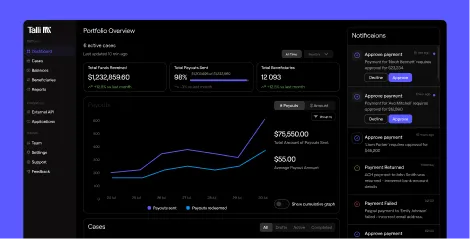
- Real-time dashboards — Full transparency on completion rates, fund flows, and compliance status across all settlements.
- Fraud mitigation controls — Automated detection prevents improper payments while minimizing data collection.
- Flexible payment options — Claimants choose preferred methods without compromising privacy protections.
Banking services are provided by Patriot Bank, N.A., Member FDIC, ensuring institutional-grade security for all settlement funds.
How Does Talli Simplify Complex Compliance Needs?
By automating consent documentation, integrating compliance screening directly into payment workflows, and providing comprehensive audit trails, Talli eliminates the manual burden that causes most GDPR compliance failures. The platform's design reflects the principle that privacy protection and operational efficiency reinforce rather than conflict with each other.
Frequently Asked Questions
What are the consequences of GDPR non-compliance in payout processing?
Beyond the headline €20 million or 4% of turnover maximum fines, non-compliance triggers mandatory public disclosure of violations, potential class action lawsuits from affected claimants, suspension of data processing activities, and substantial reputational damage that affects future client relationships.
How do cross-border data transfers affect EU settlement payouts?
US organizations distributing settlements to EU claimants must implement specific safeguards for data transfers, including Standard Contractual Clauses (SCCs) with vendors, Transfer Impact Assessments documenting US government access risks, and consideration of Data Privacy Framework certification for US processors.
Can encrypted data still be considered personal data under GDPR?
Yes. Encrypted data remains personal data under GDPR because the data subject can still be identified by whoever holds the decryption keys. Encryption is a security measure, not an exemption from GDPR obligations.
What is a Data Protection Impact Assessment and when is it required?
A DPIA is a formal evaluation of processing activities that pose high risks to individuals' rights. It's mandatory when processing involves large-scale systematic monitoring, automated decision-making with legal effects, or processing of sensitive categories like health data. Most high-volume settlement disbursements trigger DPIA requirements.
How should organizations handle claimants who withdraw consent mid-settlement?
When claimants withdraw consent for optional processing (marketing), that activity must stop immediately. However, withdrawal cannot affect processing based on other legal grounds—payment execution based on contractual necessity continues regardless of consent withdrawal, though organizations must clearly communicate this distinction to claimants upfront.