.svg)


.svg)
Global class action settlements demand rigorous regulatory compliance across multiple jurisdictions, with OFAC violations alone which can trigger civil penalties ranging from six figures to multi-million-dollar settlements, depending on the program, facts, and inflation-adjusted limits. Modern disbursement platforms like Talli address these challenges by automating sanctions screening, identity verification, and fraud detection—ensuring legal teams meet court deadlines without sacrificing compliance or claimant experience.
Key Takeaways
- Fraudulent claim attempts have surged dramatically in recent years, making automated fraud detection essential for settlement integrity
- Digital disbursement platforms achieve significantly higher payment success rates compared to paper checks
- OFAC screening automation significantly reduces manual review errors while preventing costly sanctions violations
- QSF-compliant fund segregation preserves settlement ownership and simplifies court-mandated reporting
- Claims administrators can reduce operational costs significantly when switching from checks to digital payments
- Real-time dashboards provide complete visibility into payout status, redemption rates, and compliance documentation
What Are the Core Regulatory Challenges in Global Class Action Payouts?
International settlement distributions face a complex web of regulatory requirements that vary dramatically across jurisdictions. Claims administrators must simultaneously satisfy U.S. sanctions laws, anti-money laundering regulations, tax reporting obligations, and data privacy requirements—all while meeting tight court-imposed deadlines.
- Sanctions compliance mandates require screening every recipient against OFAC's Specially Designated Nationals list and international sanctions databases before releasing funds
- Anti-money laundering requirements demand identity verification and beneficial ownership documentation for claimants receiving substantial payments
- Tax reporting obligations may include W-9 collection and 1099 reporting for U.S. payees (often using the $600 threshold), and W-8 forms or local tax documentation for non-U.S. claimants, depending on settlement type and jurisdiction
- Data privacy regulations such as GDPR and CCPA impose strict requirements on handling claimant personal information across borders
- Court reporting standards require comprehensive audit trails documenting every disbursement decision and transaction
Why Does Jurisdictional Complexity Create Compliance Risks?
Cross-border settlements introduce layered compliance obligations that multiply with each country involved. A securities fraud settlement with claimants across 40 countries must satisfy payment regulations in numerous jurisdictions while maintaining consistent fraud prevention and identity verification standards.
How Do Platforms Ensure Fund Segregation and QSF Compliance?
Qualified Settlement Funds (QSFs) require complete separation of settlement assets from operating funds to preserve ownership, satisfy fiduciary duties, and simplify tax reporting. Disbursement tools approach this requirement through dedicated For Benefit Of (FBO) account structures that maintain clear demarcation between settlement pools.
- Dedicated settlement accounts ensure each case maintains separate banking infrastructure with distinct account numbers and routing identifiers
- FBO structures preserve QSF ownership while enabling efficient distribution without commingling
- Automated reporting generates court-ready documentation showing fund flows, disbursement timing, and remaining balances
- Escrow integration provides additional protection for high-value settlements requiring third-party fund custody
Talli supports complete fund segregation with dedicated accounts for every settlement, preserving QSF ownership and ensuring legal compliance throughout the disbursement lifecycle. Banking services provided by Patriot Bank, N.A., Member FDIC.
What Mechanisms Maintain QSF Integrity Across Multiple Settlements?
Leading platforms create isolated fund pools that prevent cross-settlement contamination. Each QSF receives its own virtual account with segregated ledgers, automated balance reconciliation, and transaction-level audit trails that satisfy court scrutiny.
What Role Does KYC, OFAC, and W-9 Collection Play in Compliance?
Identity verification and sanctions screening form the backbone of settlement compliance. Every claimant must be verified against federal watchlists before receiving funds, with OFAC violations carrying penalties that can devastate a firm's finances and reputation.
- Know Your Customer (KYC) protocols verify claimant identities through document authentication, database matching, and address verification
- OFAC screening checks every recipient against the Specially Designated Nationals list and blocked persons lists maintained by the U.S. Department of Treasury
- W-9 collection captures taxpayer identification numbers required for IRS reporting on payments exceeding threshold amounts
- Beneficial ownership verification identifies the ultimate recipients of payments to business entities or trusts
How Do Automated Versus Manual Verification Processes Compare?
Manual OFAC screening becomes impractical at scale—a settlement with 50,000 claimants would require thousands of individual checks against sanctions databases. Automated platforms perform real-time screening that catches potential matches instantly while significantly reducing false positives compared to manual review processes.
Talli integrates robust compliance verification including KYC, OFAC, and W-9 collection directly into its platform, streamlining global payout processes without sacrificing thoroughness.
Why Is Fraud Mitigation Critical for Settlement Integrity?
The fraud landscape has expanded significantly in recent years, forcing claims administrators to implement sophisticated detection tools that can identify synthetic identities, duplicate submissions, and coordinated fraud rings before payments are released.
- Pattern recognition algorithms identify suspicious submission clusters sharing email domains, IP addresses, or payment destinations
- Duplicate claim detection flags identical or near-identical submissions across different claimant identities
- Synthetic identity recognition catches fabricated identities constructed from stolen personal information elements
- Device fingerprinting identifies multiple submissions originating from the same computer or network
Real-time fraud screening has prevented millions of fraudulent claims as platforms deploy increasingly sophisticated detection tools.
What Audit Trail Requirements Support Legal Defensibility?
Comprehensive audit logs document every screening decision, payment attempt, and status change throughout the disbursement lifecycle. These detailed records satisfy court reporting requirements while providing forensic documentation if fraud disputes arise post-distribution.
Talli integrates fraud mitigation and provides comprehensive audit logs, offering full transparency on fund flows and ensuring payout integrity across global distributions.
How Does Payment Method Flexibility Affect Regulatory Compliance?
Different payment rails carry distinct regulatory requirements that disbursement platforms must manage automatically. ACH transfers operate under NACHA rules, card payments require PCI DSS compliance, and international wires must satisfy correspondent banking regulations in multiple jurisdictions.
- ACH direct deposits provide low-cost domestic transfers with 1-2 day settlement times and established regulatory frameworks
- Digital wallet payments via PayPal, Venmo, or Cash App reach unbanked claimants without requiring traditional bank accounts
- Prepaid card issuance delivers immediate fund access while satisfying KYC requirements through card activation verification
- International wire transfers enable cross-border payments but require SWIFT compliance and often involve correspondent bank fees
- Real-time payment rails including RTP and FedNow provide instant settlement for time-sensitive distributions
Industry research suggests that approximately 80% of claimants prefer digital payment options over traditional checks, and platforms offering multiple rails typically see higher redemption rates.
Why Do Local Payment Methods Matter for International Claimants?
Recipients in Brazil expect PIX transfers, Indian claimants use UPI, and European recipients prefer SEPA payments. Platforms supporting diverse local payment rails across numerous countries maximize accessibility while satisfying jurisdiction-specific compliance requirements.
Talli offers flexible payout options including digital wallet integration and the Easy Prepaid Mastercard, issued by Patriot Bank, N.A., Member FDIC, pursuant to a license from Mastercard International.
What Reporting Capabilities Do Compliance-Focused Platforms Provide?
Real-time visibility into settlement status, payment completion, and compliance documentation has become essential for claims administrators managing court deadlines and stakeholder expectations. Modern platforms provide dashboard analytics that transform raw transaction data into actionable insights.
- Live payout tracking shows payment status for every claimant from initiation through successful delivery or failure
- Redemption rate monitoring identifies which payment methods drive highest completion rates across different claimant demographics
- Compliance alert systems flag screening matches, verification failures, and fraud indicators requiring manual review
- Fund flow visualization illustrates money movement from QSF accounts through payment processors to claimant accounts
- CRM integration synchronizes payout data with case management systems for unified record-keeping
How Does Automated Reporting Simplify Court Requirements?
Courts increasingly demand detailed distribution reports showing payment attempts, success rates, unclaimed fund handling, and escheatment compliance. Platforms with automated reporting capabilities generate these documents instantly rather than requiring days of manual compilation.
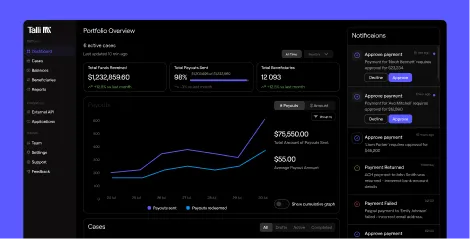
Talli provides a real-time dashboard for total control and visibility, enabling immediate tracking of payout statuses and seamless synchronization of data to CRMs for compliance and reporting.
How Do Platforms Protect Claimant Data Across Jurisdictions?
International settlements must satisfy data protection requirements from multiple regulatory frameworks simultaneously. GDPR governs European claimant data, CCPA covers California residents, and sector-specific regulations add additional layers for healthcare and financial services settlements.
- Encryption standards including AES-256 at rest and TLS 1.3 in transit protect personal information throughout the payment lifecycle
- Access controls restrict claimant data visibility to authorized personnel through role-based permissions and multi-factor authentication
- Data minimization limits collected information to what's necessary for payment processing and compliance verification
- Cross-border transfer safeguards ensure data moving between jurisdictions satisfies adequacy requirements and standard contractual clauses
- Retention policies automatically purge sensitive information after legally required holding periods expire
What Security Certifications Should Platforms Maintain?
SOC 2 Type II certification validates that platforms maintain adequate controls over security, availability, and confidentiality. PCI DSS Level 1 compliance is mandatory for any platform processing card payments, while ISO 27001 certification demonstrates comprehensive information security management.
Claimants receive secure links via SMS or email, and Talli adheres to a comprehensive Privacy Policy ensuring secure handling of personal information for global payouts.
How Should Legal Teams Evaluate Disbursement Tools for Compliance?
Selecting a disbursement platform requires systematic assessment of compliance capabilities, integration requirements, and scalability factors. The right choice depends on settlement complexity, geographic scope, and internal resource availability.
- Verify real-time OFAC screening—batch screening creates compliance gaps and delays that expose firms to regulatory risk
- Confirm QSF fund segregation capabilities—commingling settlement funds violates fiduciary duties and complicates tax reporting
- Assess fraud detection sophistication—basic duplicate screening is insufficient given current fraud attack volumes
- Evaluate payment rail coverage—international settlements require platforms supporting local payment methods across target jurisdictions
- Review integration options—API connectivity enables seamless data flow between case management systems and disbursement platforms
- Examine support infrastructure—complex settlements benefit from dedicated implementation teams and ongoing compliance guidance
What Questions Reveal Platform Compliance Maturity?
Ask potential vendors about their OFAC screening frequency (real-time versus batch), fraud prevention track record (claims prevented in the past year), and audit trail retention policies. Request sample court reports to evaluate documentation quality before committing.
Designed for teams that need compliance, speed, and total visibility, Talli automates and safeguards every claims payout—helping meet tight deadlines without losing control over compliance or claimant experience. Ready to speed up your payouts?
Frequently Asked Questions
What happens when OFAC screening returns a false positive match?
False positives occur frequently with common names and require human review before proceeding. Quality platforms implement fuzzy matching algorithms that use multiple identifiers (name plus date of birth plus address) to reduce false match rates while maintaining screening rigor. Most platforms maintain dedicated compliance queues where trained staff review flagged claimants within 24-48 hours to avoid payment delays.
How do disbursement platforms handle currency exchange for international claimants?
Cross-border payments typically involve FX conversion fees ranging from 2-5% depending on currency pair and volume. Some platforms negotiate preferential exchange rates for high-volume settlements while others pass through bank rates directly. Claimants in major markets may receive payments in local currency via domestic rails (PIX, UPI, SEPA) rather than converted wire transfers, often reducing costs significantly.
What escheatment requirements apply to unclaimed settlement funds?
Unclaimed funds become subject to state abandoned property laws after dormancy periods ranging from one to five years depending on jurisdiction. Disbursement platforms must track unclaimed payments, attempt recontact, and ultimately remit unclaimed funds to appropriate state treasuries. Modern platforms automate this entire process, generating required reports and managing remittance deadlines without manual intervention.
Can disbursement platforms integrate with existing case management systems?
Most enterprise platforms offer API connectivity enabling bi-directional data synchronization with case management systems like Clio, MyCase, or custom-built solutions. Integration typically requires IT involvement for initial configuration but operates automatically thereafter, eliminating duplicate data entry and ensuring case files reflect current payment status.
How quickly can a new settlement be configured on a disbursement platform?
Standard domestic settlements typically launch within 3-7 business days including account setup, compliance rule configuration, and claimant data import. Complex international settlements requiring multi-currency support and jurisdiction-specific compliance rules may require 10-14 days. Platforms with templated configurations for common settlement types can accelerate implementation significantly.