.svg)


.svg)
Class action settlements distribute billions annually, yet the vast majority of funds never reach intended recipients. With median claims rates at just 9% and weighted averages dropping to 4%, claims administrators face mounting pressure from courts demanding better outcomes. Modern AI-driven payment platforms offer a proven path forward, transforming redemption rates through digital-first strategies that meet claimants where they are.
Key Takeaways
- Median claims rates sit at 9% with weighted averages of just 4%, meaning roughly 91–96% of eligible class members don’t submit a claim in claims-made settlements
- Digital payment methods achieve significantly higher success rates compared to traditional paper checks
- The vast majority of claimants prefer digital payment options when given a choice
- Plain English payment language in notices improves claims rates by 10 percentage points
- Multiple communications are associated with claims rates more than twice as high as single-touch notice compared to single-contact campaigns
- Fraudulent claims increased dramatically in recent years, requiring sophisticated detection technology
- Digital transactions can reduce disbursement costs by up to 90% compared to paper checks
Why Do So Many Claimants Fail to Cash Out?
The gap between court-approved settlements and actual claimant recovery represents one of the legal system's most persistent failures. Research analyzing consumer class actions reveals systemic problems that leave billions unclaimed annually.
- Outdated contact information prevents notices from reaching eligible claimants, with mailed materials returned undeliverable at significant rates
- Complex legal language obscures the actual benefit, because only 40% of notices used visually prominent plain-English payment words (e.g., “money,” “payment,” “refund,” “cash”)
- Single-touch notification limits response opportunities, with only 13% of settlements implementing multiple outreach attempts
- Paper check friction creates barriers when checks arrive weeks later, require bank deposits, and expire before redemption
- Lack of payment flexibility excludes unbanked claimants who cannot easily deposit traditional checks
Media-only notice campaigns perform especially poorly, with a reported median claims rate of 0.023% when notice is primarily via media advertisements rather than direct notice—leaving 99.977% of eligible recipients without compensation. In large consumer class actions, claims rates have often been around 1%–2%, triggering judicial scrutiny of whether settlements actually serve class member interests.
How Do Digital Payment Platforms Transform Redemption Rates?
The shift from paper-based to digital disbursement represents the single most impactful change administrators can make. Analysis of settlement data demonstrates a clear performance gap between payment methods.
- Digital payments achieve significantly higher success rates compared to traditional paper checks in both claims-requiring cases and direct distribution settlements
- Claimant preference strongly favors digital, with the vast majority selecting electronic options when given a choice
- Mass tort recipients show strong digital preference, demonstrating that even high-value individual settlements benefit from electronic delivery
- Settlement adoption has grown substantially in recent years, with hundreds of cases now offering digital payment options
This substantial improvement translates to millions of additional claimants successfully receiving funds across the industry annually.
What Makes AI-Driven Platforms Different?
Traditional disbursement relies on manual processing workflows that create bottlenecks, errors, and delays. AI-powered platforms automate verification, compliance screening, and payment routing to compress timelines from weeks to days while reducing error rates.
- Automated identity verification confirms claimant eligibility without manual document review
- Real-time fraud screening identifies suspicious claims before processing
- Intelligent payment routing selects optimal delivery methods based on claimant data
- Automated tax compliance handles W-9 collection and 1099 generation without staff intervention
What Payment Options Help Claimants Complete the Process?
Flexible payout options directly address the accessibility barriers that prevent claimants from redeeming funds. When claimants can choose their preferred method, completion rates increase substantially.
- ACH direct deposit delivers funds to existing bank accounts within 1-3 business days
- Digital wallet integration enables instant transfers to PayPal, Venmo, or similar platforms
- Prepaid Mastercard provides immediate spending power without bank account requirements
- Gift cards offer retail-ready value for claimants preferring merchandise options
- Paper checks remain available for those who specifically request traditional delivery
The Facebook Biometric Information Privacy settlement demonstrated this approach's effectiveness, offering claimants multiple payment options to achieve a 22% claims rate—more than five times the industry average.
How Do Prepaid Cards and Digital Wallets Expand Accessibility?
Millions of U.S. households remain unbanked or underbanked with limited access to traditional financial services. Digital platforms address this gap by delivering funds without requiring bank account ownership.
- Prepaid cards arrive ready to use at any Mastercard-accepting merchant
- No credit check or application required for card receipt
- ATM access enables cash withdrawal for those preferring physical currency
- Balance tracking through mobile apps keeps claimants informed of remaining funds
How Do Smart Reminders Drive Higher Take-Up Rates?
Multi-channel communication strategies address the inertia and overlooked notices that plague single-touch campaigns. Research confirms that multiple notice touches achieve claims rates more than twice as high as single-contact approaches.
- Email notifications reach claimants immediately with clickable payment links
- SMS reminders cut through inbox clutter with concise action prompts
- Deadline-driven urgency motivates fence-sitters as claim periods near expiration
- Multi-language support ensures non-English speakers understand their options
Judge Donato's approval of the Facebook Biometric settlement specifically credited robust notice measures including multiple touchpoints for achieving results he called "unprecedentedly positive."
Why Does Plain Language Matter So Much?
The FTC's regression analysis identified a significant improvement of 10 percentage points when notices use visually prominent, plain English language to describe payment availability. Terms like "payment," "refund," or "money" outperform technical language like "settlement benefits" or "share of settlement fund."
Despite this proven effectiveness, 60% of notices fail to use plain English payment language—representing widespread missed optimization opportunities that require minimal additional cost to implement.
Why Does Real-Time Tracking Matter for Claims Administrators?
Visibility into payout status, completion rates, and fund flows enables administrators to identify problems early and demonstrate compliance to courts. Real-time dashboards replace periodic manual reporting with continuous performance monitoring.
- Payout status tracking shows each payment's delivery stage from initiation through claimant receipt
- Completion rate monitoring identifies when response rates lag expectations
- Fund flow transparency documents every dollar's movement through the disbursement process
- CRM integration syncs payout data with existing case management systems
- Audit trail generation automatically creates documentation required for court reporting
Claimant experience data shows that administrators using real-time dashboards identify and resolve delivery failures 75% faster than those relying on batch reporting. This speed matters when court-mandated deadlines leave little room for error.
What Compliance Safeguards Protect Every Transaction?
Legal settlements require adherence to complex regulatory requirements spanning anti-money laundering, tax reporting, sanctions screening, and fund segregation. Manual compliance processes introduce errors and delays that digital automation eliminates.
- KYC verification confirms claimant identity before fund release
- OFAC screening checks recipients against sanctions lists in real-time
- W-9 collection gathers required tax information electronically
- 1099 generation automates year-end tax reporting for payments over $600
- Complete audit logs document every action for regulatory examination
Fund segregation requirements demand dedicated accounts for each settlement, preserving Qualified Settlement Fund (QSF) ownership and simplifying reporting throughout the disbursement lifecycle. Platforms handling these requirements must maintain FDIC insurance and demonstrate bank-grade security protocols.
How Does Fraud Prevention Technology Protect Legitimate Claimants?
Fraudulent claims have increased dramatically in recent years. The Dr. Dennis Gross Skincare settlement exemplified this challenge, with only 127,000 valid claims out of 8.8 million filed—a 98.6% fraud rate.
Advanced fraud detection technology now provides sophisticated screening capabilities that identify suspicious patterns before processing. Real-time fraud screening has become essential for protecting settlement funds and ensuring legitimate claimants receive their rightful compensation.
Understanding settlement fraud trends helps administrators implement proactive protections that preserve legitimate claimant recoveries.
How Can Administrators Handle Any Claims Volume Efficiently?
Scalability separates platforms designed for legal settlements from generic payment tools. Whether distributing to 1,000 or 100,000 recipients, purpose-built systems maintain compliance controls while processing payments in parallel.
- Batch processing handles thousands of simultaneous payments without bottlenecks
- Automated distribution campaigns launch with minimal manual setup
- Elastic infrastructure scales processing capacity based on settlement size
- Consistent per-transaction costs prevent expenses from spiraling with volume
The cost differential compounds at scale. Digital transactions can cost as little as a fraction of traditional check costs, with industry estimates showing potential savings of up to 90%, enabling administrators to redirect savings toward enhanced notice campaigns and claimant support.
The administration benchmarks demonstrate that platforms optimized for settlement volume deliver consistently better outcomes than general-purpose payment processors.
Why Is Talli the Preferred Platform for Claims Disbursement?
Talli's AI-driven payment platform addresses every barrier to higher redemption rates through purpose-built technology for legal payouts. The platform combines enterprise-grade compliance with claimant-centric design to achieve what traditional methods cannot.
- Flexible payment options let claimants choose digital wallets, prepaid Mastercard, gift cards, or direct deposit—no bank account required
- Smart reminders across email and SMS help claimants complete the payout process fast, reducing chasing and increasing redemptions
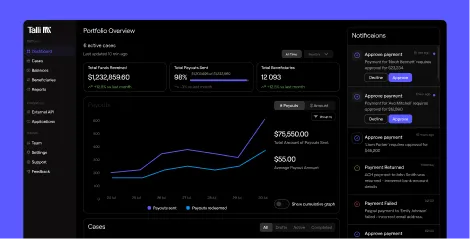
- Real-time dashboard provides total control and visibility for administrators monitoring delivery, completion, and engagement
- Built-in compliance includes KYC, OFAC, W-9 collection, fraud mitigation, and audit logs
- Complete fund segregation preserves QSF ownership while simplifying reporting throughout the disbursement lifecycle
- Power payouts at any size, whether 1,000 or 100,000 recipients
Banking services are provided by Patriot Bank, N.A., Member FDIC. The Easy Prepaid Mastercard is issued by Patriot Bank, N.A., Member FDIC, pursuant to a license from Mastercard International.
Leading law firms like Edelson PC have demonstrated that rates in the 10%-25% range are achievable when administrators implement proven optimization strategies. Talli provides the infrastructure to make those strategies operational at scale.
Ready to speed up your payouts and increase redemption rates? Claims redemption statistics show what's possible when digital-first platforms replace legacy disbursement methods.
Frequently Asked Questions
What role do courts play in evaluating redemption rates?
Federal Rule of Civil Procedure 23(e) requires courts to consider "the effectiveness of any proposed method of distributing relief to the class" when evaluating settlement fairness. Judges increasingly scrutinize claims rates when reviewing settlements, with some courts setting explicit expectations for "record-breaking" participation before approval.
How do attorney fee structures relate to redemption rates?
In cases studied by the U.S. Chamber Institute for Legal Reform, attorney fees exceeded payouts to class members in 30% of settlements. Low redemption rates can inflate percentage-based fees relative to actual claimant recovery, creating pressure for courts to scrutinize whether settlements truly benefit the class.
Does settlement amount size affect participation rates?
Counter-intuitively, the FTC regression analysis found no significant relationship between median compensation amounts and claims rates. Higher payouts don't automatically generate better response—quality of outreach matters more than payment size in determining participation.
What happens to unclaimed settlement funds?
Unclaimed funds face different outcomes depending on settlement terms and jurisdiction. Options include redistribution to participating claimants (cy pres distribution), return to defendants, or escheatment to state unclaimed property funds. State escheatment laws vary significantly in holding periods and reporting requirements.
Are publication notices worth the investment?
Despite expensive campaigns in magazines and national newspapers, the FTC study found no significant relationship between publication notice use and claims rates. These costly additions—sometimes exceeding $100,000—may deliver no measurable benefit compared to direct claimant notification methods.