.svg)


.svg)
Class action settlements suffer from chronic delays that frustrate claimants and drain administrative resources. Traditional processes that rely on manual document review, paper checks, and human verification can stretch settlement timelines from months to years, with administrative costs consuming funds meant for claimants. AI-powered platforms now enable firms to reduce distribution timelines from weeks to days while improving case preparation through automated document analysis, intelligent fraud detection, and streamlined fund distribution that transforms what used to take months into a matter of weeks.
Key Takeaways
- AI document review can reduce processing volumes by 70-85%
- AI-powered case preparation tools can potentially improve settlement outcomes significantly
- AI fraud detection systems can identify suspicious patterns that manual review processes often miss
- Settlement administration can be substantially accelerated with automation
- AI systems demonstrate high accuracy in data extraction tasks, often exceeding human reviewer performance
- Implementation typically requires around 2-6 weeks for initial setup with pilot projects starting in days
The Traditional Settlement Process: Why It's Slow and Costly
Manual class action administration creates bottlenecks at every stage. Document review alone can consume thousands of attorney hours, with large securities cases generating 3 million or more pages of discovery documents. Reviewing this volume manually can take months and drive significant costs, depending on scope, staffing, and quality-control requirements.
The core problems with traditional settlement processes include:
- Manual data entry creating error rates between 20-35%
- Paper check distribution with high uncashed rates and delivery failures
- Human verification bottlenecks slowing eligibility determinations
- Fraud vulnerability from limited pattern detection capabilities
- Compliance complexity requiring constant monitoring across jurisdictions
- Administrative overhead consuming settlement funds meant for claimants
These inefficiencies compound when managing thousands of plaintiffs across multiple jurisdictions. Each claimant requires individual eligibility screening, damages calculation, and payment processing. Without automation, claims teams spend more time on administrative tasks than on strategic case management.
AI for Data Management: Streamlining Claims and Verification
Automating Document Review and Eligibility Checks
AI-powered document analysis transforms how firms handle class action discovery and claims validation. Technology-Assisted Review (TAR) systems use predictive coding to identify relevant documents from massive datasets, processing thousands of documents in hours rather than weeks.
The automation workflow typically includes:
- Intelligent document classification sorting files by type, relevance, and privilege
- Automated data extraction pulling key facts from contracts, correspondence, and records
- Eligibility validation against class definition criteria
- Damages calculation based on extracted claim data
- Exception flagging for human review on edge cases
Reducing Manual Errors with AI-Powered Verification
AI verification systems can deliver high accuracy on repeatable extraction and validation tasks when paired with testing, sampling, and exception-based human review. This improvement stems from consistent application of rules across all documents without fatigue or distraction.
AI-powered platforms handle medical record chronologies, damage assessments, and demand letter preparation while attorneys focus on strategy and client relationships. That time savings translates directly to faster case resolution and reduced administrative costs.
Expediting Fund Distribution with AI-Driven Payment Platforms
Instant Payouts: The Digital Revolution in Class Action Settlements
Digital payment platforms eliminate the delays inherent in paper check distribution. Traditional check processing requires printing, mailing, and waiting for claimants to deposit funds—a process that can take weeks and results in significant unclaimed funds when checks go uncashed or are returned undeliverable.
Modern AI-driven platforms offer:
- Digital wallet integration for instant fund access
- Multiple payment methods including prepaid cards, ACH transfers, and mobile payments
- Automated disbursement workflows triggered by eligibility confirmation
- Real-time payment tracking for administrators and claimants
- Smart retry logic for failed transactions
These capabilities substantially accelerate settlement administration timelines. Claimants receive funds faster, redemption rates increase, and administrators spend less time chasing failed payments.
Enhancing Compliance and Security with Smart AI Features
Automated Compliance Checks: Protecting Your Settlement
Settlement administration requires strict adherence to KYC requirements, OFAC screening, and tax compliance including W-9 collection and 1099 issuance. Manual compliance processes create delays and increase error risk, particularly when managing high-volume payouts to thousands of recipients.
AI platforms automate these compliance workflows:
- KYC verification confirming claimant identity before payment
- OFAC screening checking recipients against sanctions lists
- W-9 collection and validation for tax reporting
- Audit trail generation documenting every compliance check
- Fund segregation maintaining dedicated accounts per settlement
Understanding compliance requirements in payouts becomes critical as regulations tighten. Automated systems ensure consistent application of rules while generating documentation for court reporting and regulatory audits.
AI's Role in Preventing Fraud and Ensuring Data Integrity
Settlement fraud has exploded with criminals using AI to generate fake claims at scale. Fraud farms submit thousands of fabricated claims with synthetic identities, threatening to drain settlement funds meant for legitimate claimants.
AI fraud detection counters these threats by:
- Pattern recognition identifying suspicious claim clusters
- Document authenticity analysis detecting fabricated records
- Behavioral analytics flagging unusual submission patterns
- Cross-reference checking against known fraud indicators
- Real-time scoring prioritizing claims by risk level
Firms implementing AI fraud detection systems can identify suspicious patterns that manual review processes often miss. This protection ensures legitimate claimants receive their full entitlements while handling the massive explosion in settlement fraud.
Improving Claimant Experience and Redemption Rates through AI
Personalized Communication: Keeping Claimants Informed with AI
Poor claimant communication drives low redemption rates. When claimants don't understand their status or how to complete required steps, they abandon the process. AI-powered communication systems address this through personalized, timely outreach that meets claimants where they are.
Effective AI communication includes:
- Multi-channel notifications via SMS, email, and mail
- Status updates at each processing milestone
- Plain-language explanations of required actions
- Self-service portals for document submission and payment selection
- Chatbot support for common questions
Boosting Payout Redemptions with Automated Follow-ups
Smart reminder systems dramatically improve completion rates. Rather than sending generic batch emails, AI analyzes claimant behavior to determine optimal timing, channel, and messaging for follow-up communications.
These systems track settlement claimant experience metrics including:
- Open rates by communication channel
- Click-through rates on action links
- Abandonment points in the completion process
- Response rates to different message types
- Time-to-completion by claimant segment
Platforms leveraging smart reminders report significantly higher take-up rates. When claimants can choose their preferred payment method and receive timely reminders, more complete the process successfully.
Real-time Visibility and Reporting for Administrators
Dashboard Insights: Total Control and Transparency
Real-time settlement dashboards transform how administrators monitor distribution progress. Instead of waiting for periodic reports, teams see live data on every payout status, completion rate, and fund flow.
Essential dashboard capabilities include:
- Payout status tracking from initiation through completion
- Completion rate metrics by segment, payment method, and timeframe
- Fund flow visualization showing disbursement progress
- Exception alerts for failed payments and compliance flags
- Comparative benchmarking against settlement targets
Seamless Integration for Comprehensive Reporting
Many modern platforms integrate with popular case management systems through APIs and pre-built connectors. This integration eliminates manual data entry while ensuring all stakeholders have access to current information.
Integration benefits include:
- Automated reconciliation matching payments to claims records
- CRM synchronization updating claimant records in real-time
- Court reporting generating required filings automatically
- Stakeholder dashboards providing appropriate visibility by role
- Audit documentation maintaining compliance records
These capabilities give administrators the transparency needed to manage complex settlements effectively while meeting court deadlines and reporting requirements.
Scalability and Efficiency: Powering Payouts of Any Size
Managing Millions: AI's Role in Handling High-Volume Payouts
Large class actions can involve hundreds of thousands of claimants. Traditional processes simply cannot scale to handle this volume efficiently. Manual review of 75,000 claims would take years; AI processes the same volume in weeks.
AI scalability features include:
- Batch processing handling thousands of transactions simultaneously
- Elastic infrastructure scaling compute resources with demand
- Automated workflows routing claims without manual intervention
- Exception handling escalating only true edge cases for human review
- Load balancing ensuring consistent performance at peak volume
Platforms designed for scale can process settlements efficiently whether handling 1,000 or 100,000 recipients without degradation in speed or accuracy. This capability proves essential as class actions grow larger and courts demand faster resolution.
Overcoming Challenges in AI Adoption for Legal Settlements
Addressing Data Security in AI-Driven Settlements
Class action data includes sensitive personal information, financial records, and privileged communications. Any AI platform must meet stringent security requirements including SOC 2 certification, encryption at rest and in transit, and robust access controls.
Security essentials include:
- TLS 1.2+ encryption for all data transfers
- AES-256 encryption for stored data
- Role-based access controls limiting data visibility
- Audit logging tracking all access and changes
- HIPAA compliance for medical-related settlements
Integrating AI with Existing Legal Frameworks
Successful AI adoption requires integration with existing workflows rather than wholesale replacement. Start with pilot projects on specific pain points—document review, plaintiff intake, or payment processing—before expanding scope.
Implementation best practices include:
- Phased rollout starting with highest-impact use cases
- Parallel processing validating AI results against manual review
- Team training building confidence through demonstrated success
- Feedback loops improving AI accuracy with corrections
- Change management addressing concerns about job displacement
The most common barrier to adoption is attorney resistance, not technical capability. Emphasizing that AI assists rather than replaces legal judgment helps teams embrace the technology.
The Future of Class Action Settlements: AI-Driven and Instant
Emerging Technologies Shaping the Settlement Landscape
AI capabilities continue advancing rapidly. Predictive analytics can help forecast settlement outcomes based on historical data, helping parties reach resolution faster. Future developments will further compress timelines and improve outcomes.
Emerging trends include:
- Predictive settlement modeling estimating outcomes before litigation
- Smart contract automation executing distributions based on verified conditions
- Advanced fraud detection using machine learning to identify emerging schemes
- Natural language processing enabling conversational case queries
- Continuous compliance monitoring adapting to regulatory changes automatically
Firms adopting AI today position themselves for competitive advantage as these technologies mature. The gap between AI-enabled and traditional administrators will only widen.
Why Talli Accelerates Class Action Settlement Payouts
While numerous platforms address pieces of the settlement puzzle, Talli delivers end-to-end payout automation specifically built for claims administrators managing legal settlements and mass claims distribution.
Talli's AI-driven platform combines compliance, speed, and visibility:
- Flexible payout options including digital wallets, prepaid Mastercards, and gift cards—no bank account required for claimants
- Built-in compliance with KYC, OFAC, and W-9 collection automated throughout the process
- Complete fund segregation preserving QSF ownership and simplifying court reporting
- Smart reminders across email and SMS driving higher redemption rates
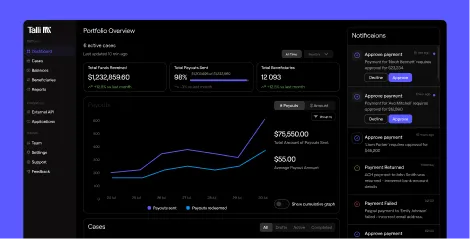
- Real-time dashboards providing total control over payout status and completion metrics
Unlike generic payment processors, Talli understands the unique requirements of legal settlements. The platform handles dedicated accounts for every settlement, generates audit logs for court filings, and ensures regulatory compliance throughout the disbursement lifecycle.
For claims teams tired of chasing uncashed checks and managing compliance manually, Talli transforms what used to take weeks into minutes. The platform powers payouts at any scale—whether 1,000 or 100,000 recipients—while delivering the seamless claimant experience that drives higher take-up rates.
Banking services provided by Patriot Bank, N.A., Member FDIC. The Easy Prepaid Mastercard is issued by Patriot Bank, N.A., Member FDIC, pursuant to a license from Mastercard International.
Frequently Asked Questions
How does AI make class action settlements faster?
AI accelerates settlements by automating the most time-intensive tasks: document review, claims validation, eligibility screening, and payment processing. AI can substantially streamline reviews and accelerate case resolution, leading to faster outcomes for clients. AI also automates compliance checks, fraud detection, and claimant communications, eliminating bottlenecks that delay distributions.
What compliance benefits do AI tools offer in settlement payouts?
AI platforms automate KYC verification, OFAC screening, W-9 collection, and tax reporting requirements. These systems apply compliance rules consistently across all claimants, generate audit trails for court reporting, and flag exceptions for human review. Automated compliance reduces error rates while ensuring every payment meets regulatory requirements. Fund segregation capabilities maintain dedicated accounts per settlement, preserving QSF ownership and simplifying reconciliation.
Can AI payment platforms integrate with existing legal systems?
Yes, many modern platforms integrate with popular case management systems through pre-built connectors and APIs. Two-way synchronization keeps claimant records current across systems while eliminating manual data entry. Firms without compatible systems can use middleware tools like Zapier for custom integrations or rely on CSV imports for batch processing.
How do AI tools help prevent fraud in settlement distributions?
AI fraud detection uses pattern recognition, document authenticity analysis, and behavioral analytics to identify suspicious claims. These systems can identify suspicious patterns that manual review processes often miss by analyzing submission patterns across thousands of claims simultaneously. AI can detect fraud farms submitting synthetic identities, fabricated documents, and coordinated claim clusters that human reviewers would miss.
Is data privacy maintained when using AI for legal payouts?
Reputable AI platforms maintain strict data security including SOC 2 Type II certification, HIPAA compliance for medical settlements, and GDPR compliance for international cases. Data encryption protects information at rest and in transit. Vendors contractually commit to no data sharing across clients, no use of client data for AI training without permission, and complete data deletion upon contract termination. Attorney-client privilege protections remain intact through platform architecture designed to maintain confidentiality.