.svg)


.svg)
Payout automation systems with built-in compliance checks are transforming how legal firms and claims administrators distribute settlement funds. These platforms combine payment processing infrastructure with regulatory screening to enable mass disbursements while automatically validating recipients against sanctions lists, PEPs databases, and adverse media—reducing implementation timelines to as little as 21 days for customer screening deployments. Modern compliance-focused payout platforms eliminate the manual burden that has historically plagued settlement administration.
Key Takeaways
- Modern payout automation platforms deliver significant reduction in manual processing time compared to legacy methods
- AI-assisted screening can cut false positives significantly by using secondary identifiers (DOB, address, nationality) instead of name-only matching; some vendors claim 95%+ lower false positives versus basic approaches.
- Accepting electronic payments can result in legal bills being paid nearly four times faster versus cash/check, per LawPay’s summary of the LawPay + MyCase 2024 Legal Industry Report.
- Self-service portals enable the majority of claimants to onboard without manual data entry
- Payment distribution timelines compress significantly with full automation
- Compliance automation substantially reduces regulatory violations through real-time screening
How Has Payout Automation Evolved in Claims Management?
The claims industry has shifted dramatically from paper-based processes to digital-first payment infrastructure. Legacy systems required manual reconciliation, physical check printing, and labor-intensive compliance verification that extended settlement timelines by weeks.
- Manual processing burden: Claims administrators historically spent around dozens of hours per week on payment processing tasks alone, according to case studies from companies that implemented automation solutions.
- Digital transformation drivers: Rising claimant expectations, regulatory complexity, and competitive pressure forced adoption of automated solutions.
- Real-time tracking emergence: Modern platforms now offer instant visibility into payment status, completion rates, and fund flows.
- Recipient experience focus: Systems evolved to prioritize claimant convenience through digital wallet integration and SMS-based payment delivery.
Why Did Legacy Systems Fail Claims Teams?
Traditional settlement administration relied on spreadsheets, manual data entry, and disconnected systems that created compliance gaps and operational bottlenecks. The shift to automated settlement software addresses these fundamental limitations.
Talli's AI-driven payment platform exemplifies this evolution by streamlining fund distribution while preventing fraud through built-in compliance automation—turning what used to take weeks into minutes.
What Are the Core Components of a Compliant Payout System?
Effective payout automation requires specific compliance infrastructure that legal and financial organizations cannot compromise. These components work together to maintain regulatory adherence while accelerating disbursements.
- KYC verification: Real-time identity validation confirms payee legitimacy before fund release.
- OFAC sanctions screening: Automated checks against global watchlists including UN, EU, and Treasury Department sanctions lists.
- W-9/W-8 tax collection: Integrated forms capture required tax documentation with TIN validation before payments process.
- Fraud mitigation protocols: Velocity checks, device fingerprinting, and behavioral analytics flag suspicious activity.
- Audit log generation: Every transaction creates comprehensive documentation meeting regulatory retention requirements for audits.
How Does Automated Screening Reduce False Positives?
AI-powered screening platforms achieve 95% reduction in false positives by implementing secondary data matching including date of birth, address, and nationality verification. This contrasts sharply with basic name-matching systems that flag a significant percentage of legitimate payees for manual review.
Talli bakes in KYC, OFAC screening, W-9 collection, fraud mitigation, and audit logs—eliminating the compliance burden that slows traditional settlement distribution.
How Does Automation Speed Up Secure Settlement Payments?
Payment velocity depends on eliminating manual touchpoints throughout the disbursement workflow. Automated systems compress timelines by processing multiple compliance checks simultaneously rather than sequentially.
- Parallel processing capability: Sanctions screening, identity verification, and payment routing execute concurrently.
- Pre-configured payment rails: Direct connections to ACH networks, card processors, and digital wallets eliminate intermediary delays.
- Automated approval workflows: Rules-based systems approve low-risk payments instantly while routing exceptions for review.
- Real-time fund movement: Same-day and next-day payment options replace traditional check clearing periods.
Organizations implementing automated payout systems report significantly compressed payment distribution timelines versus manual processing—representing substantial reductions in settlement completion time.
What Payment Methods Accelerate Fund Delivery?
Modern platforms support diverse global payment methods including ACH, wire transfer, virtual cards, PayPal, and cryptocurrency options. This flexibility ensures claimants receive funds through their preferred channel without delays from method restrictions.
Talli enables claims administrators to launch, fund, and track payouts faster than ever—whether it's 1,000 or 100,000 recipients—without losing control over compliance or claimant experience.
Why Is Complete Fund Segregation Essential for QSF Ownership?
Qualified Settlement Fund requirements demand strict separation between settlement assets and operational accounts. Compliance failures in fund segregation expose organizations to regulatory penalties and potential bar disciplinary action.
- Dedicated account architecture: Each settlement maintains isolated banking infrastructure preserving QSF ownership throughout the disbursement lifecycle.
- Trust accounting compliance: IOLTA-certified systems automatically separate earned versus unearned fees per ABA Model Rules 1.15.
- Simplified regulatory reporting: Segregated accounts generate clean audit trails for court filings and tax documentation.
- Escrow service integration: Built-in escrow functionality maintains fund security until disbursement conditions are met.
How Do Platforms Maintain IOLTA Compliance?
Legal payment processors achieve IOLTA compliance through automatic fund separation, three-way trust reconciliation, and state bar-approved processing infrastructure. Multiple state bars endorse compliant payment platforms that maintain these standards.
Talli supports dedicated accounts for every settlement, preserving QSF ownership, simplifying reporting, and ensuring legal compliance throughout the disbursement lifecycle. Banking services are provided by Patriot Bank, N.A., Member FDIC.
How Do Real-Time Dashboards Transform Claims Administration?
Visibility into payment status, completion rates, and fund flows eliminates the uncertainty that plagued traditional settlement administration. Real-time settlement dashboards provide administrators complete operational control.
- Completion rate monitoring: Track what percentage of claimants have successfully received funds versus pending or failed payments.
- Fund flow visualization: See exactly where settlement dollars reside at any moment—in transit, delivered, or awaiting claimant action.
- CRM synchronization: API integration capabilities push real-time payout data directly into existing case management systems.
- Stakeholder reporting: Generate court-ready reports and settlement summaries without manual data compilation.
What Reconciliation Features Do Administrators Need?
Effective reconciliation systems automatically match payments to claimant records, flag discrepancies, and generate exception reports for resolution. This automation delivers significant time savings compared to manual spreadsheet reconciliation.
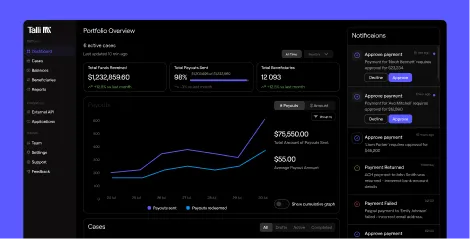
Talli provides full transparency on completion rates, fund flows, and syncs real-time payout data to your CRM—giving claims teams total control and visibility through a centralized dashboard.
What Flexible Payout Options Improve the Claimant Experience?
Claimant satisfaction directly correlates with payment accessibility. Systems offering multiple redemption methods achieve higher completion rates by accommodating diverse banking situations and preferences.
- Digital wallet transfers: Instant delivery to PayPal, Venmo, or platform-specific wallets.
- Prepaid card options: Physical or virtual Mastercard cards for claimants without bank accounts.
- Direct deposit via ACH: Standard bank transfers for claimants preferring traditional methods.
- Gift card alternatives: Retail gift cards distributed for specific use cases.
Research indicates that most clients prefer self-service payment portals over manual interaction with administrators. Flexible options reduce the friction that causes claimants to abandon the redemption process.
How Do Self-Service Portals Reduce Administrative Burden?
Branded claimant portals enable high self-onboarding rates by allowing recipients to select payment preferences, update contact information, and track disbursement status independently. This eliminates the phone calls and emails that consume administrator time.
Talli offers flexible payout options so more claimants complete the process—no bank account required. Claimants receive a secure link via SMS or email, pick their preferred payment method, and get paid without creating accounts.
How Do Automated Systems Prevent Fraud and Maintain Audit Trails?
Settlement fraud prevention requires multi-layered security controls that detect suspicious patterns while maintaining complete transaction documentation. Manual processes cannot match the detection capabilities of automated systems.
- Real-time transaction monitoring: Continuous analysis of payment velocity, amount patterns, and recipient behavior.
- Identity verification layers: Multi-factor authentication, device fingerprinting, and biometric options secure payee access.
- Sanctions list updates: Daily refresh of OFAC and global watchlists catches emerging risks immediately.
- Immutable audit logs: Blockchain-style transaction records prevent tampering and satisfy regulatory retention requirements.
Advanced fraud detection capabilities—including velocity checks and device fingerprinting—provide enterprise-grade security for organizations of all sizes.
What Security Certifications Should Platforms Maintain?
SOC 2 Type II certification validates operational security controls, while PCI DSS Level 1 compliance is mandatory for platforms processing card payments. ISO 27001 certification demonstrates comprehensive security management practices.
Talli safeguards every claims payout with fraud mitigation and audit logs baked in—ensuring organizations meet regulatory requirements without manual compliance work.
Can Payout Automation Scale From Hundreds to Hundreds of Thousands of Recipients?
Settlement sizes vary dramatically, from small personal injury cases to massive class actions involving millions of claimants. Payout infrastructure must accommodate this variability without performance degradation.
- Batch processing capacity: Enterprise platforms handle substantial transaction volumes through distributed processing architecture.
- API throughput limits: High-volume implementations require dedicated API capacity to maintain processing speed.
- Multi-entity support: Large organizations managing multiple settlements simultaneously need separate accounting structures.
- Load balancing infrastructure: Cloud-based systems automatically scale resources based on payment volume demands.
Modern platforms are designed to accommodate growing transaction volumes without significant performance impact.
What Volume Thresholds Require Enterprise Solutions?
Organizations processing high monthly payout volumes with multi-currency requirements typically benefit from enterprise platforms. High-volume payout statistics indicate that complexity increases non-linearly beyond certain thresholds.
Talli powers payouts at any size—whether it's 1,000 or 100,000 recipients—with infrastructure designed to create payout distribution campaigns, track every payment status, and monitor completion rates at scale.
How Do You Integrate Payout Automation With Existing Workflows?
Implementation success depends on connecting new payout infrastructure with established case management, accounting, and CRM systems. API-first platforms simplify this integration process.
- Native ERP connectors: Pre-built integrations with QuickBooks, NetSuite, and Sage enable automatic GL coding and reconciliation.
- Legal practice management links: Connections to Clio, MyCase, and Filevine provide case-based payment tracking.
- CRM synchronization: Salesforce and HubSpot app marketplace installations sync client and vendor records bidirectionally.
- iPaaS automation: Zapier and Make.com connectors enable custom workflow automation for specialized processes.
Implementation timelines vary based on complexity, with standard integrations typically completing faster than complex enterprise deployments with custom requirements.
What Integration Challenges Should Teams Anticipate?
Common stumbling points include bank verification delays (budget 3-5 business days), API complexity that may require development resources, and initial false positive rates that require threshold tuning during the onboarding period.
Talli ensures a seamless experience by syncing real-time payout data to your CRM—giving teams the integration flexibility they need without sacrificing compliance or visibility.
Frequently Asked Questions
What is the typical ROI timeline for payout automation implementation?
Most organizations achieve break-even within 3-5 months based on staff time savings, reduced compliance violation costs, and faster collection cycles. Year-one ROI typically exceeds 100% for firms processing substantial monthly payment volumes.
How do payout platforms handle international payments with different tax requirements?
Enterprise platforms support multi-currency accounts across 200+ countries with automated W-8 collection for international recipients, local payment method options, and optimized FX routing that reduces conversion fees compared to standard bank rates.
What happens when a claimant fails compliance screening?
Flagged claimants enter a manual review queue where compliance teams can request additional documentation, verify identity through secondary channels, or escalate to legal counsel. AI-powered systems auto-clear the majority of name-based false positives through secondary data matching.
Can small law firms benefit from payout automation or is it only for large operations?
Even small firms processing moderate monthly payment volumes can benefit from basic automation features including IOLTA compliance, automated trust reconciliation, and client payment portals that reduce collection time significantly.
How do platforms ensure data security during claimant self-onboarding?
Bank-grade AES-256 encryption protects data at rest, TLS 1.2+ secures transmission, and role-based access controls limit information exposure. Enterprise platforms require SOC 2 Type II certification and support SSO integration with SAML 2.0 protocols.