.svg)


.svg)
Full audit trails in legal disbursements create a tamper-evident, chronological record of every transaction, approval, and modification throughout the settlement lifecycle. With the Department of Justice recovering $2.68 billion from False Claims Act cases in 2023 and fraud in claims administration increasing dramatically, modern digital disbursement platforms automate compliance documentation while reducing transaction costs by 65-70% compared to paper checks. These platforms transform audit trail management from a regulatory burden into an operational advantage by embedding KYC, OFAC, and trust accounting requirements directly into payment workflows.
Key Takeaways
- Manual trust accounting processes face high compliance violation rates when processing legal settlements
- Digital disbursement platforms reduce transaction costs to $2-5 per payout compared to $7-8 for paper checks
- Automated reconciliation cuts monthly processing time by 70%, from 15 hours to 4.5 hours
- AI-powered fraud detection can significantly reduce fraudulent claims through pattern recognition and anomaly detection
- Audit logs require 6-7 year retention minimum for HIPAA and legal compliance standards
- Purpose-built platforms achieve highly accurate automated OFAC screening through automated compliance checks
- Implementation timelines range from 2-6 weeks with vendor-assisted setup
Understanding the Imperative of Audit Trails in Legal Payouts
A full audit trail documents every action taken during the settlement distribution process—from initial claim submission through final payment delivery. This chronological record captures who did what, when they did it, and what changed as a result. For claims administrators handling class action settlements or mass tort distributions, this documentation isn't optional. It's the foundation of regulatory compliance and judicial accountability.
The stakes extend beyond operational convenience:
- Regulatory requirements mandate complete transaction histories for court approval motions
- Financial transparency enables accurate reporting to settlement funds and stakeholders
- Fraud prevention requires documented verification at each distribution stage
- Accountability traces every approval and modification to specific users
- Data integrity ensures records remain unchanged after creation
Why Comprehensive Tracking Is Non-Negotiable
Settlement administrators operate under court supervision with strict reporting obligations. Judges require detailed documentation before approving final distributions, including completion rates, fund flow tracking, and compliance verification. Without comprehensive audit trails, administrators cannot demonstrate proper handling of settlement funds.
Trust account regulations compound these requirements. IOLTA compliance demands three-way monthly reconciliation proving fund segregation between client funds and operating accounts. State bar associations conduct random audits, and violations can trigger sanctions, fines, or disbarment proceedings.
The Impact of Incomplete Audits on Legal Firms
Manual audit processes break down at scale. A 10,000-claimant settlement generates hundreds of thousands of individual transactions—each requiring documentation. Spreadsheet tracking cannot maintain the legal payout compliance standards courts expect.
The consequences of inadequate audit trails include:
Bar sanctions for trust account violations discovered during random audit
Court rejection of settlement approval motions lacking proper documentation
Extended timelines as administrators scramble to reconstruct missing records
Increased costs from manual reconciliation and dispute resolution
Reputation damage affecting future settlement administration opportunities
Key Components of a Robust Legal Distribution Audit System
Effective audit trail systems combine technical architecture with operational workflows. The goal is capturing every relevant action automatically while preventing unauthorized modifications to historical records.
Designing for Tamper-Proof Records
Immutability distinguishes audit trails from simple change logs. True audit trail systems use cryptographic sealing, write-once storage, or blockchain architecture to prevent tampering. Once a record enters the system, it cannot be altered without detection—even by administrators.
Essential technical components include:
Event logging capturing every user action with contextual metadata
Cryptographic timestamping preventing backdating of entries
User activity monitoring tracking login sessions and authorization levels
Digital signatures authenticating record originators
Access controls limiting modification capabilities to system-level only
21 CFR Part 11 provides the regulatory framework for electronic records. This FDA regulation requires validated systems, complete change histories, and electronic signatures that cannot be repudiated. While developed for pharmaceutical applications, these standards represent best practices for any legal disbursement platform.
Leveraging Technology for Comprehensive Tracking
Modern platforms automate audit trail creation through API integration and real-time data capture. Rather than relying on manual documentation, every system interaction generates its own audit record automatically.
Key technology capabilities include:
Automated three-way reconciliation matching bank statements, trust ledgers, and client balances
Multi-rail payment processing with unified tracking across ACH, prepaid cards, and digital wallets
Real-time CRM synchronization eliminating manual data entry
Court-ready reporting generating documentation for judicial reviews
Webhook notifications providing instant status updates across connected systems
Your fund segregation architecture must support dedicated accounts for every settlement, preserving QSF ownership while simplifying reporting requirements.
Ensuring Compliance Through Automated KYC, OFAC, and W-9 Collections
Compliance verification represents a critical audit trail component. Every claimant must undergo identity verification, sanctions screening, and tax documentation collection before receiving payment. Manual processes create bottlenecks and compliance gaps that automated systems eliminate.
Streamlining Recipient Verification Processes
KYC (Know Your Customer) verification confirms claimant identities before payment authorization. Automated systems cross-reference provided information against identity databases, flagging discrepancies for manual review while processing clean submissions instantly.
OFAC screening compares claimants against U.S. Treasury sanctions lists. This Treasury Department mandate applies to all payments, requiring documented screening timestamps and results for each disbursement. Purpose-built platforms achieve automated OFAC compliance without manual intervention.
W-9 collection ensures proper tax reporting. Platforms must capture taxpayer identification numbers and generate accurate 1099 forms at year-end. Missing or incorrect W-9 data creates IRS reporting failures that trigger penalties and audit exposure.
Mitigating Risks with Integrated Compliance Tools
Integrated compliance automation embeds verification into payment workflows rather than treating it as a separate process. When a claimant submits payment preferences, the system automatically:
- Validates identity information against verification databases
- Screens against current OFAC sanctions lists
- Confirms W-9 data completeness and accuracy
- Documents all verification steps with timestamps
- Routes exceptions for human review with full context
This approach ensures compliance in payouts without creating manual bottlenecks that delay distributions.
The Role of Digital Wallets and Secure Payment Methods in Tracking
Payment method diversity increases redemption rates while maintaining audit trail integrity. Claimants who lack traditional bank accounts still deserve access to their settlement funds through alternative channels that remain fully traceable.
Leveraging Digital Payment Rails for Enhanced Traceability
Digital payment methods generate richer audit data than paper checks. Every transaction includes:
- Transaction history documenting initiation, processing, and completion
- Payment routing information showing fund movement paths
- Encryption protocols protecting data in transit and at rest
- Tokenization replacing sensitive data with secure identifiers
- Multi-factor authentication verifying recipient identity at redemption
ACH transfers, prepaid cards, and digital wallet payments all produce complete transaction records automatically. Compare this to paper checks, where delivery confirmation requires separate tracking systems and stale check monitoring adds administrative burden.
Providing Flexible, Yet Traceable, Payout Options
Claimant payment preferences vary significantly. Some prefer direct deposit to existing bank accounts. Others lack banking relationships entirely. Effective distribution platforms offer multiple options while maintaining consistent audit documentation across all channels.
Available payment methods typically include:
- ACH direct deposit for banked claimants preferring electronic transfers
- Prepaid Mastercard providing immediate access without bank account requirements
- Digital wallets like PayPal and Venmo for tech-savvy recipients
- Gift cards for specific merchant redemption when appropriate
Multi-channel options increase redemption rates significantly compared to paper checks alone. Higher completion rates benefit all stakeholders while reducing unclaimed fund administration.
Real-time Reporting and Dashboards for Total Visibility
Static reporting fails modern settlement administration. Stakeholders need immediate access to distribution status, completion metrics, and compliance data without waiting for batch reports or manual compilation.
Gaining Immediate Insights into Payout Statuses
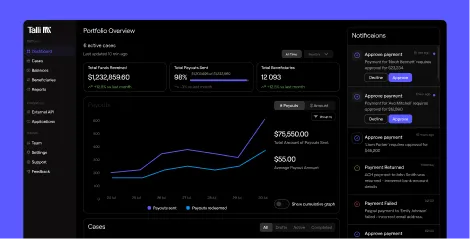
Real-time settlement dashboards transform how administrators monitor distributions. Instead of compiling spreadsheets at month-end, teams view live metrics including:
- Completion rates showing percentage of successful payouts
- Fund flows tracking money movement from settlement accounts to recipients
- Payment status by channel (ACH, card, digital wallet)
- Compliance metrics including verification completion and OFAC clearance
- Exception queues requiring manual intervention
This visibility enables proactive management rather than reactive problem-solving. Issues surface immediately rather than accumulating until month-end reconciliation.
Empowering Claims Administrators with Actionable Data
Dashboard analytics identify optimization opportunities beyond basic status tracking:
- Redemption rate analysis by payment method reveals preference patterns
- Processing time metrics highlight bottlenecks in distribution workflows
- Error rate tracking pinpoints systematic issues requiring process changes
- Engagement analytics measure communication effectiveness for incomplete payouts
API synchronization pushes this data to existing CRM and case management systems, eliminating the need for separate login credentials or manual data transfer. Your reconciliation processes improve when audit data flows automatically between systems.
Streamlining the Disbursement Lifecycle for Audit Clarity
Every stage of the disbursement lifecycle generates audit trail data. Streamlined workflows ensure consistent documentation while reducing manual touchpoints that introduce errors and delays.
Automating Tasks to Minimize Manual Errors
Automation addresses the primary source of audit trail gaps: human error. Manual data entry creates transcription mistakes, inconsistent formatting, and missing documentation. Automated workflows eliminate these risks through:
- Batch payment processing handling multiple disbursements simultaneously
- Invoice matching automatically linking payments to claim documentation
- Approval routing enforcing authorization chains for high-value transactions
- Status notifications updating stakeholders without manual communication
- Error detection flagging anomalies before processing completion
Distribution timelines compress from weeks to days when automation replaces manual processing. Court-mandated deadlines become achievable rather than aspirational.
Ensuring Every Step Is Recorded and Verifiable
Comprehensive audit trails require documentation at every workflow stage:
- Claim submission recording claimant data, award amounts, and payment preferences
- Verification completion documenting KYC, OFAC, and W-9 clearance
- Payment authorization capturing approval decisions and authorizing users
- Fund transfer initiation logging transaction details and routing information
- Delivery confirmation recording successful receipt or failed delivery attempts
- Exception handling documenting resolution steps for problematic transactions
This end-to-end documentation creates the verifiable record courts require for settlement approval and bar associations demand for trust account compliance.
The Value of Immutable Audit Logs and Fraud Mitigation
Immutability and fraud prevention work together. Tamper-proof records create accountability that deters fraudulent activity while providing evidence when violations occur.
Protecting Records from Alteration
Immutable audit logs use technical controls preventing modification of historical records. Unlike simple databases where administrators can edit entries, immutable systems protect against backdating and unauthorized changes through:
- Cryptographic hashing creating unique fingerprints for each record
- Blockchain architecture distributing records across multiple verification points
- Write-once storage preventing overwriting of existing data
- Tamper detection alerting administrators to modification attempts
These protections ensure audit trails retain evidentiary value for legal proceedings, regulatory investigations, and bar association audits.
Proactively Identifying and Preventing Fraudulent Activities
The massive explosion in fraud requires proactive detection rather than reactive investigation. AI-powered systems analyze transaction patterns to identify anomalies indicating potential fraud:
- Duplicate claim detection identifying multiple submissions from single claimants
- Address verification flagging suspicious delivery locations
- Velocity monitoring detecting unusual payment request volumes
- Pattern recognition identifying organized fraud schemes
- Anomaly alerts surfacing transactions requiring human review
Automated fraud detection significantly reduces fraudulent claims compared to manual review processes. The audit trail documents every detection decision, creating defensible records for disputed transactions.
Scaling Legal Payouts with Comprehensive Audit Capabilities
Settlement sizes vary dramatically. A platform handling 500 claimants must scale to 50,000 without compromising audit trail completeness or compliance accuracy.
Maintaining Audit Standards Across Vast Distributions
High-volume distributions multiply audit trail complexity exponentially. Each additional claimant generates verification records, payment transactions, delivery confirmations, and potential exceptions requiring documentation.
Scalable platforms maintain consistency through:
- Cloud infrastructure expanding capacity automatically with volume increases
- Load balancing distributing processing across multiple systems
- Performance monitoring identifying bottlenecks before they impact operations
- Batch optimization processing bulk transactions efficiently
- Database architecture designed for high-volume payouts without degradation
Whether processing 1,000 or 100,000 recipients, audit trail quality remains consistent. Implementation timelines of 2-6 weeks apply regardless of anticipated settlement size.
Future-Proofing Your Legal Payout System
Regulatory requirements evolve continuously. Systems built for current compliance standards must adapt to future changes without requiring complete replacement.
Future-proofing strategies include:
- Modular architecture allowing component updates without system overhaul
- API flexibility supporting new integration requirements as they emerge
- Compliance monitoring tracking regulatory changes affecting disbursement operations
- Retention policies meeting or exceeding current 6-7 year storage requirements
- Vendor partnerships with platforms committed to ongoing compliance updates
Why Talli Delivers Complete Audit Trail Solutions for Legal Distributions
While numerous payment platforms exist, Talli provides comprehensive audit trail capabilities specifically designed for claims administrators handling legal settlements and mass distributions.
Talli addresses the core challenges of legal disbursement audit trails through:
- Complete Fund Segregation: Dedicated accounts for every settlement preserve QSF ownership while simplifying reporting and ensuring legal compliance throughout the disbursement lifecycle
- Automated Compliance: KYC, OFAC, W-9 collection, fraud mitigation, and immutable audit logs built directly into payment workflows—not bolted on as afterthoughts
- Multi-Rail Payments: ACH, prepaid Mastercard, and digital wallet options increase redemption rates while maintaining consistent audit documentation across all channels
- Real-Time Dashboards: Monitor delivery, completion, and engagement instantly with built-in reporting for teams and stakeholders
- Scalable Architecture: Handle settlements from 1,000 to 100,000+ claimants without compromising audit trail integrity
Unlike generic payment processors requiring custom development for legal compliance features, Talli embeds settlement campaign requirements by design. The platform automates and safeguards every claims payout, helping administrators meet tight deadlines without losing control over compliance or claimant experience.
Banking services provided by Patriot Bank, N.A., Member FDIC. The Easy Prepaid Mastercard is issued by Patriot Bank, N.A., Member FDIC, pursuant to a license from Mastercard International.
Frequently Asked Questions
What is a full audit trail in the context of legal distributions?
A full audit trail creates an immutable, chronological record of every action taken during settlement distribution—from claim submission through final payment delivery. This includes documenting who performed each action, when it occurred, what changed, and the authorization level involved. For legal settlements, audit trails must capture verification steps (KYC, OFAC screening, W-9 collection), payment authorizations, fund transfers, delivery confirmations, and any exceptions or modifications. Courts require this documentation for settlement approval motions, and bar associations review it during trust account audits.
How does automated compliance reduce audit trail gaps?
Manual compliance processes create documentation gaps when verification steps occur outside the primary system or when staff forget to record completed actions. Automated platforms embed compliance directly into payment workflows—KYC verification, OFAC screening, and W-9 collection happen automatically as claimants provide information, with every step logged instantly. This eliminates the gap between performing compliance checks and documenting them, ensuring complete audit trails without additional administrative effort.
What retention period applies to legal disbursement audit logs?
Most legal compliance frameworks require 6-7 year minimum retention for audit logs. HIPAA mandates six-year retention for healthcare-related settlements, while state bar regulations vary by jurisdiction. Many administrators maintain records for 10+ years given potential litigation timelines. Purpose-built platforms handle retention automatically, storing audit data in encrypted, redundant systems that meet or exceed regulatory requirements without manual archive management.
Can claimants choose payment methods while maintaining audit trail integrity?
Yes. Modern platforms support multiple payment channels—ACH direct deposit, prepaid cards, digital wallets—while generating consistent audit documentation across all methods. Each payment type produces transaction records including initiation timestamps, fund routing details, delivery confirmation, and recipient authentication. Multi-channel options actually improve audit completeness compared to paper checks, which require separate delivery tracking systems and produce less detailed transaction records.
How quickly can organizations implement full audit trail capabilities?
Purpose-built legal disbursement platforms typically require 2-6 weeks for complete implementation with vendor-assisted setup. This timeline includes platform configuration, compliance workflow setup, API integration with existing case management systems, data migration, and staff training. Pre-built connectors for major CRM platforms compress integration timelines, while white-glove onboarding eliminates technical barriers for business users without dedicated IT resources.