.svg)


.svg)
The AT&T data breach settlement represents one of the largest telecommunications security compromises in U.S. history, with a $177 million fund established to compensate customers affected by two incidents disclosed in 2024—about 73 million people tied to the first incident and roughly 109–110 million customer accounts tied to the second, with some overlap. This massive class action stems from two separate data incidents in 2024 that exposed sensitive personal information ranging from Social Security numbers to detailed call records. For claims administrators and legal teams managing data breach settlements, understanding the structure and distribution mechanics of this settlement provides critical insights into modern disbursement challenges.
Key Takeaways
- The AT&T settlement totals $177 million covering two separate 2024 data breaches affecting 73+ million customers
- Maximum individual payouts reach $7,500 for those affected by both breach incidents with documented losses
- The 2024 breaches exposed SSNs, addresses, account passcodes, and call/text records for millions of customers
- Claimants with SSN exposure receive 5x higher payments than those with only metadata compromised
- The claim filing deadline of December 18, 2025 has passed; the Court held the Final Approval Hearing on January 15, 2026, and a decision on final approval is still pending.
- Digital payment platforms can reduce settlement administration costs from $3.50-$5 per payment to under $0.50
- Multiple related lawsuits were consolidated into multidistrict litigation within months of filing
Understanding the AT&T Data Breach Settlement
The AT&T data breach settlement emerged from two distinct security incidents that compromised customer data on an unprecedented scale. This settlement addresses harm caused to both current and former AT&T customers whose personal information was exposed through third-party cloud storage vulnerabilities.
What Led to the Settlement?
The first breach, discovered in early 2024, originated from incidents dating back to 2019. Hackers accessed customer data including names, addresses, Social Security numbers, dates of birth, account passcodes, and billing information. This breach affected approximately 7.6 million current customers and 65.4 million former customers.
The second breach occurred in mid-2024 when cybercriminals exploited a vulnerability in Snowflake, a third-party cloud platform AT&T used for data storage. This incident exposed call and text message records (metadata)—including phone numbers involved and cell site identification numbers for some records—for roughly 109–110 million customer accounts, largely tied to a six-month period in 2022
Key breach details include:
- First 2024 Incident: SSNs, addresses, account passcodes, billing numbers
- Second 2024 Incident: Phone numbers, call/text metadata, cell tower IDs
- Combined Impact: 73+ million unique individuals across both incidents
- Settlement Fund Allocation: $149 million for first breach, $28 million for second breach
Numerous customer testimonials submitted during litigation described ongoing impacts. One affected customer reported over 250 spam calls daily following the breach, while others described identity theft, fraudulent accounts opened in their names, and significant credit score damage.
Who is Covered by the Agreement?
The settlement creates three distinct classes based on which breach incident affected the individual. Class membership is determined by the type of data exposed and the timing of the customer's relationship with AT&T.
AT&T 1 Settlement Class covers those affected by the first 2024 breach:
- Current AT&T wireless customers as of March 30, 2024
- Former customers with data retained from previous service
- Individuals whose SSNs or personal account information was compromised
AT&T 2 Settlement Class addresses the second 2024 incident:
- Customers whose call or text records were accessed
- Individuals with cell tower location data exposed
- Those affected by the cloud platform vulnerability
Overlap Settlement Class applies to those impacted by both breaches, making them eligible for compensation from both settlement funds with maximum combined payouts.
Who is Eligible for a Payout from the AT&T Settlement?
Determining eligibility requires understanding which breach affected your data and what type of information was compromised. The settlement administrator, Kroll, maintains verification systems to confirm class membership.
Defining the Class Members
Eligibility verification occurs through the official settlement website where claimants can check their status using identifying information. AT&T notified affected customers through mail and email, though many customers reported never receiving direct notification.
Eligibility criteria by class:
- Tier 1 Members: SSN was confirmed exposed—receive 5x the base payment amount
- Tier 2 Members: Personal data exposed but SSN not included—receive base pro rata payment
- Tier 3 Members: Only call/text metadata compromised—receive lowest pro rata share
- Overlap Members: Affected by both incidents—eligible for combined maximum of $7,500
Required Documentation for Eligibility
Documentation requirements vary based on the type of compensation sought. Those claiming documented losses face stricter evidence standards than those seeking pro rata cash payments.
For Documented Loss Claims (up to $5,000/$2,500):
- Receipts for identity theft protection services
- Bank statements showing fraudulent transactions
- Credit reports documenting damage
- Police reports for identity theft
- Time spent addressing breach-related issues (hourly rate applies)
For Pro Rata Cash Payments:
- Basic identifying information matching breach records
- Confirmation of class membership status
- No additional documentation required
The settlement website specifies that documented losses must have occurred after specific dates: 2019 for the first breach claims, April 14, 2024 for the second breach claims.
How to File a Claim for the AT&T Data Breach Settlement
The claims process was designed for online submission, though the filing deadline has now passed. Understanding this process remains valuable for improving claimant experience in future distributions.
Step-by-Step Claim Submission
The filing process followed standard class action procedures:
- Eligibility Verification: Visit settlement website to confirm class membership
- Claim Form Completion: Provide identifying information and select payment preference
- Documentation Upload: Submit evidence for documented loss claims
- Payment Method Selection: Choose between check, digital payment, or prepaid card
- Confirmation Receipt: Receive acknowledgment of successful submission
The settlement administrator processed claims through a centralized portal that automated initial verification steps. This approach helped manage the massive volume while maintaining accuracy.
Important Deadlines to Note
Critical dates in the settlement timeline:
- Original Deadline: October 2025 (later extended)
- Extended Deadline: December 18, 2025 (now passed)
- Final Approval Hearing: January 15, 2026
- Payment Distribution: Pending court approval and appeals resolution
The deadline extension came after significant public interest and claimant requests for additional time. Late claims are generally not accepted absent extraordinary circumstances.
Maximizing Your AT&T Data Breach Settlement Payout
Understanding the payment structure helps claimants pursue maximum compensation. The tiered system creates significant variation in individual payouts based on data exposure severity and documented harm.
Factors Influencing Individual Payouts
Several variables determine final payment amounts:
Data Sensitivity Multipliers:
- SSN exposure qualifies for Tier 1 status—5x base payment
- Personal information without SSN receives Tier 2 amounts
- Metadata-only exposure results in Tier 3 pro rata distribution
Documentation Impact:
- Documented losses can yield up to $5,000 (first breach) or $2,500 (second breach)
- Combined documented losses for overlap members reach $7,500 maximum
- Pro rata payments depend on total valid claims filed
Claim Volume Effects:
- Higher participation reduces individual pro rata amounts
- With 73+ million eligible claimants, per-person averages may be modest
- Pro rata payments can be modest and will depend on how many valid claims are approved and how each class/fund is allocated—not a simple equal split across everyone who may be eligible
Understanding Your Potential Compensation
Realistic expectations matter for claimant satisfaction. While maximum payouts reach $7,500, most claimants without documented losses will receive substantially smaller amounts.
Payment categories breakdown:
Documented Loss (First Breach)
- Maximum amount: $5,000
- Requirements: Receipts, statements, reports
Documented Loss (Second Breach)
- Maximum amount: $2,500
- Requirements: Evidence dated after April 14, 2024
Tier 1 Pro Rata
- Maximum amount: 5× Tier 2 amount
- Requirements: SSN confirmed exposed
Tier 2 Pro Rata
- Maximum amount: Base calculation
- Requirements: PII exposed, no SSN
Tier 3 Pro Rata
- Maximum amount: Lowest share
- Requirements: Metadata only
Comparing this to other major settlements provides context. The Yahoo data breach settlement produced widely varying payments, with some claimants reporting payouts around ~$90 depending on the claim type and participation levels, while the Equifax settlement offered up to $20,000 for documented identity theft victims.
Secure and Efficient Settlement Payment Methods
Large-scale settlements like AT&T's present significant payment distribution challenges. Traditional paper check methods often result in low redemption rates and high administrative costs.
Settlement payment options typically include:
- Paper Checks: Traditional but costly—often $3.50-$5 per payment in processing
- Direct Deposit/ACH: Faster delivery but requires banking information
- Digital Wallets: Accessible for unbanked claimants
- Prepaid Cards: Immediate access without bank account requirements
Modern AI-driven payment platforms like Talli address these challenges by offering flexible payout options where claimants pick their preferred method. This approach eliminates barriers for an estimated 5.9 million U.S. households who were unbanked in 2021, according to FDIC research, who might otherwise struggle to receive settlement funds.
Digital disbursement reduces costs dramatically while improving redemption rates. Where paper checks see 40-60% redemption in large settlements, digital-first approaches consistently achieve higher completion rates through convenient mobile-accessible payment selection.
Real-Time Tracking and Transparency for Claimants
Settlement transparency builds trust and improves claimant experience. The AT&T settlement's scale—73+ million potential recipients—demands sophisticated tracking systems.
Key transparency features for modern settlements include:
- Claim Status Updates: Real-time visibility into processing stages
- Payment Delivery Confirmation: Notification when funds are distributed
- Multi-Channel Communication: Email, SMS, and portal updates
- Support Access: Clear channels for questions and issues
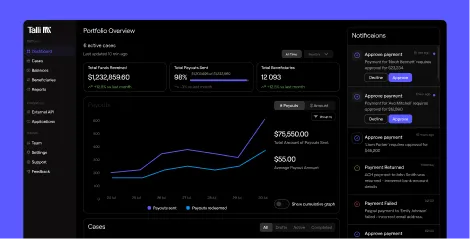
Platforms built for claims administration provide dashboards showing completion rates, fund flows, and payout status. Talli's approach enables claimants to receive secure links via SMS or email without creating accounts, reducing friction while maintaining security. Smart reminders across email, SMS, and other channels help claimants complete the payout process quickly.
This visibility matters for legal payout compliance and stakeholder reporting. Administrators can monitor delivery, completion, and engagement in real time with built-in reporting capabilities.
Compliance and Fraud Prevention in Large-Scale Settlements
Data breach settlements face heightened fraud risks—the very information stolen often enables fraudulent claim submissions. The AT&T settlement requires robust fraud prevention measures given that compromised SSNs and personal data could facilitate false claims.
Essential compliance elements include:
- KYC Verification: Confirming claimant identity matches breach records
- OFAC Screening: Ensuring payments don't violate sanctions requirements
- W-9 Collection: Tax reporting compliance for payments above thresholds
- Audit Trails: Complete documentation of all transactions
Talli automates and safeguards every claims payout with KYC, OFAC, W-9 collection, fraud mitigation, and audit logs built into the platform. Complete fund segregation supports dedicated accounts for every settlement, preserving QSF ownership and simplifying reporting throughout the disbursement lifecycle. Banking services provided by Patriot Bank, N.A., Member FDIC.
Streamlining Legal Payouts with AI-Driven Platforms
The AT&T settlement illustrates why settlement administration benefits from modern technology. With multiple lawsuits consolidated into multidistrict litigation and 73+ million potential claimants, manual processing becomes impractical and expensive.
Data breach class actions continue growing rapidly—with estimated increases of approximately 40-60% year-over-year in filings since 2020. This trend demands scalable technology solutions that can handle high volumes while maintaining accuracy and compliance.
Benefits of AI-driven payment platforms for settlements:
- Cost Reduction: Digital payments cost $0.25-$0.50 versus $3.50-$5 for paper checks
- Speed: Distribution timelines compress from weeks to days
- Accuracy: Automated verification reduces errors and fraud
- Scalability: Handle 1,000 or 100,000 recipients with equal efficiency
- Compliance: Built-in regulatory requirements eliminate manual tracking
Talli is built for teams that need compliance, speed, and total visibility. The platform powers payouts at any scale, whether processing thousands or hundreds of thousands of recipients. Real-time dashboards enable administrators to create payout distribution campaigns, track every payout status, and monitor completion rates—launching, funding, and tracking payouts faster than ever without losing control.
For claims administrators handling complex settlements like AT&T's, the right technology infrastructure determines success. What used to take weeks now takes minutes with proper automation.
Frequently Asked Questions
What if I missed the December 18, 2025 deadline?
Unfortunately, late claims are generally not accepted after the filing deadline closes. However, you should still monitor the official settlement website for any announcements about reopened claim periods, which occasionally occur if settlement funds remain after initial distribution. Contact the settlement administrator directly to inquire about exceptional circumstances that might allow late filing, such as military deployment or documented incapacity during the claim period.
When will payments be distributed?
Payment timelines depend on several factors following the January 15, 2026 final approval hearing. If no appeals are filed, distribution typically begins within 60-90 days. However, appeals can delay payments by 12-18 months or longer. The settlement administrator will send notifications when payment processing begins, and claimants should ensure their contact information remains current to receive these updates.
Can I pursue individual legal action?
The opt-out deadline has passed along with the claim filing deadline. Those who remained in the settlement class cannot now pursue separate litigation for the same claims covered by the settlement. Anyone who previously submitted an opt-out request before the deadline preserved their right to individual legal action, though they forfeit any settlement payment. Consult with a personal attorney if you believe you have grounds for independent claims beyond the settlement scope.
Will my settlement payment be taxable?
Tax treatment varies based on what the payment compensates. Payments for actual out-of-pocket losses (like reimbursement for credit monitoring you purchased) generally aren't taxable. However, portions characterized as compensation for emotional distress or punitive damages may be taxable. Settlement payments above $600 typically trigger 1099 reporting. Consult a tax professional for guidance specific to your situation, as individual circumstances affect tax obligations.
How does this compare to other data breaches?
The AT&T settlement ranks among the largest data breach class actions by affected population. For comparison: Yahoo's settlement covered 3 billion users with a $117.5 million fund; Equifax's settlement provided $380.5 million for 147 million affected individuals. AT&T's $177 million fund for 73+ million people translates to roughly $2.42 per person at baseline—though documented loss claimants may receive substantially more. The tiered structure based on data sensitivity mirrors trends in recent breach settlements.