.svg)


.svg)
Benchmarking vendor scalability for legal settlement distribution requires measuring transaction processing capacity against real-world demands—where class action settlements generate over $159 billion in fund distribution across three-year periods. For claims administrators managing high-volume payouts, selecting a platform that claims "unlimited scale" without verifiable performance data creates compliance failures and missed court deadlines. Proper benchmarking evaluates throughput under load, fraud detection capacity, and infrastructure resilience before signing enterprise contracts.
Key Takeaways
- Visa processes an average 8,500 TPS with peak capacity reaching 65,000 TPS—establishing the gold standard for high-volume transaction benchmarks
- Legacy batch processing systems fail at 22% volume spikes during month-end periods, creating distribution bottlenecks
- Digital disbursement platforms reduce traditional check timelines to estimated 24-48 hours
- AI-powered fraud detection delivers 40% reduction in fraudulent claims while maintaining processing throughput
- Bank validation systems achieve fewer payment errors through real-time verification at scale
- Stress testing should simulate 1,000+ TPS scenarios to validate vendor performance claims before contract execution
Understanding the Fundamentals of Scalability Benchmarking for Enterprise Software
Scalability benchmarking measures a platform's ability to maintain performance as transaction volumes increase exponentially. For settlement administration, this determines whether 50,000 claimants receive payments within court-mandated deadlines or face months of delays.
Defining Scalability Metrics
The primary metrics for evaluating vendor scalability include:
- Transactions Per Second (TPS): The number of payments a system processes each second under sustained load
- Throughput: Total transaction volume handled within specific time windows
- Latency: Time elapsed between payment initiation and completion
- Concurrency: Simultaneous user sessions the platform supports without degradation
- Error Rate: Percentage of failed transactions under peak load conditions
Industry benchmarks provide context for evaluation. Payment networks like Visa maintain 8,500 average TPS with burst capacity reaching 65,000 TPS. Alipay demonstrated 544,000 TPS during Singles' Day peak traffic—showing what modern infrastructure can achieve.
Challenges in High-Volume Environments
Settlement distributions create unique scaling challenges. Unlike steady e-commerce traffic, class action payouts often trigger massive simultaneous activity when claimant portals open or payment notifications deploy. Your claims team efficiency depends on platforms that handle these traffic spikes without crashing.
Designing Effective Performance Benchmarking Tests for Billions of Transactions
Effective benchmarking requires simulating real-world conditions rather than accepting vendor marketing claims.
Simulating Real-World Transaction Loads
Create test scenarios matching your actual distribution patterns:
- Batch upload testing: Import 50,000+ recipient records simultaneously to measure data ingestion speed
- Concurrent portal access: Simulate 1,000+ claimants accessing the payment selection interface simultaneously
- Payment burst processing: Trigger mass payment execution to measure sustained throughput
- Multi-channel notifications: Test SMS and email delivery systems under load
Request pilot environments from vendors and run these scenarios with synthetic data matching your settlement complexity. Platforms handling 1,000 to 100,000+ recipients should demonstrate consistent performance across that entire range.
Data Generation and Environment Setup
Your test environment must replicate production conditions:
- Generate recipient datasets with realistic address formats, tax identifiers, and payment preferences
- Include edge cases like international addresses, multiple payment methods, and varying claim amounts
- Replicate your CMS integration to measure end-to-end workflow performance
- Document baseline metrics before testing for accurate comparison
Key Metrics and KPIs for Assessing Vendor Throughput and Latency
Measuring Transactional Efficiency
Beyond raw TPS numbers, evaluate efficiency metrics that impact claimant experience:
- Average processing time per 10,000 payments: Establishes realistic distribution timeline expectations
- Portal response time: Page load speeds affecting claimant completion rates
- API latency: Response times for integration calls to your case management system
- Queue depth monitoring: How quickly backlogs clear during peak periods
Digital platforms that streamline fund distribution should demonstrate sub-second response times for claimant-facing interfaces and batch processing that scales linearly with volume increases.
Monitoring Resource Consumption
Infrastructure efficiency directly impacts long-term costs:
- CPU utilization patterns: Consistent usage versus erratic spikes indicating poor optimization
- Memory consumption: Database performance under growing recipient lists
- Storage scalability: Audit log retention and document management capacity
- Network bandwidth: Data transfer rates during bulk operations
Implementing Reliability and Volume Testing Strategies
Reliability testing validates system behavior when components fail—essential for settlement platforms where downtime means missed court deadlines.
Testing for System Resilience Under Duress
Structure resilience tests around realistic failure scenarios:
- Database failover: Measure recovery time when primary databases become unavailable
- Payment gateway outages: Verify graceful degradation when banking partners experience issues
- Network partition testing: Confirm data consistency when connectivity interrupts mid-transaction
- Load shedding behavior: Evaluate how systems prioritize critical operations under extreme load
Platforms should maintain 99.9% uptime with documented disaster recovery protocols tested quarterly.
Validating Data Integrity at Scale
Data integrity becomes critical when distributing millions in settlement funds. Verify that platforms maintain:
- ACID compliance: Atomicity, consistency, isolation, and durability for every transaction
- Duplicate prevention: Detection systems that catch fraudulent multi-submissions across massive datasets
- Reconciliation accuracy: Automated matching between initiated and completed payments
Your reconciliation processes should integrate seamlessly with vendor reporting to eliminate manual verification bottlenecks.
Evaluating Data Consistency and Integrity Across Billions of Transactions
Ensuring ACID Properties in High-Volume Systems
Settlement fund distribution demands absolute accuracy—partial payments or duplicate disbursements create legal liability and audit failures. Evaluate vendor architectures for:
- Transaction logging: Every payment recorded with timestamps, approval chains, and status changes
- Audit trails: Immutable records satisfying court reporting requirements
- Data synchronization: Real-time updates between payment platform and your CRM
Platforms offering full transparency on completion rates and fund flows provide the visibility required for compliance reporting.
Auditing Data Trails
Request documentation showing how vendors handle:
- Historical data retention: Multi-year storage for post-distribution audits
- Export capabilities: Full data extraction in standard formats for independent verification
- Change tracking: Who modified records and when—essential for disputed claims
Security Considerations in Benchmarking High-Volume Financial Systems
Proving Robustness Against Cyber Threats
High-volume settlement platforms attract fraud attempts proportional to fund sizes. Your benchmarking must include security validation:
- Penetration testing results: Third-party security assessments from recognized firms
- DDoS protection capacity: Mitigation capabilities for volumetric attacks during distribution windows
- Encryption standards: AES-256 at rest, TLS 1.2+ in transit for banking-grade protection
- Access control frameworks: Role-based permissions preventing unauthorized fund access
AI-powered fraud detection systems deliver significant protection—with documented 40% reductions in fraudulent claims processed through automated screening.
Compliance in a Scalable Environment
Verify that security doesn't degrade at scale. Platforms must maintain KYC, OFAC, and W-9 verification speed even during mass fraud prevention scenarios where thousands of claims require simultaneous screening.
Cost-Benefit Analysis of Scalable Vendor Solutions
Assessing the Financial Implications of Scale
Calculate total cost of ownership across realistic volume projections. Traditional check distribution typically costs $3-$6 per payment with processing times exceeding 6 months, while digital platforms offer average cost savings of $2.50-$6.50 per payment with estimated 24-48 hour distribution windows. Manual reconciliation workloads decrease by up to 80% with automated platforms, reducing administrative overhead by hundreds of hours at typical hourly rates. Fraud losses also decline substantially through AI-powered detection systems.
Optimizing Resource Allocation
Automation transforms cost structures. Platforms that significantly reduce manual reconciliation free claims administrators for higher-value activities while eliminating error-prone manual processes.
Leveraging Real-Time Data and Analytics for Ongoing Performance Monitoring
Building Robust Monitoring Frameworks
Post-deployment monitoring ensures vendors maintain benchmarked performance levels:
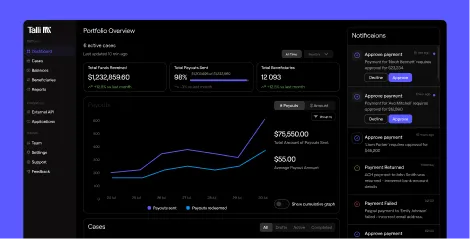
- Real-time dashboards: Payment status visibility across entire distributions
- Alerting systems: Automated notifications when metrics deviate from baselines
- Predictive analytics: Early warning for capacity issues before they impact claimants
- Performance baselines: Historical comparison showing trends over time
Platforms providing real-time dashboards enable claims teams to identify and resolve issues before they compound.
Anticipating Bottlenecks Before They Occur
Monitor leading indicators that predict performance degradation:
- Queue depth trends showing processing backlog growth
- Error rate increases suggesting system stress
- Response time elongation indicating resource constraints
Choosing the Right Benchmarking Tools and Methodologies
Selecting Industry-Standard Tools
Standardized benchmarking provides comparable results across vendors:
- TPC benchmarks: Industry-standard transaction processing metrics measuring throughput and price-performance ratios
- Load testing suites: Tools simulating thousands of concurrent users with realistic behavior patterns
- API testing platforms: Automated validation of integration performance and reliability
Comparing Benchmarking Approaches
Structure your evaluation methodology:
- Synthetic benchmarks: Controlled tests isolating specific performance characteristics
- Production simulations: End-to-end workflows replicating actual settlement distributions
- Stress testing: Pushing beyond expected volumes to identify breaking points
Fintech due diligence should include stress testing at 1,000+ TPS to validate vendor claims match reality.
Best Practices for Vendor Due Diligence and Scalability Assessment
Structuring Vendor Scalability Reviews
Create standardized evaluation criteria:
- Reference requirements: Demand client references with 50,000+ recipient distributions
- Performance documentation: Written specifications for TPS capacity, latency targets, and uptime guarantees
- Pilot programs: Test environments with your actual data volumes before commitment
- Architecture reviews: Technical documentation showing scaling mechanisms and redundancy
Negotiating Performance-Based SLAs
Build accountability into vendor contracts:
- Uptime guarantees: Minimum 99.9% availability with financial penalties for violations
- Processing time commitments: Maximum payment completion windows
- Support response levels: 24/7 coverage during active distribution periods
- Audit rights: Access to performance data and compliance certifications
Why Talli Delivers Scalable Settlement Distribution
While benchmarking methodologies matter, selecting a vendor purpose-built for legal settlement distribution eliminates much of the evaluation complexity. Talli's AI-driven payment platform addresses the specific scalability requirements claims administrators face.
Talli's infrastructure handles distributions from 1,000 to 100,000+ recipients using the same architecture—eliminating tier-based limitations that force platform upgrades mid-settlement. The platform's key scalability features include:
- AI-powered fraud detection: Automated screening delivering 40% reduction in fraudulent claims without sacrificing processing speed
- Real-time dashboards: Complete visibility into payment status, completion rates, and fund flows
- Built-in compliance: KYC, OFAC, and W-9 verification integrated into payment workflows
- Complete fund segregation: Dedicated accounts for every settlement preserving QSF ownership
Banking services provided by Patriot Bank, N.A., Member FDIC, ensure settlement funds remain protected throughout the distribution lifecycle. For claims teams evaluating vendor scalability, Talli offers the performance transparency and compliance infrastructure that benchmarking processes are designed to verify.
Frequently Asked Questions
What is the primary difference between volume testing and stress testing in the context of vendor scalability?
Volume testing validates system behavior at expected transaction levels—confirming a platform handles your projected 50,000 recipient settlement without degradation. Stress testing pushes beyond expected volumes to identify breaking points and failure modes. Both matter: volume testing confirms adequacy while stress testing reveals safety margins. Legacy systems often fail at 22% volume spikes during month-end peaks, making stress testing essential for settlement platforms facing unpredictable traffic patterns.
How can I accurately simulate billions of annual transactions during a benchmarking exercise?
Generate synthetic datasets matching your actual settlement complexity—including varied payment amounts, multiple payment methods, and realistic recipient demographics. Use load testing tools to simulate concurrent portal access and batch payment processing. Request vendor pilot environments and run tests at 1,000+ TPS sustained for extended periods. Document results against industry benchmarks like Visa's 8,500 TPS to contextualize vendor performance claims.
What are the critical compliance certifications to look for when evaluating a financial payment vendor's scalability?
Require SOC 2 Type II certification confirming data handling practices, PCI DSS Level 1 compliance for card-based disbursements, and FDIC insurance for settlement fund protection. Verify the vendor maintains real-time OFAC screening that scales with transaction volume—security that degrades under load creates compliance violations. Platforms should demonstrate KYC verification throughput measured in seconds per claimant rather than minutes, ensuring compliance doesn't bottleneck distribution timelines.
What role does real-time monitoring play in ensuring a vendor maintains scalability after initial benchmarking?
Initial benchmarks validate capability; ongoing monitoring confirms sustained performance. Real-time dashboards tracking TPS, error rates, and queue depths provide early warning when systems approach capacity limits. Automated alerting enables proactive scaling before claimants experience delays. Vendors offering real-time analytics with historical trending help claims teams identify degradation patterns and hold vendors accountable to contracted SLAs throughout multi-month distributions.
How does a vendor's complete fund segregation influence its scalability and reliability for legal payouts?
Complete fund segregation maintains dedicated accounts for each settlement, preventing co-mingling that creates reconciliation complexity at scale. This architecture simplifies reporting, preserves QSF ownership structures, and ensures legal compliance throughout distribution lifecycles. Platforms without segregation require manual accounting overhead that grows exponentially with settlement count—creating operational bottlenecks that offset any processing speed advantages.