.svg)


.svg)
Settlement administrators face a critical barrier when 4.2% of households—approximately 5.6 million—lack traditional banking relationships, preventing them from accessing funds distributed through conventional paper check methods. Modern digital payment platforms achieve up to 98% redemption rates compared to a weighted average of 77% for traditional checks. In settlements without a formal claims process, check cashing rates can drop as low as 55%. For claims administrators managing class action settlements, addressing the unbanked population isn't just about inclusion—it's essential for meeting court expectations and maximizing settlement effectiveness.
Key Takeaways
- 4.2% of households (5.6 million) are completely unbanked, with another 14.2% (19 million households) underbanked
- Digital payment platforms achieve up to 98% success rates versus a weighted average of 77% for traditional paper checks
- Check-cashing services can charge fees ranging from 1% to over 10% of a check's value—for a $500 settlement check, this could mean losing $5 to $50 just to access funds
- An estimated 15-20% of paper checks go uncashed, with billions reverting to defendants or entering escheatment
- 21.6% of unbanked households already use prepaid cards, making them a familiar and accessible solution
- Settlement fraud increased 19,000% between 2021-2023, requiring automated fraud detection systems
Understanding the Unbanked Challenge in Legal Payouts
Defining the 'Unbanked' Claimant
Unbanked individuals lack access to traditional checking or savings accounts at banks or credit unions. According to the 2023 FDIC Survey, these populations are disproportionately represented in class action settlements targeting low-income consumers—the very people the settlements intend to compensate.
The unbanked population shows significant demographic concentration:
- Black households: 10.6% unbanked
- Hispanic households: 9.5% unbanked
- Households earning under $15,000: 21.8% unbanked
- Working-age households with disabilities: 11.2% unbanked
Why Traditional Payouts Fail the Unbanked
Paper check distribution assumes universal banking access—an assumption that fails millions of claimants. When unbanked recipients receive settlement checks, they face limited options for accessing their funds.
Check-cashing services represent the most common solution, but they can charge fees ranging from 1% to over 10% of a check's value, depending on the check type. For a $500 settlement check, this could mean losing $5 to $50 just to access funds already owed to economically vulnerable individuals. Traditional check distribution also costs administrators an estimated $7.78-$20 per disbursement when factoring in printing, mailing, tracking, and reissuance.
The Impact of Low Redemption on Settlement Effectiveness
Class action participation rates routinely linger in the single digits. Over 90% of settlement money goes unclaimed on average, with unclaimed funds either reverting to defendants or entering state escheatment programs.
Courts increasingly demand higher participation rates under Rule 23(e) amendments. Judges have reduced attorneys' fees when actual benefit to the class appears minimal due to low take-up rates, creating direct financial incentives beyond social responsibility for maximizing redemption.
Flexible Payment Options: The Key to Inclusivity and Higher Redemption
Catering to Diverse Claimant Needs
Payment flexibility transforms settlement administration by meeting claimants where they are. Digital platforms offering multiple channels—ACH direct deposit, prepaid Mastercard, digital wallets, and gift cards—eliminate the assumption that all recipients have banking access.
When given choice, 91% of claimants select electronic payment methods over checks. The barrier isn't claimant preference—it's lack of options.
Key payment channels for reaching unbanked claimants include:
- Prepaid cards: Instantly spendable without bank account requirements
- Digital wallets: PayPal, Venmo, and similar services accessible via smartphone
- Gift cards: Redeemable at participating merchants with no banking needed
- ACH direct deposit: For banked recipients who prefer traditional transfers
The Role of Prepaid Cards in Modern Payouts
Prepaid cards solve the unbanked barrier entirely because 21.6% of unbanked households already use them. This familiarity makes prepaid disbursement an accessible solution leveraging existing behavior rather than forcing adoption of entirely new payment methods.
As Rob Heffernan, Co-founder and CEO of Talli, notes: "An unbanked person who might never cash a check will absolutely use a prepaid card they can spend immediately."
Streamlining the Payout Process: Making It Easy for Every Claimant
Reducing Friction: The Path to Completion
Every additional step in the payout process creates another point where claimants abandon their claims. Streamlined digital disbursement eliminates common barriers:
- No account creation required: Claimants receive secure links via SMS or email
- No app downloads: Browser-based experiences work on any smartphone
- Instant access: Funds available immediately upon selection
- Clear instructions: Simple interfaces guide claimants through payment selection
Mobile-First Payouts: Accessibility in Hand
Mobile-first design ensures accessibility for populations who may lack computer access but own smartphones. Claimants receive a secure link, select their preferred payment method, and receive funds—often within minutes rather than the weeks required for traditional check processing.
This approach particularly benefits unbanked populations who are more likely to rely on mobile devices as their primary internet access point. The claimant experience improves dramatically when the process respects their technological realities.
Leveraging Smart Follow-ups for Increased Take-Up Rates
Designing Effective Reminder Strategies
Smart multi-channel outreach dramatically increases engagement compared to single-channel paper notices mailed to potentially outdated addresses. SMS reminders achieve 90%+ open rates versus single-digit response rates for mailed notices.
Kroll reports that a combination of targeted reminder protocols, including email, postal mail, and phone outreach, can result in as many as 20% more checks being cashed. Digital platforms enable real-time address updates—when email bounces, administrators know immediately and can try alternative channels.
Automating Engagement to Boost Redemption
Effective reminder systems include:
- Initial notification: Secure link via preferred channel (SMS or email)
- First reminder: 48-72 hours after initial notification
- Escalation: Switch channels if primary doesn't generate response
- Final notice: Urgent messaging before deadline expiration
- Multilingual support: Communications in 40+ languages for diverse populations
Approximately 12% of Americans move annually, making years-old class lists unreliable for paper mail distribution. Multi-channel digital engagement ensures claimants actually receive notification and can update contact information in real-time.
Ensuring Compliance and Security in Unbanked Payouts
Regulatory Requirements for All Claimants
Compliance requirements don't change based on claimant banking status. Every payout—whether to a Chase customer or an unbanked individual using a prepaid card—must meet the same regulatory standards.
Essential compliance elements include:
- KYC verification: Validating claimant identities before payment release
- OFAC screening: Treasury Department sanctions compliance for every payment
- W-9 collection: Tax documentation for payments exceeding $600
- 1099 issuance: Year-end reporting to IRS for applicable payments
- Audit trails: Detailed documentation of every claim processed
Protecting Against Settlement Fraud
Settlement fraud increased 19,000% between 2021-2023, exposing settlement funds to massive losses. Digital disbursement platforms blocked 80 million claims showing signs of fraud in 2024 alone through AI-powered detection.
Modern platforms integrate fraud mitigation capabilities that manual processes cannot match:
- Device fingerprinting to identify coordinated fraud schemes
- Behavioral analytics detecting suspicious patterns
- Fuzzy matching of duplicate submissions
- Velocity monitoring for unusual claim volumes
- Real-time alerts for immediate intervention
Maintaining Fund Segregation and Transparency
Complete fund segregation preserves Qualified Settlement Fund (QSF) tax treatment while simplifying reporting and ensuring legal compliance throughout the disbursement lifecycle. Dedicated accounts for every settlement prevent commingling while maintaining clear audit trails.
Leveraging Real-Time Visibility and Reporting for Payout Success
Gaining Insight: What Your Payout Data Reveals
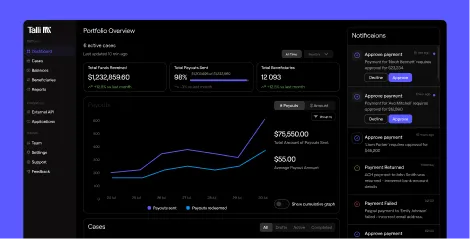
Real-time dashboards transform settlement administration from reactive to proactive. Instead of discovering problems through periodic batch reports, administrators monitor completion rates, payment status, and fund flows continuously.
Key metrics to track include:
- Completion rates: Percentage of claimants who finish the payout process
- Payment method distribution: Which options claimants prefer
- Abandonment points: Where claimants drop off in the process
- Response rates: Effectiveness of different communication channels
- Fund utilization: How much of the settlement pool has been distributed
Reporting to Stakeholders with Confidence
Courts expect detailed post-distribution accounting showing actual benefit delivered to class members. Automated reporting generates court-required documentation in standard formats, eliminating manual compilation while ensuring accuracy.
Settlement administrators who implement comprehensive digital strategies, including real-time analytics, report redemption rate improvements of 25-40% compared to those relying on traditional batch processing—because problems get identified and addressed immediately rather than weeks later.
Enhancing the Claimant Experience: Beyond Just Receiving Funds
The Human Touch: Supporting Unbanked Claimants
Unbanked individuals may be less familiar with digital payment processes, making customer support essential for successful redemption. Responsive assistance—available through multiple channels including phone, chat, and email—helps claimants navigate unfamiliar systems.
As Michael Forrest, Director of Settlement Administration at Kroll, emphasizes: "Digital or non-traditional settlement payments can be effective methods of delivering settlement relief, particularly to the unbanked—but also risk going unused or unclaimed. Post-distribution email nudges encouraging redemption, accompanied with clear instructions and claimant support, help maximize the use of these settlement awards."
Building Trust Through Transparent Communication
Many unbanked individuals distrust formal financial systems due to past negative experiences. Clear communication explaining the legitimacy of settlement payouts, combined with secure and transparent processes, builds the trust necessary for successful completion.
Key trust-building elements:
- Clear branding: Settlement communications clearly identify the case
- Transparent fees: No hidden charges or surprise deductions
- Security messaging: Reassurance about data protection
- Accessible support: Help available when questions arise
Scaling Payouts for Any Size Without Compromising Redemption
From Small Batches to Large Settlements
Whether distributing to 1,000 or 100,000 recipients, high-volume payout systems must maintain the same redemption focus. Manual processes that work for small settlements collapse under enterprise scale, while automated platforms handle volume without sacrificing claimant experience.
Class action settlements have totaled billions in recent years, with individual settlements sometimes reaching tens of thousands of claimants. Systems must scale without creating new barriers for already-underserved populations.
The Speed Advantage: Minutes vs. Weeks
What used to take six weeks now takes two days with modern disbursement platforms. Distribution timeline compression benefits all claimants, but particularly impacts unbanked individuals who may be experiencing financial hardship that prompted the original lawsuit.
Digital platforms reduce per-transaction costs from an estimated $7-20 for checks to under $1 for digital methods—savings that can be redirected toward enhanced support services or additional claimant outreach.
Why Talli Simplifies Payouts for Unbanked Claimants
Talli's AI-driven payment platform addresses the unbanked challenge through purpose-built features designed specifically for legal settlement distribution. Unlike generic payment processors, Talli combines flexible payment options with compliance automation and real-time visibility.
Key capabilities for reaching unbanked claimants include:
- Multiple payment channels: ACH, prepaid Mastercard, digital wallets, and gift cards—all without requiring bank accounts
- Smart reminders: Automated multi-channel outreach across email, SMS, and more to maximize completion rates
- Complete fund segregation: Dedicated accounts for every settlement preserving QSF ownership and simplifying reporting
- Built-in compliance: KYC, OFAC, W-9 collection, fraud mitigation, and audit logs integrated into every workflow
- Real-time dashboard: Total visibility into completion rates, fund flows, and payout status
Banking services are provided by Patriot Bank, N.A., Member FDIC. The Easy Prepaid Mastercard is issued by Patriot Bank, N.A., Member FDIC, pursuant to a license from Mastercard International. Gift Cards are issued by InComm and distributed by Talli.
For claims administrators serious about improving redemption rates across all claimant demographics, Talli delivers the automation and flexibility needed to meet tight deadlines without losing control over compliance or claimant experience.
Frequently Asked Questions
What does 'unbanked' mean in legal payouts?
Unbanked refers to individuals who lack access to traditional checking or savings accounts at banks or credit unions. According to the 2023 FDIC Survey, 4.2% of U.S. households (5.6 million) are completely unbanked, while another 14.2% (19 million households) are underbanked—meaning they have accounts but still rely on alternative financial services. In legal payouts, these populations cannot easily cash settlement checks without paying fees to check-cashing services.
How do flexible payment options increase redemption rates?
Flexible payment options eliminate the banking barrier entirely. Prepaid cards, digital wallets like PayPal and Venmo, and gift cards all allow unbanked claimants to receive and access their funds without a traditional bank account. Since 21.6% of unbanked households already use prepaid cards, this approach leverages familiar behavior rather than forcing adoption of new methods. Platforms offering multiple channels achieve up to 98% success rates compared to a weighted average of 77% for traditional checks.
What security measures protect unbanked payments?
The same compliance and security standards apply regardless of payment method or claimant banking status. Modern platforms integrate automated KYC verification, OFAC sanctions screening, W-9 collection for tax compliance, and AI-powered fraud detection. Settlement fraud increased 19,000% between 2021-2023, making automated fraud mitigation essential for all disbursements. Complete audit trails document every payment for regulatory compliance and court reporting.
How does Talli's platform help unbanked claimants?
Talli sends claimants a secure link via SMS or email—no accounts to create, no apps to download. Claimants simply click the link, select their preferred payment method from available options (including prepaid cards, digital wallets, and gift cards that don't require bank accounts), and receive their funds. Smart reminders across multiple channels help claimants complete the process, while the mobile-first design ensures accessibility for those using smartphones as their primary internet device.
What role do reminders play in redemption rates?
Smart multi-channel reminders dramatically improve engagement compared to single-channel paper notices. SMS reminders achieve 90%+ open rates versus single-digit response rates for mailed notices. Targeted reminder protocols combining email, postal mail, and phone outreach can result in as many as 20% more completions. The percentage of people who moved in the past year was 11.8% in 2024 (and 12.1% in 2023), which makes years-old class lists unreliable for mail-only outreach., digital engagement through email and SMS reaches claimants more reliably than mail to potentially outdated addresses—particularly important for mobile unbanked populations.