.svg)


.svg)
Bulk disbursement of class action funds has become a critical focus for settlement administrators facing a more than 19,000% increase in fraudulent claims from 2021-2023, though a 2025 industry report indicates a subsequent 40% drop in such claims in 2024. Modern digital payment platforms now offer secure, compliant alternatives to traditional check distribution, helping claims teams protect settlement funds while improving claimant redemption rates.
Key Takeaways
- Digital disbursement platforms save 60% or more compared to traditional check processing costs
- Digital Disbursements' technology blocked 800 million fraudulent claims in 2024
- Check payments fell from about 16% of core noncash payments in 2012 to 8.3% in 2018.
- Per-payment costs vary by organization, but surveys consistently show checks cost materially more than electronic payments—especially once you factor in reissues, support, and reconciliation.
- Digital platforms can implement settlements in as little as 48 hours
- Top platforms offer 2,500+ redemption options including digital wallets, prepaid cards, and ACH
- Approximately 25% of U.S. households remain unbanked, requiring flexible payment alternatives
What Does Bulk Disbursement Mean in Class Action Settlements?
Bulk disbursement refers to the systematic distribution of settlement funds to large groups of claimants following court approval of a class action resolution. This process involves coordinating payments to thousands or even millions of recipients while maintaining strict compliance with legal requirements and Qualified Settlement Fund (QSF) regulations.
- Fund segregation requirements Settlement administrators must maintain dedicated accounts for each settlement, preserving QSF ownership throughout the disbursement lifecycle.
- Claimant roster management Accurate tracking of verified claimants, payment amounts, and contact information across potentially massive datasets.
- Distribution plan compliance Every disbursement must align with court-approved allocation formulas and payment schedules.
- Multi-channel payment execution Modern settlements require supporting various payment methods to accommodate diverse claimant preferences and banking situations.
The complexity of these requirements has driven adoption of specialized technology platforms that automate verification, payment processing, and compliance documentation.
What Are the Biggest Challenges in Administering Class Action Payouts?
Settlement administrators face mounting obstacles that traditional manual processes cannot address efficiently. The explosion in settlement fraud represents the most significant challenge, with Digital Disbursements reporting that fraudulent claims increased by more than 19,000% between 2021 and 2023.
- Fraud prevention gaps Manual verification processes miss sophisticated fraud schemes, exposing settlement funds to significant losses.
- Data accuracy failures Outdated addresses and incorrect banking information lead to failed payments and costly reissuance cycles.
- KYC and OFAC compliance OFAC screening requirements demand systematic sanctions list verification that manual processes often skip.
- W-9 collection burdens Tax documentation requirements create administrative bottlenecks when handled without automation.
- Reconciliation complexity Tracking disbursement status across thousands of payments generates substantial reconciliation workloads.
Why Do Traditional Check Processes Fail Modern Settlements?
Paper check distribution introduces inefficiencies that compound across large-scale settlements. Each check costs $7-$15 per disbursement and can reach up to $20 when factoring in printing, mailing, and processing overhead. Paper checks declined from 15% to 8.3% of transactions between 2012 and 2019, reflecting broader market rejection of this payment method.
How Is Technology Transforming Class Action Fund Distribution?
AI-powered platforms now automate the entire disbursement workflow from claimant verification through payment delivery and reconciliation. These systems integrate fraud detection, compliance screening, and multi-channel payment options into unified solutions that digital rails outperform legacy paper-based methods.
- Cloud-based infrastructure Modern platforms operate on scalable cloud architecture that handles settlements of any size without performance degradation.
- API-first integration Direct connections to payment networks, case management systems, and CRM platforms enable seamless data flow.
- Real-time fraud screening AI algorithms analyze claims against behavioral patterns and known fraud indicators before payment approval.
- Automated compliance verification Built-in KYC, OFAC, and sanctions screening eliminates manual review requirements.
- Multi-channel payment delivery Claimants select preferred payment methods including ACH, digital wallets, prepaid cards, or traditional checks.
Which Tools Lead the Market for Class Action Payment Processing?
The settlement disbursement technology landscape includes specialized platforms designed specifically for legal payouts alongside enterprise payment processors serving multiple industries. Each solution offers distinct capabilities suited to different settlement types and organizational requirements.
What Makes Digital Disbursements From Western Alliance Bank Stand Out?
Digital Disbursements earned American Banker's Innovation of the Year in the cybersecurity and fraud category for its Anti-Fraud Triangle technology. The platform blocked 800 million fraudulent claims and prevented more than $100 million in fraudulent payouts during 2024. As a bank-backed solution, it offers FDIC-insured fund security with payment options including Zelle, Venmo, PayPal, and Mastercard Prepaid Cards.
How Does Kroll Settlement Administration Compare?
Kroll represents the established market leader with over 4,000 settlements managed and more than 100 million claims processed throughout its 50+ year history. The platform has distributed more than $30 billion in settlement funds and maintains ISO 27001 and SOC2 certifications along with HIPAA, GDPR, and CCPA compliance. Their TIA Tier IV data center delivers 99.995% uptime reliability.
What Scale Does Tremendous Offer?
Tremendous has delivered over $2 billion across 65 million payouts to customers worldwide. For legal settlements specifically, the platform has disbursed $400 million across 200 cases reaching 5.7 million claimants. Implementation speed stands out, with cases able to disburse in as little as 48 hours. The platform offers 2,500+ redemption options including PayPal, Venmo, ACH, and gift cards.
Why Is Talli Built Specifically for Legal Settlements?
Talli delivers an AI-driven payment platform purpose-built for legal payouts and claims administration. The platform achieves 30% higher redemption rates than traditional methods through flexible payout options that require no bank account. Backed by $4 million in seed funding from Vestigo Ventures, Talli provides complete fund segregation preserving QSF ownership throughout the disbursement lifecycle, according to its leadership. Banking services are provided by Patriot Bank, N.A., Member FDIC.
"Our platform represents a fundamental reimagining of settlement administration infrastructure," said Rob Heffernan, Co-founder and CEO of Talli. "By maintaining proper fund segregation throughout the entire process, we ensure claimants retain ownership of their funds while gaining the benefits of modern digital payments."
What Other Platforms Serve This Market?
Additional solutions address specific settlement administration needs:
- EpiqPay integrates with Epiq Global's broader settlement administration services, offering Amazon, Mastercard, and PayPal payment options with real-time claimant tracking.
- Lithic provides card issuing/processing infrastructure and has publicly described its partnership with Talli, delivering instant payouts through physical cards, virtual cards, and digital wallets.
- Fiserv’s Carat Payouts marketing cites digital payout delivery in ~5 seconds (or less) and claims lower costs versus checks and wires.
- B4B Payments specializes in prepaid card solutions addressing the 25% of U.S. households that remain unbanked.
- Confido Legal reports 100% client adoption of digital options over paper checks, with built-in IOLTA compliance for law firm trust accounting requirements.
- Choice Digital supports diverse settlement types including class action, mass tort, employment, regulatory, and antitrust cases with comprehensive audit trails.
How Do These Platforms Ensure Compliance and Security?
Compliance in payouts requires systematic verification across multiple regulatory frameworks. Leading platforms integrate automated screening that eliminates manual review bottlenecks while maintaining complete audit documentation.
- Fund segregation controls Dedicated accounts for each settlement preserve QSF ownership and simplify regulatory reporting.
- OFAC sanctions screening Real-time verification against Treasury Department sanctions lists before payment approval.
- KYC identity verification Document verification and fraud detection algorithms confirm claimant identity.
- W-9 tax documentation Automated collection and validation ensures 1099 reporting accuracy.
- Audit trail generation Every transaction generates comprehensive documentation for court reporting and regulatory review.
What Security Certifications Matter Most?
Enterprise platforms maintain certifications demonstrating commitment to data protection and operational security. Kroll's ISO 27001 and SOC2 certifications represent industry gold standards. Bank-backed solutions like Digital Disbursements provide FDIC insurance protecting settlement funds. PCI DSS compliance ensures credit card data security for platforms offering prepaid card options.
What Features Maximize Claimant Engagement and Redemption Rates?
Settlement redemption rates directly impact the success of any class action resolution. Platforms that prioritize claimant experience through flexible payment options and proactive communication achieve significantly higher completion rates than traditional methods.
- Multi-channel payment selection Claimants choose ACH, digital wallets, prepaid cards, or checks based on their preferences and banking situations.
- No-app-required access Recipients receive secure links via SMS or email without creating accounts or downloading applications.
- Smart reminder sequences Automated follow-ups across email, SMS, and other channels prompt claimants to complete the redemption process.
- Self-service status tracking Claimant portals enable payment tracking and information updates without administrator intervention.
- Unbanked population support Prepaid cards and digital wallet options serve the 25% of U.S. households without traditional banking relationships.
Talli's approach to increasing redemption rates enables claimants to complete redemption in under 30 seconds, eliminating friction that causes abandonment in traditional processes.
Why Does Real-Time Tracking Matter for Settlement Visibility?
Real-time settlement dashboards transform how claims teams monitor disbursement progress and respond to issues. Traditional batch processing creates visibility gaps that delay problem identification and resolution.
- Delivery status monitoring Track every payment from initiation through claimant receipt with real-time updates.
- Completion rate analytics Dashboard metrics reveal redemption patterns and identify segments requiring additional outreach.
- Fund flow transparency Real-time visibility into disbursed, pending, and returned funds supports accurate reporting.
- CRM integration Automatic synchronization of payout data with case management systems eliminates manual data entry.
- Stakeholder reporting Built-in reports satisfy court requirements and keep counsel informed of settlement progress.
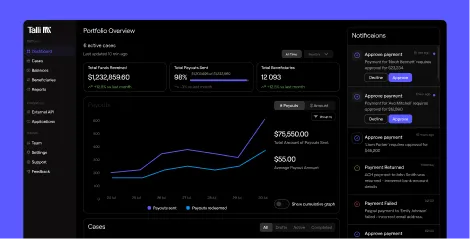
Talli's real-time dashboard provides total control and visibility, allowing teams to create payout distribution campaigns, track every payout status, and monitor completion rates through a single interface.
What Trends Will Shape Class Action Disbursement Technology in 2025?
The class action disbursement landscape continues evolving as fraud threats intensify and claimant expectations shift toward instant digital payments. Several emerging trends will influence platform selection and settlement administration strategy.
- AI-driven fraud detection Machine learning algorithms analyzing behavioral patterns and claim characteristics will become standard requirements given the documented 19,000% fraud surge.
- Instant payment delivery Settlement expectations are shifting toward same-day or instant disbursement rather than multi-week check processing timelines.
- Enhanced biometric verification Advanced identity confirmation methods will reduce fraud while improving legitimate claimant experience.
- RegTech automation Regulatory technology solutions will further automate compliance workflows as requirements grow more complex.
- Global disbursement capabilities International settlements will drive demand for platforms supporting cross-border payments in multiple currencies.
Understanding unclaimed class action funds remains critical, as improved redemption technology will reduce the billions in dormant settlement assets currently held by courts and administrators.
Frequently Asked Questions
What is the average timeline for bulk disbursement in class action cases?
Traditional check-based disbursement typically requires 2-4 weeks from approval to claimant receipt when factoring in check printing, mailing, and bank clearing. Modern digital platforms can complete disbursements within 24-48 hours, with some like Tremendous able to implement cases in 48 hours. Fiserv Carat delivers digital payouts in 5 seconds or less.
How do settlement administrators ensure claimant data security during payouts?
Leading platforms employ bank-grade encryption, multi-factor authentication, and continuous fraud monitoring throughout the payment lifecycle. Certifications including ISO 27001, SOC2 Type II, and PCI DSS demonstrate adherence to security standards. Kroll maintains a TIA Tier IV data center delivering 99.995% uptime with comprehensive physical and cyber security controls.
Can class action claimants choose their preferred payment method?
Yes, modern disbursement platforms offer claimant choice as a core feature. Options typically include ACH direct deposit, digital wallets like PayPal and Venmo, prepaid debit cards, and traditional checks. Tremendous offers 2,500+ redemption options while Talli provides flexible payout methods requiring no bank account, contributing to their 30% higher redemption rates.
What are the benefits of using an AI-driven platform for legal payouts?
AI-driven platforms automate fraud detection, compliance screening, and claimant communication that would otherwise require extensive manual effort. These systems analyze claims against behavioral patterns to identify fraud, automatically verify identities and sanctions status, and trigger personalized reminder sequences to improve redemption rates. The efficiency gains translate to faster disbursements and reduced administrative costs.
How much can organizations save by switching from checks to digital disbursements?
Digital disbursement platforms typically deliver 60% cost savings compared to check and wire transfer processing. With checks costing $7-$20 per disbursement versus under $1 for digital methods, high-volume settlements can realize substantial operational savings while improving claimant experience and reducing time-to-payment.