.svg)


.svg)
The February 2024 Change Healthcare ransomware attack stands as the largest healthcare data breach in U.S. history, compromising the protected health information of 192.7 million individuals—over half of the American population. With 78+ lawsuits consolidated in Minnesota federal court and settlement negotiations ongoing, affected patients and healthcare providers face critical questions about eligibility, claims processes, and how they'll receive their funds. Understanding digital disbursement processes has become essential for anyone impacted by this massive breach.
Key Takeaways
- The Change Healthcare breach affects 192.7 million individuals, making it approximately 2.4 times larger than the 2015 Anthem breach
- 78+ lawsuits have been consolidated in the U.S. District Court for the District of Minnesota under MDL 3108
- Settlement negotiations began December 2024, with estimated potential payouts based on industry precedent
- UnitedHealth Group projected $2.87 billion in anticipated costs from the breach, including a $22 million ransom payment
- 94% of hospitals experienced financial impact, with 80% of practices losing revenue from unpaid claims
- Dual-track litigation structure separates patient claims from provider claims, each with distinct eligibility criteria
- Claims administration will require sophisticated technology to process millions of potential claimants while preventing fraud
Understanding the Change Healthcare Data Breach: What Happened?
The incident was detected on February 21, 2024, after the ALPHV/BlackCat ransomware group used compromised credentials to access a Change Healthcare Citrix remote-access portal that did not have multi-factor authentication enabled. This single security failure gave attackers access to systems processing approximately 40% of U.S. healthcare claims.
Timeline of the Attack
The breach unfolded rapidly:
- February 21, 2024: Attackers gain initial access through unprotected Citrix portal
- February 22, 2024: UnitedHealth files SEC Form 8-K disclosing the incident
- March 2024: HHS Office for Civil Rights launches proactive investigation before formal breach reporting
- April 22, 2024: Change Healthcare begins breach notifications to affected individuals
- July 31, 2025 (posted publicly thereafter): Change Healthcare notified HHS OCR that approximately 192.7 million individuals were impacted
Affected Data and Systems
ALPHV/BlackCat claimed to have exfiltrated roughly 6 terabytes of data,
including:
- Social Security numbers
- Medical records and diagnoses
- Health insurance information
- Prescription data
- Billing and claims information
- Personal contact details
UnitedHealth CEO Andrew Witty confirmed in congressional testimony that the company paid a $22 million ransom, though this payment failed to secure data deletion. A second extortion attempt by RansomHub followed after ALPHV/BlackCat's exit scam.
Who is Eligible for the Change Healthcare Settlement?
The litigation features a dual-track structure with separate classes for patients and healthcare providers, each facing distinct harm theories and potential compensation.
Identifying Affected Parties
Patient Class Eligibility:
Individuals who received breach notification letters or whose data was processed through Change Healthcare systems may qualify. This includes patients whose:
- Health insurance claims were processed through Change Healthcare
- Medical records were stored in compromised systems
- Personal health information was exposed in the breach
Patient claims focus on:
- Identity theft risk and credit monitoring costs
- Emotional distress from privacy violations
- Out-of-pocket expenses for protective measures
Provider Class Eligibility:
Healthcare providers experienced severe operational disruption. AMA surveys found that 55% of physicians used personal funds to cover practice expenses during the outage, while 80% of practices lost revenue from unpaid claims.
Provider claims center on:
- Lost revenue from claims processing disruption
- Operational costs for implementing workarounds
- Staff time and resources diverted to crisis response
- Costs of switching to alternative payment processors
Criteria for Claim Submission
While specific settlement terms remain under negotiation, precedent from similar cases suggests tiered compensation based on:
- Type of data exposed: Social Security numbers typically warrant higher payouts than basic contact information
- Documented harm: Identity theft victims with evidence may receive enhanced claims
- Duration of impact: Longer disruption periods may increase provider compensation
The Settlement Claim Process: A Step-by-Step Guide
With settlement discussions ongoing since December 2024, affected individuals and providers should prepare for the claims process.
Current Litigation Status
Settlement talks commenced when Judge Donovan Frank ordered ex parte meetings between lead counsel and Magistrate Judge Foster. Key dates include:
- December 18, 2024: Plaintiffs' counsel met with settlement facilitator
- January 30, 2025: Defense counsel settlement meeting
- April 30, 2025: Joint in-person settlement conference
- March 21, 2025: Deadline for defendants' motions to dismiss
Required Documentation
Claimants should gather:
- Breach notification letters from Change Healthcare
- Evidence of identity theft or fraud attempts
- Credit monitoring service expenses
- Medical bills showing claims processing delays
- Bank statements documenting financial losses
For providers, documentation should include:
- Revenue comparisons before and after the attack
- Costs of alternative payment processing
- Staff overtime and contractor expenses
- Patient care delays attributable to the breach
Modern claims administration platforms can significantly streamline documentation submission and verification for settlements of this magnitude.
Important Deadlines to Remember
No settlement has been announced as of February 2026. Once approved:
- Class members will receive formal notice with specific claim deadlines
- Opt-out periods will allow individuals to pursue separate litigation
- Objection deadlines will permit challenges to settlement terms
Securing Your Settlement Funds: Payment Methods and Verification
When settlement funds become available, secure disbursement will be critical given the sensitive nature of the underlying data breach.
Choosing Your Payout Option
Large-scale settlements increasingly offer multiple payment methods:
- Direct deposit: Fastest option for banked recipients
- Digital wallets: Convenient for those preferring mobile access
- Prepaid cards: Essential for unbanked claimants
- Paper checks: Traditional option with higher non-redemption rates
The Anthem settlement precedent of $115 million for 78.8 million records ($1.46 per affected individual) provides a baseline, though Change Healthcare's larger scale and dual-track structure may yield different per-claimant amounts.
Importance of Identity Verification
Given that the breach itself involved identity data theft, verification protocols for settlement disbursement must be especially robust. Effective claims administration requires:
- KYC verification to confirm claimant identity
- OFAC screening for regulatory compliance
- Fraud detection to prevent duplicate claims
- Audit trails for court oversight
Talli's platform automates these verification processes while maintaining complete fund segregation, ensuring settlement funds reach legitimate claimants without creating new security vulnerabilities.
The Role of Compliance and Transparency in Large-Scale Payouts
A settlement of this magnitude requires meticulous legal payout compliance across multiple regulatory frameworks.
Ensuring Regulatory Compliance
Settlement administrators must address:
HIPAA Requirements:
- Claims processing involving PHI must maintain privacy protections
- Breach notification compliance (60-day rule from discovery)
- OCR delegated notification authority to Change Healthcare for affected entities
State Law Variations:
- Nebraska AG lawsuit alleges state consumer protection violations
- California residents may receive separate subclass treatment
- 26+ state court actions pending as of May 2025
Tax Reporting:
- Settlement payments may trigger IRS Form 1099 requirements
- W-9 collection from claimants ensures accurate reporting
Real-time Tracking and Reporting
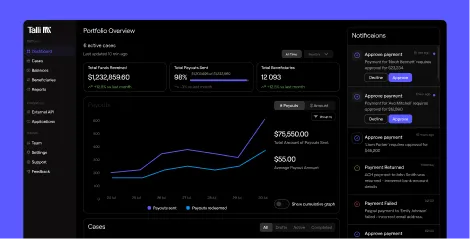
Courts overseeing settlements of this scale require comprehensive visibility. Talli provides transparency in settlement distribution through real-time dashboards showing:
- Claim submission rates and validation status
- Payment completion percentages
- Fund flow tracking and reconciliation
- Stakeholder reporting capabilities
Maximizing Redemption Rates with Efficient Payout Technology
Historical data shows that settlement redemption rates vary dramatically based on payment method and claimant communication strategies.
Leveraging Digital Communication
With 130 million+ notifications sent as of January 2025, reaching claimants requires sophisticated outreach:
- SMS notifications: Higher open rates than email
- Email campaigns: Detailed instructions and secure links
- Smart follow-ups: Automated reminders for incomplete claims
- Multi-channel coordination: Consistent messaging across platforms
Personalized Payout Choices
Flexible payment options drive higher completion rates. When claimants can select their preferred method—whether direct deposit, digital wallet, or prepaid card—more recipients successfully receive their funds. Talli's platform enables claimants to choose what works best for their situation, with no bank account required for participation.
Monitoring Settlement Progress in Real-Time
Administrators managing 78+ consolidated lawsuits need sophisticated tracking capabilities to meet court requirements and stakeholder expectations.
Key Metrics for Administrators
Critical performance indicators include:
- Claim submission rates: Percentage of notified class members filing claims
- Validation completion: Claims successfully verified versus pending review
- Payment success rates: Funds successfully delivered versus returned
- Fraud detection metrics: Duplicate claims identified and rejected
- Timeline compliance: Adherence to court-mandated disbursement schedules
Integrating Payout Data with CRM
The AHA reported 94% of hospitals experienced financial impact from the breach. Provider claimants will require integration between settlement administration systems and their existing financial management tools to reconcile payments against documented losses.
Talli's API capabilities enable seamless data synchronization, allowing claims teams to maintain complete visibility while meeting efficiency benchmarks.
Future Implications for Healthcare Cybersecurity
Beyond the immediate settlement, this breach carries lasting consequences for healthcare security standards and regulatory enforcement.
Strengthening Healthcare Security
The breach exposed fundamental vulnerabilities:
- Change Healthcare held HITRUST certification at the time of the attack
- A single server lacked multi-factor authentication
- The attacker remained undetected for days before deploying ransomware
Senator Ron Wyden has proposed removing HIPAA penalty caps and mandating minimum cybersecurity standards for healthcare entities processing significant data volumes.
Preventing Future Attacks
Industry analysts recommend:
- Mandatory multi-factor authentication across all access points
- Regular vulnerability assessments and penetration testing
- Enhanced vendor security requirements
- Improved incident response planning
- Greater transparency in breach notification timelines
The Office of Financial Research has flagged systemic risk concerns, noting that concentration in healthcare payment processing creates single points of failure affecting the entire healthcare system.
Frequently Asked Questions
What is the estimated average payout amount for individual claimants?
No official settlement amount has been announced. Using the Anthem precedent of $1.46 per affected individual as a baseline, individual patient payments could range from a few dollars to several hundred dollars depending on the total settlement fund, tiered claim structure, and whether claimants can document specific harm such as identity theft. Provider claims will likely be calculated differently based on documented revenue losses and operational costs.
How will the settlement coordinate with UnitedHealth's provider assistance program?
UnitedHealth's Temporary Financial Assistance Program (TFAP) disbursed $9 billion to providers, recovering approximately $3.2 billion as of October 2024. Settlement terms will need to address whether TFAP repayments affect settlement eligibility and whether outstanding TFAP balances will be offset against settlement awards to prevent double recovery.
Can I pursue an individual lawsuit instead of participating in the class action settlement?
Yes. When a settlement receives preliminary approval, class members typically have an opt-out period during which they can exclude themselves and pursue separate litigation. However, individual lawsuits require significant resources and proof of specific damages. Most affected individuals find class action participation more practical given the complexity of proving individualized harm from data breaches.
How long will it take to receive payment after the settlement is approved?
Based on precedent from similar large-scale data breach settlements like Equifax, the timeline typically spans 12-24 months from preliminary approval to final disbursement. This includes notice periods, claim submission windows, verification processes, and potential appeals. Modern digital disbursement platforms can significantly accelerate the actual payment delivery once claims are approved, reducing what used to take weeks to mere days.
What happens to unclaimed settlement funds?
Unclaimed funds in class action settlements typically follow cy pres distribution, directing remaining money to charitable organizations aligned with the case's purpose—often data privacy advocacy groups or consumer protection organizations. Courts may also order supplemental distributions to participating claimants or return funds to defendants based on settlement terms. Effective claimant outreach and flexible payment options minimize unclaimed funds by maximizing redemption rates.