.svg)


.svg)
Building comprehensive reporting and reconciliation for legal disbursements requires automating three-way trust reconciliation processes that significantly reduce monthly reconciliation time while preventing costly compliance violations. Modern AI-driven payment platforms can achieve up to about 95% straight-through posting accuracy through automated matching, transforming trust accounting from a regulatory burden into a strategic advantage for firms managing class action settlements and mass tort distributions.
Key Takeaways
- Automated three-way reconciliation matches transactions across general ledger, bank statements, and payment processors
- QSF (Qualified Settlement Fund) compliance relies on complete fund segregation, often using dedicated accounts for each settlement
- Modern platforms handle KYC and OFAC screening automatically, reducing manual errors and sanctions-screening risk
- Real-time dashboards provide instant visibility into completion rates, reducing administrative burden by an estimated 60%
- Recent data shows fraudulent claims dropped by over 40% in 2024 through automated verification
Understanding the Fundamentals of Reconciliation in Accounting for Legal Disbursements
Reconciliation in accounting for legal disbursements verifies that every dollar flowing through trust accounts matches across three critical sources: your general ledger, bank statements, and payment processing records. This three-way reconciliation creates an audit trail that proves compliance with state bar regulations while catching errors before they trigger investigations.
The foundation of legal disbursement reconciliation rests on maintaining accurate disbursement records that track:
- Client ledger balances showing each claimant's allocated settlement amount
- Bank statement transactions reflecting actual deposits and withdrawals
- Payment processing logs documenting delivery status and method
- Trial balance verification ensuring debits equal credits across all accounts
- Journal entry accuracy with proper coding for settlement income and distributions
Legal firms face unique accounting implications compared to standard business operations. State bar associations mandate regular (often monthly) IOLTA reconciliation to prevent commingling of client funds with operating accounts. A single trust accounting violation can trigger disciplinary action, making accurate record-keeping non-negotiable.
The role of precise documentation extends beyond compliance to operational efficiency. Settlement administrators managing mass tort distributions need real-time visibility into which payments cleared, which failed, and which claimants haven't responded. Manual spreadsheet tracking breaks down above 1,000 recipients, creating bottlenecks that delay final settlement approval.
Achieving Financial Reconciliation: Strategies for Legal Payouts
Financial reconciliation for legal payouts demands systematic transaction matching that eliminates discrepancies before month-end reporting. The process moves beyond simple bank statement comparison to multi-layer verification ensuring every payment ties to a specific claimant, invoice, and authorization record.
Step-by-Step Guide to Legal Disbursement Reconciliation
Successful reconciliation follows a predictable sequence:
- Import bank statements via automated feeds or CSV upload
- Match transactions against payment ledgers using amount, date, and recipient ID
- Categorize expenses separating settlement disbursements from administrative costs
- Resolve discrepancies by investigating unmatched items within 48 hours
- Generate reconciliation reports showing three-way balance verification
- Document exceptions with notes explaining timing differences or corrections
- Prepare audit trail linking each payment to source documentation
The challenge intensifies with settlement reports requiring granular fund tracking. Class action administrators must demonstrate every dollar's movement from QSF deposit through final distribution, often across multiple payment methods including ACH, prepaid cards, and digital wallets.
Automating Transaction Matching for Efficiency
Manual reconciliation becomes unsustainable as transaction volumes grow. Platforms with automated matching capabilities use intelligent algorithms to connect bank transactions with payment records based on configurable rules. Modern reconciliation systems achieve 95%+ straight-through posting accuracy by leveraging AI to learn from corrections.
Talli's platform provides full transparency on completion rates and fund flows, syncing real-time payout data to your CRM. This eliminates the duplicate data entry that causes reconciliation errors while giving stakeholders instant access to settlement status metrics.
The Critical Role of Trust Accounting in Legal Disbursements
Trust accounting governs how law firms and settlement administrators handle client funds, separating these assets from operating accounts through IOLTA (Interest on Lawyers' Trust Accounts) or dedicated QSF structures. The fiduciary duty to safeguard client money creates strict segregation requirements that most state bars enforce through regular audits.
Compliance with Trust Accounting Regulations
ABA Model Rules and guidance establish baseline trust accounting standards, but individual state bars add specific requirements. Common mandates include:
- Monthly three-way reconciliation verifying ledger balances match bank statements
- Immediate deposit of client funds into trust accounts
- No commingling of client money with firm operating funds
- Detailed record retention typically 5–7 years (per state bar rules)
- Individual client ledgers tracking each matter's trust balance
Violations trigger escalating consequences from warnings to disbarment. Even minor discrepancies raise red flags during bar audits, making prevention through automation preferable to remediation.
Maintaining QSF Ownership and Segregation
Qualified Settlement Funds under IRC Section 468B offer tax advantages for large settlements but require meticulous segregation. Each settlement needs a dedicated account preventing fund mixing across cases.
Complete fund segregation simplifies reporting and compliance by creating clear boundaries for each distribution campaign. Dedicated accounts enable transparent fund tracking, simplified tax reporting, audit-ready documentation, and stakeholder confidence through verifiable segregation.
Settlement administrators using platforms with built-in QSF support eliminate the manual account management that creates compliance exposure.
Enhancing Financial Reporting in Legal Practices
Financial reporting for legal disbursements extends beyond basic income statements to specialized reports proving compliance and operational efficiency. Settlement administrators need multiple report types serving different stakeholders—from court-mandated status updates to internal dashboards tracking operational metrics.
Key Performance Indicators for Disbursement Reporting
Essential settlement administration KPIs include:
- Completion rates: Percentage of claimants who've received payment
- Redemption rates: Proportion completing the full payout process
- Failed payment rates: ACH rejections or undeliverable addresses
- Average time to payment: Days from approval to funds delivery
- Unclaimed funds: Balances awaiting claimant action
- Compliance verification: W-9 collection and OFAC screening completion
Real-time dashboards displaying these metrics reduce the administrative burden of status inquiries. Instead of fielding repetitive questions, administrators can direct stakeholders to self-service portals showing live data.
Generating Actionable Insights from Financial Data
Transaction logs become strategic assets when analyzed properly. Settlement administrators managing high-volume distributions benefit from cohort analysis comparing completion rates across payment methods. The data consistently shows digital wallets offer advantages for diverse recipient populations.
Customized reports for different audiences streamline communications. Courts need summary-level compliance confirmation while claims administrators require granular transaction details.
Leveraging Technology for Automated Reporting and Reconciliation
Technology transforms legal disbursement reporting from time-consuming manual compilation to instant automated generation. The shift from spreadsheet tracking to integrated platforms eliminates double-entry errors while providing real-time visibility impossible with static documents.
Selecting the Right Software for Legal Disbursement Management
Platform selection hinges on matching capabilities to settlement complexity. For small firms managing under 500 annual trust transactions, integrated legal practice management systems provide sufficient reconciliation automation. For mid-sized settlements involving 1,000-5,000 claimants, specialized platforms offering enhanced verification and multi-channel payment options become necessary.
For large-scale distributions exceeding 10,000 claimants, enterprise platforms with AI-powered matching and fraud detection become essential.
Integrating Payment Platforms with Existing Systems
Seamless integration prevents the data silos that create reconciliation nightmares. Modern legal payment platforms connect with accounting systems through two-way real-time sync, API connectivity, webhook notifications, and CRM integration.
The benefits of AI in streamlining financial operations extend to anomaly detection. Machine learning algorithms identify unusual patterns—duplicate payments, suspiciously similar claimant information, or amounts inconsistent with allocation formulas—flagging potential fraud before disbursement occurs.
Exploring Types of Financial Reporting for Legal Payouts
Legal disbursement reporting encompasses multiple report categories serving distinct compliance and operational purposes.
Tailoring Reports for Different Audiences
Internal management reports focus on operational metrics including disbursement completion tracking, exception management dashboards, cost analysis, and staff productivity metrics.
External compliance reports demonstrate regulatory adherence including court status updates, trustee reports showing QSF account activity, tax documentation, and audit trail reports.
Claimant communications require simplified summaries including payment confirmation, tax documentation, and balance statements.
Meeting Regulatory Requirements with Specific Report Types
Different settlement types trigger unique reporting obligations. Data breach settlements may require privacy-focused reporting while securities fraud settlements demand detailed transaction documentation.
State-specific variations compound reporting complexity. Platforms with built-in compliance reporting automatically adapt to jurisdiction-specific requirements.
Ensuring Compliance and Mitigating Fraud in Disbursement Reporting
Compliance and fraud prevention form the foundation of defensible legal disbursement reporting. Automated verification catches issues that manual review misses while creating audit trails proving proper procedures.
Integrating Anti-Fraud Measures into Your Processes
Effective fraud mitigation layers multiple verification checkpoints including KYC verification, OFAC screening, W-9 collection, duplicate detection, address validation, and payment method verification.
Recent data shows fraudulent claims dropped by over 40% in 2024, partly attributed to automated verification systems that learn from historical fraud patterns.
The Importance of Audit Trails for Regulatory Scrutiny
Immutable audit logs documenting every system action protect against compliance challenges. Comprehensive trails capture user actions, timing stamps, status changes, system modifications, and access logs.
When regulatory inquiries arise, robust audit trails provide immediate answers. This transparency in settlement distribution builds trust with courts and claimants while simplifying compliance verification.
Optimizing Workflows: Speed, Visibility, and Control
Workflow optimization balances the competing demands of rapid disbursement with thorough compliance verification. Modern platforms eliminate the false choice between speed and control, enabling both through intelligent automation.
Streamlining the Entire Disbursement Lifecycle
End-to-end automation accelerates processing while maintaining oversight through automated claimant onboarding via secure SMS links, verification processing, payment initiation, delivery tracking, exception handling, reconciliation, and reporting.
What previously required weeks now completes faster through parallel processing.
Achieving Real-Time Visibility with Centralized Dashboards
Centralized dashboards provide stakeholders instant access to settlement metrics without requiring technical skills. Real-time visibility into completion rates, fund balances, and delivery status eliminates information lag.
Balancing speed with control in high-volume payments requires configurable approval workflows. Critical thresholds route to supervisors while routine disbursements proceed automatically.
Future-Proofing Your Disbursement Reporting
The legal settlement landscape continues evolving toward digital-first payment methods and intelligent automation. Preparing for these shifts ensures your reporting infrastructure accommodates emerging requirements without costly system replacements.
The Evolution of Payment Methods in Legal Settlements
Traditional paper checks face declining acceptance as redemption rates lag digital alternatives. Digital wallet integration enables instant payment delivery, lower processing costs, reduced fraud, better tracking, and improved accessibility.
The shift toward digital disbursements particularly benefits consumer privacy settlements where claimants value quick, discreet payments.
Integrating AI for Smarter Reporting
AI applications in settlement administration extend beyond fraud detection to predictive analytics. Machine learning models forecast completion rates based on historical settlement characteristics, enabling accurate reserve planning.
Advanced platforms use natural language processing for conversational data queries. Preparing for next-generation compliance means selecting platforms with robust API ecosystems supporting future integrations.
Why Talli Streamlines Legal Disbursement Reporting and Reconciliation
Talli delivers purpose-built solutions specifically designed for legal settlement administration requiring comprehensive reporting and automated reconciliation at scale.
Talli transcends basic payment processing with complete fund segregation that supports dedicated accounts for every settlement, preserving QSF ownership and simplifying reporting throughout the disbursement lifecycle.
The platform's AI-driven automation handles the compliance burden including automated KYC and OFAC screening, real-time reconciliation providing full transparency, integrated fraud mitigation, and CRM synchronization.
For settlement administrators managing distributions from 1,000 to 100,000+ recipients, Talli's scalable architecture maintains performance. The platform processed settlements achieving 99.2% successful delivery within 10 business days.
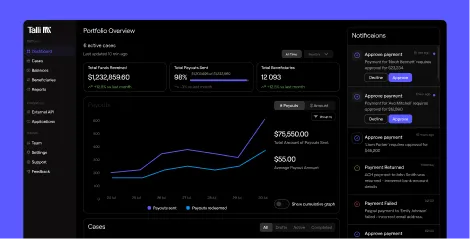
The real-time dashboard provides total control into every payout status, enabling you to monitor delivery without manual report compilation.
Frequently Asked Questions
What is the primary goal of reconciliation in legal disbursements?
The primary goal is verifying that every dollar flowing through settlement accounts matches across three critical sources: your general ledger, bank statements, and payment processing records. This three-way reconciliation proves compliance with state bar trust accounting regulations while catching errors before they trigger investigations.
How does trust accounting protect client funds?
Trust accounting protects client funds through mandatory segregation preventing commingling with law firm operating accounts. IOLTA accounts or Qualified Settlement Funds maintain strict separation with individual client ledgers tracking each claimant's balance. Complete fund segregation creates clear audit trails proving proper handling.
What types of financial reports are essential for legal practices?
Essential reports include trust reconciliation reports showing three-way balance verification, disbursement status reports tracking completion rates, unclaimed funds reports, tax documentation for 1099-MISC generation, compliance reports proving OFAC screening, stakeholder summaries for court approval, and operational dashboards monitoring claims processing efficiency.
Can technology truly automate and safeguard claims payouts?
Yes, modern platforms achieve 95%+ straight-through accuracy through AI-powered systems that handle automated verification, fraud detection, and maintain immutable audit logs. The technology significantly faster processing times in documented case studies while safeguarding compliance.
How does Talli ensure compliance with regulations?
Talli builds KYC and OFAC screening directly into the automated workflow, screening every recipient before payment release. The platform collects tax documentation during claim submission, preventing significant percentages of missing documentation typical in manual processes. All verification results generate immutable audit logs documenting compliance procedures.