.svg)


.svg)
Comprehensive data compiled from extensive research on product liability settlements, recall trends, and claims distribution challenges
Key Takeaways
- Consumer product recalls reached a 14-year high in Q1 2025 – 101 consumer product recalls occurred in Q1 2025 with 125.37 million total products recalled across industries
- Mega-settlements dominate the legal landscape – The 3M PFAS settlement alone reached $10.3 billion, while Philips CPAP settlements totaled over $1.5 billion, creating unprecedented demands on payout infrastructure
- Insurance costs continue climbing – Product liability insurance premiums reached $4.53 billion in 2024, with defense costs representing 33.6% of incurred losses at $768.9 million annually
- Jury awards show significant variation – While median personal injury awards sit at $100,000, mean awards reached $2,448,978 in 2020, highlighting the unpredictable nature of product liability outcomes
- Claims volumes strain traditional systems – With 59,000+ CPAP claims filed and settlements processing tens of thousands of claimants, manual distribution methods create bottlenecks and compliance risks
Understanding the Scope of Consumer Product Recalls: Key Statistics and Trends
1. 775 total product recalls occurred across five industries in Q1 2025
The recall landscape remains substantial across automotive, consumer products, food, medical devices, and pharmaceutical sectors. This volume represents a slight decrease from 780 recalls in Q4 2024, but the total number of affected products increased significantly. Claims administrators managing these recalls face growing complexity in tracking affected populations and distributing compensation efficiently. Source: Sedgwick Brand Protection Index
2. 125.37 million total products were recalled in Q1 2025
This figure represents a 25% increase from Q4 2024, demonstrating that while recall events may stabilize, the scale of individual recalls continues expanding. Managing distributions at this volume requires automated systems capable of handling high-volume payouts without sacrificing accuracy or compliance. Traditional paper-based methods simply cannot scale to meet these demands. Source: Sedgwick Recall Index
3. Consumer product recalls increased 90.6% from Q4 2024 to Q1 2025
This sharp quarter-over-quarter increase signals heightened regulatory scrutiny and improved defect detection processes. For claims teams, this acceleration means shorter preparation windows and greater pressure to establish efficient payout mechanisms before settlement deadlines. Organizations implementing digital payment platforms report significantly faster deployment times compared to legacy systems. Source: Sedgwick Recall Index
4. 101 consumer product recalls occurred in Q1 2025—the highest quarterly total in 14 years
This milestone reflects both increased consumer protection enforcement and improved product tracking capabilities. Each recall generates claimant populations requiring verification, communication, and compensation distribution. The complexity of managing 101 separate recall events within a single quarter underscores the need for scalable, automated claims administration solutions. Source: Sedgwick Brand Protection Index
5. The number of FDA food items recalled increased 232% in Q1 2025
Food recalls reached over 70 million units in Q1 2025, driven primarily by contamination events including Listeria, Salmonella, and undeclared allergens. These recalls often require rapid claimant identification and compensation distribution to maintain consumer trust and regulatory compliance. Digital payment methods enable faster disbursement than traditional check-based approaches. Source: Sedgwick Recall Index
The Financial Impact: Average Payouts and Settlement Values in Product Recalls
6. The 3M PFAS settlement reached $10.3 billion, paid over 13 years
This environmental contamination settlement represents the largest of its kind, addressing water system contamination across thousands of municipalities. The extended payment timeline creates ongoing disbursement requirements that demand robust, long-term payment infrastructure. Settlement administrators must maintain accurate records and flexible payment options throughout the distribution period. Source: Expert Institute Settlements
7. GlaxoSmithKline's Zantac settlement totaled $2.2 billion, resolving 93% of approximately 80,000 claims
Processing 80,000 individual claims requires systematic verification, calculation, and distribution capabilities. The 93% resolution rate demonstrates effective claims administration, but manual processing of this volume would require years of work. Modern digital disbursement platforms compress these timelines dramatically. Source: Expert Institute Report
8. The Philips CPAP settlement totaled $1.075 billion for personal injury claims
With tens of thousands of registered claims, this settlement illustrates the scale of modern product liability distributions. The complexity of medical device recalls—involving health records, injury documentation, and varied compensation tiers—demands sophisticated claims administration systems. Source: Philips
9. An additional $479 million was allocated for Philips CPAP consumer economic loss claims
Beyond personal injury claims, affected consumers received compensation for economic losses through a separate settlement fund. Individual payments ranged from $56 to $1,552, plus $100 for device returns. Managing multiple compensation tiers within a single settlement requires precise tracking and automated calculation capabilities. Source: Medtech Dive
10. Daily Harvest paid $7.67 million to settle salmonella contamination affecting 28,000 units
Food recall settlements often require rapid distribution to maintain consumer relationships and demonstrate corporate responsibility. The ratio of settlement value to affected units highlights the significant per-unit costs companies face following contamination events. Efficient payout systems help minimize administrative overhead and maximize claimant compensation. Source: Crowell & Moring Report
11. The Boar's Head Listeria recall affected over 7 million pounds of deli meat products
Following 10 deaths and 60 hospitalizations, this recall represented one of the most serious food safety incidents in recent years. Consumers who purchased recalled deli meats between May 10 and August 12, 2024, were eligible for compensation through a class action settlement addressing the contamination outbreak. Source: Crowell & Moring Report
Factors Influencing Consumer Product Recall Payout Statistics
12. Median personal injury jury awards for product liability cases reached $100,000
This figure represents the midpoint of jury awards during the 2014-2020 period, indicating typical outcomes in product liability litigation. However, the gap between median and mean awards reveals significant variation based on injury severity, product type, and jurisdictional factors. Source: Insurance Information Institute
13. Mean personal injury awards averaged $1,479,368 during 2014-2020
The substantial difference between median ($100,000) and mean ($1.48 million) awards reflects the impact of large verdicts on average calculations. Settlement administrators must prepare for wide compensation ranges within single recall events, requiring flexible payment systems capable of handling diverse payout amounts. Source: Insurance Information Institute
14. Mean personal injury awards peaked at $2,448,978 in 2020
This represented the highest mean award during the 2014-2020 period, suggesting increased jury sympathy for injury victims and potentially larger settlement reserves required by manufacturers. Rising award values translate to larger settlement funds requiring more sophisticated disbursement management. Source: Insurance Information Institute
15. Average product recall direct costs exceed $1.5 million per event
Beyond settlement payments, companies face substantial costs for notification, remediation, legal defense, and administrative expenses. These costs compound when recalls involve fraud prevention failures or compliance violations during the distribution process. Efficient claims administration helps contain overall recall expenses. Source: Marsh Product Liability
Streamlining the Payout Process for Recalled Products: Best Practices and Technology
16. 59,000+ CPAP claims were filed in the federal MDL
Managing tens of thousands of claims requires systematic intake, verification, and processing capabilities. Manual handling of this volume would consume years of staff time and introduce significant error risks. Modern claims platforms automate verification workflows while maintaining compliance with court-ordered distribution requirements. Source: Lawsuit Information Center
17. Settlement timelines range from 6-12 months for simple cases to 2-4 years for complex matters
The duration of product liability cases depends on injury severity, defendant count, and evidence complexity. Extended timelines require sustained claimant communication and payment infrastructure maintenance. Digital platforms provide consistent claimant access regardless of settlement duration. Source: Fielding Law
18. 116,000+ medical device reports were filed with the FDA regarding Philips CPAP recalls
This volume of adverse event reports created massive documentation requirements for claims verification. Linking medical reports to individual claimants demands secure data handling and systematic matching processes. Digital platforms with robust verification capabilities streamline this connection while protecting sensitive health information. Source: Expert Institute
19. 561 deaths were linked to recalled Philips CPAP and BiPAP devices as of February 2024
Settlements involving fatalities require heightened sensitivity in claimant communication and expedited payment processing for surviving families. Automated systems ensure timely disbursement while maintaining the personalized communication appropriate for these circumstances. Flexible payout options including digital wallets provide immediate access to funds. Source: FDA
Compliance and Security in Product Recall Payouts: Mitigating Risks
20. Product liability insurance premiums reached $4.53 billion in 2024
The insurance industry's substantial premium base reflects ongoing product liability exposure across manufacturing sectors. These premiums fund the eventual settlement payments that flow through claims administration systems, making efficient disbursement a priority for insurers seeking to control costs. Source: Insurance Information Institute
21. Defense costs represented 33.6% of incurred losses in 2024
Legal defense expenses consume over one-third of product liability costs, leaving less than two-thirds for actual claimant compensation. Efficient claims administration helps maximize the proportion of settlement funds reaching affected consumers rather than being absorbed by administrative overhead. Compliance-focused platforms reduce legal risk while accelerating distributions. Source: Insurance Information Institute
22. $768.9 million was spent on product liability defense and cost containment in 2024
This substantial expense category represents opportunity cost for settlement funds. Streamlined claims administration reduces the administrative burden on all parties, potentially freeing resources for claimant compensation. Modern platforms with built-in KYC, OFAC screening, and audit trails minimize compliance-related delays. Source: Insurance Information Institute
23. The combined ratio for product liability insurance reached 108.1 in 2024
A combined ratio above 100 indicates underwriting losses, meaning insurers paid more in claims and expenses than they collected in premiums. This pressure drives insurers to seek efficient claims administration partners who can minimize distribution costs while maintaining accuracy and compliance. Source: Insurance Information Institute
Improving Claim Redemption Rates: Strategies for Effective Communication and Payout Options
24. CPAP consumer claim payments ranged from $56 to $1,552 per claimant
This compensation range, plus $100 for device returns, illustrates the tiered payout structures common in product recalls. Claimants expecting hundreds of dollars respond differently than those entitled to thousands. Flexible payment methods—including digital wallets, prepaid cards, and gift cards—accommodate diverse claimant preferences across all compensation levels. Source: Lawsuit Information Center
25. Product liability insurance premiums increased 1.9% from 2023 to 2024
While premium growth moderated from prior years (20.4% in 2022), sustained increases reflect ongoing liability exposure. Insurers and self-insured manufacturers benefit from claims platforms that demonstrate cost efficiency and compliance reliability, potentially influencing future premium calculations. Source: Insurance Information Institute
Real-time Visibility and Reporting for Recall Claims Administrators
26. The 3M PFAS settlement addresses approximately 12,000 public water systems
Distributing settlement funds across 12,000 institutional recipients over 13 years requires sophisticated tracking and reporting capabilities. Administrators must demonstrate fund flows, completion rates, and compliance status to courts and stakeholders throughout the distribution period. Source: SHK Law Analysis
27. 10% common benefit fund was established in the CPAP MDL (8% fees, 2% expenses)
Multi-district litigation creates complex fund allocation requirements, with portions reserved for common benefit before individual distributions. Real-time dashboard capabilities help administrators track fund allocations across multiple settlement components while maintaining court-required reporting accuracy. Source: Lawsuit Information Center
Preparing for Future Recalls: Scalable Solutions for Payout Management
28. 3.73 million vehicles were recalled in Q1 2025—the lowest since Q2 2012
While automotive recalls decreased, this segment still represents millions of affected consumers requiring potential compensation or remediation. The automotive sector's recall infrastructure provides lessons for other industries implementing systematic response capabilities. Source: Sedgwick Recall Index
Enhancing Claims Distribution with Modern Payment Technology
Product recall settlements demand payment infrastructure that scales effortlessly while maintaining rigorous compliance standards. Whether processing 1,000 or 100,000 recipients, modern platforms ensure consistent service levels regardless of settlement size. Digital disbursement solutions eliminate manual check processing while offering claimants multiple redemption options including digital wallets, prepaid cards, and direct deposit.
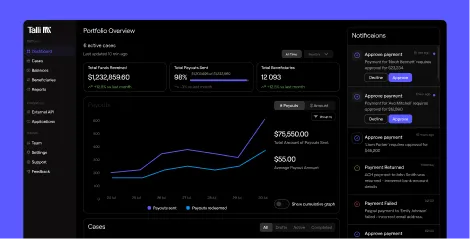
Talli powers payouts at any scale, providing the infrastructure needed for both routine and exceptional distribution events. The platform supports dedicated accounts for every settlement, preserving QSF ownership and simplifying reporting throughout the disbursement lifecycle. Organizations using Talli can launch, fund, and track payouts faster than ever—without losing control. Full transparency on completion rates, fund flows, and real-time payout data syncs seamlessly to existing CRM systems, enabling proactive management rather than reactive problem-solving.
Conclusion: The Future of Product Recall Settlement Administration
The product recall landscape continues evolving, with record-high recall volumes, billion-dollar settlements, and intensifying regulatory scrutiny creating unprecedented demands on claims administrators. The 28 statistics outlined above demonstrate both the financial magnitude and operational complexity of modern recall distributions. As mega-settlements like the $10.3 billion 3M PFAS case and $1.075 billion Philips CPAP settlement become more common, traditional manual processes simply cannot meet the demands of speed, accuracy, and compliance required by courts and claimants alike.
Organizations that embrace digital disbursement technology gain significant advantages in processing efficiency, claimant satisfaction, and settlement redemption rates. As recall frequencies continue rising and settlement values grow, the question for claims administrators is no longer whether to modernize their payment infrastructure, but how quickly they can implement scalable solutions that protect both their organizations and the consumers they serve.
Frequently Asked Questions
What is the average payout for a consumer product recall claim?
Payouts vary dramatically based on recall type, injury severity, and settlement structure. CPAP consumer claims ranged from $56 to $1,552, while personal injury claims in the same MDL averaged approximately $18,220. Median product liability jury awards reach $100,000, but mean awards can exceed $2.4 million due to significant outliers.
How does a company process payouts for a large-scale product recall efficiently?
Large-scale recalls like the Philips CPAP case (59,000+ claims) require automated verification, calculation, and distribution systems. Digital payment platforms eliminate manual check processing while offering claimants multiple redemption options including digital wallets, prepaid cards, and direct deposit. These platforms compress distribution timelines from weeks to days.
What are the critical compliance requirements for distributing recall settlements?
Settlement distributions require KYC verification, OFAC screening, W-9 collection for tax reporting, and complete audit trails demonstrating fund segregation. Regulatory enforcement has intensified significantly, making platforms with built-in compliance capabilities essential for administrators seeking to avoid penalties while meeting court-ordered deadlines.
How can claimant engagement and redemption rates be improved in a product recall payout process?
Flexible payment options significantly impact redemption rates—claimants without bank accounts can still receive funds through prepaid cards or digital wallets. Smart reminder systems across email, SMS, and other channels help claimants complete the payout process. Multi-channel communication strategies increase response rates by ensuring notifications reach claimants through their preferred channels.
What role does technology play in modern consumer product recall payouts?
Technology transforms recall payouts from months-long administrative projects into streamlined digital experiences. AI-driven platforms automate fraud detection, verification workflows, and compliance checks. Real-time dashboards provide administrators with complete visibility into completion rates, fund flows, and engagement metrics—enabling proactive management rather than reactive problem-solving.