.svg)


.svg)
Essential data on international legal payouts, compliance challenges, and how modern payment platforms are transforming global fund distribution
Key Takeaways
- Cross-border payment volumes are accelerating rapidly – Global cross-border spending is projected to grow from $194.6 trillion in 2024 to $320 trillion by 2032, creating unprecedented demand for efficient settlement distribution systems capable of handling international claimants
- Asia Pacific leads global adoption – The region commands 46.30% of the cross-border payments market share in 2025, signaling that claims administrators managing multinational settlements must prepare for significant international recipient volumes
- Transaction costs remain stubbornly high – The global average cost for sending $200 internationally sits at 6.4%, more than double the 3% UN Sustainable Development Goal target, making cost-efficient digital payment platforms essential for maximizing claimant payouts
- Speed has improved dramatically – 90% of SWIFT gpi transactions now reach beneficiary banks within one hour, yet claims administrators still struggle with legacy check-based systems that take weeks to clear internationally
- Fraud and cybercrime costs continue rising – The approximate annual cost of cybercrime globally reaches $10.5 trillion, with 88% of organizations reporting payment fraud victimization, underscoring why fraud mitigation must be built into every settlement payout workflow
- Real-time payment systems are becoming standard – More than 70 countries have adopted real-time payment systems, yet many settlement administrators still rely on batch processing methods that create delays and reduce claimant satisfaction
Understanding the Global Cross-Border Payments Landscape
1. The global cross-border payments market was valued at $371.59 billion in 2025
This massive market valuation reflects the scale of international fund movements across all sectors, including legal settlements. For claims administrators handling multi-jurisdictional class actions, understanding this market context is critical for selecting payment partners capable of operating at scale. Source: Fortune Business Insights
2. Cross-border payments market projected to reach $727.74 billion by 2034
The market is expected to grow from $397.37 billion in 2026 to $727.74 billion by 2034, representing a compound annual growth rate of 7.90%. This sustained growth indicates increasing demand for international payment infrastructure that claims administrators can leverage for high-volume payouts. Source: Fortune Business Insights
3. Cross-border spending will reach $320 trillion by 2032
Total cross-border spending is projected to grow from $194.6 trillion in 2024 to $320 trillion by 2032 across wholesale and retail segments. This 64% increase demonstrates accelerating globalization of financial flows, meaning more international claimants and greater need for payment platforms with global reach. Source: JPMorgan Chase & Co
4. Asia Pacific dominates with 46.30% market share in 2025
The Asia Pacific region leads global cross-border payments adoption, holding nearly half of the total market. This regional concentration has direct implications for class action settlements involving multinational corporations with Asian operations or customer bases, requiring administrators to ensure robust infrastructure throughout the region. Source: Fortune Business Insights
Transaction Costs and Processing Efficiency
5. Global average remittance cost stands at 6.4% for sending $200
The Financial Stability Board reports that average costs for sending $200 internationally increased to 6.4% in 2024, significantly exceeding the UN Sustainable Development Goal target of 3%. For legal settlement distributions, these fees directly reduce claimant payouts unless administrators select platforms offering more competitive rates. Source: Financial Stability Board
6. Remittance fees to Sub-Saharan Africa remain the highest globally
Average remittance costs to Sub-Saharan Africa consistently exceed other regions, often surpassing 7% of transaction value. Claims administrators managing settlements with African claimants face particular challenges in maximizing net payments received, making alternative payment rails including digital wallets and prepaid cards essential for cost reduction. Source: Financial Stability Board
7. Fees into Africa often exceed 7% of transaction value
High-cost corridors into African nations create substantial barriers for settlement claimants in these regions. When distributing settlement funds internationally, a 7% fee on a $500 settlement payment means $35 lost to transaction costs that could otherwise benefit the claimant, requiring careful channel selection. Source: Grand View Research
8. 90% of SWIFT gpi transactions reach beneficiary banks within one hour
Modern banking infrastructure has dramatically improved cross-border transaction speeds, with the vast majority of payments settling same-day. This speed improvement creates expectations among settlement claimants for rapid fund receipt, making legacy check-based systems with weeks-long delays appear increasingly outdated and frustrating to recipients. Source: Mordor Intelligence
9. Average delivery to North America completed in 12 minutes for high-value trade flows
High-value payment corridors into North America demonstrate exceptional speed, with average delivery times under 15 minutes. While settlement payments may not receive identical priority treatment, this benchmark establishes what modern payment infrastructure can achieve when administrators utilize real-time settlement dashboards. Source: Swift
10. J.P. Morgan achieves 99.5% straight-through processing rate
Leading financial institutions demonstrate that near-perfect automation is achievable in cross-border payments. This 99.5% STP rate means minimal manual intervention required for transaction completion. Claims administrators should evaluate payment partners based on similar automation metrics to ensure consistent, reliable international fund distribution without delays. Source: J.P. Morgan Payments
Market Segmentation and Transaction Types
11. Bank transfers account for 44.88% of cross-border payment volume
Traditional bank transfers remain the dominant channel for international payments, handling nearly half of all cross-border transactions. However, this dominance is declining as alternative channels gain share. For settlement distributions, bank transfers provide familiarity but often carry higher fees and slower processing than available digital alternatives. Source: Mordor Intelligence
12. Money-transfer operators projected to grow at 8.05% CAGR through 2031
Alternative payment providers are gaining market share faster than traditional banks, growing at rates exceeding 8% annually. This shift reflects demand for lower-cost, faster international payment options that settlement claimants prefer when receiving distributions, making flexible payout options essential for administrators. Source: Mordor Intelligence
13. Fintech holds the highest CAGR at 9.1% in global cross-border payments
Financial technology companies are capturing cross-border payment market share faster than any other segment, growing at 9.1% annually. This growth reflects superior technology, lower costs, and better user experiences compared to traditional banking channels, enabling settlement platforms leveraging fintech infrastructure to offer claimants more convenient options. Source: Fortune Business Insights
14. Consumer money transfers had a global TAM of $2 trillion in 2024
The consumer segment of cross-border payments represents $2 trillion in annual transaction volume, projected to reach $3.1 trillion by 2032. Legal settlement distributions to individual claimants tap into this consumer payment infrastructure, and understanding the scale and growth trajectory helps administrators anticipate available channels. Source: FXC Intelligence
Technology Innovation and Digital Transformation
15. More than 70 countries have adopted real-time payment systems
Real-time payment infrastructure has achieved global scale, with over 70 nations implementing instant payment capabilities. This widespread adoption creates opportunities for settlement administrators to offer immediate fund availability to international claimants, dramatically reducing distribution timelines compared to traditional batch processing methods. Source: J.P. Morgan Payments
16. Over 90% of central banks are researching Central Bank Digital Currencies
The near-universal interest in CBDCs signals fundamental shifts in cross-border payment infrastructure on the horizon. Settlement administrators should monitor these developments as CBDCs could eventually provide direct, low-cost channels for international distributions, making platforms designed with future-ready architecture increasingly valuable. Source: Grand View Research
17. While total stablecoin transaction volume reached $32 trillion in 2024, payment-specific volume was approximately $5.7 trillion
Digital currency transactions have achieved significant scale, with payment-specific stablecoin volumes reaching $5.7 trillion annually. While regulatory clarity for settlement distributions via stablecoins remains evolving, the payment transaction volume demonstrates viable infrastructure that forward-thinking administrators may eventually leverage for certain claimant populations. Source: BVNK
18. Stablecoin transfer volumes surpassed combined Visa and Mastercard volumes by 7.7%
The $27.6 trillion in stablecoin transfers during 2024 exceeded traditional card network volumes, demonstrating mainstream adoption of digital payment rails. This milestone indicates that blockchain-based payments have moved beyond experimental status to production-ready infrastructure that could eventually serve certain settlement distribution needs. Source: Modern Treasury
19. Active stablecoin wallets grew 53% year-over-year to exceed 30 million
The expansion from 19.6 million active wallets in February 2024 to over 30 million by February 2025 demonstrates accelerating consumer adoption of digital payment methods. For settlement claimants comfortable with digital wallets, these channels could eventually offer instant, low-cost fund receipt without requiring traditional bank accounts. Source: Modern Treasury
20. Only 32.9% of corporates had switched to ISO 20022 as of December 2024
Despite ISO 20022 adoption being required by November 2025, only one-third of corporates had completed migration. This messaging standard enables richer payment data and improved reconciliation for cross-border transactions. Settlement administrators should confirm their payment partners have completed this transition to ensure continued international payment capabilities. Source: Mordor Intelligence
21. 55% of organizations are currently adopting AI for productivity
Artificial intelligence adoption has reached majority status across organizations, with over half implementing AI for productivity improvements. For settlement administration, AI enables fraud detection, automated compliance verification, and intelligent claimant communication—capabilities that become essential when managing international distributions with diverse regulatory requirements. Source: J.P. Morgan
Fraud Prevention and Security Challenges
22. 88% of respondents reported being payment fraud victims in 2022-2023
The near-universal experience of payment fraud underscores why security must be foundational to any settlement distribution platform. Cross-border payments face elevated fraud risks due to varied identity verification standards across jurisdictions, making platforms with built-in KYC, OFAC screening, and fraud mitigation essential. Source: J.P. Morgan
23. Global cybercrime costs approximately $10.5 trillion annually
The staggering scale of cybercrime costs demonstrates why settlement fund security cannot be treated as optional. With $10.5 trillion lost globally each year, settlement funds represent attractive targets for sophisticated criminals, making robust settlement fund security with complete fund segregation essential protection. Source: J.P. Morgan
24. Export-oriented SMEs in Kenya and Ghana cite payment rejection rates above 15%
High payment rejection rates in certain corridors create challenges for settlement administrators attempting to reach claimants in underserved regions. These rejections often stem from compliance concerns or correspondent banking limitations, making platforms offering multiple payment rails—including prepaid cards and digital wallets—essential for ensuring delivery. Source: Mordor Intelligence
25. Local lenders in 21 African states have fewer than three USD correspondent lines
Limited correspondent banking relationships in developing regions create structural barriers to cross-border fund distribution. When traditional banking channels are constrained, settlement administrators must offer alternative payment methods that don't depend on correspondent networks, with digital payment options providing essential access for underbanked claimants. Source: Mordor Intelligence
Regional Growth and Market Opportunities
26. Asia-Pacific registers the fastest regional CAGR at 9.06% through 2031
The Asia-Pacific region's leading growth rate indicates where cross-border payment innovation is concentrated. Settlement administrators managing claims with significant Asian claimant populations should prioritize partners with strong regional infrastructure, as this growth also signals continually improving payment options for claimants throughout the region. Source: Mordor Intelligence
27. India cross-border payments market projected to reach $27.79 billion by 2026
India's rapidly growing cross-border payment market reflects both diaspora remittance flows and increasing business transactions. For settlements with Indian claimants, understanding local payment preferences—including mobile wallets and UPI—enables higher redemption rates through channels claimants prefer and trust for receiving international funds. Source: Fortune Business Insights
28. Brazil's Pix processed 42 billion transactions in 2023
Brazil's instant payment system demonstrates the scale achievable with modern payment infrastructure. This real-time system enables immediate fund availability for Brazilian claimants, setting expectations that traditional international wire transfers cannot meet, making settlement platforms integrated with local real-time systems increasingly valuable for administrators. Source: Mordor Intelligence
29. 30% of US-Mexico transfers executed via crypto tokens in 2023
The substantial adoption of cryptocurrency for US-Mexico remittances indicates claimant comfort with digital payment methods in certain corridors. While regulatory considerations apply to settlement distributions, this adoption level demonstrates that alternative payment rails have achieved mainstream acceptance in specific markets beyond traditional banking channels. Source: Mordor Intelligence
30. Remittances to developing countries reached $669 billion in 2023
The scale of remittance flows to developing nations—nearly $700 billion annually—demonstrates extensive infrastructure for reaching claimants in these regions. Settlement administrators can leverage this established infrastructure while selecting channels that minimize costs and maximize claimant convenience through legal payout compliance best practices. Source: Grand View Research
How Modern Platforms Are Solving Cross-Border Settlement Challenges
The statistics above reveal both the opportunities and obstacles facing claims administrators managing international settlement distributions. While cross-border payment infrastructure has improved dramatically—with 90% of transactions settling within one hour and over 70 countries offering real-time payment systems—significant challenges remain around costs, compliance, and fraud prevention.
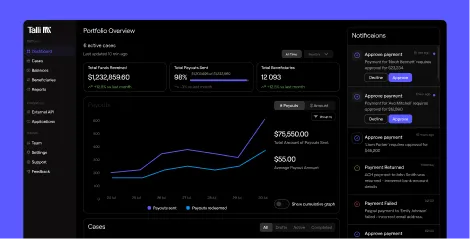
Modern settlement distribution platforms address these challenges through integrated technology solutions. Platforms like Talli provide real-time dashboards for complete visibility into international payment status, automated compliance verification including KYC and OFAC screening, and multiple payment channels that circumvent high-cost corridors. By leveraging fintech infrastructure growing at 9.1% annually, these platforms offer the speed and convenience claimants expect while maintaining the security and compliance administrators require.
The shift toward digital payment methods—evidenced by 53% growth in active stablecoin wallets and $5.7 trillion in payment-specific stablecoin volume—demonstrates claimant comfort with alternatives to traditional banking. Settlement administrators who offer flexible payout options including digital wallets, prepaid cards, and direct deposits can significantly improve redemption rates while reducing the 6.4% average transaction costs that diminish claimant payouts.
Frequently Asked Questions
What are the main compliance challenges when dealing with cross-border legal settlements?
Cross-border settlements require adherence to multiple regulatory frameworks simultaneously, including KYC verification across jurisdictions, OFAC sanctions screening, and W-9 collection for U.S. tax reporting. Each country maintains distinct identity verification requirements, and settlement administrators must ensure compliance with both origin and destination nation regulations. Platforms like Talli address these challenges by baking in KYC, OFAC, W-9 collection, fraud mitigation, and audit logs throughout the disbursement lifecycle.
How can technology improve the process of distributing funds to international claimants?
Modern payment technology enables real-time tracking, automated compliance verification, and multiple payment channel options that traditional methods cannot match. With 90% of SWIFT gpi transactions now settling within one hour and over 70 countries offering real-time payment systems, technology has fundamentally changed what's possible in cross-border distributions. AI-driven platforms automate time-consuming tasks while providing dashboard visibility that keeps administrators informed of every transaction status.
What role does AI play in preventing fraud in cross-border legal payouts?
AI enables pattern recognition across large claimant populations, identifying suspicious submissions or duplicate claims that manual review might miss. With 88% of organizations experiencing payment fraud and global cybercrime costs reaching $10.5 trillion annually, AI-powered fraud mitigation has become essential rather than optional. Machine learning models continuously improve detection accuracy while reducing false positives that delay legitimate claimant payments.
How does Talli ensure full transparency and real-time tracking for international settlement payments?
Talli provides a real-time dashboard for total control and visibility, allowing claims administrators to monitor delivery, completion, and engagement across all payment channels. The platform offers full transparency on completion rates and fund flows, with capability to sync real-time payout data to your CRM. This visibility extends across borders, ensuring administrators can track international distributions with the same precision as domestic payments.
Are there specific payment methods that are more effective for cross-border claimants?
Digital wallets, prepaid cards, and mobile payment options consistently outperform traditional wire transfers for international claimant satisfaction and redemption rates. With bank transfer fees averaging 6.4% globally—and exceeding 7% in certain corridors—alternative channels can deliver significantly more value to claimants. Flexible payout options that don't require bank accounts prove particularly effective for reaching underbanked populations in developing regions where correspondent banking relationships are limited.