.svg)


.svg)
Data breach class action filings have accelerated, with 1,488 data breach class actions filed in 2024, up from 604 in 2022. For claims administrators and legal teams managing these settlements, the distribution process presents unique challenges: extended timelines spanning multiple years, complex compliance requirements, and the critical need to maximize claimant participation. Modern digital disbursement tools have transformed what was once a months-long paper-based process into streamlined operations that deliver payments in days rather than weeks.
Key Takeaways
- Data breach settlements typically span 2-4 years from announcement to final payment distribution, with major cases like Equifax extending beyond 6 years
- Digital disbursement methods significantly reduce processing time and can materially reduce admin cost per payment versus checks — an AFP benchmarking survey summarized by Nacha found median paper check issuing costs ~$2.01–$4 versus ACH costs in the ~$0.26–$0.50 range for many businesses
- Fraudulent claims increased 19,000% between 2021-2023, making robust KYC, OFAC screening, and fraud detection essential for settlement integrity
- Low participation is a persistent challenge — in the Anthem breach settlement, reporting at the time indicated ~1.33 million claims submitted, despite the breach affecting ~79 million people, underscoring how easily notice + claim friction suppresses participation.
- Simplified digital claim forms reduce abandonment rates from 28% to 11%, while multiple payment options increase successful completion
- Per-person payouts typically range from $0.50 to $12.65 in pro-rata distributions, with actual amounts varying based on total valid claims
Understanding the Data Breach Settlement Timeline: From Notification to Payout
The path from data breach announcement to final claimant payment follows a structured but often lengthy process. Equifax shows how long these matters can run: the breach was announced in September 2017, the proposed global settlement was announced July 22, 2019, and the settlement later received final court approval in January 2020, with initial claim deadlines that same month and extended claims periods running through January 2024—a total span exceeding six years.
Key Stages of a Typical Settlement Timeline
Most data breach settlements progress through these distinct phases:
- Breach Announcement and Investigation (1-6 months): Initial disclosure, forensic analysis, and regulatory notifications
- Class Action Filing (3-12 months): Lawsuits consolidated, lead counsel appointed, initial motions
- Settlement Negotiation (6-18 months): Terms negotiated, settlement agreement drafted
- Preliminary Court Approval (2-4 months): Judge reviews fairness, authorizes notice to class members
- Notice and Claims Period (3-6 months): Claimants receive notifications, submit documentation
- Final Approval Hearing (1-2 months): Court confirms settlement, addresses objections
- Payment Distribution (2-6 months): Funds distributed to verified claimants
Large-scale settlements demonstrate timelines ranging from 18 to 36 months from settlement agreement to final court approval, with additional time required for payment distribution.
Anticipating Delays and Expediting the Process
Several factors extend settlement timelines beyond initial projections:
- Appeals from objecting class members can add 12-24 months
- Claims volume exceeding expectations requires additional verification resources
- Pro-rata adjustments when claims exceed allocated fund caps delay final calculations
- Outdated claimant contact information creates delivery failures requiring additional outreach
The FTC's Equifax settlement administration noted that leftover funds were used to reimburse people with valid claims through multiple distribution rounds, extending the overall timeline but ensuring maximum fund utilization.
Navigating Claims Administration: The Foundation of Efficient Settlements
Claims administration determines settlement success. The process requires balancing accessibility for legitimate claimants against rigorous verification to prevent fraud. According to defense counsel analysis, less than 5% of data breach class actions proceed to trial—most settle, making efficient administration essential for the vast majority of cases.
Best Practices for Claims Intake and Verification
Successful claims administrators implement structured verification protocols:
- Pre-populated claim forms using breach notification databases reduce data entry errors
- Document upload capabilities for loss documentation streamline verification
- Automated eligibility checking against class member lists accelerates processing
- Tiered verification levels based on claim amount minimize fraud while reducing friction for smaller claims
- Clear communication of documentation requirements prevents incomplete submissions
The T-Mobile settlement FAQ required reasonable documentation for out-of-pocket losses, with the Settlement Administrator having authority to determine claim validity—a standard approach that balances accessibility with integrity.
Role of Technology in Streamlining Administration
Modern claims platforms transform manual processes into automated workflows. Key capabilities include:
- Batch processing for high-volume claim verification
- API integrations with identity verification services
- Real-time status updates for claimants and administrators
- Automated correspondence for missing documentation requests
- Court-ready reporting for approval hearings and audits
Talli's AI-driven platform automates and safeguards every claims payout, enabling teams to meet tight deadlines without losing control over compliance or claimant experience.
Ensuring Compliance and Security in Data Breach Settlement Payouts
Settlement fund security has become paramount as fraudulent claims increased 19,000% between 2021 and 2023. Claims administrators must implement comprehensive compliance frameworks that satisfy court requirements while protecting fund integrity.
Regulatory Requirements for Settlement Payments
Multiple regulatory frameworks govern data breach settlement administration:
- KYC (Know Your Customer) verification prevents fraudulent claimant identity
- OFAC screening ensures payments don't reach sanctioned entities
- W-9 collection enables proper tax reporting for payments exceeding $600
- State escheatment laws dictate handling of unclaimed funds
- PCI DSS compliance protects payment card data during disbursement
- Court reporting requirements mandate detailed transaction documentation
Major breach settlements involving Target, Adobe, and Nationwide all included specific data security requirements imposed as settlement conditions, reflecting the courts' emphasis on protecting claimant information throughout the distribution process.
Implementing Robust Fraud Detection Measures
Effective fraud prevention requires layered security approaches:
- Identity verification against breach notification databases confirms claimant eligibility
- Pattern analysis identifies suspicious claim clusters from single IP addresses or locations
- Document authentication detects forged or altered loss documentation
- Velocity monitoring flags unusual claim submission patterns
- Multi-factor authentication for claimant portal access
Talli embeds OFAC compliance, KYC verification, and comprehensive audit logs into every transaction, ensuring settlement funds reach legitimate claimants while maintaining court-required documentation.
Optimizing Payout Distribution: Methods and Claimant Experience
Payment method selection directly impacts redemption rates and claimant satisfaction. Settlement data shows that most claimants prefer ACH transfers when given options, favoring faster electronic delivery over paper checks.
Diverse Payment Options for Enhanced Accessibility
Modern settlements offer multiple disbursement channels:
- ACH direct deposit: Fastest option, typically 1-3 business days
- Digital wallets (PayPal, Venmo): Convenient for unbanked populations
- Prepaid Mastercards: Immediate access without bank account requirements
- Paper checks: Traditional option for those preferring physical payment
- Gift cards: Alternative for specific settlement structures
Talli's platform supports multiple payment rails including the Easy Prepaid Mastercard (issued by Patriot Bank, N.A., Member FDIC, pursuant to a license from Mastercard International) and gift cards issued by InComm, ensuring every claimant can receive funds regardless of banking status.
Designing a Seamless Claimant Payout Journey
Claimant experience determines participation rates. Digital-first approaches have reduced form abandonment from 28% to 11% through:
- Secure links via SMS or email eliminating account creation requirements
- Mobile-optimized interfaces matching consumer expectations
- Real-time status visibility reducing support inquiries
- Clear payment timeline communication setting appropriate expectations
- Multilingual support ensuring accessibility across demographics
The Role of Technology in Modernizing Legal Payouts
Settlement distribution technology has evolved from paper-based systems requiring weeks of processing to AI-driven platforms delivering payments in days. The efficiency gains are substantial: digital disbursements significantly reduce processing time while cutting administrative costs by up to 60%.
Automating Labor-Intensive Payment Processes
Automation addresses the core inefficiencies of traditional settlement administration:
- Batch payment processing handles thousands of transactions simultaneously
- Automated verification workflows reduce manual review requirements
- Dynamic payment routing selects optimal disbursement channels per claimant
- Automated tax form generation (1099-MISC) eliminates manual compliance work
- Exception handling routes problem cases for human review while processing clean claims
Leveraging Real-Time Data for Better Oversight
Real-time dashboards transform settlement oversight from periodic reporting to continuous visibility. Administrators can monitor:
- Payment delivery status across all disbursement channels
- Completion rates by payment method and demographic segment
- Fund utilization against court-approved budgets
- Fraud alert patterns requiring investigation
- Claimant engagement metrics for outreach optimization
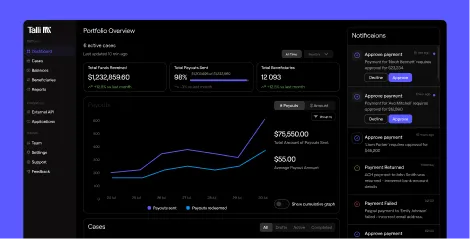
Talli's real-time dashboard provides total control and visibility, enabling teams to create payout distribution campaigns, track every status, and monitor completion rates—whether handling 1,000 or 100,000 recipients.
Real-Time Tracking and Reporting for Settlement Funds
Court-mandated reporting requirements demand comprehensive fund tracking and audit documentation. Settlement administrators must maintain complete transaction histories while providing stakeholders with actionable insights.
Gaining Full Control with Centralized Dashboards
Effective settlement dashboards consolidate critical metrics:
- Total funds distributed versus remaining balance
- Claims processed by status (approved, pending, rejected)
- Payment completion rates by channel and timeframe
- Outstanding verification requirements by claimant segment
- Projected timeline to fund exhaustion
Simplifying Financial Reconciliation and Audits
Complete fund segregation supports QSF (Qualified Settlement Fund) ownership requirements while simplifying reporting. Key reconciliation capabilities include:
- Dedicated accounts for every settlement maintaining legal compliance
- Real-time fund flow visibility for all stakeholders
- Court-ready accounting files generated automatically
- CRM synchronization for integrated case management
- 7-10 year transaction retention meeting regulatory requirements
Enhancing Trust and Engagement: Claimant Communication Best Practices
The Anthem settlement demonstrated the cost of poor engagement: only 1.33 million claims submitted from 19.1 million eligible class members—approximately 7% participation. Strategic communication dramatically improves these outcomes.
Strategic Use of Reminders to Boost Participation
Multi-channel reminder strategies increase claim completion:
- Initial notification via email and SMS with secure claim links
- Deadline reminders at 30, 14, and 7 days before claims period closes
- Incomplete claim prompts for those who started but didn't finish
- Payment method selection nudges for approved but unclaimed funds
- Distribution confirmation once payment is sent
Providing Unrivaled Support Throughout the Payout Process
Claimant support reduces abandonment and builds trust:
- Self-service status portals answering common questions automatically
- Multilingual support teams ensuring accessibility
- Clear escalation paths for complex claim issues
- Transparent timeline communication setting realistic expectations
- Proactive updates when delays occur
Talli's smart reminders across email, SMS, and additional channels help claimants complete the payout process fast, reducing the administrative burden of chasing outstanding claims.
Selecting the Right Partner for Data Breach Payout Success
The choice of settlement administration platform directly impacts fund distribution efficiency, compliance, and claimant satisfaction. With settlement amounts ranging from millions to hundreds of millions depending on breach scope and data sensitivity, selecting the right technology partner is a high-stakes decision.
Key Criteria for Evaluating Payment Platforms
Essential platform capabilities include:
- Scalability: Ability to handle from 1,000 to 100,000+ recipients without degradation
- Compliance infrastructure: Built-in KYC, OFAC, W-9 collection, and audit trails
- Payment flexibility: Multiple disbursement rails including digital wallets and prepaid cards
- Real-time visibility: Dashboard analytics for administrators and court reporting
- Integration capabilities: API access for CRM and case management systems
- Security certifications: SOC 2 Type II, PCI DSS Level 1 compliance
Why Expertise in Legal Payouts Matters
Settlement administration differs fundamentally from standard payment processing. Court-mandated deadlines, pro-rata distribution calculations, and regulatory compliance requirements demand specialized expertise. Attorney fees averaging around 30% of total settlements underscore the importance of maximizing funds reaching claimants through efficient administration.
Talli is built specifically for the claims industry, offering complete fund segregation, automated compliance verification, and flexible payment options that increase redemption rates. Banking services are provided by Patriot Bank, N.A., Member FDIC—ensuring the security and regulatory compliance that data breach settlements demand.
Frequently Asked Questions
What documentation do claimants typically need to file a data breach settlement claim?
Documentation requirements vary by claim type. Basic claims often require only identity verification and confirmation of breach notification receipt. Out-of-pocket loss claims typically require receipts, bank statements, or credit card records showing expenses for credit monitoring, account closures, or fraud remediation. Lost time claims may require employer documentation or attestation of hours spent addressing breach impacts. Most settlements allow self-attestation for losses under specified thresholds.
Can claimants file for multiple data breach settlements simultaneously?
Yes, claimants can participate in multiple settlements if they were affected by each respective breach. Each settlement operates independently with its own eligibility criteria, claims process, and payment timeline. Claimants should track each settlement's deadlines separately, as they rarely align. Filing for one settlement does not impact eligibility for others, and there is no legal limit on the number of breach settlements an individual can claim.
What happens to unclaimed settlement funds after the distribution period ends?
Unclaimed funds follow specific protocols depending on settlement terms and state laws. Common outcomes include cy pres distributions to charitable organizations related to data privacy or consumer protection, redistribution to participating claimants through additional payments, reversion to defendants (less common in modern settlements), or escheatment to state unclaimed property funds. Courts increasingly favor redistribution to claimants or cy pres over defendant reversion.
How do settlement administrators handle international claimants affected by data breaches?
International claimant handling depends on settlement terms and class definition. Some settlements explicitly include non-U.S. residents; others limit classes to domestic consumers. For included international claimants, challenges include OFAC compliance for certain countries, currency conversion for payments, limited payment rail availability, and additional identity verification requirements. Many administrators offer wire transfers or digital wallet options to accommodate international recipients.
What recourse do claimants have if their settlement claim is denied?
Most settlements include dispute resolution procedures for denied claims. Claimants typically can request reconsideration within 30-60 days of denial, providing additional documentation supporting their claim. Settlement administrators review disputed claims against stated criteria. If administrative appeals fail, some settlements allow arbitration or court intervention, though this is rare for individual claims. Denial reasons are typically documented, allowing claimants to understand deficiencies and address them if possible.