.svg)


.svg)
Cloud payout storage systems protect sensitive financial data during mass disbursements, but without proper safeguards, organizations face significant error rates that trigger costly reprocessing and compliance failures. Modern legal payout compliance frameworks combine automated validation, encryption, and real-time screening to significantly reduce manual burden while maintaining audit-ready documentation throughout the payment lifecycle.
Key Takeaways
- Pre-process validation can reduce payout error rates significantly, preventing substantial reprocessing costs
- AI-assisted OFAC screening can reduce false positive rates significantly using secondary identifiers
- Multi-factor authentication (MFA) can block over 99.9% of account compromise attacks, according to Microsoft.
- Complete fund segregation and dedicated accounts preserve QSF ownership while simplifying regulatory reporting
- Implementation timelines range from 21-45 days for compliance-enabled cloud payout systems
- The 3-2-1 backup strategy mitigates the vast majority of data loss scenarios from disasters, hardware failures, or cyber attacks
- Data integrity failures can result in catastrophic penalties—one financial institution faced $968 million in settlements from inaccurate data
What Is Data Integrity in Cloud Payout Storage?
Data integrity in cloud payout storage refers to the accuracy, consistency, and reliability of financial information throughout the entire disbursement lifecycle. For claims administrators and legal teams handling settlement payments, this means ensuring claimant details, payment amounts, and compliance records remain complete and unaltered from intake through fund distribution.
- Accuracy requirements Payment data must match source records without transcription errors or data corruption during cloud transfers.
- Consistency standards Information remains synchronized across all integrated systems including CRMs, case management platforms, and banking interfaces.
- Reliability measures Data remains accessible and uncorrupted through system failures, network issues, or malicious attacks.
- Completeness verification All required fields populate correctly before payment processing begins.
Why Does Data Integrity Matter for Legal Settlements?
The consequences of poor data integrity extend far beyond operational inconvenience. One major bank faced $968 million in settlements after improper foreclosures stemming from inaccurate data. For settlement administrators, similar failures can trigger regulatory penalties, court sanctions, and irreparable reputational damage.
Data integrity failures manifest as:
- Missing W-9 forms that halt payment processing
- Duplicate claimant records causing overpayments
- Incorrect bank account details resulting in failed ACH transfers
- OFAC screening gaps that expose organizations to sanctions violations
How Can You Fortify Security Measures for Cloud Payouts?
Security forms the foundation of data integrity. Without proper encryption, access controls, and threat detection, even the most accurate data becomes vulnerable to tampering or theft. IBM’s Cost of a Data Breach Report 2025 reports a global average breach cost of $4.44 million (down from $4.88M in 2024). making security investment essential.
- AES-256 encryption at rest This symmetric encryption standard protects stored payout data with keys that would make current supercomputers impossible timeframes to crack.
- TLS 1.3 encryption in transit The latest transport protocol blocks connections using outdated encryption methods vulnerable to interception.
- Hardware Security Modules HSMs provide physical key storage that prevents unauthorized key extraction even with system access.
- Multi-factor authentication MFA reduces account compromise by 99.9%, making it essential for all users accessing payout systems.
What Access Controls Protect Payout Data?
Role-based access control ensures users only see and modify data relevant to their responsibilities. Properly configured permissions prevent both accidental errors and intentional misuse.
- Data Stewards Configure validation rules without accessing payment details
- Compliance Officers View screening results and manage exceptions
- Finance Managers Approve flagged payments and run reconciliation reports
- IT Administrators Handle system configuration and backup management without accessing claimant data
What Verification and Validation Protocols Ensure Accuracy and Compliance?
Pre-process validation catches errors before they cause payment failures—a critical distinction from post-process exception reports that identify problems after damage occurs. Organizations implementing pre-validation strategies can significantly reduce error rates.
- Format validation SSNs must contain 9 digits, bank accounts 8-17 digits, routing numbers exactly 9 digits
- Range validation Payment amounts must exceed $0, dates must fall within settlement periods
- Uniqueness validation No duplicate claimant IDs or bank accounts processed
- Business logic rules Flag payments exceeding $50K for manual review as potential fraud indicators
How Does Automated Compliance Screening Work?
Automated OFAC screening compares every payee against Treasury Department watchlists, UN sanctions lists, and EU restricted party databases. Without proper tuning, initial screening commonly flags a high percentage of common names as false positives.
AI-assisted screening uses secondary identifiers—date of birth, address, nationality—to reduce false positives significantly. This eliminates unnecessary manual reviews while maintaining regulatory compliance.
The validation workflow includes:
- KYC verification Real-time identity validation through integrated verification partners
- W-9/W-8 collection Embedded tax forms with TIN validation against IRS databases before payment release
- Priority-based categorization Blocker errors halt processing, major errors generate alerts, minor issues log for review
Why Are Immutable Audit Logs Critical for Accountability?
Audit trails provide the documentation required for regulatory compliance, dispute resolution, and forensic analysis. Financial records typically require 7-year retention under SOX and IRS regulations, making comprehensive logging essential.
- Transaction history Every payment initiation, approval, and completion generates timestamped records
- User activity tracking All data access, modifications, and exports link to specific user IDs
- Non-repudiation Blockchain-style logging prevents tampering with historical records
- Regulatory audit support Complete documentation satisfies examiner requests without manual compilation
How Do Audit Trails Support Dispute Resolution?
When claimants or courts question payment timing or amounts, immutable logs provide definitive evidence. Talli's platform includes audit logs as a built-in feature, providing full transparency on fund flows and completion rates—essential for compliance in payouts.
How Should You Architect Backup, Recovery, and Fund Segregation?
Resilient architecture protects against data loss from hardware failures, cyber attacks, and natural disasters. The 3-2-1 backup strategy mitigates the vast majority of data loss scenarios by maintaining three copies of data on two different media types with one copy offsite.
- Daily incremental backups Capture changes only, minimizing storage costs while maintaining recoverability
- Weekly full snapshots Provide complete point-in-time restoration capability
- Monthly archival Cold storage satisfies long-term retention requirements at reduced cost
- RTO targets Recovery time objectives typically range from 2-8 hours depending on business criticality
Why Does Complete Fund Segregation Matter?
Secure fund segregation preserves QSF ownership and simplifies reporting throughout the disbursement lifecycle. Dedicated accounts for each settlement prevent commingling issues that complicate reconciliation and audit responses.
Talli supports dedicated accounts for every settlement, ensuring legal compliance while maintaining clear separation between client funds. This architecture provides:
- Simplified court reporting with isolated transaction histories
- Clear ownership documentation for regulatory examinations
- Reduced reconciliation complexity across multiple settlements
- Protection against cross-settlement accounting errors
What Does Real-Time Monitoring Offer for Proactive Integrity Management?
Reactive approaches identify problems after they cause failures. Real-time settlement dashboards shift organizations toward proactive management by surfacing anomalies as they occur.
- Performance metrics Track payment success rates, processing times, and error frequencies
- Anomaly detection Automated systems flag unusual patterns indicating potential fraud or system issues
- Alert systems Email and Slack notifications trigger within minutes of detecting validation failures or compliance hits
- Dashboard visibility Centralized views display completion rates, fund flows, and payout status across all active settlements
How Do You Configure Effective Monitoring Alerts?
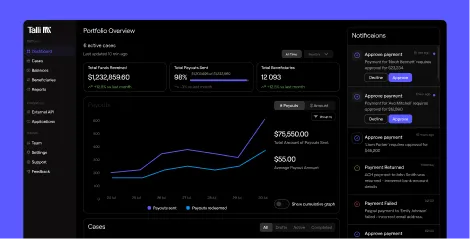
Talli's real-time dashboard provides total control and visibility, enabling claims administrators to create payout distribution campaigns, track every payout status, and monitor completion rates without waiting for batch reports.
Configure alerts for:
- Failed validation rates exceeding 10% (indicating data quality issues)
- Compliance screening hits requiring manual review
- Unusual payment velocity suggesting fraud attempts
- Bank rejection rates above baseline thresholds
Why Does Partnering With Secure Banking Services Matter?
The security posture of banking partners directly impacts data integrity. FDIC-member banks provide deposit insurance protection while maintaining regulatory compliance standards that protect client funds.
- Regulatory compliance Bank partners maintain SOC 2, PCI DSS, and other certifications required for financial data handling
- Deposit insurance FDIC coverage protects settlement funds against bank failure
- Network security Mastercard and other payment network partnerships ensure transaction security
- QSF-compliant banking Specialized accounts support qualified settlement fund requirements
Talli's banking services are provided by Patriot Bank, N.A., Member FDIC. The Easy Prepaid Mastercard is issued by Patriot Bank, N.A., pursuant to a license from Mastercard International—ensuring enterprise-grade security for every payout.
How Does Automation Transform Data Integrity and Efficiency?
Manual processes introduce human error at every touchpoint. Automated platforms can reduce manual compliance time significantly while improving accuracy through consistent rule application.
- Workflow automation Eliminate manual data entry, transfer, and verification steps
- Error reduction Consistent validation rules catch mistakes that slip past human reviewers
- API integration Direct connections to CRMs and case management systems eliminate re-keying errors
- Smart reminders Automated follow-ups across email, SMS, and other channels help claimants complete the payout process
What ROI Can You Expect From Automated Payout Systems?
Organizations implementing automated validation realize substantial returns:
- Thousands of hours saved annually on compliance screening for large-scale settlements
- Substantial cost avoidance by eliminating monthly payment re-runs
- Payment timeline compression from 90 days to 21 days through streamlined processing
- W-9 collection rates increasing from 40% to 85% via digital forms
Talli automates and safeguards every claims payout, helping organizations meet tight deadlines without losing control over compliance or claimant experience.
How Can You Deliver a Seamless Experience While Maintaining Integrity?
Data integrity measures shouldn't create friction for claimants. Modern platforms balance rigorous security with user-friendly interfaces that improve completion rates.
- Secure link delivery Claimants receive SMS or email invitations without creating accounts
- Flexible payment options Recipients choose ACH, prepaid cards, or digital wallets based on their preferences
- No bank account required Multiple redemption methods serve unbanked and underbanked populations
- Self-service portals Claimants update information and track payment status independently
What Implementation Timeline Should You Expect?
Full compliance-enabled cloud payout deployment typically requires 21-45 days:
- Week 1-2 Data assessment, cloud storage configuration, and field mapping
- Week 2-3 Validation rule setup and compliance integration
- Week 3-4 OFAC screening configuration and false positive tuning
- Week 4-5 Backup testing and disaster recovery verification
- Week 5-6 Access control implementation and security hardening
Bank account verification takes 3-5 business days for ACH setup—plan accordingly or use instant verification partners to accelerate timelines.
Frequently Asked Questions
What Happens If Ransomware Attacks My Cloud Payout Storage?
Immutable backups with object lock prevent deletion or modification during the retention period, protecting against ransomware encryption. Organizations with ransomware recovery data show that those who recovered less than 50% of data typically lacked tested disaster recovery plans—quarterly restoration drills verify that backups actually work when needed.
How Do Multi-Cloud Strategies Affect Data Integrity?
40% of data breaches involve multi-cloud storage issues. While geo-redundancy reduces single-point-of-failure risk, it adds complexity requiring centralized data governance tools. Single-cloud solutions with multi-region replication often provide sufficient redundancy with simpler management.
Can Quantum Computing Threaten Current Encryption Standards?
AES-256 symmetric encryption remains secure against quantum threats for the foreseeable future. However, asymmetric encryption (RSA/ECC) used for key exchange may require migration to post-quantum algorithms within the next decade. Organizations should monitor NIST post-quantum standardization efforts for future-proofing.
What Compliance Certifications Should Cloud Payout Providers Maintain?
Essential certifications include SOC 2 Type II, which validates operational security controls over 6-12 month audit periods. PCI DSS Level 1 certification is required for platforms processing card payments. ISO 27001 provides comprehensive information security management validation.
How Do You Handle Data Integrity for International Settlements?
International payouts require country-specific validation schemes addressing varying tax thresholds, reporting requirements, and data residency laws. GDPR compliance requires data processing agreements and support for the right to erasure requests. EU-based claimants may require data storage in European regions.