.svg)


.svg)
Legal disbursement pipelines handle highly sensitive claimant data—SSNs, bank account details, and protected health information—making them prime targets for cyberattacks. With the global data breach costs averaging $4.44 million per incident and approximately 80% of breaches caused by human error, claims administrators face mounting pressure to secure every touchpoint. The stakes compound in legal settlements where bankruptcy court oversight means breaches become public record immediately. Modern fraud mitigation strategies combined with automated security controls can transform vulnerable payment systems into fortified pipelines that protect claimant data while maintaining compliance.
Key Takeaways
- Data breaches cost organizations an average $4.44 million per incident, with legal industry breaches often higher due to court disclosure requirements
- In a Centrify-reported survey, 74% of breached organizations said privileged access abuse was involved—making privileged-access management and strict access control top priorities
- Around 80% of security incidents stem from human error—malicious, negligent, or compromised users
- GDPR violations can result in penalties up to €20 million or 4% of annual revenue
- A SOC 2 Type II report typically uses a 3–12 month observation period (often ~6 months), plus time for the audit and report
- Complete fund segregation with dedicated accounts preserves QSF ownership and ensures legal compliance throughout disbursement
Understanding the Threat: What Are Data Leaks and Dumps in Financial Pipelines?
Data leaks in disbursement pipelines occur when sensitive claimant information—personally identifiable information (PII), protected health information (PHI), or financial records—escapes controlled systems through unauthorized channels. Data dumps represent large-scale exfiltration events where threat actors extract and often publish bulk datasets on dark web marketplaces.
Legal disbursement systems face unique vulnerabilities:
- Multi-party data flows connecting law firms, claims administrators, payment processors, and banks
- High-value targets with SSNs, bank accounts, and medical records concentrated in single databases
- Court oversight requirements mandating breach disclosure to all interested parties
- Extended data retention for regulatory compliance creating long-term exposure windows
The Consumer Privacy Ombudsman role created under BAPCPA 2005 specifically addresses these risks in bankruptcy proceedings, highlighting the legal industry's recognized data protection challenges.
Common Attack Vectors in Payment Systems
Threat actors exploit specific weaknesses in disbursement infrastructure:
Credential Compromise: With approximately 74% of breaches involving privileged access abuse, stolen or misused credentials remain the primary attack vector.
API Vulnerabilities: Misconfigured APIs, forgotten API keys, and over-scoped permissions create entry points for automated attacks.
Third-Party Risks: Vendors, payment processors, and integrated platforms represent weak links—similar to the 2013 Target breach via an HVAC vendor.
Insider Threats: Employees with legitimate access can exfiltrate data through negligence or malicious intent.
Implementing Robust Data Leak Prevention Software for Secure Payouts
Data Leak Prevention (DLP) software monitors, detects, and blocks sensitive data from leaving controlled environments. For disbursement pipelines, DLP solutions must address both endpoint security and network traffic analysis.
Key Features of Effective DLP Platforms
Modern DLP platforms offer layered protection:
- Device Control: Block unauthorized USB drives and removable media while whitelisting company-issued encrypted devices
- Content-Aware Protection: Scan outgoing communications for SSN patterns, bank account numbers, and PHI markers
- Data Discovery: Identify misplaced sensitive data on employee endpoints and unencrypted storage
- Enforced Encryption: Automatically encrypt USB storage devices used for data transport
Advanced DLP platforms use data lineage technology to track information flows, achieving significant reductions in false positives compared to traditional pattern-matching approaches.
Integrating DLP with Existing Security Infrastructure
Effective integration requires:
- SIEM Connectivity: Feed DLP alerts into Security Information and Event Management systems for centralized monitoring
- Identity Provider Integration: Link DLP policies to user roles and permissions
- Cloud Platform Support: Extend protection to Google Drive, Dropbox, and OneDrive
- Email Gateway Integration: Scan attachments before transmission
Building a Comprehensive Data Leak Prevention Strategy
Beyond software deployment, effective data protection requires organizational strategy encompassing policies, procedures, and people.
Developing an Organizational Security Policy
Start with foundational elements:
- Data Classification Standards: Define sensitivity levels for different data types (public, internal, confidential, restricted)
- Acceptable Use Policies: Specify permitted data handling practices for all personnel
- Incident Response Plans: Document breach notification procedures for courts, regulators, and affected claimants
- Vendor Management Requirements: Mandate SOC 2 Type 2 certification for all third-party integrations
Your legal payout compliance framework should integrate these policies into daily operations.
Regular Audits and Vulnerability Assessments
Continuous validation ensures controls remain effective:
- Quarterly vulnerability scans identifying new weaknesses
- Annual penetration testing by third-party security firms
- Monthly tabletop exercises testing incident response readiness
- Weekly policy reviews during initial DLP deployment
The STRIDE methodology (Spoofing, Tampering, Repudiation, Information Disclosure, Denial of Service, Elevation of Privilege) provides structured threat modeling for fintech applications.
Essential Data Leak Prevention Tools for Financial Operations
Building a complete security stack requires multiple complementary tools working together.
Core Security Components
Firewalls and Intrusion Detection: Network perimeter protection with real-time threat detection. Modern solutions include behavioral analysis identifying anomalous traffic patterns.
Identity and Access Management (IAM): Centralized user provisioning with role-based access control. Integration with multi-factor authentication (MFA) prevents credential-based attacks.
Encryption Tools: AES-256 for data at rest and TLS 1.3 for data in transit. Secrets management tools like HashiCorp Vault or AWS Secrets Manager protect API keys and credentials.
Tokenization: Replace sensitive data with non-sensitive tokens, reducing exposure scope during processing.
Leveraging Automation in Data Security
Automation reduces human error—the source of approximately 80% of security incidents:
- Automated compliance checks embedded in deployment pipelines
- Policy-as-code defining security requirements in machine-readable format
- Continuous monitoring with real-time alerting for suspicious activity
- Automated remediation quarantining detected threats without manual intervention
Adhering to the Financial Privacy Act and Other Regulatory Safeguards
Legal disbursement pipelines must comply with overlapping regulatory frameworks governing financial data, health information, and consumer privacy.
Key Provisions Impacting Financial Data Security
Gramm-Leach-Bliley Act (GLBA): Requires financial institutions to explain information-sharing practices and protect sensitive data.
PCI DSS: Payment Card Industry standards mandate encryption, network segmentation, and quarterly vulnerability scans for card data. Understanding PCI-DSS Level 1 compliance is essential for settlement administrators.
HIPAA: Required for medical data in personal injury and mass tort cases, with breach notification required within 60 days.
GDPR: European claimants trigger requirements including consent management, right to erasure, and cross-border transfer controls with penalties reaching €20 million.
CCPA: California claimants require opt-out mechanisms and consumer data request response within 45 days.
Ensuring Compliance in a Globalized Environment
Multi-jurisdictional settlements create complex compliance matrices:
- Data residency options using EU data centers for GDPR compliance
- Consent management platforms tracking claimant preferences
- Automated deletion workflows supporting right-to-erasure requests
- Cross-border transfer controls including Standard Contractual Clauses
The NIST Cybersecurity Framework provides voluntary guidance adaptable across regulatory requirements.
Proactive Strategies for Data Breach Prevention in Disbursement Systems
Prevention costs a fraction of breach response. Strategic investments in security controls yield significant ROI.
Building a Culture of Security
Technology alone cannot prevent breaches. Organizational culture determines security outcomes:
- Security awareness training with regular phishing simulations
- Clear escalation procedures encouraging incident reporting
- Executive sponsorship demonstrating leadership commitment
- Performance metrics incorporating security compliance
Annual security training programs combined with ongoing phishing simulations strengthen organizational defenses against social engineering attacks.
Continuous Monitoring and Adaptation
Static security fails against evolving threats. Continuous improvement requires:
- Threat intelligence feeds updating defenses against new attack patterns
- Security metrics dashboards tracking key performance indicators
- Regular policy reviews adapting to regulatory changes
- Post-incident analysis incorporating lessons learned
OFAC screening represents one critical monitoring requirement for settlement disbursements.
Ensuring Data Integrity and Confidentiality with Fund Segregation
Complete fund segregation provides both financial controls and data protection benefits.
The Role of Segregated Accounts in Protecting Claimant Data
Dedicated accounts for each settlement create natural data boundaries:
- Reduced blast radius limiting exposure if single account compromised
- Simplified access controls with clear ownership boundaries
- Enhanced audit trails tracking fund flows per settlement
- Qualified Settlement Fund (QSF) ownership preservation maintaining legal compliance
Segregation prevents commingling that obscures data lineage and complicates breach investigation.
Technological Solutions for Fund Integrity
Modern platforms implement segregation through:
- Virtual account structures isolating funds logically within single banking relationships
- Dedicated database schemas separating claimant data by settlement
- Access control inheritance automatically restricting permissions to relevant settlements
- Automated reconciliation detecting unauthorized cross-settlement access
Leveraging Real-Time Tracking and Audit Trails for Enhanced Security
Visibility enables rapid threat detection and compliance validation. Real-time settlement dashboards transform reactive security into proactive protection.
The Power of Total Visibility in Preventing Data Misuse
Comprehensive tracking includes:
- Access logging recording every user interaction with claimant data
- Transaction monitoring flagging unusual payment amounts or timing
- Change tracking documenting all system configuration modifications
- Export controls logging data downloads and transfers
Real-time visibility enables security teams to identify anomalies before they become breaches.
Automated Alerting for Suspicious Activity
Configure alerts for:
- Off-hours access to sensitive data
- Bulk data exports exceeding normal patterns
- Failed authentication attempts indicating credential attacks
- Permission escalations suggesting insider threats
Reconciliation processes should incorporate security event review alongside financial matching.
Why Talli Strengthens Your Disbursement Pipeline Security
Talli's AI-driven payment platform integrates security by design rather than as an afterthought, addressing the unique vulnerabilities of legal disbursement pipelines.
Unlike general payment processors, Talli provides purpose-built security for claims administration:
- Complete Fund Segregation: Dedicated accounts for every settlement preserve QSF ownership while creating natural data boundaries
- Built-in Compliance: KYC, OFAC, W-9 collection, fraud mitigation, and audit logs baked into every transaction
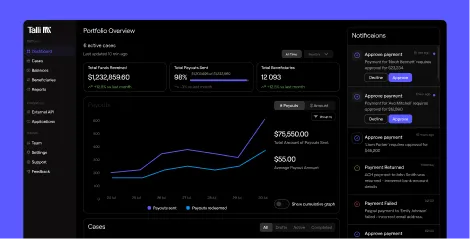
- Real-Time Dashboard: Monitor delivery, completion, and engagement with built-in reporting for courts and stakeholders
- Automated Security Validation: Every payout undergoes compliance verification before release
- Encrypted Payment Links: Claimants receive secure links via SMS or email without creating accounts
Talli's banking services through Patriot Bank, N.A., Member FDIC, combined with Mastercard partnership for prepaid cards, ensures institutional-grade security infrastructure. The platform handles settlements from 1,000 to 100,000 recipients while maintaining the compliance and visibility claims teams require.
For administrators managing sensitive claimant data across multiple settlements, Talli eliminates the security gaps that plague manual processes and disconnected systems.
Frequently Asked Questions
What is the difference between a data leak and a data dump in financial payouts?
A data leak typically involves gradual, often undetected exposure of sensitive information through misconfigured systems, insider negligence, or unauthorized access. A data dump refers to large-scale, intentional exfiltration where threat actors extract bulk datasets—often published on dark web marketplaces for sale. Both threaten disbursement pipelines, but data dumps generally indicate sophisticated attacks requiring immediate incident response, while leaks may stem from human error causing around 80% of breaches.
How does encryption help prevent data leaks in payment processing?
Encryption transforms readable data into unreadable ciphertext, rendering stolen information useless without decryption keys. For disbursement pipelines, AES-256 encryption protects data at rest in databases, while TLS 1.3 secures data in transit between systems. Even if attackers breach perimeter defenses, properly encrypted data remains protected. Key management through tools like HashiCorp Vault ensures encryption keys themselves aren't exposed.
What are my legal obligations under financial privacy regulations regarding claimant data?
Legal obligations vary by jurisdiction and data type. GLBA requires protecting financial information, HIPAA mandates safeguards for health data in personal injury cases, and GDPR imposes penalties up to €20 million for European claimant data mishandling. Bankruptcy proceedings require breach disclosure to courts and all interested parties. The Consumer Privacy Ombudsman role under BAPCPA 2005 specifically addresses data protection in bankruptcy claims.
Can small claims administrators afford effective data leak prevention?
Yes, though implementation approaches differ by scale. Cloud-based DLP solutions offer subscription pricing that fits various budgets. More importantly, the average breach cost of $4.44 million far exceeds security investments. Small administrators should prioritize high-impact, lower-cost controls: MFA implementation, employee training, vendor security assessments, and encrypted communications. Purpose-built platforms like Talli bundle security controls into the disbursement infrastructure, reducing separate security tool requirements.
How does Talli ensure the security and privacy of sensitive claimant information during payouts?
Talli integrates multiple security layers into its disbursement platform. Complete fund segregation maintains dedicated accounts for every settlement, creating natural data boundaries. Built-in KYC, OFAC screening, and fraud mitigation verify recipients before payment release. Encrypted payment links delivered via SMS or email eliminate claimant account creation while maintaining security. Real-time dashboards provide total visibility into every transaction, while comprehensive audit logs support compliance reporting and incident investigation. Banking services through Patriot Bank, N.A., Member FDIC, ensure institutional-grade infrastructure protection.