.svg)


.svg)
Poorly designed claims disbursement flows create a predictable cascade: confused recipients flood support lines with basic questions about payout status, payment methods, and documentation requirements. In retail banking, one survey found only 21% of customers report complete satisfaction with digital experiences, and 51% cite a poor digital experience as a reason for switching providers. Modern claimant experience platforms can materially reduce support ticket volume through self-service capabilities, transforming a resource drain into streamlined operations that improve recipient satisfaction while cutting costs.
Key Takeaways
- Self-service portals with searchable FAQs reduce support ticket volume by an estimated 40-75% based on implementations at companies like Atlassian and HubSpot
- Proactive SMS and email notifications prevent a significant portion of status inquiry tickets by addressing concerns before recipients contact support
- 51% of customers switch providers due to poor digital experience, making recipient flow design a competitive differentiator
- AI-powered chatbots handle an estimated 40-85% of routine inquiries without human intervention
- 71% of customers consider ease of interaction a primary factor when choosing an insurance provider
- A commonly cited estimate suggests UX investments can return up to $100 for every $1 spent
Understanding the Foundation of User Experience Design for Payouts
User experience design for legal disbursements requires understanding the unique psychology of recipients navigating claims processes. Unlike typical e-commerce transactions, claimants are often in vulnerable financial situations, dealing with settlement proceeds from personal injury, class actions, or bankruptcy distributions. This emotional context amplifies every friction point in your payment flow.
The foundation of effective UX design rests on several core principles:
- Clarity over cleverness - Every screen should communicate exactly what action the recipient needs to take
- Progressive disclosure - Present information in layers, showing essential details first with options to learn more
- Consistent visual language - Maintain uniform design patterns so recipients never have to relearn navigation
- Immediate feedback - Confirm every action instantly so users know the system received their input
- Error prevention - Design interfaces that make mistakes difficult rather than relying on error messages
Research from UXPin demonstrates that well-designed user flows improve usability and increase task completion rates by making interactions straightforward. For claims administrators focused on claimant satisfaction, this translates directly to fewer abandoned disbursements and reduced support contacts.
Journey mapping provides the analytical framework for identifying where recipients struggle. Financial institutions using this approach report improved satisfaction by identifying frustrating blockers and inconsistencies. The process involves documenting every touchpoint from initial notification through final payment confirmation, noting emotional states and potential friction points at each stage.
Key Elements of a Successful Recipient-Friendly Payout Flow
Clear Instructions and Visual Cues
Effective disbursement flows guide recipients without requiring them to read dense instruction text. Visual hierarchy directs attention to primary actions, while secondary information remains accessible but unobtrusive.
Essential design elements include:
- Progress indicators showing completion percentage and remaining steps
- Visual cues like icons and color coding to distinguish action types
- Inline help text appearing contextually when users hover or tap fields
- Mobile optimization ensuring full functionality on smartphone screens
- Multi-language support for diverse recipient populations
Insurance UX studies reveal that simplified language and visual aids significantly reduce confusion. A comprehensive platform redesign at one insurer resulted in 30% higher engagement and 25% fewer support queries.
Payment Method Selection
Flexible payment options accommodate recipient preferences while reducing friction. Not every claimant has a traditional bank account, and forcing specific payment methods creates barriers that generate support tickets.
Your flow should offer:
- Direct deposit (ACH) for recipients with bank accounts
- Digital wallet integration for mobile-first users
- Prepaid card options for unbanked recipients
- Gift card alternatives where appropriate
When recipients can select their preferred method through a simple interface, they complete the process independently rather than calling support to discuss options. This flexibility directly impacts claims redemption rates.
Minimizing Friction: How Optimized Flows Enhance Customer Support
Proactive Communication Strategy
The most effective way to reduce support tickets is preventing the questions that generate them. Real-time status updates and proactive notifications address recipient concerns before they escalate to support contacts.
Proactive communication can reduce avoidable “status check” contacts by answering common questions before people reach out. For claims disbursement, this means automated notifications at key milestones:
- Claim received - Confirmation with expected timeline
- Verification complete - Next steps clearly outlined
- Payment initiated - Method, amount, and expected arrival date
- Payment delivered - Final confirmation with reference numbers
Smart reminders across email and SMS help claimants complete the payout process faster, reducing the need for follow-up support contacts while improving support efficiency.
Self-Service Options
Comprehensive self-service knowledge bases enable recipients to resolve questions independently. The data supporting this approach is compelling: HubSpot handles 60% of inquiries through self-service, Shopify resolves 40% of merchant questions without human intervention, and one company reduced direct support responses by 75% after implementing a robust knowledge base.
Effective self-service components include:
- Searchable FAQ database with common disbursement questions
- Step-by-step guides with screenshots for complex processes
- AI-powered chatbots providing instant answers to routine queries
- Status lookup tools allowing recipients to check progress without contacting support
Research indicates around 61% of customers prefer self-service for simple issues. Meeting this preference reduces call volume while improving recipient satisfaction.
Building Skills in Payment System UX Design
The intersection of UX design and financial technology creates substantial career opportunities for designers who understand both disciplines. Payment systems require specialized knowledge beyond general UX principles, including regulatory constraints, security requirements, and the unique emotional dynamics of financial transactions.
Key skills for payment system UX designers include:
- Information architecture - Structuring complex financial data for clarity
- Interaction design - Creating intuitive flows for multi-step processes
- Usability testing - Validating designs with actual user demographics
- Accessibility expertise - WCAG compliance for inclusive design
- Domain knowledge - Understanding payment regulations and compliance requirements
Professional development combines foundational design training with industry-specific knowledge. Recommended learning includes general UX foundations through programs like Nielsen Norman Group certification, financial services specialization covering regulatory compliance, and accessibility training on WCAG guidelines and inclusive design principles.
Compliance and Security in User-Friendly Payment Flows
Balancing Security with Usability
Security requirements and user experience often create tension in payment system design. Recipients expect simple, fast processes while regulations demand robust verification. The challenge lies in implementing compliance without creating friction that generates support tickets.
Essential compliance components include:
- KYC (Know Your Customer) - Identity verification before releasing funds
- OFAC screening - Checking recipients against sanctions lists
- W-9 collection - Tax documentation for reportable payments
- Fraud mitigation - Real-time detection of suspicious activity
- Audit trails - Complete documentation for regulatory review
Effective compliance in payouts integrates these requirements seamlessly into the user flow rather than presenting them as obstacles. Progressive verification collects information incrementally, avoiding overwhelming recipients with lengthy forms.
Data Privacy and Encryption
Strong encryption (often AES-256) is commonly used to protect sensitive financial data throughout the disbursement process. Two-factor authentication can add security with minimal friction when implemented thoughtfully.
Privacy considerations extend to communication practices. Recipients should understand how their data will be used, with clear consent mechanisms and easy access to privacy policies. Transparent data practices build trust while satisfying regulatory requirements.
For claims administrators managing OFAC compliance, automated screening integrated into the payment flow eliminates manual checks while ensuring regulatory adherence.
Leveraging CRM for Enhanced Customer Service and Recipient Satisfaction
Customer relationship management systems become powerful tools when integrated with payment flows. Real-time data synchronization enables support teams to see complete recipient histories, reducing resolution time when contacts do occur.
CRM integration benefits include:
- Historical context - Support agents see previous interactions instantly
- Proactive outreach - Automated follow-up based on recipient behavior patterns
- Segmentation capabilities - Tailored communication based on recipient characteristics
- Performance metrics - Tracking support effectiveness across campaigns
Syncing payout data to your CRM provides total control and visibility, enabling reconciliation and reporting that satisfies stakeholder requirements while informing continuous improvement.
Personalized communication drives better outcomes. Research shows around 70-77% of customers expect personalized experiences from financial service providers. CRM data enables this personalization at scale, addressing recipients by name and referencing their specific claim details.
Measuring Success: Metrics for Recipient Flow Optimization and Support Reduction
Key Performance Indicators
Quantifiable metrics validate UX improvements and identify remaining friction points. Track these KPIs to measure recipient flow effectiveness:
- Completion rates - Percentage of recipients finishing the entire process
- Abandonment rates - Where and when recipients drop off
- Time to completion - Duration from initial notification to payment selection
- Support ticket volume - Total contacts per disbursement campaign
- First-contact resolution - Tickets resolved without escalation
- Self-service adoption - Percentage using knowledge base versus contacting support
- CSAT/NPS scores - Direct recipient satisfaction feedback
Real-time dashboards enable monitoring of delivery, completion, and engagement with built-in reporting for teams and stakeholders.
Analytics Implementation
Struggle analysis automatically tracks behaviors indicating friction. Analytics can flag behaviors that signal friction—like repeated form errors, excessive scrolling, and rapid repeated clicks. For example, small validation or formatting bugs can trigger form failures that quietly drive support volume.
Session recordings reveal exactly how recipients interact with your flow, highlighting confusion points that quantitative data alone might miss. Combined with A/B testing, these insights enable continuous optimization based on actual user behavior rather than assumptions.
Why Talli Simplifies Recipient-Friendly Payment Flows
While numerous payment platforms exist, Talli delivers solutions specifically designed for claims administrators managing legal disbursements who need both compliance and superior recipient experience.
Talli addresses the core challenges covered throughout this article:
- Mobile-optimized recipient experience - Claimants receive a secure link via SMS or email with no accounts to create, completing the process from their phones in minutes
- Flexible payment options - Recipients choose what works best, including options for those without bank accounts, increasing redemption rates
- Smart reminders - Automated follow-ups across email and SMS help claimants complete payouts without support intervention
- Built-in compliance - KYC, OFAC, W-9 collection, fraud mitigation, and audit logs are integrated into the flow, not added as friction
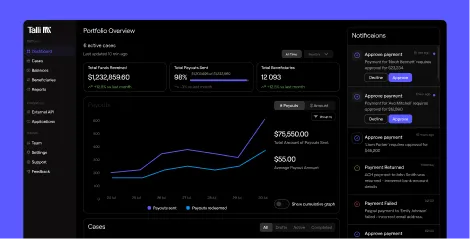
- Real-time dashboard - Create distribution campaigns, track every payout status, and monitor completion rates with full transparency
- Complete fund segregation - Dedicated accounts for every settlement preserve QSF ownership and simplify reporting
For claims teams focused on reducing support tickets while maintaining compliance, Talli automates and safeguards every payout so you can meet tight deadlines without losing control over the claimant experience. Banking services provided by Patriot Bank, N.A., Member FDIC.
Frequently Asked Questions
What is a recipient-friendly flow in payment processing?
A recipient-friendly flow is a user-centered design approach that enables claimants to complete disbursement processes intuitively without requiring support intervention. It prioritizes clear instructions, visual guidance, flexible payment options, and proactive communication. Effective flows reduce cognitive load by presenting information progressively, confirming actions immediately, and providing self-service options for common questions. Research shows well-designed flows can reduce support ticket volume by an estimated 40-75% while improving completion rates.
How does user experience design reduce support tickets in legal payouts?
UX design reduces support tickets by eliminating confusion points that generate recipient questions. This includes clear progress indicators showing completion status, proactive notifications addressing concerns before recipients contact support, self-service portals enabling independent question resolution, and simplified language that avoids legal jargon. Companies implementing these approaches report significant support ticket reductions through UX optimization, with additional gains from AI-powered chatbots handling routine inquiries.
What role does compliance play in designing efficient payment flows?
Compliance requirements like KYC verification, OFAC screening, and W-9 collection must integrate seamlessly into user flows rather than creating friction points. Effective design implements verification progressively, collecting information incrementally rather than overwhelming recipients with lengthy forms. When compliance feels like a natural part of the process rather than an obstacle, recipients complete verification without generating support tickets about requirements or experiencing abandonment due to perceived complexity.
Can AI tools genuinely enhance the recipient's payout experience?
Yes, AI tools significantly enhance recipient experience when implemented thoughtfully. AI-powered chatbots handle an estimated 40-85% of routine inquiries without human intervention, providing instant answers to common questions about status, timelines, and requirements. Predictive AI can anticipate issues before they occur, triggering proactive outreach. However, financial matters often require human empathy for sensitive situations, so effective implementations balance automation efficiency with appropriate human touchpoints for complex cases.
How do I measure the success of a recipient-friendly payment flow?
Measure success through completion rates (percentage finishing the entire process), abandonment rates (where recipients drop off), time to completion, support ticket volume per campaign, and self-service adoption rates. Track CSAT and NPS scores for direct satisfaction feedback. Session analytics revealing behaviors like rage clicks or repeated form errors identify specific friction points. Compare these metrics before and after design changes to quantify improvements and identify remaining optimization opportunities.