.svg)


.svg)
Selecting the right digital disbursement vendor determines whether your settlement payments reach claimants in minutes or weeks—and whether those recipients actually complete the redemption process. With digital payments achieving up to 98% success rates in specialized platforms compared to just 55-77% for paper checks, the stakes for choosing the right platform have never been higher. Modern claims administration platforms must balance processing speed, recipient satisfaction, compliance automation, and cost efficiency to meet court-mandated deadlines while keeping claimants satisfied.
Key Takeaways
- Digital disbursements can achieve up to 98% payment success rates versus only 55-77% for traditional paper checks
- Recipients given payment choice report studies have found very high satisfaction (about 94%) when recipients are offered payout choice.
- Research indicates around 67% of consumers prefer senders offering instant disbursement options
- Class action settlements offering digital payments increased 2,600% from 2020 to 2024
- Advanced fraud prevention systems have blocked hundreds of millions of fraudulent claims, with specialized vendors reporting over 723 million prevented in 2024
- Real-time payment infrastructure is seeing rapid adoption, with around 86% of businesses now utilizing faster payment services
Why Does Speed Matter So Much in Legal Payouts?
Speed in settlement disbursements extends far beyond convenience—it directly impacts claimant welfare, administrative costs, and court compliance. When evaluating vendors, claims administrators must look beyond marketing claims of "instant" payments to understand actual processing timelines.
- Processing time versus settlement time
Vendors may process payments instantly via API but actual fund availability depends on payment rail selection. Same-day ACH settles within hours, while standard ACH takes 1-3 business days. - Real-time payment infrastructure growth
Real-time payment infrastructure like FedNow’s settled value reached about $245.8B in Q2 2025, demonstrating that instant settlement is becoming mainstream rather than premium. - Business adoption trends
Around 86% of businesses now utilize faster payment services, making real-time capabilities a baseline expectation rather than a differentiator. - Court deadline compliance
Digital platforms can process digital rails and compress distribution from weeks to days (or faster), while check workflows add printing, mailing, and reissue delays., ensuring administrators meet court-mandated distribution timelines.
What Speed Metrics Should You Evaluate?
When comparing vendors, request specific documentation on three distinct timeframes: API response time (seconds), settlement time (hours to days based on payment rail), and end-to-end delivery confirmation (including recipient notification and fund access).
How Does Recipient Experience Affect Payout Success?
Recipient experience encompasses every touchpoint from initial payment notification through successful fund redemption. Claimant satisfaction metrics reveal that experience quality directly correlates with whether claimants actually complete the payment process.
- The choice-satisfaction connection
When consumers receive payment method options, studies show satisfaction reaches around 94% compared to only 80% for recipients without choice—a statistically significant 17-point improvement. - Instant payment preference
In surveys, consumers often choose instant options roughly two-thirds of the time when they’re available. - No-friction access
Leading platforms deliver secure links via SMS or email requiring no account creation, eliminating barriers that cause claimants to abandon the redemption process. - Digital preference dominance
94% of payees prefer digital over paper checks when given the option in class action settlements.
What Compliance and Security Features Are Non-Negotiable?
Compliance capabilities separate purpose-built legal disbursement platforms from generic payment processors. Administrators must verify that vendors provide automated regulatory adherence without manual intervention. Legal payout compliance requirements continue evolving, making built-in automation essential.
- KYC and identity verification
Automated Know Your Customer processes verify claimant identities in real-time without delaying payment release, catching fraudulent submissions before funds leave the settlement account. - OFAC sanctions screening
Mandatory Office of Foreign Assets Control list verification must occur automatically for every payment to prevent distributions to prohibited entities. - W-9 collection automation
Platforms should capture tax documentation electronically and generate 1099 forms automatically, reducing manual tax-document handling and lowering avoidable reporting mistakes. - Fund segregation requirements
Qualified Settlement Fund (QSF) compliance demands dedicated accounts for each settlement, preserving ownership structure and simplifying court reporting throughout the disbursement lifecycle. - Audit trail generation
Every transaction requires comprehensive documentation for regulatory compliance and court oversight, with complete records generated automatically rather than compiled manually.
How Do Vendors Prevent Settlement Fraud?
Fraud prevention technology has become the defining capability for legal disbursement platforms. Advanced fraud prevention systems have blocked hundreds of millions of fraudulent claims, with specialized vendors reporting over 723 million prevented in 2024—representing a significant increase from 26 million in 2023.
The Triangle of Fraud Protection collaboration achieved exceptional ROI by preventing over $100 million in fraudulent payouts through multi-layered detection including duplicate claim identification, device fingerprinting, and behavioral analysis. As Jeff Richardson, CEO of Digital Disbursements, noted: "The claimant-first philosophy requires balancing robust fraud detection with ensuring legitimate class members aren't blocked."
Why Does Payment Method Flexibility Drive Higher Redemption?
Payment flexibility directly impacts whether claimants successfully receive their funds. Platforms offering multiple disbursement options accommodate diverse banking situations and generational preferences that single-method systems cannot address. Understanding recipient payment redemption helps administrators select vendors that maximize completion rates.
- Push-to-debit leadership
Among instant payment users, around 89% of push-to-debit recipients prefer receiving funds instantly, followed by digital wallet users at 88%. - The alias effect advantage
Push-to-debit and digital wallets allow recipients to receive bank account deposits without disclosing sensitive routing numbers, combining speed with enhanced security. - Unbanked population inclusion
About 4.2% of U.S. households were unbanked in 2023, requiring prepaid card options that deliver immediate fund access without traditional banking relationships. - Digital wallet willingness to pay
Around 46% of digital wallet preferrers will pay fees for instant access compared to only 33% of push-to-debit users, indicating strong demand for speed among mobile-first recipients.
Talli addresses this need by offering flexible payout options where claimants pick what payment method works best—including ACH direct deposit, prepaid Mastercard, and digital wallet integration—ensuring no bank account is required for fund access. Banking services are provided by Patriot Bank, N.A., Member FDIC.
How Do Smart Follow-Ups Maximize Redemption Rates?
Claimant engagement through automated communication dramatically improves payout completion rates. Claims redemption rate statistics demonstrate that proactive outreach converts passive recipients into completed payments.
- Multi-channel communication
Smart reminders across email, SMS, and additional channels help claimants complete the payout process faster while reducing administrator follow-up burden. - Engagement timing optimization
Automated systems determine optimal reminder frequency and channel based on recipient behavior patterns, avoiding over-communication that triggers opt-outs. - Real-time status updates
Recipients receive instant confirmation when payments are initiated, processed, and available, reducing support inquiries and building confidence in the disbursement process. - Reduced administrative chasing
Platforms with intelligent follow-up capabilities eliminate manual tracking of unresponsive claimants, transforming weeks of staff time into automated workflows.
What Reporting and Visibility Capabilities Should Vendors Provide?
Real-time dashboards and comprehensive reporting transform claims administration from reactive tracking to proactive management. Administrators need complete visibility into fund flows, completion rates, and individual payment status without manual reconciliation.
- Real-time dashboard access
Platforms should provide instant visibility into payout distribution campaigns, every payment status, and aggregate completion rates through unified interfaces. - CRM integration capabilities
Sync real-time payout data directly to existing case management systems, eliminating duplicate data entry and ensuring stakeholder access to current information. - Court-ready reporting
Automated generation of distribution reports, fund accounting summaries, and compliance documentation for judicial oversight throughout the settlement lifecycle. - Fund flow transparency
Complete visibility on every dollar from settlement account through claimant receipt, with audit trails satisfying regulatory requirements.
Can Vendors Scale for High-Volume Settlements?
Scalability determines whether platforms can handle everything from small employment settlements to massive consumer class actions with hundreds of thousands of recipients. Evaluate vendor capabilities against your largest anticipated distribution volumes. High-volume payout statistics reveal significant performance differences between platforms.
- Volume capacity documentation
Request specific SLA commitments for processing 10,000, 50,000, and 100,000+ payments within defined timeframes. - System reliability metrics
Demand uptime guarantees and historical performance data showing actual availability during peak processing periods. - Customer support responsiveness
High-volume distributions require dedicated support with documented response time commitments, not generic help desk queues. - Integration implementation timelines
API-based platforms typically deploy in 2-3 weeks while custom integrations may require 4-6 weeks, affecting settlement timeline planning.
Talli powers payouts at any size—whether 1,000 or 100,000 recipients—while providing unrivalled customer support throughout the distribution lifecycle.
How Should You Calculate Total Cost of Ownership?
Vendor pricing comparisons must extend beyond per-transaction fees to capture the complete cost picture. Success rate differentials, administrative overhead reduction, and fraud prevention value often dwarf headline pricing differences.
- Paper check baseline costs
Traditional check processing costs around $7-$20 per payment when including printing, mailing, tracking, and reissuance expenses. - Digital cost efficiency
Organizations can achieve around 60% cost savings by switching from paper checks to digital disbursements according to industry analysis. - Success rate economics
With up to 98% digital success rates versus 55-77% for checks, cost-per-successful-payment becomes more important than cost-per-attempt. - Fraud prevention ROI
Systems preventing fraudulent payouts deliver measurable returns—specialized collaborations have achieved exceptional ROI percentages by preventing millions in fraudulent distributions. - Administrative time recapture
Automation eliminates manual reconciliation, compliance verification, and claimant communication tasks that consume 15-20 staff hours weekly in traditional workflows.
What Hidden Costs Should You Watch For?
Some vendors charge premium fees for digital wallet or prepaid card options that can exceed paper check costs for small settlements. Verify pricing across all payment methods and ask about minimum volume requirements, implementation fees, and ongoing platform charges beyond per-transaction costs.
Why Is Talli the Preferred Choice for Legal Disbursements?
Talli's AI-driven payment platform addresses every evaluation criterion that distinguishes effective disbursement vendors from generic payment processors. Built specifically for legal payouts, Talli combines processing speed, recipient experience optimization, and compliance automation in a unified solution.
- Same-day disbursement capability
What used to take weeks now takes minutes, with real-time processing that meets court-mandated deadlines. - Complete compliance automation
KYC, OFAC, W-9 collection, fraud mitigation, and audit logs are built into every transaction without manual intervention. - Flexible claimant payment options
Recipients choose their preferred method—ACH, prepaid Mastercard, or digital wallet—with no bank account required. - Real-time dashboard visibility
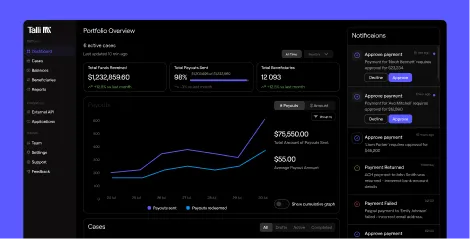
Monitor delivery, completion, and engagement in real-time with built-in reporting for teams and stakeholders. - Complete fund segregation
Dedicated accounts for every settlement preserve QSF ownership, simplify reporting, and ensure legal compliance throughout distribution.
Ready to speed up your payouts? Talli automates and safeguards every claims payout so you can meet tight deadlines without losing control over compliance or claimant experience.
Frequently Asked Questions
What certifications should I verify before selecting a disbursement vendor?
Verify PCI DSS Level 1 certification (highest payment security standard requiring annual audits), SOC 2 Type II compliance (service organization controls for data security), and state money transmitter licenses for all jurisdictions where claimants reside. Request current audit completion dates rather than accepting claims of certification without documentation.
How do disbursement platforms handle international claimants?
Cross-border settlement distributions require additional compliance layers including FATCA reporting, currency conversion capabilities, and country-specific banking regulations. Most domestic-focused platforms offer limited international capabilities, so verify specific country coverage and associated fees before assuming global reach.
What happens when claimants fail to redeem their payments?
Leading platforms automatically track unclaimed funds, send escalating reminder sequences, and manage escheatment requirements according to state dormancy laws. Verify that vendors handle the complete unclaimed funds lifecycle including dormancy period tracking, state reporting, and final escheatment processing.
How do vendors handle payment disputes or failed transactions?
Evaluate vendor processes for handling returned ACH payments, disputed card transactions, and failed delivery attempts. Leading platforms provide automated retry logic, alternative payment method prompts, and dedicated support teams for escalated resolution rather than placing administrative burden back on claims teams.
What reporting do courts typically require for settlement distributions?
Courts generally require fund accounting summaries showing source and disposition of all settlement funds, distribution reports documenting successful payments and redemption rates, and compliance certifications confirming regulatory adherence. Verify that platforms generate these reports automatically in court-accepted formats.