.svg)


.svg)
Designing a disbursement system capable of processing millions of transactions needs careful design—ACH return file errors alone can cause hundreds of hours of manual work each month. Modern settlement distribution platforms eliminate this burden through event-driven microservices architecture, achieving high payment success rates while automating compliance tasks that checks require manually, transforming complex legal payouts into streamlined operations that complete in weeks instead of months.
Key Takeaways
- Event-driven microservices enable 10,000+ transactions per second through horizontal scaling and distributed databases
- ACH processing typically costs under $1 per transaction compared to $3-4 for checks, delivering significant per-transaction savings at scale
- Pre-built platforms reduce time-to-market from 6-18 months to 3-6 months compared to custom builds while cutting implementation costs substantially
- Automated retry logic resolves the majority of failed payments without manual intervention, dramatically reducing operational overhead
- Real-time payment rails like RTP and FedNow enable instant disbursements for time-sensitive settlements
- Distributed databases support 2,250 TPS baseline with horizontal scaling to handle peak transaction loads
Understanding High-Volume Disbursement System Requirements
Disbursement systems differ from regular payment systems—they send thousands or millions of payouts from a single settlement. Unlike standard payment processing designed for one-to-one transactions, disbursement systems must orchestrate bulk payments across multiple payment methods while maintaining precise audit trails for regulatory compliance.
Core system capabilities must include:
- Batch processing optimization for executing 10,000 to 10 million+ disbursements in single operations
- Multi-rail payment support spanning ACH, wire transfers, real-time payments, checks, and digital wallets
- Recipient self-service portals enabling claimants to select payment preferences and update banking information
- Automated compliance engines handling KYC/AML verification, OFAC screening, and tax reporting
- Real-time reconciliation matching payments to bank confirmations and flagging exceptions
- Immutable audit trails for court review, regulatory oversight, and stakeholder reporting
Transaction volume directly impacts architectural decisions. Systems processing under 100,000 transactions monthly can operate on monolithic architectures, while operations exceeding this threshold require microservices decomposition for independent scaling of payment processing, recipient management, and reconciliation components.
Choosing the Right Architectural Pattern for Scalability
Event-Driven Microservices Architecture
High-volume disbursement operations demandEvent-driven microservices let each part of the system scale on its own. This pattern separates recipient management, payment orchestration, ledger operations, and reconciliation into discrete services communicating through message queues.
Essential microservices components include:
- Recipient Management Service: Handles KYC/AML verification and payment method preferences
- Disbursement Orchestration Service: Executes batch processing and payment rule engines
- Payment Rail Connectors: Interface with ACH networks, wire systems, and digital wallets
- Ledger Service: Maintains immutable transaction records using double-entry accounting
- Reconciliation Service: Processes bank files and manages exception handling
- Notification Service: Delivers email, SMS, and webhook communications
This microservices approach enables teams to deploy updates to individual services without system-wide downtime, critical for maintaining high uptime during settlement campaigns that can't tolerate interruptions.
Technology Stack Selection
Your database choice determines how well the system can scale. Traditional PostgreSQL maxes out at approximately 10,000 TPS on single nodes, creating bottlenecks for peak batch processing. Distributed SQL databases like CockroachDB support horizontal scaling, processing 2,250 TPS baseline with capacity to scale to tens of thousands of transactions per second.
Recommended technology components:
- Message Queue: Apache Kafka or Redpanda for event streaming and asynchronous processing
- Backend Framework: Node.js, Go, or Java optimized for high concurrency
- API Gateway: Kong or AWS API Gateway for rate limiting and security
- Cache Layer: Redis for idempotency key management and rate limiting
- Infrastructure: Kubernetes on AWS, Azure, or GCP for containerized deployment
The event sourcing pattern creates Permanent transaction records by saving every change as an event, enabling complete audit trails and time-travel debugging essential for legal settlement compliance.
Implementing Core Disbursement Platform Features
Batch Payment Processing Engine
Batch processing groups payments by method, bank, or region to save time and money. NACHA file generation for ACH processing can handle millions of transactions in single files, but payment processor API rate limits create bottlenecks.
Parallel processing with multiple API keys or batch transfer APIs eliminates constraints, but requires sophisticated orchestration logic to prevent duplicate payments.
Critical batch processing features:
- Idempotency controls using unique transaction IDs and distributed locking to prevent duplicates
- Payment calculation engines for pro-rata distributions, tiered payouts, and tax withholding
- Payment routing logic selecting optimal rails based on amount, speed requirements, and costs
- Automated retry mechanisms with exponential backoff for transient failures
- Dead-letter queues for undeliverable payments requiring manual intervention
Multi-Rail Payment Integration
Supporting many payment methods helps reach both banked and unbanked people, maximizing redemption rates. ACH processing provides the most cost-effective option for domestic disbursements, while wire transfers and real-time payments serve time-sensitive needs.
Payment method distribution typically follows these patterns:
- ACH: 60-70% of recipients (next-day settlement, lowest cost)
- Checks: 15-25% (unbanked recipients, older demographics)
- Wire transfers: 5-10% (high-value urgent payments)
- Digital wallets: 5-10% (younger demographics, gig economy)
- Prepaid cards: 3-5% (unbanked without bank accounts)
Integration complexity varies significantly across payment rails. ACH requires NACHA file generation and return file processing, wire transfers demand SWIFT/ISO 20022 formatting, and digital wallets use REST APIs with varying authentication schemes.
Ensuring Compliance and Security at Scale
Automated KYC/AML Verification
Regulatory compliance begins with recipient onboarding through Customer Identification Programs (CIP) that verify identity before initial payments. Manual KYC review doesn't scale effectively, creating bottlenecks for large-scale settlements.
Automate low-risk approvals and send high-risk cases for manual review:
- Auto-approve: US-based recipients with clean OFAC screens and payments under $10,000
- Manual review: International recipients, large payments, or OFAC name matches
- Enhanced due diligence: Politically exposed persons or sanctioned country connections
OFAC screening must occur at recipient onboarding and immediately before each disbursement, as sanctions lists update continuously. Integration with specialized providers automates this requirement, reducing false positive rates that plague basic name-matching algorithms.
Tax Reporting Automation
US tax compliance requires 1099 tax form generation for recipients receiving $600+ annually, with electronic filing deadlines creating operational pressure. For many independent contractors and service providers, the 1099-NEC form is now used instead of 1099-MISC. Manual 1099 preparation becomes untenable at scale, demanding integration with tax compliance platforms.
W-9 collection during recipient onboarding captures required tax information before payments begin, preventing scrambling at year-end. Digital W-9 workflows with automated validation reduce errors that trigger IRS notices.
Fund segregation requirements for Qualified Settlement Funds demand dedicated accounts for each settlement, preserving QSF ownership while simplifying reporting and ensuring legal compliance throughout the disbursement lifecycle.
Architecting for Real-Time Tracking and Reconciliation
Building Comprehensive Reporting Dashboards
Real-time payment tracking helps teams monitor progress instead of reacting to issues. Administrator dashboards must surface completion rates, payment failures, and fund flows without requiring technical expertise.
Essential dashboard metrics include:
- Overall completion rate: Percentage of eligible recipients who have received payments
- Payment method breakdown: Distribution across ACH, checks, wires, and alternative methods
- Exception queue status: Failed payments awaiting resolution
- Daily disbursement volume: Transaction counts and dollar amounts processed
- Bank reconciliation status: Matched versus unmatched payments
- Compliance metrics: KYC completion, OFAC screening, tax form collection
CRM integration synchronizes payment data with case management systems, enabling administrators to answer recipient inquiries without toggling between platforms.
Automating Reconciliation Processes
Bank reconciliation traditionally consumes significant administrative resources, matching outgoing payments to bank confirmations and investigating discrepancies. Automated reconciliation reduces month-end closing from days to hours by parsing bank files and matching transactions programmatically.
ACH return file processing presents particular complexity, as banks return failed payments via NACHA return files that must be matched to original transactions. Return codes indicate failure reasons—closed accounts, invalid routing numbers, insufficient funds—each requiring different resolution approaches.
Automated retry logic resolves the majority of failed payments without manual intervention by attempting up to three retries over seven days. Persistent failures route to dead-letter queues for manual review, focusing human attention where it adds value.
Optimizing Recipient Experience and Redemption Rates
Designing Intuitive Self-Service Portals
Recipient portals reduce support burden while increasing redemption rates by enabling claimants to select payment preferences, update banking information, and track disbursement status without contacting support teams.
Mobile-first design proves critical, as many recipients access portals exclusively via smartphones. Convenient phone access through secure links delivered via SMS or email eliminates account creation friction that reduces completion rates.
Key portal features include:
- Payment method selection: ACH, check, or digital wallet options with clear delivery timelines
- Bank account verification: Instant account validation through third-party services
- Real-time payment tracking: Status updates from initiated through completed
- Document repository: Access to tax forms, payment confirmations, and settlement documentation
- Preference management: Communication settings and payment method updates
Proactive Recipient Engagement
Smart reminders across email, SMS, and automated calls significantly improve completion rates by re-engaging recipients who haven't completed payment setup. Behavioral triggers based on time since initial notification, partial completion, or approaching deadlines optimize contact frequency without creating notification fatigue.
Communication personalization using recipient data—claim amount, payment method status, specific blockers—increases response rates compared to generic reminders. Multi-channel approaches recognize that different demographics prefer different contact methods, with younger recipients favoring text messages while older claimants respond better to phone calls.
Scaling from Thousands to Millions of Transactions
Capacity Planning for Growth
Plan for growth early so the system can scale smoothly as volume increases. Performance testing at 10x expected peak load identifies breaking points and validates that system architecture supports planned growth.
Testing scenarios should include:
- Batch processing throughput: One million disbursements processing in under one hour
- Database write capacity: Sustained 10,000+ transactions per second
- API response times: p95 under 200ms, p99 under 500ms under load
- Failure recovery: System recovery from node failure without data loss
- Concurrent user load: Portal supporting thousands of simultaneous recipient logins
Cloud infrastructure elasticity enables rapid scaling by adding compute resources during peak processing windows and reducing capacity during idle periods, optimizing costs while maintaining performance.
Managing Operational Complexity
As transaction volumes scale from 1,000 to 100,000 recipients, operational complexity increases substantially. Manual exception handling that works for dozens of failed payments becomes untenable at scale, demanding automation and systematic workflows.
Tiered support structures enable efficient issue resolution:
- Tier 1 Automation: Chatbots and knowledge bases handle common questions
- Tier 2 Support: Agents address account updates and payment tracking inquiries
- Tier 3 Specialists: Technical staff resolve complex exceptions and system issues
Customer support excellence differentiates modern platforms from legacy systems, with response time commitments and dedicated account management for large settlements building stakeholder trust.
Why Talli Streamlines High-Volume Disbursements
While generic payment processors offer basic transaction capabilities, Talli delivers purpose-built solutions for legal settlements, class actions, and mass claims requiring sophisticated compliance and stakeholder management.
Talli's AI-driven platform automates the complete disbursement lifecycle:
- Intelligent Payment Routing: Automatically selects optimal payment methods based on recipient preferences, cost, and settlement timelines
- Built-in Compliance Engine: KYC, OFAC, and W-9 integrated into recipient onboarding workflows with fraud mitigation and audit logs
- Multi-Rail Payment Support: Seamlessly processes ACH, wire transfers, checks, and digital wallet disbursements through unified APIs
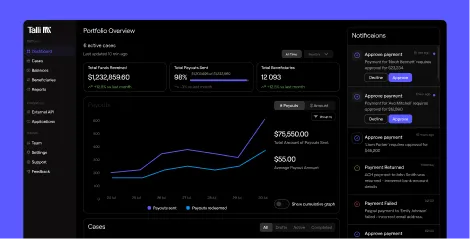
- Real-Time Dashboards: Complete visibility into payment status, completion rates, and fund flows with CRM synchronization
- Automated Reconciliation: Bank file processing and exception handling that significantly reduces manual intervention
Unlike platforms requiring months of integration work, Talli enables settlement campaigns to launch in weeks through pre-configured workflows for class action and mass tort disbursements. The platform handles dedicated account structures for fund segregation, preserving QSF ownership while simplifying court reporting requirements.
Talli's recipient experience maximizes redemption rates through convenient mobile access, flexible payment options requiring no bank account, and smart reminders that re-engage claimants without manual intervention. Whether distributing funds to 1,000 or 1 million recipients, Talli's infrastructure scales transparently while maintaining compliance and control.
Banking services provided by Patriot Bank, N.A., Member FDIC, ensure funds remain secure throughout the disbursement process. For settlement administrators and law firms requiring speed, compliance, and complete visibility over high-volume payouts, Talli delivers the specialized capabilities that generic payment platforms can't match.
Frequently Asked Questions
What are the primary challenges in building a scalable disbursement system?
The most critical challenges include implementing idempotency controls to prevent duplicate payments, processing ACH return files that require complex matching logic, navigating state-by-state money transmitter licensing requirements across multiple jurisdictions, and maintaining high payment success rates at scale. Additionally, organizations underestimate the complexity of real-time reconciliation, which can consume hundreds of hours monthly without automation, and the ongoing maintenance burden of security patching and regulatory compliance updates.
How does fund segregation contribute to legal compliance in large-scale payouts?
Fund segregation through dedicated accounts for each settlement preserves Qualified Settlement Fund (QSF) ownership, which provides crucial tax benefits and legal protections. This structure simplifies reporting to courts and trustees by maintaining clear audit trails showing exactly which funds belong to which settlement. Segregation also ensures that commingling doesn't occur between different settlement classes or priority tiers, preventing disputes about payment allocation. For bankruptcy and class action cases, courts often mandate fund segregation as a condition of settlement approval.
What role does AI play in modern payment platforms for claims administration?
AI enhances disbursement platforms through intelligent payment routing that automatically selects optimal payment methods based on recipient demographics, cost optimization, and delivery timelines. Machine learning models predict which recipients require additional follow-up communications to complete payment setup, enabling proactive engagement that increases redemption rates. Natural language processing powers chatbots that handle routine recipient inquiries, reducing support burden substantially. AI-driven fraud detection identifies anomalous payment patterns—like multiple payments to single accounts—that indicate potential fraud before funds disburse.
How can a system ensure high redemption rates for claimants without traditional bank accounts?
Multi-rail payment support proves essential for serving unbanked and underbanked populations. Offering prepaid card options through banking partners enables recipients to receive funds without bank accounts, while check distribution serves those preferring traditional methods. Digital wallet integrations with PayPal, Venmo, and Cash App capture younger demographics comfortable with app-based financial services. Self-service portals allowing recipients to select their preferred payment method, combined with smart reminders that re-engage those who haven't completed setup, drive completion rates above 95% when implemented effectively.
What security measures are essential for protecting millions of transactions from fraud?
Essential security layers include TLS 1.3 encryption for data in transit and AES-256 encryption at rest, tokenization of sensitive banking information to prevent raw data storage, role-based access controls limiting data exposure, and multi-factor authentication for all administrative access. Real-time OFAC screening prevents payments to sanctioned individuals, while velocity checks flag unusual patterns like excessive payments to single accounts. Idempotency controls using distributed locking prevent duplicate disbursements that create financial losses. Regular penetration testing and SOC 2 Type II audits validate security controls remain effective as systems evolve.