.svg)


.svg)
Choosing the right platform for bulk disbursement to thousands of claimants requires balancing cost efficiency, fraud prevention, and compliance requirements that can make or break settlement distribution success. Modern digital disbursement platforms can reduce processing costs by up to 80% while cutting distribution timelines from weeks to days, with claimant redemption rates improving 15-25% when multiple payment options are offered. Yet with fraudulent claim rates increasing 19,000% between 2021-2023 and nearly $3 billion in securities class action settlements distributed in Q4 2024 alone, platform selection requires rigorous evaluation beyond headline features.
Key Takeaways
- Digital disbursement platforms reduce costs 80% versus paper checks, with ACH transfers costing $0.25-$0.50 per transaction compared to $3-$8 for checks
- Each uncashed check costs administrators an average of $150 to track and reconcile, creating hidden cost multipliers
- Fraudulent claims surged 19,000% from 2021-2023, with millions of bot-generated claims flagged in individual cases
- Offering 3-4 payment methods increases redemption rates 15-25%, with 80% of claimants preferring digital payouts
- AI automation reduces settlement processing time by 80%, with operational expenses dropping 30-43% after implementation
- Platforms should provide PCI DSS Level 1, SOC 2 Type II certification, and automated 1099 generation to meet regulatory expectations and best practices
Understanding 'Disbursed' in Legal Payouts
The term "disbursed" in legal settlements refers to the actual distribution of settlement funds from qualified settlement funds or escrow accounts to verified claimants. This process differs fundamentally from allocation, which determines payment amounts, or approval, which confirms claim validity.
Legal disbursement encompasses three critical stages:
- Fund segregation – Settlement funds held in dedicated accounts preserving QSF tax treatment
- Payment processing – Actual transfer of funds through chosen payment rails to verified recipients
- Reconciliation – Tracking each transaction and maintaining audit trails for court reporting
The disbursement process must satisfy court-mandated reporting requirements while addressing compliance tracking. Courts increasingly require detailed post-distribution accounting showing every transaction and fee deduction.
Qualified Settlement Funds under 26 U.S. Code § 468B demand complete fund segregation with dedicated FBO accounts. Escheatment laws add jurisdiction-specific complexity, with unclaimed settlement funds reverting to state custody after statutory periods ranging from one to five years. Administrators must track dormant periods and file unclaimed property reports meeting state requirements.
What Does Disbursement Mean for Volume-Based Settlements?
Volume-based settlements involving thousands or millions of claimants create exponential complexity that manual processes cannot address. The difference between distributing 100 checks and 100,000 isn't linear—it's transformational.
Traditional paper check distribution for 80%+ of personal injury disbursements creates unsustainable cost structures at scale. A commercial check costs $7.78 to issue on average, with some cases exceeding $20 when factoring tracking and reconciliation.
Processing thousands of simultaneous payments requires:
- Batch processing capabilities – Handling bulk payment files with automated validation
- Multi-rail infrastructure – Supporting ACH, prepaid cards, digital wallets, and wire transfers simultaneously
- Real-time status tracking – Monitoring delivery confirmation and failed payments across methods
- Automated reconciliation – Matching payments to claims without manual spreadsheet tracking
- Scalable fraud detection – Processing identity verification and duplicate detection in real-time
Platforms designed for volume operations process settlements in 24-48 hours versus traditional 2-3 week timelines, critical when court orders mandate distribution deadlines.
Securities fraud settlements distributed $675 million in Q1 2024 alone. Data quality issues multiply at scale—a 2% error rate affects 2,000 claimants in a 100,000-person settlement. Payment method diversity becomes critical when serving unbanked populations who cannot accept ACH transfers.
Navigating Payment Processing for Legal Claims
Payment processing for legal claims differs fundamentally from commercial transactions due to regulatory oversight, fund segregation requirements, and court reporting obligations.
Key Challenges in Legal Payment Processing
Legal payment infrastructure must solve challenges that standard processors ignore:
- QSF compliance – Maintaining dedicated settlement accounts with proper tax treatment
- Court-ready reporting – Generating exports showing every fee deduction and fund movement
- Split disbursements – Distributing settlement amounts to claimants, attorneys, and lienholders
- Statutory timelines – Meeting court-mandated distribution deadlines with provable documentation
- Audit trail requirements – Creating immutable transaction logs with timestamp documentation
Traditional payment gateways lack features for these specialized requirements, forcing administrators to build workarounds through manual processes that scale poorly.
Ensuring Security and Compliance
PCI DSS Level 1 compliance represents the highest payment card security standard but addresses only one compliance dimension. Legal settlements require layered security:
Identity Verification: Multi-factor authentication, biometric verification, and device fingerprinting prevent unauthorized access. Given the scale and sophistication of recent fraud, basic password protection is no longer enough.
Data Encryption: SSL/TLS for data in transit and AES-256 for stored data protect sensitive claimant information. End-to-end encryption ensures payment details remain secure throughout processing.
OFAC Screening: Platforms must cross-reference claimants against sanctions lists before releasing funds. Automated screening processes every payment in real-time without manual review bottlenecks.
SOC 2 Type II certification validates security controls for sensitive data handling beyond payment transactions.
Streamlining Payment Processing for Claims Administrators
Claims administrators manage multiple settlements simultaneously while maintaining small operational teams. Platforms that reduce administrative burden become strategic advantages.
Modern platforms eliminate manual intervention through:
- Automated eligibility verification – Checking claim validity against settlement criteria
- Batch payment creation – Uploading CSV files with thousands of payments processing simultaneously
- Exception handling – Flagging failed payments with automated retry logic
- Tax document generation – Creating 1099 forms automatically with TIN validation
- Reconciliation matching – Connecting payments to claims without spreadsheet tracking
RPA (Robotic Process Automation) reduces processing time 60-70% while lowering error rates to below 1%.
Real-time dashboards transform settlement oversight from reactive checking to proactive management. Effective dashboards provide completion rate tracking, payment method breakdown, failed payment monitoring, fund flow visualization, and CRM synchronization pushing payment data to existing systems without manual exports.
Key Features in Payment Processing Companies
Evaluating payment processors requires distinguishing essential features from optional enhancements that increase costs without proportional value.
What to Look for in a Payout Partner
Multi-Rail Payment Support: ACH transfers cost $0.25-$0.50 per transaction with 2-3 day settlement. Digital wallets deliver in 1-2 business days. Wire transfers provide same-day settlement for high-value claims. Prepaid cards serve unbanked claimants. FedNow enables real-time settlement at $0.045 per transaction.
Fraud Detection Architecture: Machine learning algorithms flag duplicate claims, unusual address patterns, and synthetic identities. Pattern analysis across thousands of claims identifies coordinated fraud schemes manual review misses. Millions of bot-generated claims in recent cases demonstrate fraud sophistication requiring AI-powered detection.
Compliance Automation: KYC/AML protocols, OFAC screening, W-9 collection, fraud mitigation, and audit logs must operate automatically. Platforms maintaining detailed audit trails with immutable transaction records satisfy regulatory review requirements.
Banking Partnerships: Banking services through FDIC-insured institutions provide claimant confidence in payment security.
Evaluating Compliance and Security Capabilities
Request specific certifications during vendor evaluation:
- SOC 2 Type II reports – Validate security controls through independent audits
- PCI DSS compliance certificates – Verify payment card security standards
- Insurance coverage – Confirm cyber liability and errors & omissions policies
- Disaster recovery plans – Understand backup systems and failover procedures
- Data retention policies – Verify compliance with record-keeping requirements
Ask vendors about handling regulatory changes. Platforms that monitor regulatory changes and update compliance engines automatically prevent administrator compliance gaps.
Optimizing Your Payment Processing Business
Claims administrators can apply fintech customer experience principles to improve claimant satisfaction and settlement completion rates.
Service design principles from consumer fintech translate directly to settlement disbursements:
Mobile-First Experiences: Claimants receive secure links via SMS or email accessing payment portals from smartphones. Mobile-optimized interfaces accommodate claimants without computer access, expanding reach and improving completion rates.
Payment Method Flexibility: Offering choice increases perceived control and satisfaction. When a large majority of claimants choose instant disbursement when offered, providing options drives redemption rates.
Proactive Communication: Smart reminders across email, SMS, and push notifications help claimants complete verification steps. Automated follow-ups reduce administrator burden while preventing claimants from missing deadlines.
Transparent Status Updates: Real-time tracking showing payment progress from submission through delivery creates confidence.
Implement staged rollouts when adopting new platforms through pilot programs with smaller settlements, vendor scorecards tracking performance metrics, claimant feedback collection, cost modeling, and benchmark tracking against industry standards.
Ensuring Compliance and Security in Mass Disbursements
Regulatory compliance extends beyond payment processing to encompass data privacy, anti-money laundering, tax reporting, and court oversight requirements.
State-specific escheatment laws create compliance complexity for settlements with nationwide claimant populations. California requires unclaimed property reporting within three years; Delaware allows five years. Platforms must apply correct dormancy periods based on claimant addresses.
Tax reporting requires 1099 generations for payments exceeding $600. OFAC screening applies to all payments regardless of amount, requiring checking claimants against sanctions lists before releasing funds.
Data privacy regulations add compliance layers:
- CCPA/CPRA Requirements: California claimants have rights to know what data administrators collect and delete data upon request
- GDPR Obligations: European claimants trigger GDPR compliance including data processing agreements
- HIPAA Considerations: Medical settlements involving health information require HIPAA compliance
Platforms should document how they protect personally identifiable information, where data is stored, who has access, and retention periods.
Enhancing Claimant Experience and Redemption Rates
Claimant experience directly impacts redemption rates, which determine settlement success.
Friction points in payment acceptance create abandonment:
- Account creation requirements – Forcing username/password creation adds unnecessary barriers
- Document upload complexity – Mobile-optimized capture through smartphone cameras beats desktop-only interfaces
- Payment method limitations – Requiring bank accounts excludes unbanked claimants
- Unclear instructions – Plain language explanations in multiple languages serve diverse populations
- Slow processing – Week-long timelines frustrate claimants expecting instant results
Leading platforms eliminate account creation entirely, providing secure single-use links. Document verification through AI-powered extraction eliminates manual review delays.
Maximize redemption through:
Payment Method Diversification: Offering 3-4 options increases redemption 15-25%. ACH serves banked claimants efficiently. Prepaid cards provide immediate access without bank accounts. Digital wallets accommodate claimants preferring familiar brands.
Multilingual Support: Settlement notices in Spanish, Chinese, and other languages serve diverse populations. Customer support availability in multiple languages prevents barriers from blocking payments.
Reminder Campaigns: Initial payment offers see 40-60% response rates. Automated follow-ups at 7, 14, and 21 days capture claimants who missed initial notices.
Instant Gratification: Same-day or instant payment options appeal strongly to claimants. When 80% choose instant payment when offered, speed becomes a competitive advantage.
Real-time Visibility and Reporting
Court reporting requirements demand detailed accounting showing every dollar distributed. Real-time visibility prevents last-minute scrambles to compile reports.
Modern dashboards provide insights beyond basic payment tracking:
- Completion rate trends – Identify which communication methods drive highest response
- Payment method preferences – Understand demographic patterns guiding future settlement designs
- Geographic distribution – Visualize claim density identifying potential fraud patterns
- Time-to-completion metrics – Measure days from notice to acceptance optimizing reminder timing
- Support inquiry analysis – Track common questions suggesting process improvements
Stakeholder reporting serves multiple audiences:
Court Reports: Judges require comprehensive accounting showing beginning balance, funds disbursed, fees deducted, and ending balance. Export formats in Excel, PDF, and CSV enable filing in court-specified formats.
Attorney Updates: Defense counsel and plaintiff attorneys need regular status updates. Automated weekly reports reduce administrator communication burden.
Claimant Communications: Individual claimants receive payment confirmations, tax documents, and settlement closing notices.
Reconciliation capabilities sync payment data to CRM systems, eliminating duplicate data entry.
Why Talli Makes Bulk Disbursement Simple
Talli delivers purpose-built solutions specifically designed for legal settlement distribution at scale.
Talli's AI-driven payment platform addresses the complete disbursement lifecycle:
Complete Fund Segregation: Dedicated accounts for every settlement preserve QSF ownership, simplify reporting, and ensure legal compliance. Banking services through Patriot Bank, N.A., Member FDIC provide institutional stability.
Multi-Rail Payment Flexibility: Claimants choose payment methods that work best—ACH, prepaid Mastercard issued by Patriot Bank, digital wallets, or traditional checks. No bank account required.
AI-Powered Fraud Detection: Machine learning algorithms flag suspicious patterns across thousands of claims. KYC, OFAC, W-9 collection, fraud mitigation, and audit logs operate automatically.
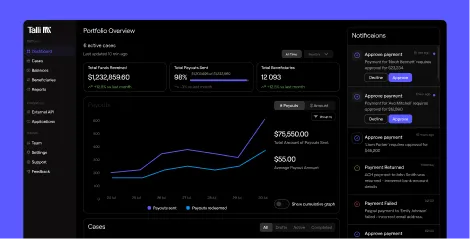
Real-Time Control: Launch, fund, and track payouts with dashboards providing total visibility into completion rates, fund flows, and payment status.
Built for Scale: Whether distributing to 1,000 or 100,000 recipients, Talli’s infrastructure handles volume without performance degradation—turning workflows that took weeks into processes that run in minutes.
Compliance by Design: Automated 1099 generation, state-specific escheatment tracking, and court-ready reporting formats eliminate manual compliance work. Real-time payout data syncs to existing CRMs.
For administrators managing complex settlements requiring speed, compliance, and total visibility, Talli provides infrastructure purpose-built for legal disbursements.
Frequently Asked Questions
What is the primary challenge in disbursing funds to thousands of claimants?
The primary challenge combines cost control with fraud prevention at scale. Traditional paper check distribution costs an average of $7.78-$20 per check with uncashed checks adding $150 in tracking costs, making manual processing economically unsustainable. Simultaneously, fraudulent claims increased 19,000% between 2021-2023. Platforms must deliver 80% cost reduction through automation while implementing AI-powered fraud detection.
How do platforms ensure compliance with regulations like KYC and OFAC?
Leading platforms automate compliance through integrated engines that screen every payment without manual intervention. OFAC screening cross-references claimants against government sanctions lists in real-time before releasing funds. KYC/AML protocols verify identity through multi-factor authentication and document validation using AI-powered extraction. Platforms maintain detailed audit trails satisfying regulatory review requirements and generate required tax forms including 1099 documents for payments exceeding $600.
Can claimants choose their preferred payment method?
Yes, modern platforms offer multiple payment options with claimants selecting preferences during acceptance. Payment rails typically include ACH transfers ($0.25-$0.50 per transaction, 2-3 days), prepaid debit cards, digital wallets like PayPal and Venmo, wire transfers for high-value claims, and traditional paper checks. Offering 3-4 methods increases redemption rates 15-25%. 80% of claimants prefer digital payouts over checks.
What reporting should I expect from a payout platform?
Comprehensive platforms provide real-time dashboards with complete transparency on completion rates, fund flows, and payment status. Court-ready reporting exports in CSV, Excel, and PDF formats show beginning balance, funds disbursed, fees deducted, and ending balance with transaction-level detail. Automated reconciliation syncs real-time data to existing CRM systems. Advanced platforms offer predictive analytics forecasting final redemption rates, geographic distribution visualization, and payment method preference tracking.
Is fund segregation maintained for each settlement?
Yes, Qualified Settlement Fund compliance under 26 U.S. Code § 468B requires complete fund segregation with dedicated FBO accounts for each settlement. Leading platforms establish separate accounts preserving QSF ownership and ensuring legal compliance. Banking services through FDIC-insured institutions provide institutional stability and regulatory oversight. Commingling settlement funds violates QSF requirements, triggering adverse tax consequences. Platforms maintain separate accounting records demonstrating segregation to courts during audits.