.svg)


.svg)
Legal settlements and mass claims distributions demand payment methods that balance speed, compliance, and claimant convenience. Modern payment orchestration platforms route disbursements across multiple rails—ACH, push-to-card, and digital wallets—through a single integration, achieving 98% redemption rates compared to just 77% for paper checks. For claims administrators managing thousands of recipients under court deadlines, the difference between single-rail and multi-rail disbursement strategies can mean 80% cost reduction and processing times compressed from weeks to days.
Key Takeaways
- Digital disbursements achieve 98% redemption rates versus 77% for traditional paper checks
- Push-to-card payments reach 245 million eligible debit cards with near-instant fund delivery
- Consumer expectations have shifted dramatically—In January 2025, 41% of consumers reported receiving instant disbursements most often, up from 11% in 2018
- Multi-rail orchestration reduces total disbursement costs by 60-80% compared to paper check processing
- Failed ACH transfers can be significantly reduced when using bank account verification
- Settlement processing becomes 85% faster with automated compliance and digital payment rails
Understanding the Landscape of Fund Disbursement: ACH vs. Other Methods
Payment orchestration enables businesses to route disbursements across multiple payment rails through a single API integration. For legal firms and settlement administrators, this means transforming weeks-long paper check processes into same-day digital disbursements while maintaining strict trust accounting compliance.
The core disbursement methods serve different purposes:
- ACH (Automated Clearing House): Batch-processed bank transfers settling in 1-3 business days, costing $0.50-$2 per transaction
- Push-to-Card: Instant payments to existing debit cards via Visa Direct or Mastercard Send, typically higher per-transfer fees than ACH (provider- and network-dependent)
- Digital Wallets: PayPal, Venmo, and similar platforms offering immediate access with variable percentage-based fees
- Prepaid Cards: Physical or virtual cards for unbanked recipients requiring no existing account
Each rail carries distinct advantages for specific settlement scenarios. ACH works best for high-volume, lower-urgency distributions where cost efficiency matters most. Push-to-card suits time-sensitive payouts where recipients need immediate fund access. Digital wallets provide familiar interfaces that increase redemption rates among younger demographics.
ACH Payment Processing for Legal Payouts
ACH remains the backbone of settlement disbursements, processing billions of transactions annually through NACHA's regulated network. Understanding its mechanics helps claims administrators optimize for both speed and cost.
How ACH Processing Works
ACH operates through batch processing windows rather than real-time settlement. Transactions submitted before daily cutoff times are processed in the next batch, with funds typically settling within 1-3 business days. Same-day ACH options exist but carry premium fees.
Key ACH considerations for legal disbursements include:
- Processing windows: Batch submissions throughout the day with next-day or same-day options
- Return codes: Failed transactions return with specific codes indicating issues (insufficient funds, closed accounts, invalid routing numbers)
- Transaction limits: Same-Day ACH is generally available for transactions under $1 million
- NACHA compliance: Strict rules governing authorization, timing, and error resolution
Reducing ACH Failures
Failed ACH transfers plague settlement distributions when recipient banking details contain errors. Platforms using bank account verification services like Plaid can significantly reduce payment failures, saving massive follow-up costs.
Your reconciliation processes must account for ACH returns and re-processing. Automated systems flag failures immediately, triggering alternative payment method offers to affected claimants.
The Power of Push-to-Card Technology in Modern Disbursements
Push-to-card technology leverages existing card network infrastructure to deliver funds directly to debit cards within minutes. With 245 million eligible debit cards, this method reaches the vast majority of claimants without requiring them to share sensitive banking details.
Why Push-to-Card Matters for Settlements
Speed differentiates push-to-card from traditional methods. While ACH takes 1-3 days, push-to-card payments arrive within minutes in most cases. This immediacy transforms claimant experience, particularly for recipients depending on settlement funds for urgent needs.
The technology works through Visa Direct and Mastercard Send networks, routing funds directly to linked debit cards. Recipients see payments credited like any other card transaction, familiar and straightforward.
Push-to-card advantages include:
- Instant availability: Funds accessible within minutes, not days
- No bank account sharing: Recipients provide only card numbers, reducing friction
- Higher completion rates: Familiar interface increases redemption success
- Real-time confirmation: Immediate transaction status visibility
Push-to-card requires integration with card network APIs and carries higher per-transaction costs than ACH. The cost differential—typically higher for instant delivery—makes sense for time-sensitive payouts but may not suit high-volume, low-value distributions where speed matters less than cost efficiency.
Integrating Digital Wallets for Enhanced Claimant Experience
Digital wallet adoption has accelerated dramatically, with consumer expectations shifting toward instant payment access. Platforms like PayPal and Venmo provide familiar interfaces that reduce friction and boost redemption rates, particularly among younger claimants.
Why Digital Wallets Increase Redemption
Digital payments outperform checks because they meet recipients where they already transact. Claimants comfortable with mobile payments find wallet-based disbursements intuitive, requiring no learning curve or new account creation.
The recipient choice model proves critical. When claimants select their preferred payment method—ACH, push-to-card, or digital wallet—completion rates can approach near-total completion for digital options when recipients can choose their preferred rail versus 50-70% when forced into a single method.
Digital wallet benefits for claims distribution:
- Immediate fund access: No waiting for check clearing or ACH settlement
- Mobile-first experience: Recipients manage payments from their phones
- No bank account required: Serves unbanked and underbanked populations
- Familiar interface: Reduces support inquiries and confusion
Serving Unbanked Claimants
A significant portion of settlement recipients lack traditional bank accounts. Digital wallets and prepaid cards ensure these claimants receive funds without exclusion. Platforms offering multiple payment rails accommodate diverse recipient circumstances without requiring claims administrators to manage separate processes.
Building a Robust Disbursement Strategy: Compliance, Security, and Speed
Legal disbursements operate under strict compliance requirements that generic payment processors often cannot address. OFAC screening, KYC verification, and tax reporting create obligations that require specialized infrastructure.
Compliance Automation Requirements
Effective disbursement platforms automate compliance workflows rather than creating manual checkpoints that slow processing:
- KYC/AML verification: Identity confirmation before fund release
- OFAC screening: Sanctions list checking with risk-based thresholds
- W-9 collection: Tax documentation gathering for payments exceeding $600
- 1099 generation: Automated tax form creation and filing
- Audit trails: Complete transaction history for regulatory review
Manual compliance processes cannot scale. Automated systems process thousands of transactions while maintaining 100% compliance coverage, flagging only genuine risk indicators for human review.
Fund Segregation and Trust Accounting
Qualified Settlement Funds (QSFs) require complete fund segregation throughout the disbursement lifecycle. Legal-specific platforms maintain dedicated accounts for every settlement, preserving QSF ownership and simplifying reporting for court-supervised distributions.
Trust accounting integration matters critically. Platforms without native IOLTA support create compliance risks that can trigger bar association issues.
Optimizing Payouts: Maximizing Redemption Rates with Smart Solutions
Redemption rate optimization directly impacts settlement success. Every unredeemed payment represents a claimant who didn't receive entitled funds and potential liability for residual fund handling.
The Recipient Choice Advantage
Offering multiple payment rails consistently outperforms single-method approaches. Research shows 100% of clients choose digital disbursements when given the option, compared to 50-70% completion when forced into paper checks.
Effective choice architecture includes:
- Clear method presentation: Simple comparison of speed versus cost tradeoffs
- Default to digital: Position electronic options prominently while maintaining check fallback
- Mobile-first design: Optimize selection interface for smartphone users
- One-click selection: Minimize steps between notification and payment method choice
Smart Follow-Up Systems
Unredeemed payments require systematic follow-up. Automated reminder sequences across email, SMS, and other channels help claimants complete the payout process. Smart reminders increase redemption rates while reducing the manual "chasing" that burdens claims teams.
Effective follow-up strategies include:
- Multi-channel outreach: Email, SMS, and phone reminders reaching recipients through preferred channels
- Escalating urgency: Messaging that emphasizes approaching deadlines
- Alternative method offers: Suggesting different payment options when initial method fails
- Support access: Clear paths to human assistance for complex situations
Real-time Visibility and Reconciliation for Financial Control
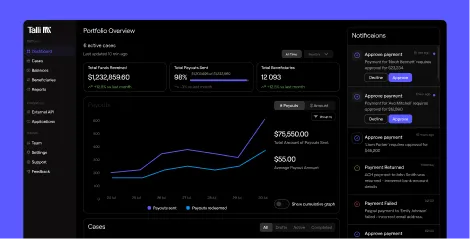
Transparency in settlement distribution requires comprehensive dashboards showing every payment status, fund flow, and completion metric. Real-time visibility eliminates the blind spots that plague traditional paper-based disbursement processes.
Effective disbursement platforms provide visibility across payment status tracking, completion rate metrics, fund flow monitoring, and compliance status. Integrated platforms sync disbursement data with existing case management and accounting software, eliminating manual data entry and reconciliation errors.
API connectivity enables automated three-way reconciliation, real-time sync of payment status updates, and custom reporting formatted for stakeholder and court requirements.
Why Talli Streamlines Legal Settlement Disbursements
While multiple platforms address payment orchestration, Talli provides purpose-built infrastructure specifically designed for legal settlements and mass claims distribution.
Talli's AI-driven platform automates and safeguards every claims payout with:
- Multi-rail payment orchestration: ACH, push-to-card, digital wallets, and prepaid cards through a single integration
- Complete fund segregation: Dedicated accounts for every settlement preserving QSF ownership and simplifying reporting
- Compliance automation: KYC, OFAC, W-9 collection, fraud mitigation, and audit logs built into every workflow
- Smart follow-up systems: Automated reminders across email and SMS driving higher redemption rates
- Real-time dashboards: Total visibility on completion rates, fund flows, and payout status
- Scalable infrastructure: Whether distributing to 1,000 or 100,000 recipients
Banking services provided by Patriot Bank, N.A., Member FDIC. The Easy Prepaid Mastercard is issued by Patriot Bank, N.A., Member FDIC, pursuant to a license from Mastercard International.
For claims administrators managing tight court deadlines, Talli delivers the speed and compliance infrastructure that legal payout compliance demands—transforming what used to take weeks into minutes.
Frequently Asked Questions
What are the primary differences between ACH, push-to-card, and digital wallet disbursements?
ACH processes bank-to-bank transfers in batches, typically settling in 1-3 business days at around $0.50-$2 per transaction. Push-to-card delivers funds to debit cards within minutes but costs more per transaction. Digital wallets like PayPal and Venmo provide instant access through familiar mobile interfaces with variable fee structures. Each method serves different recipient preferences and urgency requirements.
How does payment orchestration ensure compliance with KYC and OFAC requirements?
Modern disbursement platforms automate compliance by integrating KYC and OFAC screening into payment workflows. Transactions automatically route through identity verification and sanctions checking before fund release. Risk-based thresholds allow low-risk domestic payments to process automatically while flagging higher-risk transactions for manual review, maintaining compliance without creating bottlenecks.
Can claimants choose their preferred payment method, and how quickly do they receive funds?
Yes—offering recipient choice is critical for maximizing redemption rates. Claimants who select their preferred method show 100% digital adoption versus 50-70% when limited to single options. Fund timing varies by method: push-to-card and digital wallets deliver within minutes, same-day ACH settles within hours, and standard ACH takes 1-3 business days.
What features should claims administrators look for in disbursement tracking and reporting?
Essential features include real-time payment status updates, completion rate metrics by payment method and campaign, fund flow monitoring showing distributed versus remaining balances, and compliance status tracking for KYC and tax documentation. Platforms should also offer CRM integration for automated data synchronization and customizable reporting for court and stakeholder requirements.
How does fund segregation work for legal settlements?
Qualified Settlement Funds require complete separation of settlement funds from operating accounts throughout the disbursement lifecycle. Legal-specific platforms maintain dedicated accounts for each settlement, preserving QSF ownership structures while simplifying the reporting and audit requirements that court-supervised distributions demand. This fund segregation ensures legal compliance and provides clear audit trails for every dollar distributed.