.svg)


.svg)
Settlement administrators face a dual mandate: process payments efficiently while maintaining audit-ready documentation that satisfies court requirements and regulatory scrutiny. Traditional systems separate payment processing from record management, creating compliance gaps where 40% of lawyers fail to perform quarterly transaction reviews industry-wide. Modern AI-driven payment platforms eliminate this disconnect by integrating disbursement processing with comprehensive archiving, automated exports, and e-discovery-ready documentation—transforming what once required 2-3 days for retrieval into instant access that satisfies even the most demanding discovery requests.
Key Takeaways
- Integrated disbursement platforms deliver 80% reduction in work compared to traditional separated systems
- Document retrieval drops from 2-3 days to instant when moving from physical to cloud-based record management
- Processing time decreases from 9-15 days to 2-5 with automated digital systems
- Automated reconciliation reduces errors from 3-5% to under 1%, avoiding IRS penalties averaging $60-310 per incorrect form
- Complete fund segregation preserves QSF ownership while simplifying court reporting throughout disbursement lifecycle
- Best practices recommend 7-year retention minimum with immutable audit logs for complete chain of custody
Understanding the Imperative of Record Archiving for Legal Payouts
Record archiving for legal disbursements extends beyond simple document storage. Every settlement payment generates transaction records, compliance documentation, tax forms, and audit trails that must remain accessible for years after distribution completes. The challenge intensifies when administrators manage settlements with tens of thousands of claimants, each requiring individualized documentation.
Why Secure Archiving is Non-Negotiable
Settlement administrators carry fiduciary responsibilities that demand meticulous record-keeping:
- Court oversight requirements mandate detailed accounting of every dollar distributed
- Tax reporting obligations require accurate Form 1099 reporting and supporting documentation when payments trigger reporting thresholds
- Regulatory compliance spans KYC verification, OFAC screening, and AML requirements
- Litigation holds can freeze record destruction for years during ongoing disputes
- Professional responsibility rules expose administrators to malpractice claims without proper documentation
Without proper archiving, administrators risk trust accounting failures that can result in professional sanctions, financial penalties, and reputational damage. Your compliance management systems must capture every transaction with immutable timestamps and user attribution.
Regulatory Landscape for Financial Records
Multiple regulatory frameworks govern disbursement record retention:
Federal Requirements: IRS mandates retention of tax-related documents including Form 1099 filings, W-9 collections, and payment substantiation. Bank Secrecy Act compliance requires maintaining KYC documentation and suspicious activity reports.
State Bar Rules: Trust accounting requirements vary by jurisdiction but universally demand three-way reconciliation between bank accounts, client ledgers, and payment records. Real-time settlement dashboards automate this reconciliation process.
Court Orders: Settlement agreements often specify documentation requirements beyond standard regulations, including periodic status reports and final accounting submissions.
Mastering Data Export: Seamlessly Accessing Your Disbursement History
Effective record management requires more than secure storage—administrators need rapid, flexible export capabilities that serve diverse stakeholder needs. Court monitors require summary metrics while auditors demand transaction-level detail.
Key Features for Efficient Data Export
Modern disbursement platforms should provide:
- Multiple export formats including PDF for court submissions, Excel for analysis, and CSV for system integrations
- Customizable report templates matching common court reporting requirements
- Real-time data synchronization with CRM and case management systems
- Bulk export capabilities handling very large settlements without performance degradation
- Granular filtering options by date range, payment status, claimant demographics, and compliance flags
The ability to generate court-ready accounting exports within minutes rather than weeks transforms discovery response from crisis management to routine operations.
Integrating Exported Data with Existing Systems
Seamless integration eliminates manual reconciliation errors:
API Connectivity: RESTful APIs enable real-time data synchronization between disbursement platforms and accounting systems. Modern platforms support OAuth 2.0 authentication with comprehensive error handling.
Pre-built Connectors: Integration with major platforms like QuickBooks, Salesforce, and legal practice management software reduces implementation time from weeks to days.
Webhook Support: Real-time notifications for payment events enable automated workflows in connected systems without polling or manual status checks.
Preparing Disbursement Records for e-Discovery
Electronic discovery requests demand rapid access to disbursement records with verifiable chain of custody. Traditional systems requiring 2-3 days to compile records from disparate sources create discovery response risks and escalate legal costs.
The Role of Technology in e-Discovery
Purpose-built disbursement platforms generate e-discovery-ready documentation automatically:
- Immutable audit trails using append-only, tamper-evident logging help prevent retroactive modification
- Comprehensive metadata captures timestamps, user actions, and system events
- Granular search capabilities enable keyword, date range, and transaction type filtering
- Chain of custody documentation proves record integrity from creation through production
- Privilege tagging identifies potentially protected communications within settlement records
When discovery requests arrive, administrators with integrated platforms respond in hours rather than weeks, demonstrating complete transparency in settlement distribution.
Best Practices for Minimizing e-Discovery Burdens
Proactive strategies reduce discovery response costs:
Implement Litigation Hold Protocols: Automated systems suspend normal retention schedules when litigation holds trigger, preventing inadvertent destruction.
Maintain Consistent Naming Conventions: Standardized file naming enables rapid identification of responsive documents across large record sets.
Document Retention Decisions: When records are destroyed per policy, maintain destruction logs proving compliance with established schedules.
Segregate Settlement Records: Keep each settlement's documentation separate to avoid producing unrelated materials in response to targeted requests.
Implementing an Effective Document Retention Schedule for Payouts
Retention policies balance competing pressures: maintaining records for potential litigation while managing storage costs and privacy obligations. Enterprise record management practices for 2024 emphasize automation and clear policy documentation.
Developing a Tailored Retention Policy
Effective retention schedules address:
- Statutory requirements varying by document type and jurisdiction
- Contractual obligations specified in settlement agreements
- Limitation periods for potential claims against administrators
- Tax audit windows typically extending 3-7 years
- Perpetual retention for certain court orders and final accountings
Most legal records experts recommend defaulting to the longest applicable retention period when requirements conflict. This approach prevents premature destruction while maintaining compliance across multiple frameworks.
Automation for Retention Compliance
Manual retention management fails at scale. Automated systems provide:
Policy Enforcement: Rules-based retention automatically applies appropriate schedules based on document classification, preventing human error.
Destruction Scheduling: Automated reminders and approval workflows ensure timely destruction after retention periods expire while capturing required authorizations.
Litigation Hold Integration: Discovery of potential litigation automatically suspends destruction for relevant records.
Audit Documentation: Complete logs of retention decisions, hold implementations, and destruction activities satisfy regulatory inquiries.
Leveraging AI for Enhanced Compliance and Audit Readiness
Artificial intelligence transforms compliance from reactive checking to proactive risk prevention. AI-powered platforms analyze transaction patterns, flag anomalies, and automate verification workflows that would overwhelm manual processes.
AI's Role in Proactive Compliance
Modern disbursement platforms deploy AI across multiple compliance functions:
- Fraud detection identifying duplicate claims, identity theft patterns, and unusual account behaviors
- OFAC screening with reduced false positives that don't slow legitimate payments
- KYC verification automating identity document validation and address confirmation
- Tax form accuracy ensuring proper 1099-MISC generation based on payment thresholds and recipient classification
These capabilities reduce reconciliation errors from 3-5% to under 1% while accelerating processing speeds.
Meeting Audit Requirements with Smart Systems
Audit readiness requires comprehensive documentation generated automatically throughout disbursement operations. AI systems maintain:
Complete Transaction Histories: Every payment action from initiation through completion with timestamps, approvals, and system events.
Compliance Verification Records: Documentation of KYC checks, OFAC screenings, and fraud prevention measures for each claimant.
Reconciliation Reports: Automated three-way reconciliation satisfying bar trust accounting requirements across all jurisdictions.
Exception Documentation: Detailed records of flagged transactions, resolution actions, and approval chains.
The Benefits of Centralized Disbursement Record Management
Centralized platforms eliminate the fragmentation plaguing traditional settlement administration. When payment processing, compliance verification, tax reporting, and record archiving operate in unified systems, administrators gain efficiency while reducing error rates.
Improving Efficiency with a Unified System
Consolidated record management delivers measurable operational improvements:
- Processing time reduction from 9-15 days to 2-5
- Administrative work reduction of 80% through automation
- Elimination of manual reconciliation between disparate systems
- Instant document retrieval replacing 2-3 day turnaround
- Reduced staff time of 500+ hours annually on compliance tasks
These efficiency gains compound as settlement sizes increase, making centralized platforms essential for high-volume operations.
Enhanced Security for Sensitive Financial Data
Centralized platforms implement enterprise-grade security:
Encryption Standards: AES-256 encryption at rest and TLS 1.3 in transit protect sensitive beneficiary data and payment records.
Access Controls: Role-based permissions ensure administrators, counsel, and court monitors see only appropriate information with full audit logging.
Disaster Recovery: Geographically distributed backups with documented uptime SLAs and disaster recovery objectives reduce downtime and prevent data loss.
Compliance Certifications: SOC 2 Type II and PCI DSS Level 1 compliance demonstrates security posture to courts and regulators.
Why Talli Simplifies Disbursement Record Management
While numerous platforms address portions of the record management challenge, Talli delivers comprehensive solutions specifically designed for legal settlement administration where disbursement processing and documentation requirements intersect.
Talli transcends basic payment processing with integrated record management that includes:
- Complete Fund Segregation: Dedicated accounts for every settlement preserving QSF ownership while simplifying reporting and ensuring legal compliance
- Built-in Compliance Automation: KYC, OFAC, W-9 collection, fraud mitigation, and immutable audit logs eliminate manual compliance tracking
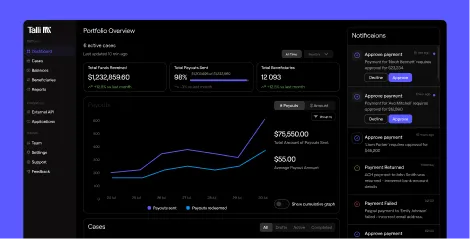
- Real-time Dashboard Visibility: Monitor delivery, completion, and engagement with built-in reporting for teams and stakeholders
- Court-Ready Exports: Automated generation of PDF and Excel accounting reports matching common court requirements
- Multi-Channel Disbursement: ACH transfers, prepaid Mastercard cards, digital wallets, and checks from a single platform with unified record-keeping
Unlike generic payment processors lacking archiving capabilities or document management systems without disbursement functionality, Talli unifies both requirements. The platform handles settlements from 1,000 to 100,000+ recipients without degradation while maintaining the documentation standards courts demand.
For claims administrators managing complex settlements with tight compliance deadlines, Talli's integrated approach eliminates the reconciliation nightmares, discovery delays, and audit anxiety that plague traditional separated systems. Banking services are provided by Patriot Bank, N.A., Member FDIC, ensuring institutional-grade fund security.
Frequently Asked Questions
What is the difference between archiving and e-discovery for disbursement records?
Archiving refers to the systematic storage and retention of disbursement records according to established policies and regulatory requirements. E-discovery is the process of identifying, collecting, and producing those archived records in response to litigation or regulatory inquiries. Effective archiving makes e-discovery manageable—when records are properly organized with complete metadata and audit trails, responding to discovery requests takes minutes instead of weeks. Modern platforms integrate both functions, generating e-discovery-ready documentation automatically during normal disbursement operations.
How long must settlement disbursement records be retained?
Retention requirements vary by document type, jurisdiction, and settlement agreement terms. IRS tax documentation typically requires 3-7 year retention, while court orders and final accountings may require perpetual retention. Most legal records experts recommend maintaining a 7-year minimum retention that satisfies most statutory requirements. However, specific settlement agreements may impose longer periods. When in doubt, consult legal counsel and default to the longest applicable requirement to prevent premature destruction.
Can disbursement data be exported in formats compatible with legal e-discovery tools?
Yes, modern disbursement platforms provide exports in standard formats including PDF, Excel, CSV, and JSON that integrate with common e-discovery review platforms. The key requirement is complete metadata preservation—timestamps, user attribution, and transaction relationships must transfer accurately. Purpose-built legal payment platforms generate exports specifically designed for court submissions and regulatory review, including chain of custody documentation that proves record integrity.
What security measures protect archived financial disbursement records?
Enterprise-grade disbursement platforms implement multiple security layers including AES-256 encryption for data at rest, TLS 1.3 encryption for data in transit, role-based access controls with full audit logging, multi-factor authentication requirements, and geographically distributed backups. Compliance certifications including SOC 2 Type II and PCI DSS Level 1 validate these security measures. For settlement records containing sensitive beneficiary information, secure fund segregation ensures complete isolation between different settlement funds.
How can automation reduce compliance risks in disbursement record management?
Automation addresses the primary source of compliance failures: human error in manual processes. Automated systems reduce reconciliation errors from 3-5% to under 1%, perform real-time three-way reconciliation satisfying trust accounting requirements, enforce retention schedules without relying on manual tracking, and maintain complete audit trails capturing every action. The result is 80% reduction in work while simultaneously improving compliance outcomes and audit readiness.