.svg)


.svg)
Class action claims showing indicia of fraud surged 19,000% between 2021 and 2023—from 400,000 to over 80 million claims—creating a critical challenge for settlement administrators who must balance fraud prevention with payout speed. Modern AI-driven platforms can process fraud checks nearly instantaneously while blocking a large share of suspicious attempts, transforming what was once a frustrating trade-off into a streamlined operation. The key lies in implementing layered fraud detection that works faster than traditional manual review while providing superior protection for settlement funds.
Key Takeaways
- Fraudulent class action claims increased 19,000% from 2021 to 2023, reaching over 80 million claims annually
- Western Alliance's Anti-Fraud Triangle identified and prevented more than 800 million fraudulent claims in 2024, preventing over $100M in potential fraud
- AI-powered fraud detection delivers rapid decision times compared to slower, sequential checks
- Some vendors report ~0.01% false-positive rates in specific bot-mitigation workflows with strong fraud detection
- Real-time KYC and OFAC screening can be automated without adding transaction delays
- Fund segregation through dedicated settlement accounts provides an additional fraud protection layer
Understanding the Evolving Landscape of Digital Disbursement Fraud
Payment fraud costs organizations over $30 billion annually, with settlement disbursements representing a particularly attractive target for sophisticated criminals. The explosion in fraudulent claims has outpaced traditional fraud prevention methods, leaving claims administrators vulnerable to coordinated attacks that exploit manual review processes.
Modern disbursement fraud takes several forms:
- Synthetic identity fraud using fabricated claimant identities
- Account takeover redirecting legitimate payments to criminal accounts
- Duplicate claim submissions exploiting weak verification systems
- Bot-driven attacks submitting thousands of fraudulent claims simultaneously
- Beneficiary manipulation changing payment details after approval
The consequences extend beyond financial losses. Failed fraud prevention damages claimant trust, delays legitimate payments, and creates compliance risks that can trigger regulatory scrutiny. Settlement administrators face the difficult task of stopping fraud without creating bottlenecks that frustrate legitimate claimants.
Balancing Speed and Security: The Digital Disbursement Challenge
Traditional fraud prevention forces a painful choice: implement thorough checks that slow payments to a crawl, or prioritize speed while accepting higher fraud rates. This trade-off becomes particularly acute during high-volume settlement distributions where thousands of claimants expect rapid payment.
Manual review processes add 2-5 minutes per transaction. Rule-based automated systems reduce this to 5-10 seconds but still create noticeable delays when processing thousands of payments. For settlement administrators managing tight court deadlines, these delays compound into serious operational challenges.
Client expectations have shifted dramatically. Claimants accustomed to instant digital payments in other contexts expect similar speed from settlement distributions. When fraud prevention creates friction, redemption rates drop as frustrated claimants abandon the payment process.
The solution lies in AI-powered systems that process fraud checks nearly instantaneously—faster than human perception can detect—covering 50+ payment fraud scenarios. This approach eliminates the speed-versus-security trade-off entirely.
Implementing Robust KYC and OFAC Screening in Real-Time
Know Your Customer (KYC) verification and Office of Foreign Assets Control (OFAC) screening form the foundation of effective fraud prevention. These compliance checks catch fraudulent claimants before the payments process, but traditional approaches add significant delays.
Automating Identity Verification for Swift Compliance
Modern identity verification APIs process checks in under one second by analyzing multiple data points simultaneously:
- Government ID validation against official databases
- Biometric matching using selfie verification
- Address verification through postal and utility records
- Phone number validation and carrier lookups
- Email age and reputation scoring
Platforms like Alloy aggregate 250+ data sources into unified verification decisions, eliminating the need for manual document review. This automation reduces KYC false positives while accelerating compliant claimant approval.
Real-Time Sanctions Checks
OFAC screening must occur before every disbursement to comply with federal requirements. Traditional batch processing creates dangerous gaps where sanctions lists update between checks.
Real-time OFAC screening integrates directly into the payment workflow, checking recipients against current sanctions lists at the moment of transaction. This approach provides:
- Immediate screening against updated OFAC lists
- Automatic holds on potential matches for review
- Audit trails documenting every screening decision
- Reduced manual review burden for false positives
Securing Transactions with Advanced Fraud Mitigation and Audit Trails
Beyond identity verification, transaction-level fraud detection catches suspicious patterns that individual checks miss. Machine learning algorithms analyze behavioral signals, payment velocities, and historical patterns to score risk in real-time.
Leveraging AI for Proactive Fraud Detection
AI-powered fraud detection outperforms rule-based systems across every metric. While traditional rules catch 60-75% of fraud, machine learning models achieve 90%+ detection rates with fewer false positives.
The technology works by analyzing:
- Behavioral patterns identifying anomalies in claimant actions
- Device fingerprinting detecting suspicious access methods
- Velocity checks flagging unusual transaction frequencies
- Network analysis connecting related fraudulent claims
- Historical comparison scoring against known fraud patterns
Modern platforms like SEON deliver fraud decisions quickly using "whitebox" machine learning that explains its reasoning—critical for compliance documentation.
The Power of Comprehensive Audit Logs
Every fraud prevention decision requires documentation for regulatory compliance and potential dispute resolution. Automated audit trails capture:
- Timestamp and outcome of every verification check
- Data sources consulted for each decision
- Risk scores and contributing factors
- Manual override decisions with justifications
- Complete transaction history for forensic analysis
These immutable records satisfy court reporting requirements while enabling rapid response to fraud investigations.
Optimizing Payouts: Ensuring the Right Recipient Gets Paid, Fast
Fraud prevention succeeds when legitimate claimants receive payments quickly while fraudulent actors face insurmountable barriers. This requires optimizing the entire payout process, not just adding security checks.
Streamlined Recipient Information Collection
Collecting accurate payment details reduces fraud opportunities while improving claimant experience:
- Secure link delivery via SMS or email eliminates account creation friction
- Pre-populated fields using verified claimant data reduce errors
- Real-time validation catches typos before submission
- Multiple payment options accommodate claimant preferences
Offering Flexible and Secure Digital Payment Options
Payment flexibility increases redemption rates while maintaining security. Claimants who can choose their preferred method—digital wallet, prepaid card, or direct deposit—complete the process at higher rates.
Digital payment rails also provide superior fraud protection compared to paper checks. Instant delivery eliminates mail theft risks, while digital verification ensures funds reach intended recipients.
The Role of Fund Segregation and QSF Ownership in Fraud Prevention
Qualified Settlement Funds require strict fund separation that also serves as a fraud prevention layer. Dedicated accounts for each settlement prevent commingling while creating clear audit trails.
Maintaining QSF Integrity
Complete fund segregation protects against multiple fraud vectors:
- Internal misappropriation becomes immediately visible
- External attacks can't access multiple settlements through single breach
- Regulatory compliance demonstrates proper fund handling
- Simplified reporting shows exact fund flows per settlement
Settlement administrators should demand dedicated FBO (For Benefit Of) accounts that preserve QSF ownership while enabling efficient digital disbursement.
Benefits of Dedicated Settlement Accounts
Separate accounts for each settlement provide operational advantages beyond fraud prevention:
- Individual reconciliation for court reporting
- Clear fund ownership documentation
- Simplified tax treatment per settlement
- Rapid identification of discrepancies
Real-Time Tracking and Reporting for Unwavering Control
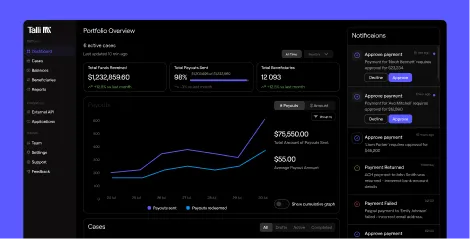
Visibility into payment status enables rapid fraud response while satisfying stakeholder reporting requirements. Real-time dashboards transform settlement administration from reactive to proactive.
Gaining Instant Insights into Every Payout Status
Modern payment platforms provide real-time visibility into:
- Individual payment status from initiation through completion
- Aggregate completion rates across settlement campaigns
- Fraud flag rates and resolution outcomes
- Delivery confirmation and claimant engagement metrics
This visibility enables rapid response when fraud patterns emerge, limiting exposure before significant losses occur.
Integrating Payout Data for Business Intelligence
CRM synchronization ensures payment data flows into existing systems without manual entry. API connections enable:
- Automatic status updates in case management systems
- Real-time reporting for stakeholder dashboards
- Compliance documentation generation
- Performance analytics for process optimization
Streamlining Legal Payouts with AI: The Future of Fraud Prevention
The settlement fraud explosion demands AI-powered solutions that scale with attack sophistication. Western Alliance Bank's Digital Disbursements platform, using ClaimScore's AI-powered fraud detection, identified and prevented more than 800 million fraudulent claims in 2024—preventing over $100 million in potential fraud losses.
This "Anti-Fraud Triangle" approach combines:
- Digital Disbursement Platform processing payments with built-in fraud monitoring
- AI-Powered Fraud Scoring analyzing claim patterns in real-time
- Case-Specific Verification adding layers appropriate to each settlement
The combination achieves what seemed impossible: faster payouts with better fraud protection.
Why Your System Needs to Go Beyond Basic Payment Security
Legacy payment systems built for different eras can't match modern fraud sophistication. Coordinated attacks using synthetic identities, bot networks, and social engineering require equally sophisticated defenses.
Traditional safeguards fall short in several areas:
- Static rules can't adapt to evolving fraud tactics
- Batch processing creates windows for fraud between checks
- Manual review can't scale to high-volume settlements
- Siloed data misses patterns visible across settlements
Organizations achieving ROI in under six months from fraud prevention investments share a common approach: they replaced legacy systems with integrated AI platforms designed for modern threats.
Choosing a Partner for Secure and Rapid Digital Disbursements
Selecting a payment platform requires evaluating fraud prevention capabilities alongside processing speed and cost:
Critical questions for potential providers:
- What is your fraud detection rate and false positive rate?
- How quickly do fraud checks process per transaction?
- What compliance certifications do you maintain?
- How do you handle high-volume settlement distributions?
- What reporting capabilities support court requirements?
Platforms processing fraud decisions rapidly while achieving low false positive rates represent current best-in-class performance. Anything slower or less accurate creates unnecessary risk.
Why Talli Simplifies Fraud Prevention in Digital Disbursements
While multiple platforms address fraud prevention, Talli delivers comprehensive solutions specifically designed for legal settlement and claims administration requirements.
Talli's AI-driven payment platform integrates fraud prevention directly into the disbursement workflow:
- KYC, OFAC, and W-9 collection automated at claimant onboarding
- Fraud mitigation and audit logs built into every transaction
- Complete fund segregation with dedicated accounts per settlement
- Real-time dashboard providing total visibility into payout status
- Flexible payment options including digital wallets and prepaid cards
The platform handles settlements of any size—whether 1,000 or 100,000 recipients—without sacrificing speed or security. Claimants receive secure links via SMS or email, choose their preferred payment method, and receive funds without creating accounts or providing bank details.
For settlement administrators facing tight court deadlines, Talli's approach transforms what used to take weeks into minutes. Smart reminders increase redemption rates while comprehensive reporting satisfies stakeholder requirements. Banking services through Patriot Bank, N.A., Member FDIC, provide the regulatory foundation claims teams require.
Frequently Asked Questions
What is the biggest challenge in preventing fraud in digital disbursements?
The primary challenge is maintaining payout speed while implementing thorough fraud checks. Traditional manual review adds 2-5 minutes per transaction, creating unacceptable delays for high-volume settlements. Modern AI platforms solve this by processing fraud decisions nearly instantaneously while analyzing dozens of risk factors simultaneously. This eliminates the speed-versus-security trade-off that plagued earlier fraud prevention approaches.
How can AI accelerate fraud prevention without delaying payments?
AI fraud detection processes multiple verification checks in parallel rather than sequentially. While rule-based systems require 5-10 seconds per transaction, machine learning platforms deliver rapid decisions by analyzing behavioral patterns, device fingerprints, and historical data simultaneously. Platforms like Abrigo's real-time wire fraud detection achieve 90%+ detection rates with minimal latency.
How does fund segregation protect against fraud in settlement payouts?
Complete fund segregation creates dedicated accounts for each settlement, preventing commingling and creating clear audit trails. This approach makes internal misappropriation immediately visible, limits exposure if a single account is compromised, and satisfies QSF compliance requirements. Settlement administrators should require dedicated FBO accounts that preserve ownership while enabling efficient digital disbursement.
What kind of reporting is essential for effective fraud monitoring?
Effective fraud monitoring requires real-time visibility into payment status, fraud flag rates, and resolution outcomes. Real-time dashboards enable rapid response when fraud patterns emerge, while comprehensive audit logs satisfy court reporting requirements. CRM integration ensures payment data flows automatically into existing systems, eliminating manual reconciliation and enabling performance analytics.
Can digital wallets increase fraud risk, or do they enhance security?
Digital wallets actually enhance security compared to paper checks by eliminating mail theft risks and providing instant delivery confirmation. Digital payment rails enable real-time verification, immediate fraud detection, and complete transaction visibility—protections impossible with physical check distribution. Recipients also benefit from faster access to funds and greater payment flexibility.