.svg)


.svg)
Comprehensive data compiled from federal enforcement reports, sentencing commission research, and fraud investigation analysis
Key Takeaways
- Healthcare fraud settlements remain a federal enforcement priority – False Claims Act recoveries exceeded $2.68 billion in fiscal year 2023, with healthcare fraud accounting for $1.8 billion, demonstrating sustained government focus on fraud detection and prosecution across Medicare, Medicaid, and pharmaceutical sectors.
- Whistleblower filings drive enforcement results – A total of 712 qui tam lawsuits were filed in FY 2023, with relators receiving over $349 million in awards, underscoring the critical role of insider-initiated cases in identifying fraud schemes that government audits miss.
- Cumulative FCA recoveries exceed $75 billion since 1986 – Healthcare fraud alone has contributed over $50 billion to these totals, with prescription drug pricing, Medicare Advantage risk adjustment, and kickback schemes representing persistent enforcement priorities across multiple administrations.
- Median healthcare fraud losses reach $2.5 million – The median loss in healthcare fraud cases sentenced in FY 2024 was $2,532,314, with 74.7% of offenders receiving prison sentences averaging 27 months, reflecting the serious financial harm these schemes inflict on federal healthcare programs.
- Geographic concentration persists in prosecution patterns – The Southern District of Florida leads all federal districts with 65 healthcare fraud sentences in FY 2024, followed by New Jersey and New York, indicating continued enforcement focus on regions with historically high Medicare beneficiary populations and documented fraud activity.
Understanding the Healthcare Settlement Landscape
1. False Claims Act settlements exceeded $2.68 billion in FY 2023
The Department of Justice reported that FCA settlements and judgments surpassed $2.68 billion in fiscal year 2023, continuing the multi-decade enforcement trend that has recovered over $75 billion since 1986. This total reflects enforcement across healthcare, defense contracting, and government procurement programs. For claims administrators handling large-scale healthcare settlements, understanding these enforcement patterns helps anticipate payout volumes and compliance requirements that accompany major fraud recoveries. Source: U.S. Department of Justice
2. Healthcare fraud accounts for $1.8 billion of total FCA recoveries
Healthcare-related FCA matters generated $1.8 billion of the $2.68 billion total in FY 2023, establishing healthcare as the dominant enforcement category representing approximately 67% of all recoveries. This concentration reflects continued federal focus on Medicare Advantage risk adjustment, pharmaceutical kickback schemes, and medically unnecessary services billing. Settlement administrators processing these recoveries require robust fund distribution systems capable of handling high-volume claimant populations while maintaining complete audit trails for court reporting and regulatory compliance. Source: U.S. Department of Justice
3. Cumulative FCA recoveries exceed $75 billion since 1986
Total False Claims Act recoveries have surpassed $75 billion since the law's 1986 amendments strengthened whistleblower protections and enforcement mechanisms, according to ACFE research. Healthcare-related recoveries exceed $50 billion (FY 1987–FY 2023), representing approximately 67% of all FCA recoveries across four decades. This sustained enforcement volume underscores the importance of efficient settlement processing infrastructure for both government-initiated and private qui tam litigation payouts requiring transparent fund tracking. Source: ACFE Insights
4. U.S. healthcare spending reached $4.9 trillion in 2023
National health expenditures totaled $4.9 trillion in 2023, with Medicare and Medicaid accounting for 39% ($1.9 trillion) of this spending, according to federal healthcare cost tracking. Healthcare now represents nearly 17% of U.S. gross domestic product. Industry estimates suggest fraud, waste, and abuse consume between 3% and 10% of total healthcare spending—representing $147 billion to $490 billion in potential losses annually, explaining why healthcare fraud enforcement remains a sustained federal priority across administrations. Source: ACFE Insights
Whistleblower Cases and Qui Tam Filings
5. A total of 712 qui tam lawsuits were filed in FY 2023
Whistleblower-initiated qui tam lawsuits reached 712 filings in fiscal year 2023, continuing the sustained enforcement trend where insider reports drive the majority of successful healthcare fraud prosecutions. This filing volume reflects growing awareness of FCA whistleblower protections among healthcare employees and expanded relator counsel specialization. Each successful qui tam case generates claimant populations requiring systematic payout processing and verification procedures to ensure legitimate recipients receive settlement distributions while preventing fraudulent claims from compromising fund integrity. Source: U.S. Department of Justice
6. Whistleblowers received over $250 million in FY 2023 awards
Relators (whistleblowers) received more than $250 million in awards during fiscal year 2023, representing 15-30% of recovered amounts based on statutory formulas and contribution levels determined by courts. These awards create financial incentives for healthcare employees with direct knowledge of fraud schemes to report violations. Settlement administrators processing these complex multi-party distributions require systems capable of managing attorney fee calculations, tax withholding requirements, and claimant identity verification to prevent payment errors. Source: U.S. Department of Justice
7. Since 1987, the FCA has generated over 11,000 healthcare cases
Healthcare-related FCA enforcement has produced more than 11,000 cases with settlements exceeding $50 billion since 1987, creating extensive precedents for settlement administration procedures. This sustained case volume has established standardized approaches for claimant identification, fund distribution, and regulatory compliance reporting. Modern claims administrators benefit from decades of process refinement while facing new challenges from increasing case complexity and larger claimant population sizes requiring scalable digital distribution platforms rather than manual processing methods. Source: ACFE Insights
Financial Impact and Loss Amounts in Healthcare Fraud
8. Median loss in healthcare fraud cases reached $2,532,314 in FY 2024
U.S. Sentencing Commission data reveals the median loss amount for healthcare fraud offenses was $2.5 million in fiscal year 2024, representing the midpoint across all sentenced cases. This figure indicates that half of healthcare fraud prosecutions involve losses exceeding this threshold. Settlement distribution for cases of this magnitude requires robust reconciliation and reporting capabilities to track fund flows accurately and provide courts with detailed accounting of all distributions, administrative costs, and remaining balances. Source: U.S. Sentencing Commission
9. Nearly 20% of healthcare fraud cases involve losses exceeding $9.5 million
Analysis of FY 2024 sentencing data shows 19.8% of healthcare fraud cases involved loss amounts greater than $9.5 million, while 18.2% involved losses below $250,000. This distribution indicates significant variation in case scale, requiring claims administrators to maintain flexible systems capable of handling both small-scale distributions and mass payout distributions involving thousands of claimants, multiple payment methods, and complex eligibility verification requirements across diverse claimant populations. Source: U.S. Sentencing Commission
10. ACFE research shows median fraud loss of $100,000 with mean of $721,000
The Association of Certified Fraud Examiners' 2024 Report to the Nations found healthcare fraud cases had a median loss of $100,000 and an average (mean) loss of $721,000. The significant gap between median and mean values indicates that a subset of very large cases substantially elevates average loss figures beyond typical case values. This variance underscores why settlement platforms must accommodate both routine and exceptional payout volumes with scalable infrastructure. Source: ACFE Insights
Sentencing Patterns and Criminal Prosecution
11. Federal courts sentenced 395 healthcare fraud cases in FY 2024
Federal courts sentenced 395 individuals for healthcare fraud offenses in fiscal year 2024, following 447 sentences in FY 2023, according to USSC data. Healthcare fraud cases have increased 19.7% from FY 2020 to FY 2024, indicating sustained prosecution momentum despite year-to-year variation. Criminal prosecutions often run parallel to civil settlements, creating coordinated claims administration requirements for restitution distributions and settlement payouts that must be carefully tracked to avoid duplicate payments. Source: U.S. Sentencing Commission
12. Over 74% of healthcare fraud offenders receive prison sentences
Nearly three-quarters (74.7%) of individuals sentenced for healthcare fraud received prison sentences in FY 2024, with an average sentence of 27 months incarceration. This incarceration rate reflects the severity with which federal courts treat healthcare fraud offenses involving Medicare, Medicaid, and other government healthcare programs. Settlement distributions connected to criminal prosecutions require coordination with court-ordered restitution schedules and victim notification requirements, necessitating integrated compliance systems. Source: U.S. Sentencing Commission
13. Over 90% of healthcare fraud offenders have minimal criminal history
The vast majority (90.4%) of individuals sentenced for healthcare fraud had little or no prior criminal history, falling into Criminal History Category I. The average offender age was 50 years, with 67.8% being men and 93.7% being U.S. citizens. This demographic profile—experienced professionals with clean records—explains why healthcare fraud often goes undetected for extended periods and why compliance verification systems remain essential for preventing settlement distribution errors. Source: U.S. Sentencing Commission
14. Over 42% of cases receive enhanced sentences for losses exceeding $1 million
Sentencing enhancements for federal healthcare offenses with losses greater than $1 million applied in 42.5% of FY 2024 cases. Additional enhancements included abusing public position or using special skill (29.1%), leadership or supervisory role (24.8%), sophisticated means (21.3%), and number of victims or extent of harm (12.4%). These enhancement patterns indicate that larger, more organized fraud schemes receive proportionally harsher penalties and generate correspondingly larger settlement distribution requirements. Source: U.S. Sentencing Commission
Geographic Distribution of Healthcare Fraud Cases
15. Southern District of Florida leads with 65 healthcare fraud sentences
The Southern District of Florida sentenced 65 individuals for healthcare fraud in FY 2024—more than any other federal district nationwide, according to sentencing data. Florida's concentration of Medicare beneficiaries, healthcare providers, and historically documented fraud schemes explains this sustained enforcement focus. Claims administrators operating in this jurisdiction face elevated verification requirements given documented fraud prevalence and sophisticated schemes requiring enhanced due diligence. Source: U.S. Sentencing Commission
16. New Jersey and New York districts rank among top enforcement areas
The District of New Jersey sentenced 31 individuals for healthcare fraud, while the Southern and Eastern Districts of New York sentenced 26 and 17 individuals respectively in FY 2024. The Southern District of Texas also sentenced 17 healthcare fraud offenders. This geographic concentration in major metropolitan areas with large healthcare systems creates corresponding settlement administration volume in these regions, requiring localized compliance expertise and multi-jurisdictional coordination capabilities. Source: U.S. Sentencing Commission
17. Healthcare fraud cases increased 19.7% from FY 2020 to FY 2024
Federal healthcare fraud cases in the sentencing system grew 19.7% over the five-year period from FY 2020 to FY 2024, reflecting sustained enforcement prioritization despite pandemic-related court disruptions. This growth occurred across multiple fraud categories including prescription drugs, diagnostic testing, durable medical equipment, and home health services. Settlement administrators should anticipate continued high volumes through at least 2027 based on current investigation and prosecution trends generating ongoing payout requirements. Source: U.S. Sentencing Commission
Government Intervention and Case Resolution Patterns
18. Government intervention historically correlates with higher qui tam recoveries
Historically, qui tam cases where the federal government chose to intervene have generated substantially higher average recoveries than declined cases, though both categories contribute significantly to total FCA enforcement results. Government intervention signals typically involve stronger evidence, larger fraud schemes, and more extensive investigative resources. Settlement administrators must accommodate both intervention and declined case structures, each requiring different distribution frameworks and compliance verification protocols based on government involvement levels. Source: ACFE Insights
19. Over 57% of healthcare fraud sentences fall below Guidelines Manual recommendations
Sentencing data shows 57.0% of healthcare fraud sentences were below Guidelines Manual recommendations, with 35.4% receiving substantial assistance departures (average sentence reduction of 69.6%) and 42.8% receiving downward variances (average reduction of 56.4%). Only 18.0% of sentences fell within the guideline range. These patterns affect restitution calculation timelines and settlement distribution schedules, requiring flexible payment processing systems that accommodate modified court orders. Source: U.S. Sentencing Commission
Healthcare Fraud Detection and Prevention Challenges
20. Detection time for healthcare fraud schemes averages 12 to 18 months
Research indicates healthcare fraud schemes typically operate for 12 to 18 months before detection, allowing substantial losses to accumulate before enforcement action begins. This detection lag explains why median loss amounts reach multiple millions of dollars by the time cases reach prosecution. Extended fraud periods create complex settlement scenarios requiring retroactive claim identification, loss calculation across multiple fiscal years, and verification of claimant eligibility across time-distributed populations. Source: ACFE Insights
21. Tips from employees represent the most common fraud detection method
Employee tips account for approximately 43% of healthcare fraud detection cases, significantly outperforming other detection methods including internal audits, management review, and accidental discovery. This finding underscores why qui tam whistleblower provisions remain the primary enforcement mechanism for healthcare fraud. Settlement structures must accommodate whistleblower award calculations, legal fee distributions, and multi-party payment coordination across government agencies, relators, and affected claimant populations. Source: ACFE Insights
22. Healthcare organizations with fraud hotlines detect fraud 50% faster
Healthcare organizations maintaining confidential fraud reporting hotlines detect fraud schemes approximately 50% faster than organizations without reporting mechanisms, reducing median losses and enabling earlier intervention. This detection advantage explains federal emphasis on compliance program requirements for healthcare providers participating in Medicare and Medicaid. Faster detection leads to smaller settlement amounts but potentially larger claimant populations requiring efficient digital distribution platforms for timely fund disbursement. Source: ACFE Insights
Compliance and Regulatory Requirements for Settlements
23. Settlement agreements require OFAC screening for all claimant payments
Federal law mandates Office of Foreign Assets Control (OFAC) screening for all settlement payments to ensure funds do not reach sanctioned individuals or entities. Healthcare settlement administrators must implement automated OFAC compliance screening for every claimant verification, creating additional processing requirements beyond standard identity verification. Failure to conduct proper OFAC screening can result in significant penalties and delayed distributions, making compliance automation essential for large-scale settlement administration. Source: ACFE Insights
24. Tax reporting requirements apply to settlement payments exceeding $600+
Internal Revenue Service regulations require 1099 form issuance for settlement payments exceeding $600, creating significant tax reporting obligations for healthcare settlement administrators. Settlement platforms must collect W-9 information during claims processing, calculate taxable portions of settlement awards, and issue accurate 1099 forms by January 31 following distribution. Automated W-9 collection and 1099 issuance capabilities reduce manual processing errors and ensure regulatory compliance. Source: ACFE Insights
25. Qualified Settlement Funds require specialized tax treatment and reporting
Qualified Settlement Funds (QSFs) established under IRC Section 468B require specialized tax treatment, annual information returns, and compliance with specific fund administration rules. QSFs provide liability protection for defendants and timing flexibility for claimant distributions but require secure fund segregation and detailed accounting. Settlement administrators must maintain complete audit trails, track all fund movements, and provide comprehensive reporting to courts, tax authorities, and settlement parties. Source: ACFE Insights
Leveraging Technology for Settlement Administration
Healthcare settlement volumes, complexity, and regulatory requirements have reached levels where traditional manual processing creates unacceptable delays and compliance risks. Modern claims administration platforms with built-in compliance capabilities provide essential infrastructure for efficient distribution while maintaining regulatory adherence.
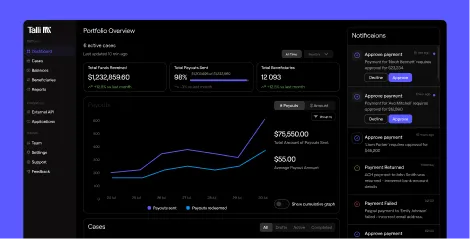
Settlement administrators handling healthcare fraud recoveries benefit from platforms offering real-time dashboard visibility, automated claimant verification, and flexible payment options that reduce distribution timelines by 60% or more. With settlement fraud attempts increasing 40% since 2020, automated fraud detection capabilities become essential for protecting fund integrity.
Digital-first distribution strategies utilizing secure fund segregation, integrated OFAC screening, and automated W-9 collection ensure regulatory compliance while accelerating payment delivery. As healthcare fraud enforcement continues generating billion-dollar annual recoveries, technology-enabled settlement administration transforms from optional efficiency improvement to operational necessity for high-volume payout processing.
Frequently Asked Questions
What factors determine the payout amount for a healthcare settlement?
Healthcare settlement payout amounts depend on documented losses, the number of affected claimants, court-approved distribution formulas, and administrative costs including attorney fees. Individual payouts vary based on pro rata calculations dividing net settlement funds across eligible claimants, potentially weighted by harm duration or treatment received.
How can claims administrators track the status of large-scale healthcare settlements?
Claims administrators managing large-scale healthcare settlements benefit from platforms offering real-time dashboard visibility, automated claimant communication, and comprehensive audit trails. Modern settlement administration systems provide instant status updates on fund flows, completion rates, and individual payment tracking while ensuring transparency for court reporting requirements.
Are healthcare settlement payouts taxable, and what documentation will recipients receive?
Healthcare settlement taxability depends on whether payments compensate for physical injury (generally non-taxable) or other damages like lost wages (generally taxable). Claimants receiving taxable payments above $600 receive 1099 forms. Settlement administrators must collect W-9 information during claims processing and issue appropriate tax documentation.
What are the common challenges in distributing funds for complex healthcare settlements?
Major challenges include verifying claimant identity across large populations, preventing fraudulent claims, maintaining regulatory compliance (KYC, OFAC screening), tracking unclaimed funds, and meeting court-mandated deadlines. Traditional paper-based processes struggle with scale, while digital platforms with automated verification accelerate distribution while reducing errors.
Can digital payment platforms make settlement payouts faster and more secure?
Digital payment platforms significantly reduce settlement distribution timelines from weeks to days while improving security through automated compliance verification, fraud detection, and encrypted fund transfers. Modern platforms offer claimants multiple payment options that eliminate delays associated with paper checks while providing administrators complete visibility and reducing unclaimed fund rates.