.svg)


.svg)
High-volume payment platforms now process between 100 and 544,000 transactions per second depending on architecture, while traditional systems struggle to keep pace with modern disbursement demands. For claims administrators and legal teams managing mass settlements, understanding how these platforms scale is essential for selecting technology that delivers compliance, speed, and total visibility. Talli's AI-driven payment platform powers payouts at any size—whether 1,000 or 100,000 recipients—using the same cloud-native infrastructure principles that drive the world's largest payment networks.
Key Takeaways
- Modern platforms achieve 100-544,000 TPS through cloud scalability, sharding, and Layer 2 solutions
- Some providers claim stablecoin/blockchain-based cross-border settlement can complete in under 3 minutes in certain scenarios, while SWIFT transfers can take 3–5 days depending on corridor and cutoffs
- Transaction costs can drop to an estimated 0.5-2% compared to 2-7% for legacy payment methods
- Automated systems can reduce error rates to less than 1% versus average manual error rates of 1-4%
- Database optimization enables real-time dashboards and instant fund flow visibility
- Load balancing algorithms distribute workloads across servers to maintain high availability targeting 99.9% uptime
- Built-in compliance tools automate KYC, OFAC screening, and audit trails at scale
What Makes Cloud Scalability Essential for High-Volume Payment Operations?
Cloud scalability determines whether a payment platform can handle sudden transaction surges without performance degradation. The ability to expand computing resources on demand separates enterprise-grade disbursement systems from legacy infrastructure that collapses under pressure.
- Infrastructure elasticity allows platforms to add servers within seconds during peak demand periods
- Horizontal scaling distributes transaction loads across multiple machines rather than overloading single servers
- Auto-scaling triggers automatically provision additional resources when transaction volumes spike
- Distributed architecture eliminates single points of failure that could halt disbursements
- On-demand resources mean organizations pay only for capacity they actually use
The difference in capacity is substantial. While PayPal processes approximately 475 TPS, super-app wallets leveraging cloud-native infrastructure handle over 544,000 TPS during peak periods.
How Does Elasticity Handle Unpredictable Settlement Loads?
Settlement administrators face dramatic volume fluctuations when court approvals trigger simultaneous payouts to thousands of claimants. Cloud-native platforms automatically detect these surges and provision additional computing resources before bottlenecks form. This elasticity proves critical for handling high-volume settlement submission rates without manual intervention.
How Do Platforms Optimize Transaction Processing for Peak Performance?
Transaction processing optimization determines how quickly payments move from initiation to recipient confirmation. Modern platforms employ multiple strategies to minimize latency while maintaining data integrity across millions of concurrent transactions.
- Batch processing groups similar transactions to reduce per-payment overhead
- Asynchronous processing allows systems to queue transactions without blocking subsequent requests
- Database sharding splits payment records across multiple servers for parallel access
- Caching mechanisms store frequently accessed data in memory for instant retrieval
- Atomic transactions ensure payments either complete fully or roll back entirely
Stellar's network demonstrates these principles at scale, with capacity up to 1,500 transactions per second for MoneyGram's 170-country remittance operations. This throughput transforms settlement timelines from weeks to minutes.
What Strategies Enable Ultra-Fast Payment Disbursements?
Speed in legal disbursements directly impacts claimant satisfaction and fund redemption rates. Platforms achieve sub-minute processing through message queues that decouple transaction submission from execution, connection pooling that maintains persistent database links, and idempotency controls that prevent duplicate payments during retries.
Why Is Load Balancing Critical for Distribution and Resilience?
Load balancing distributes incoming transaction requests across multiple servers to prevent any single machine from becoming overwhelmed. This traffic distribution maintains consistent performance regardless of volume spikes and provides fault tolerance when individual servers fail.
- Health checks continuously monitor server status and route traffic away from degraded systems
- Session persistence ensures related transactions reach the same server for consistent processing
- DNS load balancing directs initial requests to geographically optimal data centers
- Redundancy keeps backup servers ready to absorb traffic instantly during failures
- Fault tolerance maintains operations even when multiple components experience issues
Without proper load balancing, platforms risk cascading failures where one overloaded server triggers timeouts that overwhelm adjacent systems. Enterprise payment platforms use these techniques to maintain high availability, typically targeting 99.9% uptime as an industry standard.
How Do Platforms Maintain Uptime During Peak Settlement Periods?
Class action settlements often trigger thousands of simultaneous claimant portal logins and payment requests. Load balancers detect this surge and distribute connections across server clusters while spinning up additional capacity. This architecture ensures real-time settlement dashboards remain responsive even during the highest-volume disbursement events.
How Do Advanced Routers Enable Smart Load Balancing?
Network-level load balancing through advanced routers provides the foundation layer for traffic distribution before requests reach application servers. These hardware and software solutions optimize data flow across the entire payment infrastructure.
- Intelligent routing analyzes packet contents to direct transactions to appropriate processing systems
- Multi-WAN load balancing distributes traffic across multiple internet connections for redundancy
- Quality of Service (QoS) prioritizes payment transactions over less critical network traffic
- Bandwidth management allocates network capacity based on transaction type and urgency
- Failover automatically switches to backup connections when primary links fail
Gateway redundancy ensures payment platforms remain accessible even during regional internet outages, critical for maintaining claimant trust during time-sensitive disbursement windows.
Which Load Balancing Algorithms Work Best for High-Volume Transactions?
Algorithm selection determines how efficiently platforms distribute workloads across available resources. Different approaches suit different transaction patterns and infrastructure configurations.
- Round-robin distributes requests sequentially across all servers equally
- Least connection routes new transactions to servers with fewest active connections
- Weighted round-robin assigns more traffic to higher-capacity servers proportionally
- Least response time directs requests to servers currently responding fastest
- IP hash ensures requests from the same source consistently reach the same server
For settlement disbursements involving high-volume payouts, least response time algorithms typically deliver optimal performance by dynamically adapting to real-time server conditions rather than using static distribution rules.
How Should Organizations Choose the Right Algorithm?
Transaction characteristics guide algorithm selection. Stateless payment verifications work well with round-robin distribution, while multi-step claimant verification processes benefit from IP hash algorithms that maintain session continuity. Weighted approaches suit hybrid infrastructures mixing legacy and modern servers.
How Does Database Optimization Ensure Data Integrity at Scale?
Database performance directly impacts how quickly platforms can retrieve claimant records, verify payment eligibility, and record completed transactions. Optimization strategies prevent the data layer from becoming the bottleneck in otherwise scalable systems.
- Indexing strategies create fast lookup paths for frequently queried fields like claimant IDs
- Query optimization restructures database requests to minimize processing time
- Replication maintains synchronized copies across multiple servers for redundancy
- Partitioning splits large tables by date or category for faster access
- Connection pooling maintains ready database links instead of creating new connections per request
These techniques enable platforms to provide real-time visibility into completion rates, fund flows, and payout status. Claims administrators gain the transparency needed to monitor every dollar while syncing data to CRM systems.
What Protects Payment Records at Scale?
ACID properties—Atomicity, Consistency, Isolation, Durability—ensure payment records remain accurate even during system failures. Atomic transactions guarantee that partial payments never occur, while durability ensures confirmed disbursements survive server crashes. These database guarantees prove essential for legal payout compliance requirements.
What Monitoring and Alerting Systems Keep High-Volume Platforms Running?
Proactive monitoring detects performance degradation before it impacts claimant experience. Robust alerting systems notify operations teams of anomalies requiring immediate attention.
- System metrics track CPU usage, memory consumption, and network throughput continuously
- Real-time dashboards visualize transaction volumes, success rates, and processing times
- Anomaly detection identifies unusual patterns that may indicate fraud or system issues
- Automated alerts notify teams via email, SMS, or integration with incident management tools
- Distributed tracing follows individual transactions across all system components
Platforms built for scale, like those processing over 10,000 digital securities issuances, rely on comprehensive monitoring to maintain service levels. Automated systems can reduce error rates to less than 1% compared to average manual error rates ranging from 1-4%.
How Do Teams Detect Performance Bottlenecks Before They Impact Payouts?
Capacity planning uses historical transaction data to predict future resource requirements. Baseline performance metrics establish normal operating parameters, enabling instant recognition when systems deviate. Log aggregation centralizes error messages from all components for rapid troubleshooting during incidents.
Why Are Security and Compliance Non-Negotiable for Financial Platforms?
Security breaches and compliance failures expose organizations to regulatory penalties, reputational damage, and financial losses that dwarf any savings from cutting corners. High-volume platforms must embed protection into every layer.
- Data encryption protects transaction details both in transit (TLS 1.3) and at rest (AES-256)
- Access controls limit system permissions based on role and responsibility
- Fraud detection analyzes transaction patterns to identify suspicious activity
- Identity verification confirms claimant authenticity through KYC processes
- Audit trails create immutable records documenting every system action
Enterprise platforms achieve ISO 27001 and PCI DSS certifications to demonstrate security rigor. Built-in OFAC screening, W-9 collection, and fraud mitigation eliminate manual verification workflows that introduce human error.
How Do Platforms Meet Regulatory Demands for High-Volume Transactions?
Regulatory compliance scales alongside transaction volume when automated into platform architecture. Compliance in payouts requires continuous sanctions list screening, tax reporting accuracy, and comprehensive audit documentation. Modern platforms handle these requirements automatically rather than burdening administrators with manual checks.
How Can Platforms Build Future-Proof Architecture for Growth?
Architecture decisions made today determine whether platforms can scale to meet tomorrow's settlement volumes without costly rebuilds. Forward-looking design patterns accommodate explosive growth while maintaining performance.
- API-first integration enables seamless connections with external systems and future technologies
- Event-driven architecture processes transactions as they occur without polling delays
- Containerization packages applications for consistent deployment across any infrastructure
- Decoupled services allow independent scaling of individual platform components
- Continuous delivery pushes improvements to production without service interruptions
These principles enable platforms to process cross-border settlements rapidly at estimated costs of 0.5-1% versus 3-5 days and 2-7% fees through traditional rails—representing significant improvements in settlement efficiency.
What Design Patterns Support Scalability and Adaptability?
Microservices architecture breaks monolithic systems into independently deployable components that scale based on individual demand. Container orchestration platforms like Kubernetes automate resource allocation across server clusters. DevOps practices integrate development and operations for faster iteration.
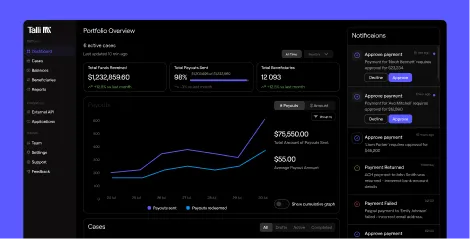
Talli automates and safeguards every claims payout so administrators can meet tight deadlines without losing control over compliance or claimant experience. The platform's cloud-native architecture handles settlement campaigns of any size while maintaining full transparency on completion rates and fund flows through real-time dashboards.
Frequently Asked Questions
What is the typical setup time for implementing a high-volume payment platform?
Setup timelines range from 2-8 weeks for managed services with pre-built integrations to 2-6 months for self-managed blockchain infrastructure requiring custom development. Most organizations achieve production deployment within 4-6 weeks including sandbox testing, compliance configuration, and pilot transactions.
How do platforms handle claimants without bank accounts?
Modern disbursement platforms offer multiple payment rails including prepaid debit cards, digital wallet transfers, and retail cash pickup locations. This flexibility eliminates banking requirements that historically prevented unbanked and underbanked claimants from accessing settlement funds.
What happens when transaction volumes exceed platform capacity?
Auto-scaling triggers automatically provision additional computing resources when predefined thresholds are crossed. Queue-based architectures absorb temporary surges by holding requests until processing capacity catches up. Enterprise platforms with proper scaling rarely experience capacity-related failures.
How do organizations migrate from legacy payment systems to modern platforms?
Migration typically follows a phased approach: parallel operation runs old and new systems simultaneously for validation, followed by gradual transaction shifting, then full cutover. The process takes 6-12 months for payment rails and 12-24 months for core banking system replacements.
What security certifications should high-volume payment platforms maintain?
Enterprise platforms should hold ISO 27001 for information security management, PCI DSS Level 1 for payment card data protection, and SOC 2 Type II for security and availability controls. Additional certifications may be required based on jurisdiction and transaction types.