.svg)


.svg)
Managing mass tort payouts without real-time visibility is like flying blind through regulatory turbulence. According to industry research, fraudulent claims increased 19,000% from 2021 to 2023, while traditional settlement processes typically take 2-4 years from filing to distribution. Modern real-time settlement dashboards transform this chaos into controlled, transparent fund distribution—compressing timelines from weeks to days while achieving 98% payment success rates compared to just 55-77% with traditional checks.
Key Takeaways
- Real-time tracking platforms prevented an estimated 723 million fraudulent claims in 2024 through automated screening and pattern detection
- Digital payout platforms achieve 98% success rates versus 55-77% for paper check distributions
- Implementation timelines typically range from basic setups of 2-4 weeks to 6-8 weeks for complex multi-tier settlements
- Median claim rates remain at just 9% in consumer class actions, but digital-first approaches significantly improve redemption
- Distribution timelines compress from approximately weeks to days with automated real-time tracking
The Challenge: Why Mass Tort Payouts Need Real-Time Tracking
Mass tort settlements present unique distribution challenges that overwhelm traditional spreadsheet tracking. When you're managing thousands of claimants across multiple payment tiers, manual processes create compliance gaps, fraud vulnerabilities, and claimant dissatisfaction that compound with every delayed update.
The scale of modern settlements demands automation. Consider a pharmaceutical mass tort with 10,000 claimants spread across tiered compensation ranging from $5,000 to $150,000 per recipient. Traditional check processing would take 6-8 weeks minimum, cost $15-20 per check, and achieve disappointing redemption rates due to bounced checks, outdated addresses, and processing delays.
The Pitfalls of Traditional Payout Methods
Manual settlement administration creates several critical vulnerabilities:
- Delayed fraud detection — Without real-time screening, fraudulent claims process undetected until post-payment audits reveal the damage
- Court reporting bottlenecks — Compiling status updates from spreadsheets takes days instead of minutes
- Claimant communication gaps — Recipients have no visibility into payment status, generating support inquiries
- Compliance documentation holes — Audit trails become reconstruction projects rather than automatic records
- Fund reconciliation errors — Manual calculations introduce mistakes that delay case closure
The explosion in settlement fraud has made these vulnerabilities existential threats to settlement integrity. Real-time tracking addresses each weakness systematically.
Defining Real-Time Tracking in Legal Payouts: What It Is and Why It Matters
Real-time tracking for mass tort payouts means instant visibility into every aspect of fund distribution—from claimant verification through final payment confirmation. Unlike batch processing systems that update overnight, true real-time platforms show status changes as they occur.
The technology encompasses several integrated components:
- Instant dashboard updates reflecting claimant actions within seconds
- Automated compliance screening running KYC, OFAC, and fraud checks simultaneously
- Live fund flow monitoring showing exactly where settlement dollars reside
- Immediate notification systems alerting administrators to issues requiring attention
- Continuous audit trail generation documenting every transaction automatically
Beyond Basic Reporting: The Power of Live Data
Standard reporting tools tell you what happened yesterday. Real-time tracking tells you what's happening now—and enables proactive intervention before problems escalate.
This distinction matters enormously for compliance in payouts. When a claimant fails OFAC screening, you want immediate notification rather than discovering the issue during month-end reconciliation. When completion rates plateau, you can launch targeted reminder campaigns within hours instead of waiting for weekly reports to reveal the trend.
Achieving Total Control and Visibility with Real-Time Payout Dashboards
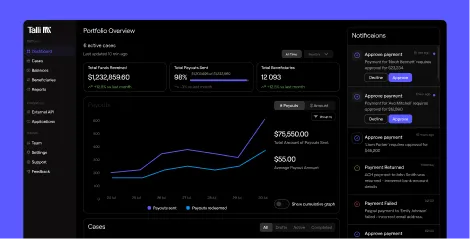
The dashboard serves as mission control for settlement distribution. Modern platforms provide authorized parties access to relevant financial data from a centralized electronic interface, eliminating information silos and status ambiguity.
Effective dashboards display:
- Completion rate metrics — Percentage of claimants who have finished verification and received payment
- Fund allocation status — Current balance, committed amounts, and distributed totals
- Compliance screening results — Flagged claims requiring manual review
- Communication engagement — Open rates, click-through rates, and response patterns
- Payment method distribution — Breakdown of ACH, prepaid cards, digital wallets selected
Customizing Your Payout Dashboard for Optimal Insight
Different stakeholders need different views. Compliance managers focus on screening results and audit documentation. Finance teams monitor fund flows and reconciliation status. Legal operations track completion rates for court reporting.
Role-based permissions ensure each user sees relevant information without unnecessary complexity. Your claims team efficiency improves when dashboards present actionable data rather than overwhelming detail.
Configure automated alerts for:
- Completion rates falling below target thresholds
- Unusual patterns suggesting fraud activity
- Fund balances approaching minimum levels
- Compliance screening backlogs accumulating
- Court reporting deadlines approaching
Streamlining Fund Distribution and Enhancing Compliance with Real-Time Data
Settlement fund management requires meticulous compliance with tax regulations, sanctions screening, and court oversight requirements. Real-time tracking transforms these obligations from administrative burdens into automated workflows.
How Real-Time Data Bolsters Regulatory Adherence
Qualified Settlement Funds (QSFs) demand complete fund segregation with dedicated accounts for every settlement. Modern platforms maintain this separation automatically while providing instant visibility into each fund's status.
Critical compliance integrations include:
- OFAC screening — Real-time sanctions list checking prevents payments to prohibited parties
- KYC verification — Identity confirmation before any funds release
- W-9 collection — Tax documentation gathered automatically during onboarding
- Audit trail generation — Every action logged with timestamps and user attribution
The OFAC compliance requirements alone justify real-time tracking investment. Screening must occur before payment processing, and results require documentation for regulatory review.
Integrating Fraud Prevention into Your Tracking System
Fraudulent claims have become sophisticated operations targeting mass tort settlements. Real-time platforms employ multi-tiered detection approaches including:
- Duplicate claim identification — Pattern matching across submissions
- Synthetic identity detection — AI analysis of provided information
- Bot attack prevention — Recognition of automated submission patterns
- Velocity checks — Flagging unusual submission rate patterns
These protections contributed to the estimated 723 million fraudulent claims prevented in 2024—representing billions of dollars protected from fraudulent distribution.
Improving Claimant Experience Through Transparent Real-Time Updates
Settlement recipients rarely understand the distribution process. This knowledge gap generates anxiety, support inquiries, and ultimately lower redemption rates when frustrated claimants abandon the process.
Real-time tracking enables transparent communication that transforms the claimant experience:
- Secure portal access — Claimants check their own status without contacting support
- Automated progress notifications — SMS and email updates at each milestone
- Payment method selection — Recipients choose ACH, prepaid cards, or digital wallets
- Clear timeline expectations — Accurate estimates based on current processing status
Empowering Claimants with Self-Service Tracking
Modern platforms provide claimants secure links via SMS or email, requiring no account creation. Recipients simply click to view their verification status, payment amount, and expected distribution timeline.
This transparency reduces support volume by approximately 30% or more while improving claimant satisfaction. When recipients can answer their own questions, they're far more likely to complete the redemption process.
Multi-channel communication strategies further boost completion rates. SMS achieves 10-16% response rates compared to 2-3% for email alone. Combining channels increases overall engagement by 30-50% versus single-channel approaches.
Integrating Real-Time Payout Data with Your CRM and Accounting Systems
Isolated payment platforms create data silos that undermine operational efficiency. Effective real-time tracking requires seamless integration with existing case management and accounting systems.
The Benefits of a Unified Data Ecosystem
Bidirectional data synchronization eliminates duplicate entry and reconciliation errors:
- Case management sync — Claimant records update automatically across platforms
- Accounting integration — Payment data flows directly to financial systems
- Document management — Verification records link to case files automatically
- Reporting automation — Court-required updates generated from live data
API integration capabilities determine how smoothly data flows between systems. Modern platforms offer REST APIs enabling custom connections even for teams without dedicated technical resources.
Choosing Compatible Integration Solutions
Evaluate integration readiness against your existing technology stack:
- Native connectors — Pre-built integrations with major case management platforms
- CSV import/export — Batch processing fallback for systems without API support
- Webhook triggers — Event-based notifications enabling real-time system updates
- Custom API development — Tailored connections for proprietary systems
Most enterprise platforms support standard integrations without additional fees, though complex custom connections may require development investment.
Step-by-Step Implementation Process
Implementing real-time tracking follows a predictable sequence that experienced administrators can typically complete within basic setups of 2-4 weeks or 6-8 weeks for complex multi-tier settlements.
Phase 1: Platform Selection and Account Setup (Week 1-2)
Request demos from vendors demonstrating capability with your settlement size and complexity. Compare fraud detection features, integration options, and reporting capabilities before signing contracts and establishing dedicated QSF accounts.
Expected outcome: Vendor account created, QSF accounts established through partner bank, initial training scheduled.
Phase 2: Data Migration and Configuration (Week 2-4)
Export claimant lists from your case management system including names, contact information, and settlement amounts by tier. The vendor uploads data, configures payment tiers, sets up compliance screening parameters, and creates branded claimant portals.
Common stumbling point: Data quality issues with missing emails or incorrect addresses. Solution: Run data hygiene cleanup before migration rather than troubleshooting during distribution.
Phase 3: Integration and Testing (Week 4-6)
Connect platform APIs to existing systems for bidirectional data sync. Customize notification templates, configure dashboard views for different user roles, and process test distributions to verify all workflows function correctly.
Run a soft launch with 50-100 claimants to validate the complete process before full rollout.
Phase 4: Full Distribution Launch (Week 6+)
Send initial notifications to all eligible claimants with secure portal links. Monitor the real-time dashboard for completion rates, engage support teams for claimant assistance, and execute payment batches as verification completes.
Why Talli Delivers Speed, Scale, and Visibility for Mass Tort Payouts
While multiple platforms offer settlement administration capabilities, Talli provides purpose-built infrastructure specifically designed for legal payouts at scale.
Talli's AI-driven platform addresses the core challenges of mass tort distribution:
- Real-time dashboard — Create payout campaigns, track every status, and monitor completion rates from a centralized interface
- Complete fund segregation — Dedicated accounts for every settlement preserve QSF ownership and simplify reporting
- Built-in compliance automation — KYC, OFAC, W-9 collection, fraud mitigation, and audit logs integrated natively
- Flexible payment options — ACH, prepaid Mastercard, digital wallets, and gift cards let claimants choose what works best
- Smart reminder campaigns — Multi-channel outreach across email and SMS drives higher redemption rates
Banking services provided by Patriot Bank, N.A., Member FDIC ensure regulatory compliance and fund security. The Easy Prepaid Mastercard is issued by Patriot Bank, N.A., pursuant to a license from Mastercard International.
For large-scale settlements ranging from 1,000 to 100,000+ recipients, Talli's infrastructure scales without compromising speed or compliance. The platform reduces distribution timelines from weeks to days while providing the transparency courts and stakeholders demand.
Future-Proofing Your Firm with Continuous Real-Time Tracking Innovations
Settlement administration technology continues advancing rapidly. Firms investing in modern platforms today position themselves for emerging capabilities:
- Predictive analytics — AI models forecasting completion rates and identifying at-risk claimants before they abandon redemption
- Enhanced fraud detection — Machine learning algorithms improving pattern recognition across settlements
- Expanded payment options — New digital wallet integrations and cryptocurrency capabilities
- Regulatory automation — Automatic adaptation to changing compliance requirements across jurisdictions
The firms achieving the best outcomes treat real-time tracking as infrastructure rather than software. Building processes around live data visibility creates compounding efficiency gains with each settlement administered.
Frequently Asked Questions
What is real-time tracking in the context of mass tort payouts?
Real-time tracking means instant visibility into every aspect of settlement distribution—from claimant verification through final payment confirmation. Unlike traditional systems updating daily or weekly, real-time platforms show status changes within seconds. This includes compliance screening results, payment processing status, fund balances, and claimant engagement metrics. Administrators can monitor completion rates, identify issues, and launch interventions without waiting for batch reports.
How does real-time tracking prevent fraud in legal settlements?
Real-time tracking platforms employ automated screening that runs continuously as claims are submitted. This includes duplicate detection across submissions, synthetic identity analysis, OFAC sanctions screening, and pattern recognition for bot attacks. In 2024, these systems prevented an estimated 723 million fraudulent claims through immediate detection before payment processing. Without real-time capabilities, fraudulent claims often process undetected until post-distribution audits.
Can claimants track their own payout status in real time?
Yes, modern platforms provide claimants secure links via SMS or email to self-service portals requiring no account creation. Recipients can view their verification status, expected payment amount, selected payment method, and estimated distribution timeline. This transparency reduces support inquiries by approximately 30% or more while improving overall satisfaction and redemption completion rates.
How long does it take to implement a real-time tracking system for mass tort payouts?
Implementation timelines typically range from basic setups of 2-4 weeks to 6-8 weeks for complex multi-tier settlements requiring custom integrations. The primary variables are data quality, settlement complexity, and integration requirements with existing case management systems. Starting QSF account establishment during settlement negotiations rather than after court approval saves 2-4 weeks from the overall timeline.
Is real-time tracking suitable for mass tort payouts of any size?
es, though the implementation approach varies by scale. Settlements under 1,000 claimants can use simpler configurations, while distributions exceeding 10,000 recipients benefit from dedicated support and custom integrations. Modern platforms like Talli handle large-scale settlements from 1,000 to 100,000+ recipients without compromising speed or compliance. The key consideration is matching platform capabilities to settlement complexity rather than raw claimant count alone.