.svg)


.svg)
Manual KYC verification for legal settlements creates massive bottlenecks that delay payouts by months and drain operational budgets. When claims administrators process thousands of claimants through paper-based identity checks, the result is abandonment rates up to 40% and labor costs that can exceed hundreds of thousands of dollars for large settlements. Automated KYC platforms transform this regulatory burden into a streamlined process, achieving up to 85% faster onboarding while integrating OFAC screening, W-9 collection, and fraud mitigation directly into digital disbursement workflows.
Key Takeaways
- Automated KYC reduces verification timelines from weeks to days, achieving an estimated 70-80% time reduction compared to manual processes
- Per-verification costs average $0.30 to $0.50 depending on volume and provider
- Manual KYC causes up to 40% claimant abandonment; automation significantly reduces drop-off rates
- Modern platforms verify thousands of government ID types across 200+ countries through OCR and biometric authentication
- Turnkey legal platforms can deploy in days to weeks, while custom enterprise implementations may take several weeks
- AI-powered fraud detection significantly improves accuracy compared to manual screening
- Mass tort settlements can save tens of thousands of dollars per settlement through automation
Understanding the Imperative of KYC in Digital Claims
Know Your Customer (KYC) verification forms the compliance backbone of every legal settlement distribution. Without proper identity verification, claims administrators face fraud exposure, regulatory penalties, and court challenges that can derail entire payout programs. The stakes compound when settlements involve thousands of claimants across multiple jurisdictions.
Your KYC obligations encompass:
- Identity verification – Confirming claimants are who they claim to be
- OFAC screening – Checking names against sanctions and watchlists
- W-9 collection – Gathering taxpayer identification for IRS reporting
- Fraud detection – Identifying synthetic identities and duplicate claims
- Audit trail creation – Documenting every verification step for court records
The legal payout compliance landscape demands these checks happen before any funds leave the settlement account. Manual processing creates unacceptable delays when courts impose distribution deadlines. Automated KYC platforms eliminate these bottlenecks by processing verifications in minutes rather than weeks.
The Risks of Incomplete KYC
Skipping or rushing identity verification exposes your organization to severe consequences. Fraudulent claims can drain settlement funds meant for legitimate claimants, triggering court intervention and potential malpractice claims. OFAC violations can trigger substantial civil (and sometimes criminal) penalties that vary by sanctions program and are updated for inflation.
Beyond legal risks, incomplete KYC damages claimant trust. When fraud goes undetected, legitimate claimants receive smaller distributions. Your compliance management systems must catch bad actors before they compromise the settlement.
Key Components of Automated KYC Workflows
Automated KYC platforms combine multiple verification technologies into seamless workflows. Understanding these components helps claims administrators select and configure the right solution for their settlement requirements.
Document Verification and Authentication
Modern platforms use OCR (Optical Character Recognition) to extract data from government-issued IDs. Leading solutions support thousands of document types including passports, driver's licenses, and national ID cards across 200+ countries. The verification process checks:
- Document authenticity – Detecting forgeries, alterations, and expired documents
- Data extraction accuracy – Capturing names, dates, and ID numbers
- Cross-reference validation – Matching extracted data against claim submissions
Biometric Authentication
Liveness detection prevents fraudsters from using stolen photos or deepfakes. Claimants take a selfie that the system matches against their ID photo while confirming they're a real person present at verification. iBeta Level 2 certification indicates platforms meeting rigorous anti-spoofing standards.
Sanctions and Watchlist Screening
Real-time OFAC screening checks every claimant against government sanctions lists, Politically Exposed Persons (PEP) databases, and adverse media sources. Understanding your KYC false positive rate becomes critical here—overly sensitive screening creates manual review backlogs while insufficient screening misses genuine risks.
Streamlining Compliance: KYC, OFAC, and W-9 Collection
Effective automation integrates multiple compliance requirements into a single claimant experience. Rather than separate processes for identity verification, sanctions screening, and tax form collection, modern platforms handle everything in one session.
Integrated Compliance Workflow
A well-designed automated workflow processes claimants through:
- Secure link delivery – SMS or email with mobile-optimized verification portal
- ID document upload – Photo capture with real-time quality guidance
- Biometric selfie – Liveness check and facial matching
- OFAC/AML screening – Instant sanctions and watchlist checks
- W-9 collection – Digital tax form capture for payments exceeding $600
- Status notification – Immediate confirmation or escalation for manual review
This integrated approach achieves substantially fewer data entry errors compared to manual processes while creating complete audit trails for court reporting. Your OFAC compliance documentation becomes automatic rather than an administrative burden.
Automating Tax Compliance
Settlements distributing payments above $600 must issue 1099 forms to claimants and the IRS. Automated platforms capture W-9 information during verification, validate TIN (Taxpayer Identification Number) accuracy, and generate 1099s automatically at year-end. This eliminates the manual collection process that often delays distributions.
Enhancing Efficiency and Speed in Payouts
The operational impact of automated KYC extends far beyond compliance. Claims administrators report dramatically faster claimant verification when moving from manual to automated processes. What previously took weeks now happens in days.
From Weeks to Minutes: The Speed Advantage
Traditional manual verification requires:
- Staff time reviewing each ID document
- Phone calls to verify information
- Physical mail for document collection
- Manual data entry into case management systems
- Separate processes for OFAC screening and W-9 collection
Automated systems compress this timeline dramatically:
- Instant document processing – OCR extraction in seconds
- Real-time screening – OFAC checks complete during claimant session
- Immediate status updates – Webhooks notify case management systems instantly
- Batch processing capability – Handle thousands of verifications simultaneously
For a 5,000-claimant settlement, automation reduces verification time from 12 weeks to approximately 2 weeks while cutting labor costs significantly.
Reducing Manual Overhead
Claims team efficiency improves when staff focus on exception handling rather than routine verification. Automated platforms flag only a small percentage of claimants for manual review, freeing your team to address genuine compliance issues rather than processing paperwork.
Boosting Claimant Experience with Seamless Verification
Poor claimant experience directly impacts settlement completion rates. Complex verification processes frustrate claimants who abandon claims rather than navigate confusing requirements. The settlement claimant experience determines whether funds reach their intended recipients.
Mobile-First Design
Most claimants access verification links on smartphones. Effective platforms provide:
- Responsive interfaces – Optimized for iOS and Android devices
- Camera integration – Direct photo capture without file uploads
- Clear guidance – Step-by-step instructions with visual cues
- Progress indicators – Showing verification status throughout the process
Reducing Friction, Increasing Trust
Automated KYC significantly reduces abandonment by eliminating common pain points. Claimants complete verification in a single session without creating accounts or remembering passwords. Smart reminders via SMS and email re-engage claimants who start but don't finish the process.
For claimants without smartphones or technical comfort, well-designed systems offer phone support hotlines and alternative verification paths. Your recipient payment redemption rates improve when every claimant has a viable path to completion.
Protecting Against Fraud and Ensuring Data Security
Settlement fraud has exploded in recent years, with sophisticated schemes targeting mass tort and class action distributions. Automated KYC provides multiple layers of defense against these threats while maintaining the security standards courts demand.
Multi-Layer Fraud Detection
Modern platforms deploy AI-powered fraud detection significantly improving accuracy compared to manual review:
- Synthetic identity detection – Identifying fabricated identities combining real and fake information
- Duplicate claim flagging – Catching claimants submitting under multiple identities
- Device fingerprinting – Identifying suspicious submission patterns
- Velocity checks – Detecting mass submission attacks
The settlement fraud landscape requires proactive defense rather than reactive investigation after funds leave the settlement account.
Security Certifications and Data Protection
Enterprise KYC platforms maintain rigorous security certifications:
- SOC 2 Type II – Independent verification of security controls
- ISO 27001 – Information security management standards
- PCI DSS – Payment card industry data protection
- GDPR/CCPA – Privacy regulation compliance
Data encryption protects sensitive information both in transit (TLS 1.3) and at rest (AES-256). Role-based access controls limit staff visibility to only necessary information.
Integrating KYC with Fund Segregation and Reporting
Automated KYC becomes most powerful when integrated with broader settlement administration systems. The connection between identity verification, fund management, and court reporting creates operational efficiency that standalone tools cannot match.
QSF-Aware Workflows
Qualified Settlement Funds require complete fund segregation with detailed tracking of every dollar from deposit through distribution. Integrated platforms maintain dedicated accounts for each settlement, preserving QSF ownership while simplifying reporting throughout the disbursement lifecycle.
Real-Time Dashboard Visibility
Real-time settlement dashboards transform claims administration by providing:
- Verification completion rates – Track progress against distribution deadlines
- Manual review queue status – Monitor backlog and staff workload
- Fraud flag summaries – Identify emerging patterns requiring investigation
- Fund flow visibility – See every dollar from settlement account to claimant
CRM integration syncs verification status automatically, eliminating manual updates and ensuring case management systems reflect current reality.
Choosing the Right Partner for Automated KYC Solutions
Platform selection determines implementation success. Claims administrators should evaluate providers against legal-specific requirements that generic fintech solutions often lack.
Evaluation Criteria
Consider these factors when selecting a KYC automation partner:
- Legal workflow integration – Does the platform understand QSF compliance and court reporting?
- Multi-rail payment support – Can verified claimants receive funds via ACH, prepaid cards, or digital wallets?
- Volume scalability – Will the platform handle settlements with 100,000+ claimants?
- Implementation timeline – How quickly can you go live with a new settlement?
- Support model – Is dedicated support available during court-mandated deadlines?
Generic KYC providers excel at fintech onboarding but require significant custom development for legal settlements. Purpose-built legal platforms like Talli include QSF integration, court-ready reporting, and transparency in settlement distribution without additional development costs.
Cost Structure Analysis
Pricing models vary significantly across providers:
- Per-verification fees – Averaging $0.30-$0.50 depending on volume
- Monthly subscriptions – $5,000-$75,000 based on feature tier
- Enterprise custom pricing – Negotiated for large settlements
- Legal-specific platforms – Often bundled with payment processing
Calculate total cost including hidden fees for overages, premium support, and additional users. Volume-based pricing often makes automation more cost-effective than manual processing once settlements exceed several thousand claimants.
Why Talli Simplifies KYC for Digital Claim Distributions
While numerous KYC platforms serve general fintech needs, Talli delivers purpose-built solutions specifically designed for legal settlements and mass claims distribution.
Talli's AI-driven payment platform integrates KYC automation directly into the disbursement workflow with:
- Automated Compliance Built-In: KYC, OFAC, W-9 collection, fraud mitigation, and audit logs are baked into every payout—not bolted on as afterthoughts
- Complete Fund Segregation: Dedicated accounts for every settlement preserve QSF ownership and simplify court reporting throughout the disbursement lifecycle
- Flexible Payment Options: Once verified, claimants choose their preferred payment method—ACH, prepaid Mastercard, or digital wallet—no bank account required
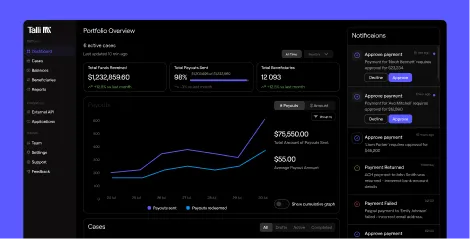
- Real-Time Dashboard Control: Create payout distribution campaigns, track every verification and payout status, and monitor completion rates from a single interface
- Smart Follow-Up Automation: Email and SMS reminders re-engage claimants who start but don't complete verification, driving higher redemption rates
Unlike generic KYC providers requiring custom integration work, Talli provides end-to-end settlement administration from claimant onboarding through final payout. The platform handles verification, compliance documentation, and fund distribution within a single system designed for teams that need compliance, speed, and total visibility.
Banking services are provided by Patriot Bank, N.A., Member FDIC. For claims administrators managing settlements of any size, Talli transforms what used to take weeks into minutes while maintaining the compliance controls courts demand.
Frequently Asked Questions
What is KYC for claims?
KYC (Know Your Customer) is the identity verification process that confirms claimants are who they claim to be before receiving settlement funds. It's crucial for legal distributions because it prevents fraud, ensures OFAC compliance, collects required tax documentation (W-9), and creates audit trails courts require. Without proper KYC, claims administrators risk distributing funds to fraudulent claimants, violating sanctions regulations, and facing legal challenges to settlement administration. Automated KYC achieves substantially faster verification while maintaining these compliance standards.
How does automated KYC prevent fraud?
Automated KYC platforms deploy multiple fraud detection layers including document authenticity verification, biometric liveness detection (preventing photo and deepfake fraud), OFAC/sanctions screening, and AI-powered pattern analysis. These systems significantly improve fraud detection accuracy compared to manual review by identifying synthetic identities, duplicate claims, and suspicious submission patterns in real-time. The automation also creates tamper-proof audit trails documenting every verification decision for court records.
What are KYC integration benefits?
Integrated platforms eliminate the handoff between verification and payment that creates delays and data errors. When KYC is built into the disbursement workflow, verified claimants proceed immediately to payment selection without re-entering information. This integration substantially reduces claimant abandonment, accelerates distribution timelines, and ensures compliance documentation flows automatically to court reports. Platforms like Talli include fund segregation, QSF management, and multi-rail payment options within the same system.
How long does KYC implementation take?
Implementation timelines vary based on platform type and customization requirements. Turnkey legal platforms can deploy in days to weeks, while custom enterprise implementations with extensive API integration may take several weeks. Most implementations include a pilot phase testing with 100-200 claimants before full rollout. For a 10,000-claimant settlement, plan for approximately 2 weeks of platform setup followed by a phased rollout processing several thousand claimants per week.
What are KYC technical requirements?
Technical requirements depend on your integration approach. Pre-built connectors for major case management systems (Salesforce, Litify, Filevine) require no coding—just admin-level configuration. API integration for custom systems requires developer resources familiar with REST APIs and webhooks. All approaches need secure data transfer capabilities, proper user access controls, and compliance with data retention policies (typically 5-7 years for legal settlements). Platforms supporting no-code workflow builders allow compliance officers to configure verification steps without IT involvement.