.svg)


.svg)
Law firms verify payment to eligible consumers through a multi-layered process combining identity validation, fraud detection, and compliance screening that protects settlement funds amid a documented surge in fraudulent settlement submissions: more than 80 million claims submitted in 2023 showed “significant” indicia of fraud—up more than 19,000% since 2021 (per Digital Disbursements/Western Alliance research, reported by Reuters). Modern claims administrators use AI-powered platforms that automate claimant verification while maintaining detailed audit trails for court oversight. Talli's digital disbursement platform streamlines this entire process with built-in KYC, OFAC screening, and fraud mitigation capabilities.
Key Takeaways
- Fraudulent settlement claims have increased dramatically in recent years, making verification the top priority for claims administrators
- The Dr. Dennis Gross settlement processed 8.8 million claim submissions, ultimately validating only 127,000 while rejecting approximately 8.7 million
- Digital payment options can improve payout completion when paired with clear instructions, claimant support, and follow-up nudges.
- Uncashed check tracking costs an estimated $150-300 per payment, creating substantial hidden expenses for law firms
- Trust account violations account for nearly 50% of attorney discipline cases in some states
- Modern digital workflows can compress payout timelines from weeks to days in many cases, but exact timing depends on claim review, payment rails, and exception handling.
What Are the Fundamentals of Class Action Settlements?
Class action settlements involve distributing compensation from a settlement fund to eligible class members who suffered harm from a defendant's actions. The settlement agreement defines eligibility criteria, while claims administrators handle the complex logistics of verifying claimants and disbursing funds.
- Settlement fund structure Defendants deposit agreed amounts into qualified settlement funds that preserve tax advantages and maintain legal compliance throughout distribution.
- Class representative role Named plaintiffs represent the broader class and must approve settlement terms before court submission.
- Claims administrator responsibilities Third-party administrators manage notice processes, claim intake, verification, and payment distribution under court supervision.
- Distribution plan requirements Courts approve detailed plans specifying how funds will be allocated among claimants based on documented harm levels.
Why Does Settlement Verification Matter More Than Ever?
The scale of settlement fraud has reached crisis proportions. In the Jimenez v. Artsana case, approximately 875,000 products were sold but 3.5 million claims were filed. In the JUUL/Altria settlement process, filings cited estimates that valid claims could be around 2 million out of a much larger submission volume, highlighting why verification controls matter. Without robust verification, legitimate claimants receive diluted payments or nothing at all.
How Does the Initial Verification Process Work for Eligible Claimants?
The initial verification process combines document validation with identity screening to separate legitimate claims from fraudulent submissions. This multi-step approach addresses the massive settlement fraud while ensuring eligible consumers receive their rightful compensation.
- Claim form collection Claimants submit forms with personal information, class membership attestations, and supporting documentation through online portals or mail.
- Proof of purchase requirements Product liability settlements often require receipts, order confirmations, or account records demonstrating actual purchase during the claim period.
- Declaration under penalty of perjury Most claim forms include sworn statements that misrepresentation constitutes perjury, creating legal deterrence against fraud.
- Data matching and deduplication AI systems identify duplicate claims from the same individual using name variations, addresses, and device fingerprints.
- Identity verification (KYC) Government ID validation, SSN confirmation, and address verification confirm claimant identities before payment authorization.
What Role Does OFAC Screening Play in Verification?
Banks and payment providers commonly screen payees and transactions against OFAC sanctions lists as part of sanctions compliance. Separate AML monitoring (typically handled by the bank/payment provider) may trigger additional review or reporting where required. Talli automates this process with OFAC screening baked into every transaction.
What Ensures Secure and Compliant Fund Distribution?
Secure fund distribution requires complete segregation between settlement funds and operating accounts, with comprehensive audit trails documenting every transaction. Law firms face severe consequences for compliance failures—trust account violations cause nearly 50% of attorney discipline cases in Michigan alone.
- Qualified settlement fund (QSF) management QSFs provide tax-advantaged vehicles that preserve ownership while simplifying reporting throughout the disbursement lifecycle.
- Complete fund segregation Settlement funds must remain in dedicated accounts separate from firm operating funds—commingling even briefly constitutes an ethical violation.
- Three-way reconciliation Monthly reconciliation between bank statements, trust ledgers, and client ledgers ensures accounting accuracy and audit readiness.
- Banking partner compliance FDIC-insured institutions like Patriot Bank provide the regulatory framework for secure fund custody.
- Comprehensive audit trails Every disbursement requires written authorization and documentation for court review and regulatory compliance.
How Does Talli Maintain Compliance Throughout Distribution?
Talli supports dedicated accounts for every settlement, preserving QSF ownership and ensuring legal compliance throughout the disbursement lifecycle. The platform maintains complete fund segregation with KYC, OFAC, W-9 collection, fraud mitigation, and audit logs built into every workflow.
What Payment Methods Are Available to Settlement Recipients?
Modern settlement administration offers multiple payment channels that accommodate diverse banking situations and preferences. Digital payment rails significantly outperform traditional checks in both speed and redemption rates.
- ACH direct deposit Funds transfer directly to claimant bank accounts within 24-48 hours, eliminating mail delays and lost check issues.
- Prepaid debit cards The Easy Prepaid Mastercard issued by Patriot Bank, N.A. provides immediate access for claimants without bank accounts.
- Digital wallet integration Modern platforms support transfers to PayPal, Venmo, and other digital wallets for maximum claimant convenience.
- Gift card options Gift cards issued by InComm offer flexibility for claimants preferring retail redemption options.
- Traditional paper checks Legacy option maintained for claimants who specifically prefer physical payment, though redemption rates are lower compared to digital alternatives.
Why Do Digital Payments Increase Redemption Rates?
Digital payment options achieve significantly higher redemption rates by removing barriers that cause check abandonment. Claimants receive secure links via SMS or email with no accounts to create, then select their preferred payment method and receive funds within hours rather than weeks.
How Do Claims Administrators Track and Report Settlement Progress?
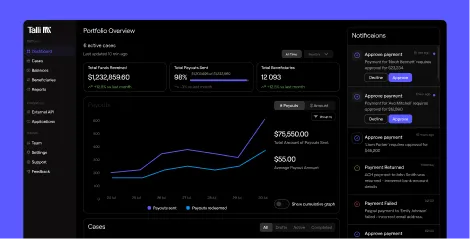
Real-time settlement dashboards provide claims administrators with complete visibility into every aspect of fund distribution. This transparency supports court reporting requirements while enabling proactive management of payment issues.
- Completion rate monitoring Dashboards display real-time percentages of successful payments, pending claims, and failed transactions requiring attention.
- Fund flow tracking Administrators see exactly where every dollar sits in the distribution pipeline, from QSF through final claimant receipt.
- CRM integration Real-time payout data syncs automatically to case management systems, eliminating manual data entry and reconciliation.
- Engagement analytics Metrics reveal which claimants have opened communications, clicked payment links, or abandoned the process midway.
- Audit-ready reporting One-click report generation produces court-compliant documentation for status hearings and final approvals.
What Visibility Does Talli Provide?
Talli delivers full transparency on completion rates, fund flows, and syncs real-time payout data to your CRM. The platform enables administrators to create payout distribution campaigns, track every payment status, and monitor completion rates through a single dashboard.
How Can Law Firms Enhance the Claimant Experience Through Efficient Payouts?
Claimant experience statistics directly impact settlement success metrics and law firm reputation. Streamlined processes that respect claimant time and preferences produce dramatically better outcomes than cumbersome legacy approaches.
- Mobile-first design Claimants receive secure links via SMS or email and complete the entire process from their phones—no accounts to create or apps to download.
- Payment method choice Letting claimants pick what works best for them eliminates barriers that cause abandonment and increases satisfaction.
- Smart reminder systems Automated follow-ups across email, SMS, and other channels help claimants complete the payout process before deadlines expire.
- Customer support access Live operator assistance helps claimants navigate documentation requirements and resolve payment issues quickly.
- Progress transparency Self-service portals let recipients track payment status without contacting administrators.
How Do Smart Reminders Improve Redemption Rates?
Higher take-up rates result from smart follow-ups that reach claimants through their preferred channels at optimal times. Outbound calling proves particularly effective for high-value payments, while automated SMS reminders work well for routine distributions.
What Happens to Unclaimed Funds in Class Action Settlements?
Unclaimed settlement funds create administrative burdens and potential legal complications when claimants fail to collect payments. Traditional methods see a significant percentage of checks go uncashed, costing an estimated $150-300 per payment to track and reconcile.
- Escheatment requirements State dormancy laws require unclaimed funds to be remitted to state treasuries after specified holding periods, typically 1-5 years.
- Cy pres distribution Courts may direct residual funds to charitable organizations whose mission aligns with the interests of class members.
- Secondary distribution rounds Some settlement agreements allow pro-rata redistribution of unclaimed amounts to claimants who successfully received initial payments.
- Address update campaigns Skip tracing services and address verification help locate missing claimants before funds become subject to escheatment.
- Due diligence documentation Administrators must demonstrate reasonable efforts to locate claimants before treating funds as abandoned.
How Is Technology Transforming Settlement Payment Verification?
AI-driven platforms have fundamentally changed what's possible in settlement administration. The Dr. Dennis Gross settlement demonstrates this transformation—8.8 million claim submissions were processed, ultimately validating only 127,000 and rejecting approximately 8.7 million, ensuring valid claimants received an average of $41 per payment instead of about $0.60 per claim if all 8.8 million submissions had been treated as valid.
- Three-layer fraud defense Modern platforms deploy Web Application Firewalls (WAF), AI bot detection, and human fraud specialists working together to stop illegitimate claims.
- Fuzzy matching algorithms AI identifies abnormal patterns by comparing claims against each other, flagging suspicious similarities that manual review would miss.
- Device fingerprinting Digital signatures from submission devices link multiple claims to single sources, exposing mass fraud attempts.
- Scalability without compromise Enterprise platforms process millions of payments simultaneously while maintaining compliance controls and real-time reporting.
- Continuous monitoring Suspicious IP addresses and domains are tracked across all settlements, building intelligence that improves fraud detection over time.
Why Is Talli the Preferred Platform for Modern Settlement Verification?
Talli automates and safeguards every claims payout so administrators can meet tight deadlines without losing control over compliance or claimant experience. The platform launches, funds, and tracks payouts faster than ever—whether distributing to 1,000 or 100,000 recipients. With KYC false positive management built in, Talli ensures legitimate claimants aren't blocked while fraudulent ones are stopped.
Frequently Asked Questions
What information do claimants need to provide to receive settlement payment?
Requirements vary by settlement type but typically include government-issued ID, proof of address, SSN for tax reporting, and documentation of harm such as purchase receipts or account records. Some settlements allow self-certification without proof of purchase for smaller payment tiers.
How long does settlement payment take after claim approval?
Traditional paper check methods require 7-14 days for mailing plus 3-5 days for bank clearing. Digital platforms like Talli deliver funds within 24-48 hours of approval, with some payment methods providing same-day access.
Are there fees for receiving settlement payments?
Most settlement agreements prohibit deducting fees from claimant payments. Digital payment options like ACH and prepaid cards typically carry no recipient fees, while some digital wallets may assess standard transfer charges.
What happens if claimants move after submitting a claim?
Claimants should update their contact information through the claims administrator portal immediately. Modern platforms track failed deliveries and attempt re-contact through multiple channels. Traditional check systems often require formal reissuance requests.
How do law firms protect personal information during payment processing?
Settlement administrators employ bank-grade encryption, multi-factor authentication, and continuous fraud monitoring. Platforms like Talli maintain PCI DSS compliance and SOC 2 Type II certification for data security, with banking services provided by Patriot Bank, N.A., Member FDIC.