.svg)


.svg)
Distributing settlement funds to international claimants presents significant challenges that traditional wire transfers simply cannot address efficiently. Manual cross-border payments typically cost over $50 per transaction when including sending, intermediary, and receiving bank fees, take up to five business days, and are prone to errors from incorrect banking details. Modern digital payment platforms now automate currency conversion, compliance screening, and local payment method selection, transforming what used to take weeks into same-day settlements while cutting costs by up to 93%. For claims administrators managing multi-country distributions, localized payout experiences have become essential for maximizing redemption rates and meeting court-mandated deadlines.
Key Takeaways
- Modern payout platforms reduce failed payments by 88% through automated bank account verification versus manual data collection
- Local payment rails like SEPA, PIX, and ACH are significantly more cost-effective than international wire transfers
- Settlement speed improves from 5 days to same-day when using digital wallets and real-time payment networks
- Self-service claimant portals demonstrably reduce support ticket volume by eliminating "where's my payment?" inquiries
- The payment orchestration market is projected to grow from $1.5 billion to $8.1 billion by 2032, reflecting rapid enterprise adoption
- AI-driven payment routing reduces transaction failures by 38% through intelligent gateway selection
Understanding the Complexity of International Payments in Legal Settlements
Cross-border settlement distributions involve far more than simply sending money overseas. Each country maintains distinct banking regulations, tax requirements, and preferred payment methods that claims administrators must address to ensure claimants actually receive their funds.
The core challenges include:
- Currency conversion risks where exchange rate fluctuations between approval and settlement can cost 2-4% of payout value
- Banking infrastructure gaps leaving unbanked populations in emerging markets without traditional payment options
- Regulatory fragmentation across jurisdictions requiring different compliance documentation
- Settlement timing varying from instant to five business days depending on payment method and destination
- Hidden fee structures where intermediary banks add charges claimants don't see until funds arrive
Traditional wire transfers compound these issues. A class action settlement paying 50,000 international claimants through SWIFT transfers faces roughly $1.75–$2.75 million in wire fees alone depending on bank routes. When factoring in staff time for manual data collection, compliance verification, and failed payment remediation, the true cost of legacy payment methods becomes unsustainable.
Leveraging Technology for Seamless Cross-Border Payouts
How AI Streamlines Global Fund Distribution
Artificial intelligence transforms international payment processing by automating decisions that previously required manual intervention. Modern platforms use AI to analyze recipient locations, payment amounts, and available methods to select optimal routing in real-time.
Key AI capabilities include:
- Intelligent gateway selection routing payments through the lowest-cost, fastest channel per destination
- Fraud pattern detection identifying suspicious transactions before funds leave your account
- Currency optimization suggesting timing and hedging strategies based on market analysis
- Predictive compliance flagging potential regulatory issues before they block payments
- Automated reconciliation matching incoming confirmations with outgoing payment records
The impact is measurable. AI-driven routing reduces payment failures by 38% compared to static payment configurations, while 68% of enterprises now use API-based payment orchestration to manage cross-border transactions.
The Role of Digital Wallets in Enhancing Claimant Experience
Digital wallets eliminate the primary friction point in international payouts: collecting accurate banking details. Instead of requiring claimants to provide IBAN numbers, SWIFT codes, and routing information, wallet-based payments need only an email address or phone number.
Popular wallet options vary by region:
- PayPal maintains broad global coverage for developed markets
- Alipay and WeChat Pay dominate Chinese claimant populations
- M-Pesa serves East African recipients without traditional bank accounts
- PIX enables instant payments throughout Brazil
- UPI handles real-time transfers across India
Platforms supporting 550+ payment methods across 130+ countries ensure claimants can receive funds through their preferred channel. This flexibility directly impacts redemption rates, as claimants who face payment friction simply abandon the process.
Managing International Compliance: KYC, OFAC, and Local Regulations
Ensuring Regulatory Adherence in Global Claim Settlements
International payouts trigger compliance requirements across multiple jurisdictions simultaneously. Failure to screen recipients against sanctions lists or collect proper tax documentation exposes settlement administrators to significant legal and financial penalties.
Critical compliance requirements include:
- OFAC sanctions screening against the Specially Designated Nationals (SDN) list before any payment
- KYC verification confirming recipient identity matches settlement records
- Tax form collection including W-8 forms for non-US recipients and W-9 forms for US claimants
- AML monitoring tracking payment patterns for suspicious activity
- GDPR adherence for European claimant data handling
The regulatory landscape continues expanding. PSD2 requirements govern European payment processing, while FATF recommendations influence anti-money laundering standards globally. Your compliance management processes must adapt continuously to these evolving requirements.
Automated Compliance Checks for Peace of Mind
Manual compliance verification cannot scale to meet the demands of large settlement distributions. Modern platforms automate compliance through:
Sanctions Screening: Real-time OFAC checks against every recipient before payment initiation, with automatic holds on flagged transactions pending review.
Tax Form Collection: Integrated W-8/W-9 collection within claimant onboarding workflows, blocking payouts until documentation is complete. Automated TIN validation reduces incomplete submissions by 80%.
Audit Trail Generation: Immutable logs documenting every compliance check, approval, and payment status change for court reporting and regulatory examinations.
Multi-Jurisdiction Licensing: Platforms licensed across US, EU, UK, and Asia-Pacific regions ensure payments comply with local requirements without administrator intervention.
Optimizing Payout Options for Global Claimants
Providing Flexible Payment Methods Across Borders
Claimant demographics vary dramatically across international settlements. A data breach class action might include tech-savvy users comfortable with digital wallets alongside elderly recipients who've never used online banking. Accommodating this diversity requires multiple payment options per region.
Effective localization provides:
- Bank transfers via local rails (SEPA for Europe, ACH for US, Faster Payments for UK)
- Digital wallets matching regional preferences
- Prepaid cards for recipients without bank accounts
- Mobile money for emerging market populations
- Gift cards as alternative redemption options
The key insight: forcing claimants into a single payment method guarantees abandonment. Platforms offering choice across 200+ countries with multiple methods per region consistently outperform single-method alternatives on completion rates.
Boosting Redemption Rates with Diverse Payout Choices
Settlement redemption rates directly correlate with payment method availability. When claimants encounter barriers—whether requiring a bank account they don't have or navigating confusing international transfer instructions—they abandon the process entirely.
Strategies to maximize redemption include:
- No bank account required options using prepaid cards or digital wallets
- Self-service selection letting claimants choose their preferred method
- Mobile-first design recognizing most international access occurs via smartphone
- Local currency presentation eliminating confusion about exchange rates
- Smart reminder sequences via email and SMS in the claimant's language
One insurance claims platform achieved a 99.5% success rate processing $160 million in payouts by implementing localized payment options with automated verification.
Enhancing Claimant Experience in a Global Context
The Importance of Language and Cultural Sensitivity in Payouts
International claimants interacting with English-only payment portals face immediate friction. Even recipients fluent in English may distrust communications that don't match their local language or cultural expectations.
Effective localization requires:
- Multi-language portals supporting 27+ languages for global coverage
- Local date formats matching regional conventions
- Culturally appropriate communication avoiding idioms that don't translate
- Regional support hours ensuring assistance during local business times
- Localized payment terminology using familiar banking terms per country
White-label portals displaying the settlement administrator's brand (rather than an unknown third-party platform) further build trust. Claimants verify they're interacting with an official source rather than a potential scam.
Providing Unrivalled Support to International Claimants
Support requirements multiply with international distributions. Claimants in different time zones, speaking different languages, with different banking systems all need assistance navigating the payout process.
Comprehensive support strategies include:
Self-Service Resources: FAQ pages, video tutorials, and step-by-step guides addressing common questions before they become support tickets.
Multi-Channel Access: Email, chat, and phone support covering major languages and time zones.
Proactive Communication: Status updates and smart reminders preventing inquiries about payment timing.
Escalation Paths: Clear procedures for complex situations requiring manual intervention.
Self-service portals demonstrably reduce support burden, allowing claimants to track payment status and update their own information without contacting administrators.
Streamlining Claims Management with Centralized Visibility
Gaining Total Control Over Global Payout Campaigns
Managing international distributions without centralized visibility creates chaos. When payment status lives across fifteen different banking portals, multiple spreadsheets, and scattered email threads, administrators cannot answer basic questions about campaign progress.
Real-time dashboards provide essential visibility:
- Payout status tracking showing pending, processing, completed, and failed payments
- Completion rate monitoring identifying bottlenecks in the redemption process
- Geographic breakdown revealing which regions lag behind expectations
- Fund flow visualization tracking money from source accounts through to recipient wallets
- Exception management surfacing failed payments requiring manual attention
This visibility transforms stakeholder reporting. Instead of compiling data from multiple sources for court filings or client updates, administrators export consolidated reports directly from their dashboard.
Integrated Reporting for Cross-Border Settlements
Reconciliation complexity grows exponentially with international payments. Each currency requires separate tracking, exchange rates must be documented at transaction time, and intermediary fees need allocation to specific payouts.
Automated reconciliation capabilities include:
- Multi-currency consolidation presenting all payments in base currency for reporting
- Real-time sync with accounting systems eliminating manual journal entries
- Exchange rate documentation capturing actual rates applied to each transaction
- Fee allocation attributing costs to specific settlements or claimant groups
- Audit-ready exports formatted for court, trustee, or regulatory requirements
Organizations report reducing reconciliation time by up to 80% through automated platform integration with their accounting systems.
The Benefits of Automated Payouts for International Legal Teams
Saving Weeks: The Speed Advantage of Automated Global Payouts
Traditional international settlement distribution follows a painful timeline: collect banking details via email (2-3 weeks), verify information manually (1-2 weeks), process payments through banking portals (1 week), remediate failures (2-4 weeks). Total elapsed time often exceeds three months.
Automated platforms compress this dramatically:
- Recipient onboarding: Claimants self-enter verified banking details in 3-5 minutes
- Compliance screening: Automated OFAC/KYC checks complete in seconds
- Payment initiation: Batch processing thousands of payments simultaneously
- Settlement: Same-day to 48 hours depending on method and destination
- Exception handling: Automated retries with immediate failure notifications
What used to take weeks now takes minutes. This speed advantage matters enormously when courts mandate distribution deadlines or when claimants urgently need funds.
From Manual to Automated: Transforming Cross-Border Disbursements
The ROI of automation becomes obvious at scale. Consider a settlement administrator processing 50,000 international claimants: traditional wire transfer methods incur approximately $1.75 million in fees alone, plus substantial staff time for manual processing and failed payment remediation. Automated platforms reduce transaction fees dramatically while eliminating most manual labor, delivering savings of up to 93%.
Beyond direct costs, automation eliminates the reputational risk of delayed payments, reduces compliance exposure, and frees staff for higher-value activities.
Selecting Your International Payout Platform: Key Considerations
What to Look for in a Global Payment Partner
Not all payment platforms serve legal settlement requirements equally. General-purpose fintech solutions designed for marketplace sellers or gig economy payments may lack critical compliance features administrators need.
Essential evaluation criteria include:
- Geographic coverage matching your claimant population locations
- Payment method diversity ensuring options for banked and unbanked recipients
- Compliance automation including OFAC screening, KYC verification, and tax form collection
- Fund segregation maintaining dedicated accounts per settlement for QSF ownership preservation
- Audit trail completeness documenting every action for court reporting
- White-label capability presenting your brand rather than confusing third-party names
- Integration flexibility connecting with existing case management systems
Settlement administration demands features that consumer payment apps don't provide. Evaluate platforms specifically against legal payout requirements rather than general payment capabilities.
Evaluating Platforms for Compliance and User Experience
Platform selection requires balancing administrative efficiency against claimant experience. The best solution minimizes friction for both sides simultaneously.
For administrators, prioritize:
- Batch payment processing handling thousands of transactions efficiently
- Real-time visibility into payment status without manual tracking
- ERP integration syncing with accounting systems automatically
- Configurable approval workflows matching your internal controls
- Responsive support from teams familiar with legal settlement requirements
For claimants, prioritize:
- Simple onboarding requiring minimal information entry
- Payment choice accommodating diverse preferences
- Mobile accessibility functioning smoothly on smartphones
- Clear communication explaining next steps and timing
- Reliable delivery ensuring funds arrive as promised
Platforms achieving both administrator efficiency and claimant satisfaction deliver measurably higher redemption rates and lower total cost per payout.
Future-Proofing Your Legal Payout Strategy with Innovation
Staying Ahead: Adapting to Evolving Payment Landscapes
The cross-border payment landscape continues evolving rapidly. Real-time payment networks now operate in over 60 countries, digital wallet adoption accelerates globally, and regulatory frameworks increasingly mandate faster settlement times.
Emerging trends to monitor include:
- Instant payment expansion as more countries launch real-time gross settlement systems
- Central bank currencies potentially simplifying cross-border transfers
- Open banking APIs enabling direct account-to-account payments without intermediaries
- Embedded finance integrating payment capabilities directly into case management workflows
- Regulatory harmonization gradually standardizing compliance requirements across jurisdictions
Platforms built on modern API architectures adapt more readily to these changes than legacy systems requiring extensive customization.
The Role of AI in the Next Generation of Legal Payouts
Artificial intelligence capabilities continue expanding beyond basic automation. Next-generation applications include:
- Predictive analytics forecasting redemption rates by claimant segment
- Natural language processing enabling conversational queries about payment status
- Anomaly detection identifying potential fraud patterns before funds transfer
- Dynamic optimization continuously improving routing decisions based on outcome data
- Automated documentation generating court-ready reports without manual compilation
The payment orchestration market growth to $8.1 billion reflects enterprise recognition that AI-driven platforms deliver measurable advantages over manual processes.
Why Talli Simplifies International Claimant Payouts
While multiple platforms address cross-border payments, Talli delivers purpose-built solutions specifically designed for legal settlement distribution and mass claims administration.
Talli's AI-driven payment platform provides comprehensive international payout capabilities:
- Multi-Method Flexibility: Claimants select their preferred payment option including digital wallets, prepaid cards, and direct bank transfers—no bank account required for participation
- Automated Compliance: KYC, OFAC screening, W-9 collection, and fraud mitigation baked into every transaction with complete audit logs for court reporting
- Complete Fund Segregation: Dedicated accounts for every settlement preserve QSF ownership, simplify reporting, and ensure legal compliance throughout the disbursement lifecycle
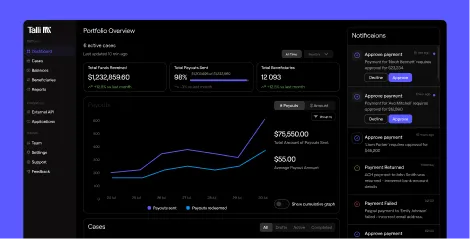
- Real-Time Dashboard: Create payout campaigns, track every payment status, and monitor completion rates with built-in reporting for stakeholders
- Smart Follow-Ups: Automated reminders across email and SMS help claimants complete the payout process, driving higher redemption rates
- Scalable Infrastructure: Power payouts at any size, whether 1,000 or 100,000 recipients
Banking services are provided by Patriot Bank, N.A., Member FDIC. The Easy Prepaid Mastercard is issued by Patriot Bank, N.A., pursuant to a license from Mastercard International.
For claims administrators managing international distributions, Talli eliminates the complexity of cross-border payments while maintaining the compliance rigor legal settlements demand. What used to take weeks now takes minutes—with full transparency on fund flows, completion rates, and claimant engagement.
Frequently Asked Questions
What are the main challenges of making international legal payouts?
The primary challenges include high transaction costs from wire transfer fees, lengthy settlement times (3-5 business days for SWIFT transfers), complex compliance requirements across jurisdictions (OFAC, KYC, tax documentation), and payment failures from incorrect banking details when collecting information manually. Currency exchange rate fluctuations can also erode payout values by 2-4% between approval and settlement without proper hedging strategies.
How does an AI-driven payment platform help with international compliance?
AI-driven platforms automate compliance checks that would otherwise require manual review. This includes real-time OFAC sanctions screening against every recipient, automated W-8/W-9 tax form collection integrated into claimant onboarding, KYC identity verification, and fraud pattern detection. Automated compliance reduces processing time from weeks to seconds while generating complete audit trails for court reporting. Platforms report 38% fewer payment failures through AI-driven routing and compliance automation.
Can claimants without a traditional bank account receive payments internationally?
Yes. Modern payout platforms offer multiple alternatives for unbanked recipients including prepaid debit cards, digital wallets (PayPal, Alipay, M-Pesa), mobile money transfers, and gift cards. These options are particularly important for emerging market claimants where traditional banking penetration remains low. Platforms supporting 550+ payment methods ensure recipients can access funds regardless of their banking status.
What security measures are in place for cross-border transactions?
Enterprise payout platforms implement multiple security layers including AES-256 encryption for data at rest, TLS 1.2+ encryption in transit, SOC 2 Type II certification, PCI-DSS Level 1 compliance for card payments, and role-based access controls with multi-factor authentication. Additionally, automated OFAC screening, AML monitoring, and fraud detection systems protect against unauthorized transactions. Complete audit trails document every action for regulatory examinations and court filings.
How quickly can international claimants receive their funds using a modern platform?
Settlement speed depends on payment method and destination. Digital wallets and real-time payment networks (PIX in Brazil, UPI in India, Faster Payments in UK) deliver funds instantly to the same-day. Local bank transfers via ACH or SEPA typically settle within 1-3 business days. Traditional wire transfers remain the slowest option at 3-5 business days. Modern platforms automatically route payments through the fastest available method per destination, dramatically reducing the weeks-long timelines associated with manual processing.