.svg)


.svg)
Mapping settlement workflows to API endpoints transforms how claims administrators process legal payouts—reducing manual handoffs and compressing distribution timelines (often from days to hours, depending on verification and payment rails). Modern API payment platforms eliminate manual bottlenecks by automating fund distribution, compliance verification, and claimant communication through programmable endpoints. For claims teams managing thousands of recipients, understanding how each workflow stage connects to specific API functions means the difference between seamless disbursement and operational chaos that threatens court-mandated deadlines.
Key Takeaways
- Settlement workflows break into discrete stages—intake, verification, approval, disbursement, and reconciliation—each mappable to specific API endpoints
- Claims team efficiency can improve significantly when manual processes are replaced with automated API calls
- API-driven workflows enable real-time tracking of every payout status from initiation to completion
- Compliance automation through APIs can automate routine KYC/sanctions checks and tax-form collection, while routing matches/edge cases to manual review.
- High-volume payouts scale efficiently when workflow states trigger automated endpoint responses
- Redemption rates can increase when API-powered smart reminders reach claimants through multiple channels
- Settlement administrators can reduce distribution timelines from weeks to days through proper API integration
Understanding Settlement Workflows: The Foundation for API Integration
Before mapping anything to API endpoints, you need complete clarity on your existing settlement workflow structure. Every legal payout follows a predictable sequence of stages, each requiring specific actions, data inputs, and compliance checks. The goal of API integration is to automate these stages while maintaining the control and visibility claims administrators require.
A typical settlement workflow includes:
- Claimant intake — Receiving and validating claim submissions
- Identity verification — KYC checks, document validation, fraud screening
- Eligibility determination — Confirming claimants meet settlement criteria
- Payment calculation — Determining individual payout amounts based on settlement terms
- Compliance screening — OFAC checks, W-9 collection, tax reporting requirements
- Fund segregation — Ensuring proper QSF ownership and account separation
- Disbursement execution — Actual payment delivery through chosen methods
- Reconciliation — Matching payments with records and generating audit trails
Each stage represents a distinct workflow state that can map to one or more API endpoints. Understanding this foundation ensures your API integration approach addresses every operational requirement without creating gaps in your compliance framework.
Why Traditional Workflows Fall Short
Manual settlement processing creates inefficiencies that API integration eliminates. Spreadsheet-based tracking forces rekeying information across systems, introducing errors and delays. Replacing spreadsheet limitations with API-connected systems ensures data flows automatically between stages. Manual OFAC and KYC checks slow disbursement timelines, while reaching claimants through manual email limits redemption rates. According to Federal Reserve research on payment systems, automated payment processing reduces error rates and speeds settlement times substantially compared to manual methods.
The Power of API Integration for Streamlined Settlements
API integration fundamentally changes settlement administration by creating programmable connections between workflow stages and system actions. Instead of manually triggering each step, properly mapped APIs execute automatically based on workflow state changes.
What API Integration Delivers
For claims administrators, API integration provides:
- Speed — Automated processing eliminates manual handoffs between stages
- Accuracy — Programmatic data handling reduces human error
- Compliance — Built-in verification at every transaction point
- Visibility — Real-time dashboards showing every payout status
- Scalability — Handle thousands of recipients without proportional staff increases
- Audit trails — Complete documentation of every action for regulatory review
How API Endpoints Work in Settlement Context
An API endpoint is a specific URL that accepts requests and returns responses. In settlement workflows, each endpoint corresponds to a particular action:
- POST /campaigns — Creates a new settlement distribution campaign with defined parameters
- POST /claimants — Adds individual recipients to an active campaign
- GET /claimants/{id} — Retrieves current status and information for a specific claimant
- POST /payouts — Initiates a payment to a verified recipient
- GET /payouts/{id}/status — Returns real-time status of a specific disbursement
- POST /verify — Triggers compliance screening for a claimant
- GET /reports — Generates reconciliation and completion rate data
Understanding this endpoint structure helps claims teams communicate requirements to developers or evaluate platform capabilities during vendor selection.
Mapping Workflow States to API Endpoints: A Step-by-Step Guide
Converting your settlement workflow into API-ready processes requires systematic analysis of each stage, its triggers, required data, and expected outcomes. This mapping exercise creates the blueprint for technical implementation.
Step 1: Document Current Workflow States
Start by listing every distinct state a claimant passes through in your settlement process:
- Pending — Claim submitted, awaiting review (trigger: Form submission)
- Verification Required — Identity documents needed (trigger: Manual review flag)
- Verified — KYC/compliance passed (trigger: Reviewer approval)
- Eligible — Meets settlement criteria (trigger: Manual confirmation)
- Payment Pending — Approved, awaiting disbursement (trigger: Batch scheduling)
- Disbursed — Payment sent (trigger: Manual processing)
- Completed — Funds received by claimant (trigger: Bank confirmation)
- Failed — Payment returned or rejected (trigger: Bank notification)
Step 2: Identify Data Requirements for Each State
Each workflow state requires specific data inputs and produces outputs that feed subsequent stages:
Verification Required state needs:
- Claimant ID and contact information
- Required document types
- Submission deadline
- Communication preferences
Verified state produces:
- Verification timestamp
- Reviewer ID or system reference
- Compliance check results
- Risk score (if applicable)
Step 3: Map States to API Operations
Connect each state transition to the appropriate API endpoint and HTTP method:
Pending → Verification Required
- Endpoint: POST /claimants/{id}/verification-request
- Payload: Document requirements, deadline, notification preferences
- Response: Request confirmation, communication record
Verification Required → Verified
- Endpoint: POST /claimants/{id}/verify
- Payload: Submitted documents, verification type
- Response: Pass/fail status, compliance flags, next action
Eligible → Payment Pending
- Endpoint: POST /payouts
- Payload: Claimant ID, amount, payment method, campaign reference
- Response: Payout ID, estimated delivery, transaction reference
Step 4: Define Webhook Events for Status Updates
Webhooks enable real-time notifications when external events affect your workflow:
- payment.completed — Bank confirms funds delivered
- payment.failed — Transaction rejected or returned
- verification.expired — Document submission deadline passed
- compliance.flagged — OFAC or fraud alert triggered
Your system listens for these events and automatically updates workflow states without polling the API continuously.
Enhancing Efficiency with Workflow Automation Tools and APIs
Workflow automation extends beyond basic API calls to include intelligent routing, conditional logic, and multi-channel communication. Modern settlement platforms combine these capabilities to minimize manual intervention while maximizing completion rates.
Rule-Based Processing
Automated workflows apply business rules at each stage without human review:
- Amount thresholds — Payments above $10,000 trigger enhanced verification
- Risk scoring — High-risk claimants route to manual review queues
- Document validation — Automated checks for required information completeness
- Compliance flags — OFAC matches pause disbursement pending investigation
These rules execute through API calls that evaluate conditions and trigger appropriate actions. Your compliance framework benefits from consistent application of verification requirements. FDIC guidance emphasizes strong due diligence, controls, and ongoing monitoring when working with payment processors—automation can help enforce these controls consistently while flagging exceptions for review.
Smart Follow-Up Automation
Redemption rates can increase substantially when automated reminders reach claimants through their preferred channels:
- SMS notifications when action is required
- Email follow-ups with direct links to complete verification
- Escalation sequences for non-responsive claimants
- Alternative contact attempts when primary methods fail
APIs power this communication by triggering messages based on workflow state and elapsed time without manual intervention. McKinsey research on digital engagement shows multi-channel automated outreach substantially improves completion rates compared to single-channel manual approaches.
Key API Design Principles for Secure and Compliant Payouts
Settlement APIs must address unique security and compliance requirements that general payment APIs may overlook. Understanding these principles helps claims administrators evaluate platforms and ensure proper implementation.
Authentication and Authorization
Secure API access requires multiple layers:
- API keys — Unique credentials for each integration
- OAuth 2.0 — Token-based authentication with limited lifespans
- Role-based access — Different permissions for administrators, reviewers, and systems
- IP whitelisting — Restrict API access to known servers
Your vendor should provide detailed documentation on authentication requirements and support two-factor authentication for portal access.
Compliance Automation Through APIs
OFAC screening and KYC verification integrate directly into disbursement workflows:
Pre-payment screening:
- Endpoint: POST /claimants/{id}/compliance-check
- Checks performed: OFAC, PEP lists, adverse media
- Response: Clear/flagged status with match details
Document collection:
- Endpoint: POST /claimants/{id}/documents
- Supported types: W-9, government ID, address verification
- Validation: Automated completeness and format checks
Audit logging:
- Every API call generates immutable audit records
- Timestamps, user IDs, and data changes captured automatically
- Export endpoints provide compliance reporting on demand
Data Encryption and Privacy
Settlement APIs must protect sensitive claimant information:
- TLS 1.2+ encryption for all data in transit
- AES-256 encryption for stored data
- Tokenization of payment credentials
- Data minimization — APIs request only required information
- Retention policies — Automatic purging per regulatory requirements
PCI DSS compliance is essential for any platform handling payment card data.
Real-Time Tracking and Reporting through API Endpoints
Visibility into payout status transforms claims administration from reactive firefighting to proactive management. API-powered dashboards provide the transparency stakeholders demand throughout the disbursement lifecycle.
Status Monitoring Endpoints
Real-time tracking APIs deliver current state for individual payouts and aggregate campaigns:
Individual payout status:
GET /payouts/{id}/status
Response: {
"status": "in_transit",
"payment_method": "digital_wallet",
"initiated_at": "2024-01-15T14:30:00Z",
"estimated_delivery": "2024-01-15T14:35:00Z"
}
Campaign-level metrics:
GET /campaigns/{id}/metrics
Response: {
"total_recipients": 15000,
"completed": 12450,
"pending": 2100,
"failed": 450,
"completion_rate": 83.0
}
System Integration Capabilities
APIs enable bidirectional data flow between settlement platforms and existing systems:
- Case management sync — Payment status updates flow to legal case files
- Accounting integration — Disbursement records populate general ledger automatically
- Reporting tools — Business intelligence platforms pull settlement data via API
- Communication platforms — Claimant contact history syncs across systems
This integration eliminates duplicate data entry and ensures all stakeholders work from current information. Reconciliation processes become straightforward when systems share a single source of truth.
Building a Robust API Integration Platform for Legal Services
Claims administrators evaluating API integration platforms should assess capabilities against settlement-specific requirements that generic payment processors may not address.
Essential Platform Capabilities
Your integration platform must support:
- Fund segregation — Structures (e.g., separate accounts or trusts) that satisfy QSF segregation requirements where applicable.
- Multiple payment methods — Digital wallets, prepaid cards, ACH, and checks from single API
- Flexible payout options — Claimants choose preferred method without bank account requirement
- Scalable infrastructure — Handle 1,000 or 100,000 recipients without performance degradation
- Developer resources — Comprehensive documentation, SDKs, and sandbox environments
Implementation Considerations
Successful API integration requires planning beyond technical connectivity:
Phased rollout:
- Start with pilot campaign to validate integration
- Monitor error rates and processing times
- Scale gradually while optimizing based on results
Error handling:
- Define retry logic for transient failures
- Create manual review queues for systematic errors
- Build alerting for unusual patterns
Testing frameworks:
- Sandbox environments for pre-production validation
- Test cases covering normal and edge scenarios
- Load testing for high-volume campaigns
Achieving Higher Redemption Rates with Smart API-Driven Follow-Ups
Payout completion rates directly impact settlement success. API-powered communication automation can significantly improve claimant engagement and redemption outcomes.
Multi-Channel Outreach
APIs trigger communications across channels based on claimant preferences and response patterns:
- Initial notification — SMS or email when payment is ready
- Reminder sequence — Escalating urgency as deadline approaches
- Channel switching — Try alternate contact method after non-response
- Final notice — Urgent communication before fund escheatment
Each touchpoint executes through API calls that log delivery status and update workflow accordingly.
Personalized Communication
API-driven messaging enables customization beyond mail merge:
- Payment method recommendations based on claimant profile
- Localized content for diverse recipient populations
- Accessibility accommodations for specific needs
- Timing optimization based on engagement patterns
These personalizations improve customer support quality while reducing inbound inquiry volume.
Abandonment Recovery
When claimants start but don't complete the payout process, APIs enable targeted recovery:
Trigger: Claimant views payment options but doesn't select
API action: Send follow-up with method comparison
Result: Reduced abandonment at decision point
Trigger: Claimant enters partial information then exits
API action: Save progress, send completion link
Result: Resume capability increases conversions
These automated interventions increase redemption rates without requiring manual outreach. Research from Deloitte on digital payment adoption confirms that multi-channel automated reminders substantially improve completion rates.
Why Talli Simplifies Settlement Workflow API Integration
While numerous payment platforms exist, Talli delivers comprehensive API capabilities specifically designed for legal settlement disbursement and claims administration.
Talli addresses the unique requirements of settlement workflows with:
- Complete fund segregation — Dedicated accounts for every settlement preserving QSF ownership, simplifying reporting, and ensuring legal compliance
- Built-in compliance automation — KYC, OFAC, W-9 collection, fraud mitigation, and audit logs in every API transaction
- Flexible payment options — Claimants receive a secure link via SMS or email, pick their preferred method, and get paid without creating accounts
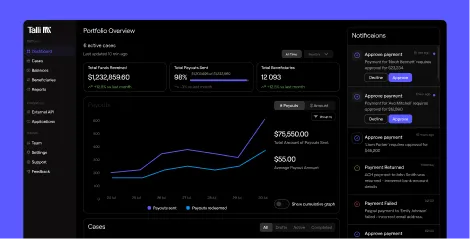
- Real-time dashboard — Create payout campaigns, track every status, and monitor completion rates with total visibility
- Smart follow-ups — Automated reminders across email and SMS help claimants complete the process fast
- Scalable infrastructure — Power payouts at any size, whether 1,000 or 100,000 recipients
Unlike generic payment processors, Talli understands that claims teams need API access even when they're not technical. The platform combines enterprise-grade API capabilities with intuitive interfaces that claims administrators can use without developer support.
For settlement workflows requiring speed, compliance, and visibility, Talli's API-driven platform handles the technical complexity while your team focuses on successful fund distribution.
Frequently Asked Questions
What is the difference between a workflow and an API endpoint in legal settlements?
A workflow represents the complete sequence of stages a settlement payout passes through—from initial claim intake through compliance verification, payment execution, and final reconciliation. An API endpoint is a specific technical interface that performs one action within that workflow. For example, the "verification" workflow stage might involve multiple API endpoints: one to request documents, another to validate submissions, and a third to record completion. Understanding this distinction helps claims administrators communicate requirements to technical teams effectively.
How does API integration help prevent fraud in settlement payouts?
API integration enables real-time fraud prevention by automating screening at critical workflow points. When a claimant submits information, APIs instantly check against OFAC lists, verify identity documents, and flag suspicious patterns—all before payment processing begins. This systematic approach catches issues that manual review might miss while creating audit trails proving due diligence. Platforms handling settlement fraud integrate these checks directly into workflows through automatic API calls.
Can API-driven automation reduce the time for claimants to receive funds?
Yes. Settlement distribution timelines can compress dramatically when APIs eliminate manual handoffs between workflow stages. What previously required days of batch processing—data entry, compliance review, payment initiation—executes in minutes through automated API calls. Digital payment methods enabled through APIs deliver funds to claimants within hours rather than the weeks required for traditional check disbursement.
What specific compliance challenges do APIs address in legal fund distribution?
APIs automate the compliance requirements that create bottlenecks in manual processes: KYC verification confirms claimant identity before payment, OFAC screening checks recipients against sanctions lists, W-9 collection captures tax information for reporting, and audit logging documents every action for regulatory review. Rather than routing each transaction through human reviewers, APIs apply these checks automatically while flagging exceptions for manual attention, ensuring consistent compliance while reducing processing costs.
Is an in-house development team necessary to integrate APIs for settlement workflows?
Not necessarily. While custom API integration requires technical expertise, modern settlement platforms like Talli provide pre-built interfaces that claims administrators can configure without coding. Many teams start with platform dashboards for campaign management and claimant communication, then pursue deeper API integration as needs evolve. For organizations without developers, claims teams can benefit from API capabilities through vendor-managed implementations or low-code integration tools.