.svg)


.svg)
Yes, mass disbursement platforms supporting prepaid cards and digital wallets now represent the fastest-growing segment of legal settlement administration. Digital payment adoption in class action and mass tort cases has grown significantly, with 558 settlements using digital payments in 2024 compared to just 17 four years earlier. Modern digital disbursement platforms offer claims administrators multiple payment rails including prepaid Mastercards, virtual cards, and PayPal, Venmo, Zelle, direct deposit, and card-based payouts (e.g., Mastercard) are common digital rails used in settlement distributions.—all while maintaining the compliance infrastructure required for legal settlements.
Key Takeaways
- Mass disbursement platforms achieve 98% payment success rates compared to 55-77% for traditional paper checks
- Prepaid cards and digital wallets represent 45% of payment selections in legal settlements (23% prepaid, 22% digital wallets)
- Digital platforms reduce settlement processing costs by up to 80% versus paper-based methods
- In 2024 data, 94% of class action payees selected digital payments (vs 6% paper checks) when given a choice
- Real-time fraud screening prevented hundreds of millions of fraudulent claims in 2024
- Consumer instant payment adoption has grown substantially
- Purpose-built legal platforms maintain QSF fund segregation while enabling digital payments
What Types of Platforms Support Prepaid Cards and Digital Wallets for Mass Disbursements?
The mass disbursement landscape includes two distinct platform categories: general-purpose mass payment processors and purpose-built legal settlement platforms. Both support prepaid cards and digital wallets, but their capabilities differ significantly based on target use cases.
General Mass Payment Platforms:
- Tipalti offers comprehensive mass payments across 200+ countries and currencies with 50+ payment methods, primarily serving gig economy and affiliate payouts
- PayQuicker provides a Payouts OS platform connecting to 120 digital wallet providers globally, focused on clinical trials and contractor payments
- Fiserv Digital Payouts delivers enterprise-grade solutions with Money Network prepaid cards and sub-5-second payout speeds through banking infrastructure integration
- Bank of America Global Digital Disbursements integrates Zelle, Venmo, PayPal, and Interac network options for corporate payout programs
Legal-Specific Disbursement Platforms:
- Talli provides AI-powered disbursements with QSF fund segregation, fraud detection, and court-ready compliance specifically for class action and mass tort settlements
- Digital Disbursements (Western Alliance Bank) maintains the largest market share in legal settlements with over 1,155 cases analyzed
- Choice Digital offers legal-focused payment solutions with specialized settlement administration features
What Makes Legal Settlement Platforms Different From General Payment Processors?
Purpose-built legal platforms address requirements that generic payment systems cannot match. Secure fund segregation through dedicated FBO (For Benefit Of) accounts preserves QSF ownership throughout the disbursement lifecycle. These platforms also generate court-ready accounting exports, automated 1099-MISC tax documentation, and complete audit trails required for judicial oversight.
Why Has Digital Payment Adoption Grown So Dramatically in Legal Settlements?
The shift from paper checks to digital disbursements accelerated due to measurable performance gaps that courts and administrators could no longer ignore. Traditional check distribution produces 55-77% cash rates depending on whether a claims process exists, while digital payments achieve 98% successful delivery.
Key Drivers of Digital Adoption:
- Court effectiveness requirements under Federal Rules of Civil Procedure Rule 23(e)(2)(C)(ii) mandate that judges consider distribution method effectiveness when approving settlements
- Claimant preference data showing 91% of payees prefer digital options when given a choice
- Cost pressure on settlement funds with paper check processing consuming $7.78 to $20+ per payment versus under $1 for digital methods
- Fraud explosion forcing adoption of real-time screening capabilities that only digital platforms provide
- Timeline compression enabling distribution within 24-48 hours instead of 7-14 days
The growth trajectory continues accelerating. Year-over-year adoption increased 182% from 2023 to 2024, exceeding the previous year's 146% growth rate.
How Does Payment Speed Affect Settlement Outcomes?
Processing time directly impacts claimant satisfaction and redemption rates. Settlement claimant satisfaction metrics demonstrate that payment timing significantly influences perception of the entire legal process. When claimants receive funds within hours rather than weeks, completion rates increase by 15-25% compared to traditional distribution methods.
What Prepaid Card and Digital Wallet Options Do These Platforms Offer?
Modern mass disbursement platforms provide claimants multiple redemption choices that accommodate diverse banking situations. Payment method preferences in 2024 legal settlements show clear trends toward card-based and wallet-based options.
Payment Method Distribution:
- Debit cards (push-to-debit) represent 28% of selections
- Prepaid cards account for 23% of payment preferences
- Digital wallets (Apple Pay, Google Pay, Samsung Pay) comprise 22% of choices
- Venmo and PayPal capture 18% of disbursements
- ACH/bank transfers represent 9% of selections
Talli's platform specifically offers Easy Prepaid Mastercard options issued by Patriot Bank, N.A., Member FDIC, pursuant to a license from Mastercard International. Gift card alternatives distributed by Talli are issued by InComm and redeemable at participating merchants.
Why Do Instant Payment Options Matter for Claimants?
Consumer demand for instant payments has grown substantially, with 41% of U.S. consumers now receiving instant disbursements most often. When given payment method choices, consumers select instant options approximately 7 out of 10 times.
Push-to-debit card recipients show 89% correlation with instant payment preference. Digital wallet users demonstrate the highest willingness to pay fees for instant access at 46%, compared to 33% for debit card users. This behavioral data indicates that payment optionality—not technology alone—drives adoption success.
How Do These Platforms Handle Fraud Prevention?
Fraud prevention capabilities have become essential table stakes for mass disbursement platforms. Fraudulent class action claims increased 19,000% between 2021 and 2023, forcing administrators to deploy sophisticated detection technologies.
2024 Fraud Prevention Results:
- Real-time screening and verification tools prevented hundreds of millions of fraudulent claims
- Coordinated technology deployment produced the first-ever recorded decline in fraudulent claims—down more than 40%
- ClaimScore reviewed over 60 million claims using risk scoring algorithms
- Multi-layered detection reduced duplicate payment destination attempts by 53%
Key Fraud Indicators Targeted:
- Duplicate payment destinations across multiple claims
- Newly created email domains (down 70% in 2024)
- International email domain usage (down 53%)
- Bulk-generated Hotmail/Outlook accounts (down 61%)
- IP address clustering and geolocation anomalies
Paper checks remain demonstrably less secure than digital payments. FinCEN reported 841 financial institutions filing suspicious activity reports for mail theft-related check fraud totaling over $688 million in 2024.
What AI Capabilities Enhance Fraud Detection?
Talli's AI-powered fraud detection moves beyond reactive screening to real-time prevention. The platform analyzes payment patterns, validates identities against multiple data sources, and flags suspicious activity before funds leave settlement accounts. This approach directly addresses the finding that coordinated deployment of multiple detection technologies produced the 40% decline in fraudulent submissions.
What Compliance Features Do Legal Disbursement Platforms Provide?
Compliance automation represents a critical differentiator between platforms designed for legal settlements and general-purpose payment processors. Legal payout compliance requirements extend across multiple regulatory frameworks simultaneously.
Built-In Compliance Capabilities:
- KYC verification through multi-layered identity validation including government ID scanning, SSN verification, and credit bureau address matching
- OFAC screening against Treasury Department sanctions lists for every payment recipient
- W-9 collection and validation for tax reporting requirements
- 1099-MISC generation with bulk processing for payments exceeding $600 and electronic IRS filing
- Audit trail documentation capturing every transaction detail for court and regulatory review
- Escheatment tracking managing state-by-state unclaimed property laws with varying dormancy periods
Talli maintains complete fund segregation through dedicated accounts for every settlement, preserving QSF ownership while simplifying reporting and ensuring legal compliance throughout the disbursement lifecycle. Banking services provided by Patriot Bank, N.A., Member FDIC ensure proper regulatory oversight.
How Does Fund Segregation Protect Settlement Claimants?
QSF requirements under IRS Section 468B mandate that settlement funds maintain separate accounts without commingling with other assets. Talli's platform architecture maintains proper fund segregation through dedicated FBO accounts throughout the entire process—a capability that generic payment processors typically lack.
What Results Can Claims Administrators Expect From Digital Disbursements?
Quantifiable performance improvements demonstrate why 98%+ of settlement administrators find digital disbursements effective for their operations.
Documented Performance Metrics:
- Success rate improvement: 98% successful delivery versus 55-77% for paper checks
- Cost reduction: Up to 80% savings per payment compared to check processing
- Timeline compression: Distribution within 24-48 hours instead of 7-14 days
- Redemption rate increase: 15-25% improvement with digital-first payment options
- Fraud prevention: Hundreds of millions of fraudulent claims blocked in 2024
A nationwide consumer protection class action with 50,000 claimants demonstrates typical outcomes. Using digital disbursement platforms, administrators processed all payments within 48 hours of court approval, achieved 96% successful delivery versus 60-70% typical for checks, reduced per-payment costs from $15 to $2, and generated automated tax documentation.
How Do Platforms Handle Large-Scale Distributions?
Enterprise platforms scale to process hundreds of thousands of payments simultaneously. Whether distributing to 1,000 or 100,000 recipients, modern platforms maintain compliance controls while providing real-time reporting to administrators and courts. Mass tort settlements showed 800% growth in adoption from 2022-2024, demonstrating platform capacity for complex, high-volume distributions.
Why Do Claimants Prefer Prepaid Cards and Digital Wallets?
Claimant preferences reflect practical considerations around accessibility, speed, and convenience. Settlement claimant satisfaction data reveals specific factors driving digital payment preference.
Accessibility Advantages:
- No bank account required for prepaid card or digital wallet receipt
- Immediate fund availability versus waiting for check clearing
- No check-cashing fees that disproportionately affect unbanked populations
- Mobile-first access through smartphone apps claimants already use
User Experience Benefits:
- Secure link delivery via SMS or email without requiring account creation
- Self-service payment selection choosing preferred method from available options
- Real-time status tracking monitoring payment progress through claimant portals
- Smart reminder systems across email and SMS increasing completion rates
Talli's platform delivers a seamless experience for every claimant through convenient phone-based access. Recipients receive secure links and pick the payment method that works best for their situation, eliminating barriers that reduce redemption rates in traditional check-based distributions.
What Should Administrators Consider When Selecting a Platform?
Choosing the right mass disbursement platform requires evaluating capabilities against specific settlement requirements. Claims team efficiency metrics indicate that platform selection significantly impacts operational outcomes.
Evaluation Criteria:
- Payment rail diversity: Prepaid cards, digital wallets, ACH, and check options
- Fraud prevention sophistication: Real-time screening versus batch processing
- Compliance automation depth: KYC, OFAC, tax reporting, audit trail capabilities
- Fund segregation architecture: QSF compliance and FBO account structures
- Integration capabilities: API access for CRM and case management systems
- Scalability: Capacity to handle settlement size from hundreds to hundreds of thousands of claimants
- Claimant support: Multilingual portals and customer service resources
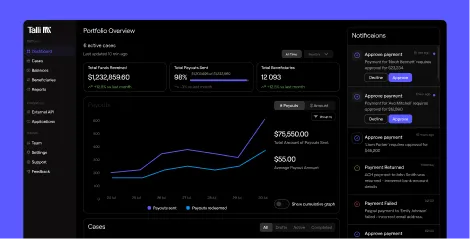
Talli provides complete transparency in settlement distribution with real-time dashboards for total control and visibility. Administrators create payout distribution campaigns, track every payout status, and monitor completion rates through a single interface. The platform syncs real-time payout data to existing CRM systems, eliminating manual reconciliation requirements.
Frequently Asked Questions
Can mass disbursement platforms handle international settlement claimants?
Leading platforms support international disbursements across 200+ countries with multi-currency capabilities. However, cross-border legal settlements face additional complexity from GDPR data privacy requirements for European citizens, which can conflict with U.S. record retention mandates. Administrators should verify platform capabilities for specific international jurisdictions before selection.
What happens when claimants don't redeem their digital payments?
Modern platforms automatically track unredeemed funds and manage escheatment requirements based on state-by-state dormancy laws, which typically range from 1-5 years. Automated systems send smart reminders across email and SMS to increase completion rates before escheatment deadlines, reducing cy pres remainder funds and court scrutiny.
Will FedNow instant payments change the disbursement landscape?
The Federal Reserve's FedNow instant payment infrastructure, launched in 2023, offers potential for near-zero-cost instant settlements. Major settlement administrators plan integration by late 2025, though actual bank adoption has been slower than projected. Full network effects may not materialize until 2026-2027, but platforms preparing for FedNow integration position administrators for future cost advantages.
What security measures protect digital settlement payments from interception?
Bank-grade encryption protects data in transit and at rest, while multi-factor authentication prevents unauthorized account access. Continuous fraud monitoring analyzes payment patterns and flags anomalies before fund release. Platforms holding FDIC-insured accounts through partner banks like Patriot Bank, N.A. provide additional protection layers for settlement funds.
How do platforms generate tax documentation for large settlements?
Automated systems generate 1099-MISC forms for all payments exceeding $600, with bulk electronic filing to the IRS and distribution to recipients. Year-end processing capabilities handle thousands of tax documents simultaneously, eliminating manual preparation errors that occur in 6-8% of manually processed payments.