.svg)


.svg)
Mass disbursement fraud has exploded with a 19,000% surge in claims between 2021 and 2023, forcing settlement administrators and claims teams to prioritize vendors with robust fraud prevention capabilities. Selecting the right platform means the difference between protecting millions in settlement funds and watching fraudulent actors drain legitimate claimant awards. Modern fraud prevention solutions integrate AI-powered detection, real-time screening, and automated compliance verification to secure every payout.
Key Takeaways
- Fraudulent settlement claims increased 19,000% between 2021-2023, making built-in fraud prevention essential
- Leading platforms prevented 800+ million fraudulent claims and blocked $100+ million in fraudulent payouts in 2024
- Digital disbursement platforms achieve 98% payment success rates compared to 55-77% for paper checks
- Real-time fraud screening can process 723+ million claims annually without slowing disbursement timelines
- AI-powered detection identifies suspicious patterns including duplicate payment destinations, new email domains, and bot networks
- Implementation timelines vary by integration + compliance scope; some vendors position onboarding as “weeks, not months.” depending on compliance requirements and integration complexity
- Platforms with built-in KYC, OFAC, and W-9 collection eliminate manual verification while ensuring regulatory compliance
Why Has Fraud Prevention Become Critical for Mass Disbursements?
The fraud landscape for settlement payments has fundamentally changed. Bad actors now deploy sophisticated techniques including bot networks, synthetic identities, and coordinated submission attacks that legacy payment systems cannot detect. One eyelash serum settlement saw 97% of claims flagged as fraudulent, demonstrating how quickly fraudsters can overwhelm traditional verification processes.
- Bot network attacks submit thousands of claims within minutes using automated scripts
- Synthetic identity fraud combines real and fabricated information to create believable fake claimants
- Duplicate payment destinations route multiple claims to single bank accounts or prepaid cards
- New email domain exploits use recently registered domains to evade reputation-based filters
- International IP masking hides fraudulent submissions behind VPNs and proxy servers
Without built-in fraud prevention, settlement administrators face impossible choices between delaying legitimate payments for manual review or releasing funds to fraudulent claimants. Legal payout compliance increasingly requires platforms to identify and block these threats automatically.
What Does the Financial Impact Look Like?
The financial consequences extend beyond direct fraud losses. Claims administrators managing settlements without adequate fraud protection face:
- Extended settlement timelines as manual review queues grow
- Increased operational costs from hiring additional verification staff
- Court scrutiny when fraud rates damage settlement fund integrity
- Claimant dissatisfaction when legitimate payments are delayed for review
What Fraud Prevention Features Should You Look For in a Vendor?
Not all mass disbursement platforms approach fraud prevention equally. Some bolt on basic verification tools as afterthoughts, while others build fraud detection into their core architecture. Effective platforms combine multiple layers of protection that work together without creating friction for legitimate claimants.
- Real-time AI screening that analyzes claims as they arrive, not in overnight batches
- Behavioral pattern recognition that identifies anomalies in submission timing, volume, and characteristics
- Velocity controls that flag unusual claim volumes from single sources
- Device fingerprinting that tracks submissions across multiple claims
- Geographic verification that matches claimant locations against expected populations
- Payment destination analysis that identifies suspicious routing patterns
OFAC screening represents a baseline requirement—sanctions list checking should happen automatically on every payment without manual intervention. Advanced platforms extend this with continuous monitoring that catches changes to claimant status throughout the settlement period.
How Important Is Real-Time Detection vs. Batch Processing?
Real-time fraud detection provides critical advantages over batch processing approaches. Platforms screening 723+ million claims annually demonstrate that speed and security can coexist. Batch processing creates windows where fraudulent claims can be approved before detection systems catch suspicious patterns.
Which Vendors Offer AI-Powered Real-Time Fraud Detection?
Several mass disbursement vendors now incorporate AI-powered fraud detection, though capabilities vary significantly based on their target market and architectural approach.
Talli delivers purpose-built fraud prevention for legal settlements with:
- AI-driven pattern recognition trained on settlement-specific fraud indicators
- Real-time screening integrated with KYC, OFAC, and W-9 collection
- Complete audit trails meeting court documentation requirements
- Flexible payment options that maximize redemption rates
Tipalti offers fraud monitoring through their Tipalti Detect® module available on enterprise tiers:
- Machine learning algorithms identifying payment anomalies
- Duplicate detection across payee database
- Sanctions screening integration
- Risk scoring for payment prioritization
Digital Disbursements provides an "Anti-Fraud Triangle" approach combining:
- Real-time fraud screening on all submissions
- ClaimScore integration for behavioral analytics
- Settlement-specific fraud rule configuration
i-payout includes multi-factor authentication and PCI-DSS compliance with:
- SOC 1 certification for security controls
- GDPR compliance for data protection
- 24/7 support for fraud incident response
How Do These Platforms Handle KYC and OFAC Compliance?
Compliance automation separates professional-grade disbursement platforms from basic payment processors. Manual KYC verification creates bottlenecks that delay legitimate payments while still missing sophisticated fraud. Effective compliance in payouts relies on automated systems that verify identity, screen against sanctions lists, and collect required tax documentation without human intervention.
- Automated KYC verification validates claimant identity against government databases and credit bureau records
- OFAC sanctions screening checks every payment against Treasury Department prohibited party lists
- W-9/W-8 collection gathers required tax documentation electronically with validation
- 1099 generation automates year-end tax reporting with high accuracy rates
- Audit log creation documents every verification step for court and regulatory review
Talli integrates compliance verification directly into the payment workflow, ensuring no disbursement proceeds without complete documentation. This approach eliminates the compliance gaps that expose settlement administrators to regulatory penalties.
What Happens When Screening Flags a False Positive?
KYC false positive rates matter because blocking legitimate claimants damages redemption rates and claimant satisfaction. Top platforms include:
- Manual review queues with streamlined approval workflows for flagged claims
- Threshold adjustment capabilities allowing administrators to tune sensitivity
- Clear escalation paths for claims requiring additional documentation
- Claimant communication tools to request verification without delaying the entire settlement
What Does Implementation Look Like for Fraud-Focused Platforms?
Implementation timelines typically range from 4-8 weeks depending on integration complexity and compliance requirements. Legal settlements typically require additional time for court approval and QSF (Qualified Settlement Fund) structure establishment.
Week 1-2: Platform Selection and Onboarding
- Complete vendor evaluation and contract signing
- Receive dedicated customer success manager assignment
- Access sandbox environment for testing
- Establish onboarding timeline with milestones
Week 2-4: Banking and Compliance Configuration
- Set up FDIC-insured banking partner relationship
- Configure QSF structure for fund segregation
- Establish OFAC screening rules and thresholds
- Upload claimant data templates and validate formatting
Week 3-5: Fraud Detection Configuration
- Configure fraud rule thresholds based on settlement characteristics
- Set up AI risk scoring parameters appropriate to claim type
- Establish manual review workflows for high-risk submissions
- Test detection systems against known fraud patterns
Week 4-6: Integration and Testing
- Connect API to existing CRM or settlement administration system
- Synchronize claimant data and verify accuracy
- Execute end-to-end payment testing
- Validate court-ready reporting capabilities
Week 7-8: Go-Live and Monitoring
- Load production claimant data
- Initiate first payment batch with enhanced monitoring
- Track fraud alerts and adjust thresholds based on results
- Monitor redemption rates to ensure legitimate claimants receive funds
Transparency in settlement distribution requires real-time dashboards that show administrators exactly how fraud prevention systems are performing throughout the disbursement period.
How Do Leading Vendors Compare on Fraud Prevention Capabilities?
Vendor selection requires matching fraud prevention capabilities to specific settlement requirements. Platforms designed for legal settlements understand court approval processes and QSF compliance in ways that generic payment processors cannot match.
Legal Settlement Specialists:
Talli and Digital Disbursements offer purpose-built fraud prevention for class actions, mass torts, and bankruptcy distributions. These platforms prevented $100+ million in payouts in 2024 and achieved 40% year-over-year reduction through continuous AI model improvement.
Enterprise Payment Platforms:
Tipalti serves broader use cases including affiliate payouts, royalty distributions, and gig economy payments. Their Detect® fraud monitoring provides strong protection but requires their enterprise-tier subscription starting at custom pricing.
Transaction-Based Platforms:
i-payout and similar processors charge 1-3% per transaction with compliance features included. This model works for moderate volumes but becomes expensive at scale.
Flat-Fee Options:
MassPay positions pricing around successful transactions and custom engagement—confirm exact fees with sales, though fraud detection capabilities are less robust than specialized legal platforms.
What ROI Can You Expect From Built-In Fraud Prevention?
The return on investment for fraud-enabled disbursement platforms comes from multiple sources beyond direct fraud prevention. Organizations implementing these solutions report:
- 48 days saved annually in payment workload (Sovrn case study)
- 50%+ reduction in time for payment processing (Tapjoy case study)
- Avoided hiring 2 FTE resources for payment processing
- 98% payment success rates compared to 55-77% for paper checks
For a hypothetical 10,000-claimant settlement with $500 average payouts, traditional methods without fraud prevention could expose administrators to millions in fraudulent payments. Digital rails with built-in fraud detection protect settlement funds while simultaneously improving legitimate claimant experience.
How Does Fraud Prevention Affect Claimant Satisfaction?
Claimant experience improves when fraud prevention operates invisibly. Legitimate claimants should never know their submission was screened against hundreds of fraud indicators. The best platforms:
- Complete fraud screening in seconds without visible delay
- Avoid false positives that require claimant intervention
- Provide fast payment delivery once claims are approved
- Offer multiple payment options accommodating all claimant situations
Why Is Talli the Preferred Choice for Secure Settlement Disbursements?
Talli's AI-driven platform addresses the specific fraud prevention challenges facing legal settlement administrators with capabilities purpose-built for claims distribution.
- Complete fund segregation maintaining QSF ownership and simplifying reporting throughout the disbursement lifecycle
- Built-in KYC, OFAC, W-9 collection and fraud mitigation with comprehensive audit logs
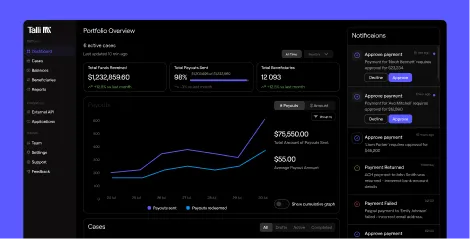
- Real-time dashboard visibility for monitoring completion rates, fund flows, and fraud detection performance
- Flexible payout options including digital wallets, prepaid cards, and ACH that work for banked and unbanked claimants
- Smart reminder systems across email, SMS, and additional channels driving higher redemption rates
- Banking through Patriot Bank (Member FDIC) ensuring fund security and regulatory compliance
What used to take weeks now takes minutes. Talli automates and safeguards every claims payout so administrators meet tight deadlines without losing control over compliance or claimant experience.
Frequently Asked Questions
Can fraud prevention systems distinguish between legitimate claimants and fraudsters using similar personal information?
Advanced AI systems analyze dozens of behavioral and technical indicators beyond basic identity data. Device fingerprints, submission timing patterns, network characteristics, and historical claim behavior create profiles that identify fraudulent submissions even when personal information appears legitimate. The best platforms achieve high detection rates while maintaining low false positive rates that protect legitimate claimants.
How do mass disbursement platforms handle fraud attempts that occur after initial claim approval?
Continuous monitoring throughout the settlement period catches fraud that evolves over time. Payment destination changes, unusual redemption patterns, and coordinated withdrawal activity trigger alerts for manual review. Some platforms also implement velocity controls on fund access that prevent rapid extraction of fraudulently obtained payments.
What documentation do courts require regarding fraud prevention measures for settlement approval?
Courts typically require detailed descriptions of fraud prevention protocols, projected fraud rates based on historical data, plans for handling disputed claims, and reporting mechanisms that demonstrate ongoing monitoring. Platforms with built-in court reporting capabilities simplify this documentation requirement significantly.
How do fraud prevention features affect payment processing speed for legitimate claimants?
Properly implemented fraud prevention operates in real-time without adding noticeable delay for legitimate claimants. AI-powered screening completes in seconds, and only flagged claims enter manual review queues. Platforms that batch fraud screening or require manual verification for all claims create unnecessary delays that damage claimant satisfaction.
What happens to funds blocked due to fraud detection?
Blocked funds remain in the settlement account and may be redistributed to verified claimants through cy pres provisions or returned according to settlement agreement terms. Detailed audit trails document every blocked payment for court reporting and potential appeals by claimants who believe they were incorrectly flagged.