.svg)


.svg)
Offering multiple payment options to settlement claimants sounds simple until you face the operational reality: separate compliance workflows for each channel, fragmented reporting systems, and administrative overhead that scales with every new payment method. Yet 80% of claimants find digital payments more convenient than traditional checks. Modern AI-driven payment platforms can consolidate ACH, digital wallets, prepaid cards, and checks into a single workflow that reduces disbursement costs by 40-70% while automating compliance across every channel.
Key Takeaways
- Multi-channel payout platforms reduce transaction costs from $7-8 per check to $0.25-0.50 for ACH transfers
- Offering 3-4 payment options increases redemption rates by 15-25% compared to check-only distribution
- Automated compliance platforms significantly reduce administrative errors through built-in KYC, OFAC, and tax form validation
- Digital payment adoption in class actions grew from 2 settlements in 2019 to 170+ in 2022
- Implementation timelines range from 2-4 weeks for basic integration to 6-8 weeks for full enterprise deployment
- Real-time dashboards can reduce support calls by around 40% through claimant self-service tracking
Understanding the Fundamentals of Multi-Channel Payouts
Multi-channel payouts allow claims administrators to distribute settlement funds through multiple payment methods from a single unified system. Instead of managing separate workflows for checks, ACH transfers, and digital wallets, a consolidated platform handles payment orchestration, compliance verification, and recipient communication across all channels simultaneously.
The core components of multi-channel payout systems include:
- Payment method orchestration - Routing funds through multiple disbursement channels
- Unified compliance automation - Single workflow for KYC, tax collection, and sanctions screening regardless of payment type
- Batch and individual processing - Handling large volumes of simultaneous payments alongside ad-hoc disbursements
- Real-time tracking - Dashboard visibility into payment status and redemption rates across all channels
The business case for multi-channel is straightforward. When recipients can choose their preferred payment method, more complete the process. Flexible payout options can improve completion rates and reduce support burden—especially when claimants can choose their preferred method for businesses offering them, while restricted options leave money on the table through unclaimed funds.
The Modern Payout Landscape
Today's settlement recipients expect the same payment flexibility they experience in consumer transactions. Traditional check-only distribution creates friction that suppresses redemption rates and generates administrative burden through uncashed check tracking.
Available payment channels now include:
- ACH direct deposit - Lowest cost option at $0.25-0.50 per transaction
- Prepaid cards - Ideal for unbanked recipients, costs $3-5 per card
- Digital wallets - PayPal, Venmo, and similar platforms at 2-3% fees
- Virtual cards - Single-use card numbers for immediate fund access
- Traditional checks - Still necessary for some recipients at $7-8 each
The key is offering choice without creating operational chaos. Payment orchestration platforms use smart routing to direct each payment through the optimal channel while maintaining unified compliance and reporting.
Managing Compliance and Security Across Payment Channels
Adding payment channels typically multiplies compliance requirements. Each method has distinct regulatory obligations, security protocols, and audit trails. Without centralized management, compliance teams face exponential complexity as channels increase.
Key Regulatory Requirements
Claims administrators must address multiple compliance frameworks simultaneously:
Tax Collection: W-9 and W-8 forms required for payments exceeding $600. Approximately 20-30% of payees need follow-up reminders to submit required forms, making automated nudge campaigns critical.
Sanctions Screening: OFAC compliance requires screening all recipients against sanctioned party lists. Real-time screening must occur before any payment release regardless of channel.
Data Security: PCI DSS Level 1 compliance is mandatory for platforms handling card payments. This includes TLS 1.2+ encryption for data in transit and AES-256 for data at rest.
State Escheatment: Tracking and reporting unclaimed funds by jurisdiction. Each state has different dormancy periods and reporting requirements.
The estimated cost of compliance failures can exceed $14 million, making automated compliance management essential rather than optional. Modern platforms with built-in compliance workflows eliminate manual tracking while ensuring consistent adherence across all payment types.
Securing Each Payment Channel
Security requirements vary by payment method, but unified platforms apply consistent controls:
- Role-based access control with 15-20+ granular permission levels
- Two-factor authentication required for all administrative users
- Hardware Security Modules for cryptographic key storage
- Real-time fraud detection using ML-based anomaly identification
- Complete audit trails for every transaction and system access
Fraud prevention becomes more manageable with centralized monitoring. Instead of reviewing suspicious activity across disconnected systems, administrators see all channels through a single security dashboard.
Streamlining Fund Management with Complete Segregation
Legal settlements require meticulous fund tracking that traditional payment systems weren't designed to provide. Qualified Settlement Funds (QSFs) demand complete segregation, dedicated accounting, and court-ready reporting.
The Importance of Dedicated Accounts
Each settlement requires its own fund segregation to:
- Preserve QSF ownership and tax treatment
- Simplify court-required reporting and accounting
- Ensure legal compliance throughout the disbursement lifecycle
- Prevent commingling that could jeopardize settlement integrity
Modern platforms support dedicated accounts for every settlement, automatically maintaining separation while enabling efficient multi-channel distribution from each fund.
Simplifying Financial Reporting
Court oversight requires comprehensive reporting that manual processes struggle to provide. Automated systems generate:
- Real-time fund flow visibility showing exactly where every dollar resides
- Completion rate tracking by payment method and recipient segment
- Audit-ready documentation with complete transaction histories
- CRM synchronization pushing payout data to case management systems
This level of transparency in settlement distribution would require dozens of staff hours weekly through manual processes. Automation delivers it continuously without additional effort.
Enhancing Claimant Experience Through Flexible Payout Options
Claimant satisfaction directly impacts redemption rates. When recipients find the payment process confusing or their preferred method unavailable, they abandon claims—leaving settlement funds undistributed and creating administrative headaches.
Empowering Claimants with Choice
The most effective approach lets claimants select their preferred payment method through simple, mobile-friendly interfaces. Digital disbursement strategies show that same-day payment options dramatically improve satisfaction scores.
Effective claimant portals include:
- Secure link delivery via SMS or email—no accounts to create
- Clear payment method explanations with processing time estimates
- Mobile-optimized selection for smartphone completion
- Real-time status tracking eliminating "where's my payment" calls
When claimants complete the process easily, redemption rates climb. Studies show digital-first payment strategies consistently outperform check-only distribution by significant margins.
Serving Banked and Unbanked Recipients
Not all claimants have bank accounts. Approximately 5.9 million US households remain unbanked, and many more are underbanked with limited account access. Multi-channel platforms serve both populations effectively.
For unbanked recipients:
- Prepaid cards provide immediate fund access without bank requirements
- Gift cards offer retail spending options at participating merchants
- Digital wallets enable payments through smartphone apps
- Cash pickup options through retail networks where available
Comparing paper checks to digital wallet payments reveals stark differences in recipient satisfaction and completion rates. Digital options eliminate mail delays, lost check issues, and bank hold periods that frustrate claimants.
Achieving Real-Time Visibility and Control Over Payouts
Manual payment tracking through spreadsheets breaks down at scale. When managing thousands of recipients across multiple payment channels, real-time dashboards become essential for operational control.
Leveraging Dashboards for Total Control
Real-time settlement dashboards provide instant visibility into:
- Payment status for every recipient across all channels
- Completion rates segmented by payment method, amount tier, and timeline
- Failed payment alerts requiring immediate attention
- Fund flow tracking showing disbursement progress against settlement totals
Claims administrators can create payout distribution campaigns, monitor engagement metrics, and identify bottlenecks before they impact settlement timelines. Organizations report higher satisfaction ratings when claimants have instant fund access and real-time tracking.
Integrating Payout Data with Your Systems
Isolated payment systems create reconciliation nightmares. Modern platforms offer multiple integration options:
API Connectivity: Real-time data synchronization with case management systems like Salesforce, enabling same-day digital disbursements embedded directly in existing workflows.
Pre-built Connectors: Standard integrations with major systems including Guidewire, NetSuite, and Microsoft Dynamics reduce implementation time.
Flat-File Processing: CSV upload options for organizations not ready for full API integration, supporting batch processing without custom development.
Bidirectional data flow ensures payment status updates appear automatically in case management systems, eliminating manual reconciliation and providing stakeholders with current information.
Boosting Redemption and Completion Rates with Smart Reminders
Even with excellent payment options, claimants need reminders to complete the process. Life intervenes—emails get buried, text messages forgotten, and payment selection pages abandoned mid-process. Approximately 25-35% of claimants don't complete payment method selection without follow-up.
Automated Follow-Ups for Higher Engagement
Effective reminder campaigns use multiple channels with escalating urgency:
- Initial notification via email and SMS with clear action steps
- Day 3 reminder emphasizing ease of completion
- Day 7 follow-up noting time sensitivity
- Day 14 final notice with deadline warning
- Phone outreach for high-value uncompleted selections
Multichannel invoicing research confirms that multichannel communication strategies significantly boost timely remittance rates. Claimants who receive coordinated email, SMS, and mail touchpoints complete at higher rates than single-channel approaches.
Strategies for Maximizing Completion
Beyond reminders, several tactics improve completion rates:
- Progressive profiling - Collect only essential information upfront, gathering additional details later
- Smart defaults - Pre-select the most popular payment method (typically ACH) while allowing changes
- Mobile optimization - Ensure every step works flawlessly on smartphones
- Clear progress indicators - Show claimants how close they are to completion
- Immediate confirmation - Provide instant verification that selection was received
Tracking claims redemption rates allows administrators to benchmark performance and identify improvement opportunities across settlements.
Scaling Payout Operations: From Small to Enterprise Needs
Whether distributing to 1,000 or 100,000 recipients, the platform must scale without proportional increases in staff or complexity. Enterprise settlements multiply every operational challenge—compliance verification, payment processing, support inquiries, and reporting requirements.
Designing for Scalability
Scalable payout infrastructure requires:
- Batch processing capability handling hundreds of thousands of payments simultaneously
- Automated validation eliminating manual review bottlenecks
- Self-service portals reducing support staff requirements
- Cloud-based architecture expanding capacity on demand
Mass tort settlement platforms demonstrate that automation can significantly reduce distribution timelines. Staff hours previously spent on manual payment processing redirect to exception handling and claimant support.
Handling High-Volume Distributions
Large settlements present unique challenges:
- Tax form collection at scale - Automated campaigns essential when approximately 20-30% need follow-up
- Bank verification failures - Approximately 10-15% of ACH selections may fail initial verification, requiring fallback options
- Support volume management - Self-service tracking reduces call center load
- Payment timing coordination - Batch scheduling prevents system overload
The economics improve with scale. Per-payment costs decline while redemption rate improvements compound across larger recipient populations.
Why Talli Simplifies Multi-Channel Payouts for Legal Settlements
While multiple platforms offer multi-channel payment capabilities, Talli delivers purpose-built solutions specifically designed for legal settlement distribution and claims administration.
Talli's AI-driven payment platform addresses the core challenges covered throughout this guide:
Unified Compliance Automation: KYC, OFAC screening, W-9 collection, fraud mitigation, and audit logs are built into every payment workflow. Compliance happens automatically regardless of which payment channel recipients select.
Complete Fund Segregation: Dedicated accounts for every settlement preserve QSF ownership, simplify court reporting, and ensure legal compliance throughout the disbursement lifecycle.
Flexible Payout Options: Claimants choose from ACH, prepaid Mastercard, digital wallets, and more. No bank account required—increasing completion rates among underbanked populations.
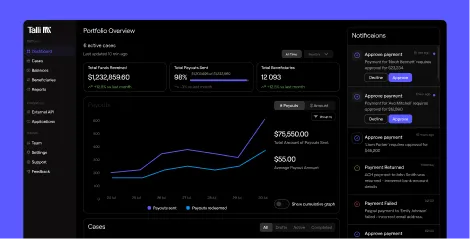
Real-Time Dashboard Control: Create payout campaigns, track every payment status, and monitor completion rates through a single interface. See every dollar with full transparency on fund flows.
Smart Follow-Up Campaigns: Automated reminders across email, SMS, and additional channels help claimants complete the payout process quickly. Higher take-up rates mean less chasing and more redemptions.
Enterprise Scale Support: Whether distributing to 1,000 or 100,000 recipients, Talli powers payouts at any size without losing control over compliance or claimant experience.
Banking services are provided by Patriot Bank, N.A., Member FDIC. The Easy Prepaid Mastercard is issued by Patriot Bank, N.A., Member FDIC, pursuant to a license from Mastercard International.
For claims administrators seeking to eliminate the complexity of multi-channel payouts while improving redemption rates and compliance, Talli transforms what used to take weeks into minutes.
Frequently Asked Questions
What are multi-channel payouts and why are they important for claims?
Multi-channel payouts allow claims administrators to distribute settlement funds through multiple payment methods—ACH, prepaid cards, digital wallets, and checks—from a single unified platform. They matter because 80% of claimants find digital payments more convenient than checks, and offering 3-4 payment options increases redemption rates by 15-25% compared to check-only distribution. Without channel choice, settlements face higher unclaimed fund rates and lower claimant satisfaction.
How does a platform ensure compliance when offering various payout methods?
Modern multi-channel platforms centralize compliance through automated workflows that apply regardless of payment type. This includes built-in KYC verification, real-time OFAC sanctions screening, automated W-9/W-8 collection, and comprehensive audit trails. The automation significantly reduces administrative errors compared to manual processes while ensuring consistent compliance across all channels. Without centralization, each payment method would require separate compliance workflows, multiplying administrative burden.
Can multi-channel payouts actually simplify fund distribution for claims administrators?
Yes, when implemented through a unified platform. The complexity comes from managing separate systems, not from the payment methods themselves. Consolidated platforms handle payment orchestration, compliance verification, and reporting across all channels simultaneously. This approach typically reduces processing costs by 40-70% compared to traditional check distribution while cutting distribution timelines from weeks to days. The key is choosing platforms designed specifically for legal settlement requirements.
What role do smart reminders play in increasing payout completion rates?
Smart reminders are essential because approximately 25-35% of claimants don't complete payment method selection without follow-up. Automated campaigns using coordinated email and SMS touchpoints significantly improve completion rates compared to single-channel outreach. Effective reminder sequences escalate urgency over time while making the completion process as simple as possible. For tax form collection specifically, automated nudges starting 14 days before payout deadlines reduce non-compliance by approximately 50%.
How does real-time visibility benefit claims administrators managing multiple payment channels?
Real-time dashboards eliminate the spreadsheet tracking that breaks down at scale. Administrators see payment status for every recipient across all channels, completion rates segmented by payment method, failed payment alerts requiring attention, and fund flow progress against settlement totals. This visibility enables proactive management—identifying bottlenecks before they impact timelines and reallocating resources based on actual performance data. Organizations report reduced support calls when claimants have access to self-service tracking portals showing their payment status.