.svg)


.svg)
The National Public Data breach allegedly exposed up to 2.9 billion records—with reporting estimating up to ~170 million people affected—making it one of the largest known background-check data exposures. With the company having filed for Chapter 11 protection in October 2024—though that bankruptcy petition was later dismissed and victims facing lifetime identity exposure, understanding the settlement landscape and how digital disbursements for settlements work has become essential for affected individuals and claims administrators alike.
Key Takeaways
- National Public Data breach exposed 2.9 billion records including SSNs, full names, addresses, and relative information across US, UK, and Canadian residents
- Company filed Chapter 11 bankruptcy in October 2024 and ceased operations by December 2024, complicating victim compensation
- No settlement has been announced due to the company's insolvency—victims may receive zero direct compensation through class action
- California CPPA has taken enforcement action resulting in a $46,000 fine for registration violations, signaling increased regulatory enforcement against data brokers
- Multiple state attorneys general have initiated investigations, potentially creating alternative compensation pathways
- Historical breach settlements show per-person payouts ranging from $20-$100 flat to $5,000+ for documented losses
- Digital claims platforms now handle a majority of recent settlements, reducing processing times from months to days
- Victims should take immediate protective action regardless of settlement status—credit freezes, fraud alerts, and ongoing monitoring
Understanding the NPD Breach Settlement: What Claimants Need to Know
The NPD breach represents a watershed moment for data privacy and settlement administration. Unlike typical data breaches where companies remain operational and negotiate settlements, National Public Data's collapse creates unprecedented challenges for victim compensation.
Defining the NPD Breach
National Public Data, a Florida-based data broker operating through Jerico Pictures Inc., specialized in background check services by aggregating personal information from public records. The breach timeline reveals critical delays in victim notification:
- December 2023: Initial breach occurs via exploitation of plaintext password vulnerabilities
- April 2024: Stolen data appears on dark web marketplaces
- August 2024: Public disclosure and class action lawsuits filed
- October 2, 2024: Company files Chapter 11 bankruptcy citing liability claims in the "hundreds of millions"
- Late 2024: National Public Data went offline after the breach fallout (and later reporting indicates the service reappeared online under new ownership in 2025).
The eight-month notification delay meant victims could not protect themselves during the critical period when their data circulated on criminal marketplaces. This delay far exceeds GDPR's 72-hour notification standard and highlights systemic failures in US breach disclosure requirements.
Who Is Eligible for Compensation?
The breach affects an undetermined number of individuals across the United States, United Kingdom, and Canada. Eligibility criteria include anyone whose personal information was collected and stored by National Public Data, regardless of whether they directly interacted with the company.
This creates a significant challenge: most victims never knew NPD possessed their data. Data brokers operate by scraping public records and aggregating information without consumer consent or notification.
The lead class action case, Christopher Hofmann v. Jerico Pictures, alleges:
- Negligence in data security practices
- Breach of fiduciary duty
- Unjust enrichment from monetizing personal data without adequate protection
- Failure to implement basic security measures (passwords stored in plaintext)
Key Dates for Claimants
Unlike typical settlements with clear claim deadlines, the NPD case remains in flux:
- Current status: No settlement announced due to bankruptcy proceedings
- Bankruptcy status: The October 2024 Chapter 11 filing was later dismissed; litigation and regulatory actions may continue on separate tracks.
- Potential settlement timeline: If a settlement occurs, 2-3 years from resolution is typical
- State AG settlements: May proceed independently of class action
Victims should monitor developments through settlement tracking databases and state attorney general announcements while focusing on protective measures they can take immediately.
Seamless Payouts: How Modern Platforms Streamline Settlement Distribution
Even without a confirmed NPD settlement, understanding how modern claims platforms operate helps victims know what to expect from future compensation processes. The settlement administration industry has undergone significant transformation, moving from paper-based systems to automated digital platforms.
The Evolution of Settlement Payouts
Traditional settlement distribution relied on mailed checks, manual claim verification, and processing timelines stretching 12-18 months. These methods created substantial friction:
- 10-15% of checks go undeliverable or uncashed
- Manual review creates 1-2 year processing backlogs
- Paper documentation increases fraud vulnerability
- Limited language and accessibility support excludes claimants
Modern high-volume payout systems have transformed this landscape. Digital platforms now handle claim ingestion, verification, fraud detection, and disbursement through automated workflows.
Benefits of Digital Distribution
For a breach affecting 100+ million potential claimants like NPD, digital infrastructure becomes essential. Contemporary settlement platforms deliver:
- Automated claim verification reducing manual review from weeks to hours
- Real-time fraud detection identifying duplicate claims and identity verification failures
- Multiple payment rails including ACH, digital wallets, and prepaid cards
- Multi-language support reaching diverse claimant populations
- Mobile-first design accommodating claimants without computer access
The shift to digital has been dramatic, with most recent settlements offering digital claim submission compared to a much smaller percentage in previous years.
Enhanced Security and Compliance in NPD Settlement Payouts
Given that NPD victims have already experienced security failures, settlement administrators face heightened obligations to protect claimant data during compensation processes. Compliance in legal payouts requires multiple verification layers without creating barriers to legitimate claims.
Protecting Claimant Data
Settlement platforms handling breach compensation must implement security measures including:
- KYC (Know Your Customer) verification ensuring payments reach legitimate victims
- OFAC screening preventing distributions to sanctioned individuals
- W-9 collection for tax compliance on payments exceeding reporting thresholds
- SOC 2 Type II certification demonstrating comprehensive security controls
- Encrypted data transmission protecting sensitive information throughout the claims process
These requirements become especially critical when claimants must submit the same types of personal information (SSNs, addresses) that were compromised in the original breach.
Meeting Regulatory Requirements
The NPD case highlights expanding regulatory involvement in data breach enforcement. The California Privacy Protection Agency has taken enforcement action against NPD, resulting in a $46,000 fine for failing to register as a data broker—a relatively small penalty that signals larger enforcement actions to come.
CPPA Head of Enforcement Michael Macko stated: "We will litigate and bring enforcement actions when businesses violate California's privacy laws."
With multiple states initiating investigations, settlement administrators must navigate multi-jurisdictional compliance requirements that vary by state. California law can increase leverage in privacy cases, but settlement payouts are still negotiated and often pro-rated—there isn’t a guaranteed minimum payout per person.
Accelerating Compensation: The Speed and Efficiency of Digital Payouts
For breach victims facing ongoing identity theft risks, settlement timing matters enormously. Every month of delay represents additional exposure to fraud and financial harm.
From Weeks to Minutes: The Digital Difference
Historical breach settlements demonstrate how technology accelerates compensation:
- Yahoo (2013–2014): Settlement $117.5M; Processing timeline 4–5 years; Per-person range up to $358
- Equifax (2017): Settlement up to $425M; Processing timeline ~2 years; Per-person range up to $125–$500
- T-Mobile (2021): Settlement $350M; Processing timeline ~2 years; Per-person range up to $25,000
- AT&T (2024): Settlement $177M (proposed); Processing timeline ~1 year (fast-tracked); Per-person range $75–$5,000
- Evolve Bank (2024): Settlement $3.78M; Processing timeline < 1 year; Per-person range $20–$3,000
The trend shows acceleration—settlements that once required 4-5 years now complete in under two. Digital platforms enable this speed through:
- Automated eligibility verification against breach databases
- Instant payment processing via digital rails
- Real-time status tracking for claimants and administrators
- Parallel processing handling thousands of claims simultaneously
Boosting Redemption Rates
Settlement value means nothing if victims don't claim their compensation. Traditional check-based settlements see redemption rates as low as 30-40%. Digital platforms with improved claims redemption strategies achieve significantly higher completion through:
- SMS and email notifications with secure claim links
- No account creation required—claimants complete process in one session
- Mobile-optimized interfaces reaching claimants where they are
- Smart reminders for incomplete claims
- Multiple payment options accommodating different preferences
Flexible Payment Options for NPD Claimants: Choice and Convenience
Modern settlement platforms recognize that claimant populations include individuals with varying banking access and payment preferences. The NPD breach affected people across all demographics—many of whom lack traditional bank accounts.
Effective disbursement systems offer:
- Direct ACH transfer for claimants with bank accounts
- Digital wallet integration (PayPal, Venmo, Cash App)
- Prepaid debit cards for those without bank accounts
- Physical checks as a fallback option
- Gift cards for smaller claims amounts
This flexibility matters particularly for breach settlements where affected populations may include:
- Elderly individuals unfamiliar with digital banking
- Younger claimants without established bank relationships
- Lower-income individuals relying on check-cashing services
- Rural claimants with limited banking access
Talli's platform supports multiple payment methods with no bank account required—ensuring flexible options reach every eligible claimant.
Maximizing Claimant Engagement and Redemption Rates
The gap between eligible claimants and those who actually receive compensation represents significant value left unclaimed. Most recent settlements use tiered compensation structures, requiring claimants to submit documentation to access higher payment levels.
Effective engagement strategies include:
- Clear communication explaining claim requirements and deadlines
- Proactive outreach via SMS, email, and phone
- Simplified documentation requirements where legally permissible
- Progress tracking showing claimants their submission status
- Dedicated support answering claimant questions
Settlement administrators should handle the explosion in fraud while maintaining claimant-friendly processes. The balance between security and accessibility determines whether victims actually receive compensation.
Real-Time Visibility and Control for Settlement Administrators
Administrators managing NPD-scale distributions need comprehensive oversight capabilities. With 100+ million potential claimants, manual tracking becomes impossible.
Real-time settlement dashboards provide:
- Live claim submission monitoring tracking volume and completion rates
- Fraud detection alerts flagging suspicious patterns for review
- Payment status tracking showing disbursement progress
- Regulatory reporting generating compliance documentation automatically
- CRM integration syncing payout data with existing systems
These capabilities transform claims administration from reactive to proactive, enabling administrators to identify bottlenecks, address fraud patterns, and optimize claimant experience in real-time.
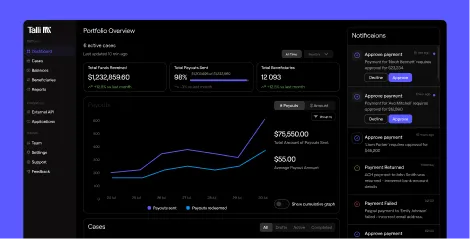
Talli's dashboard delivers total visibility—administrators can track every payout status, monitor completion rates, and access audit trails throughout the disbursement lifecycle.
Building Trust: Complete Fund Segregation and QSF Ownership
Settlement funds require careful fiduciary management. Qualified Settlement Funds provide the legal structure for holding and distributing settlement proceeds while maintaining tax efficiency and regulatory compliance.
Secure fund segregation ensures:
- Dedicated accounts for each settlement preventing commingling
- QSF ownership preservation throughout the disbursement lifecycle
- Simplified tax reporting for administrators and claimants
- Legal compliance with court-approved distribution plans
- Complete audit trails documenting every transaction
For NPD victims, any future settlement would benefit from platforms offering complete fund segregation with banking services from FDIC-member institutions.
What Victims Should Do Now
Regardless of settlement status, NPD breach victims should take immediate protective action:
Within 24-48 hours:
- Check whether your email address appears in breach datasets using Have I Been Pwned, and use IdentityTheft.gov if you need step-by-step guidance for responding to identity theft.
- Review credit reports via AnnualCreditReport.com
- Change passwords on accounts using exposed email addresses
Within 1-4 weeks:
- Place credit freezes with Equifax, Experian, and TransUnion
- File fraud alerts with credit bureaus
- Document any suspicious activity
Ongoing:
- Enroll in identity theft monitoring services
- Monitor financial accounts quarterly
- Consider IRS Identity Protection PIN
- Save documentation of any identity theft losses for potential future claims
Consumer Watchdog Director Teresa Murray emphasized: "If people weren't taking precautions in the past, which they should have been doing, this should be a five-alarm wake-up call for them."
Frequently Asked Questions
If National Public Data is bankrupt, does that mean I'll receive nothing from the settlement?
Bankruptcy significantly complicates victim compensation but doesn't eliminate all pathways. While the class action against the company itself may yield minimal recovery, victims may receive compensation through other channels. State attorney general settlements often proceed independently—with multiple states investigating, multi-state settlement agreements may establish victim compensation funds separate from the bankrupt company's assets. Additionally, victims who experience documented identity theft may recover through other means such as identity theft insurance policies or individual suits against data recipients who purchased information from NPD.
How do I know if my data was specifically included in the NPD breach versus other breaches?
The NPD breach is distinctive because it contained records from people who never directly interacted with National Public Data. Check HaveIBeenPwned.com, which now includes NPD breach data. If your SSN appears in breach databases tied to NPD, you're likely affected. The presence of historical addresses (not just current) and relative information is another indicator, as NPD specialized in aggregating multi-decade personal records for background check purposes. Unlike single-service breaches, NPD exposure likely means your information appeared in combination with family member data.
Can I file an individual lawsuit against National Public Data instead of joining the class action?
While legally possible, individual suits against NPD face significant practical barriers. The company's bankruptcy and cessation of operations means there are limited assets available for any judgment. Class actions consolidate legal resources and typically achieve better outcomes when the defendant has constrained ability to pay. However, if you suffered substantial documented losses (exceeding $10,000 in identity theft damages, for example), consulting with a privacy attorney about your specific situation may be worthwhile. Some victims pursue individual suits against data purchasers who bought NPD information rather than NPD itself.
What makes the NPD breach different from other major data breaches like Equifax?
Several factors distinguish NPD. First, Equifax remained operational and financially capable of funding a $425M settlement—NPD declared bankruptcy. Second, NPD victims generally had no knowledge the company possessed their data, while Equifax victims had direct consumer relationships. Third, NPD's plaintext password storage represents an extreme security failure even by breach standards. Finally, the scope is unprecedented—2.9 billion records versus Equifax's 147 million. This combination of scale, security negligence, company insolvency, and victim unawareness creates unique challenges for compensation.
How long should I continue monitoring my credit and identity after the NPD breach?
Given that Social Security numbers cannot be changed, NPD victims face permanent exposure risk. Unlike payment card breaches where new cards resolve the vulnerability, SSN exposure creates lifetime monitoring obligations. Security experts recommend: indefinite credit freezes (unfreezing only when needed for legitimate credit applications), annual credit report reviews at minimum, ongoing fraud alerts, and IRS Identity Protection PIN enrollment. Consider this a permanent change to your financial security practices rather than a temporary response. The cost of continuous monitoring services may be justified for the remainder of your life given the severity of SSN exposure.