.svg)


.svg)
Claims teams are modernising how they distribute funds - moving away from paper checks toward digital payment platforms that offer cleaner experiences and faster delivery to claimants.
This shift is necessary. But in the rush to adopt digital solutions, many claims teams are overlooking a critical question that goes beyond user experience and operational efficiency: does your payment platform's structure align with your fiduciary duties?
Specifically, fund ownership and who owns unclaimed settlement funds?
What Makes Third-Party Client Money Different
Third-party client money refers to funds that don't belong to your operating business. You're holding them in trust, escrow, or fiduciary capacity, and you're obligated to disburse them to beneficiaries based on legal, contractual, or court approved terms.
Common examples include class action settlements, Qualified Settlement Funds (QSFs), mass tort distributions, insurance payouts, shareholder distributions, and trustee managed disbursements.
Of course, the defining characteristics are that the money isn't yours, you're holding it for someone else, and you have a legal duty to get it to the right people.
This isn't operationally different from any other payment flow, but it's regulatorily akin to custody and fiduciary accounting than commerce.
How Third Party Client Money Should Flow
A compliant third-party client money flow requires specific structural elements:
- Segregation of funds. Client funds must be held in dedicated trust, For Benefit Of (FBO), or escrow accounts. They can never be commingled with operating capital or pooled with other clients' money without clear ledger separation.
- Ownership of funds. Ownership of funds stays with the claimant at all times.
- Clear roles. Who holds the funds? Who instructs disbursements? Who executes payments? Who provides oversight? These roles need explicit definition and separation.
- Prefunding. Funds must be received before payouts are initiated. No credit extension, no float, no netting against operating balances.
- Full auditability. End to end ledgering, transaction-level reconciliation, and clear beneficiary attribution for every dollar.
- Controlled disbursement. Claims are paid out only after validation, approvals, and controls are satisfied.
Most importantly ownership of the funds does not change until they're successfully delivered to the intended recipient - or until they revert according to the settlement agreement, court order, or applicable law.
A Structural Consideration in Digital Payment Platform Selection
Payment platforms vary significantly in how they handle unclaimed funds, and this distinction has meaningful implications for claims teams with fiduciary responsibilities.
Some platforms are purpose built for regulated third-party money flows and maintain fund segregation, ownership continuity, and redistribution capabilities throughout the distribution lifecycle. Others are designed primarily for commercial payment distribution and may operate under terms of service that were not developed with QSF requirements or court-supervised settlement frameworks in mind.
The critical question teams should ask of any platform is straightforward: if a claimant does not redeem their payment within the platform's specified timeframe, what happens to those funds?
The answer to this question varies significantly across platforms and should be a primary consideration in vendor selection. Claims teams should review payment platforms terms of service carefully, with particular attention to:
- How and where funds are held during the distribution period
- Whether ownership of funds transfers to the payment platform at any point
- What happens to unredeemed funds after expiration periods
These are not merely operational questions. For teams with fiduciary responsibilities, the answers have direct bearing on their obligations under the applicable settlement agreement and court orders."
Potential Fiduciary Concerns
Claims teams often have fiduciary responsibilities depending on their role and the applicable settlement agreement. Those duties include:
Safeguarding funds. Client money must be protected and managed with care. Transferring ownership of unclaimed funds to a commercial payment platform that profits from non delivery may raise questions about proper safeguarding
Exercising due care in vendor selection. Claims teams are responsible for understanding how their payment vendors handle client money. Understanding how a platform's terms address unclaimed funds is an important part of the vendor evaluation process.
Ensuring funds reach intended recipients. Court approved settlements establish a specific distribution framework governing how funds should be allocated to class members or through approved alternative mechanisms. Claims teams should evaluate whether their payment platform's handling of unclaimed funds is consistent with that approved framework.
Understanding vendor economics. Payment platform revenue models vary, and claims teams should understand how their chosen platform generates revenue and whether that model supports or creates potential tension with the goal of maximising successful claimant payment delivery.
Claims team oversight has evolved considerably. Courts increasingly require detailed Post-Distribution Accounting and often inquire about actual participation rates and the disposition of unclaimed funds. Claims teams will be asked how unclaimed funds were handled and whether the distribution approach aligned with the court's approved settlement framework.
How to Assess Whether Your Payment Vendor Is Suitable
Not all payment platforms are built the same way. If you're responsible for distributing third-party client funds, you need to ask your vendor these specific questions:
Who legally owns the funds at each stage?
- When they're deposited in to the payment platform?
- While they're held awaiting distribution?
- If recipients don't claim them?
Are funds segregated at the account level? Client money should be held in dedicated trust or FBO accounts, not pooled with the vendor's operating capital or other customers' funds and held on their own balance sheet
Is prefunding mandatory? The vendor should never extend credit or create floats with client funds.
What happens to unclaimed funds? Does the vendor:
- Keep them as revenue?
- Return them to you for redistribution?
- Hold them indefinitely until claimed?
Can you produce a transaction-level audit trail? You need end to end visibility from deposit to disbursement, including rejected payments, returns, and escheatment.
How does the vendor's economic model work? Are they incentivized for successful delivery, or do they profit from non-redemption?
How does your platform define successful payment delivery? Is delivery measured when funds reach the claimant's account, or when the payment notification is sent
Points to consider when evaluating whether a payment platform is suitable for third-party client money:
- Lack of clear custody structure or fund segregation protocols
- Pooled accounts without client-level ledger separation
- Funds held on the platform's own balance sheet rather than in segregated trust or FBO accounts
- Terms of service that transfer ownership of funds to the payment platform upon loading
- Terms of service that allow the payment platform to retain unclaimed funds after a specified period
- Limited post disbursement transparency or inability to provide detailed reporting on actual claimant payment status
- Revenue models where the platform benefits financially from lower redemption rates
- Delivery metrics that measure notification transmission rather than confirmed fund receipt by claimants
Vendors who cannot answer these questions clearly and transparently may warrant further scrutiny before being entrusted with third-party client money.
What a Platform Built for Third-Party Client Money Looks Like
Talli was designed specifically for regulated third-party money flows - class actions, mass torts, claims administration, and other use cases where funds are held for beneficiaries.
What that means structurally:
- Segregated, prefunded architecture. Client funds are held in dedicated FBO accounts. Your settlement funds never touch Talli's operating capital and are never pooled with other clients' money.
- No ownership transfer. Funds remain your client money - held for claimants - until they're successfully delivered to claimants (the funds are in the claimant’s account ). If claimants don't claim their payments, the ownership of the funds never transition to Talli. They remain in your control for redistribution, reversion, or cy pres distribution according to your settlement terms.
- Economics aligned with delivery. Our revenue only comes from successful payouts, which means our economic incentives are aligned with yours: get money to claimants efficiently.
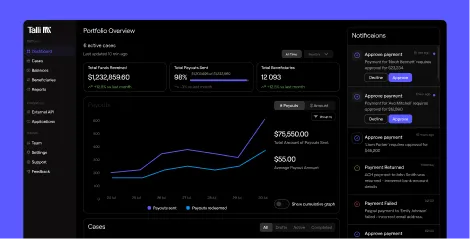
- Full transparency and auditability. Transaction-level ledgering, real-time reconciliation across all payout rails (virtual cards, ACH, checks, digital wallets etc), and comprehensive reporting for Post-Distribution Accounting.
- Purpose built for fiduciary compliance. Every architectural decision - from fund segregation to escheatment handling - was made with client money obligations and handling in mind.
This approach is designed to help mitigate legal risk and support cleaner audits, and settlement funds that reach the people intended to benefit.
The Bottom Line
If you're responsible for distributing settlement funds, mass tort payments, or any other form of third-party client money, the structural characteristics of your payment platform are an important consideration alongside the payment methods it supports
While certain payment platforms may offer operational convenience, claims teams should carefully evaluate whether the platform's approach to funds ownership and unclaimed funds aligns with their fiduciary obligations and the court-approved distribution framework
The good news: alternative platform structures exist. You don't have to choose between operational convenience and fiduciary compliance.
If you're currently using a digital platform to distribute settlement funds, audit your vendor against the questions above. Pay particular attention to what happens with unclaimed funds.
If you're evaluating payment platforms for upcoming distributions, make vendor suitability for third-party client money your first filter, not your last consideration.
Talli was built to handle third-party client money from day one. If you want to see how segregated fund architecture and aligned economics actually work in practice, we're happy to walk you through it.