.svg)


.svg)
Comprehensive data compiled from extensive research on payment fraud trends, prevention strategies, and their impact on legal payouts and settlement distribution
Key Takeaways
- Payment fraud affects nearly all organizations – 79% of organizations experienced actual or attempted payments fraud in 2024, with check fraud and business email compromise each impacting 63% of businesses, making fraud mitigation essential for claims administrators
- Financial losses have reached historic levels – Consumers reported losing a record $10 billion to fraud in 2023, while online payment fraud is projected to reach $131 billion in 2025
- Traditional payment methods carry the highest risk – Check fraud remains the most common payment fraud type at 63%, with 1.9 million stolen US bank checks posted on dark web platforms in 2024, yet 91% of organizations continue using checks
- Recovery rates remain critically low – Only 22% of organizations recovered 75% or more of funds lost to payments fraud, while 20% were unable to recover any funds at all
- Compliance infrastructure is non-negotiable – Organizations with fully implemented fraud prevention policies show improved recovery rates, yet only 66% have fully implemented BEC prevention procedures
- Digital payment solutions reduce fraud exposure – Real-time payments fraud affected only 2% of organizations compared to 63% for checks, demonstrating the protective value of modern payment infrastructure
The Global Threat: Understanding the Scale of Payment Fraud
1. Online payments fraud projected to exceed $362 billion between 2023 and 2028
The scale of payment fraud has reached unprecedented levels, with projections indicating cumulative losses will exceed $362 billion over a five-year period. This figure underscores why claims administrators must prioritize fraud prevention in every settlement distribution workflow. The global payments industry, valued at $2.4 trillion as of 2023, faces systematic threats that require proactive mitigation strategies rather than reactive responses. Source: McKinsey Global Payments
2. Global e-commerce losses from online payment fraud are projected to reach $131 billion in 2025
E-commerce fraud losses continue to escalate dramatically, with global losses projected to reach $131 billion in 2025 according to Juniper Research. This growth rate demonstrates that fraudsters continuously adapt their tactics to exploit payment vulnerabilities across all digital channels. For settlement administrators managing digital disbursements, these statistics highlight the critical need for platforms with built-in fraud detection capabilities. Source: Juniper Research
3. 79% of organizations experienced actual or attempted payments fraud in 2024
Nearly eight in ten organizations faced fraud attempts or actual fraud incidents in 2024, representing minimal improvement from 80% in 2023 despite increased security investments. This persistent threat level indicates that traditional fraud prevention approaches are insufficient against evolving attack vectors. Claims teams processing high-volume settlements face heightened exposure without comprehensive compliance in payouts protocols. Source: 2025 AFP Payments Fraud
4. Consumers lost over $1 trillion to fraud globally in 2024
The Global Anti-Scam Alliance and Feedzai research reveals that consumers worldwide lost over $1 trillion to fraud in 2024. This staggering figure includes settlement claimants who become targets for fraud schemes specifically designed to intercept legal payouts. Protecting claimants requires platforms that combine verification protocols with secure payment delivery mechanisms to prevent interception and unauthorized access. Source: Global Anti-Scam Alliance
Why Legal Payouts Are Prime Targets for Fraudsters
5. Business email compromise affected 63% of organizations in 2024
BEC attacks remained devastatingly effective, impacting 63% of organizations through sophisticated impersonation schemes. Settlement administrators face particular vulnerability as fraudsters target payment authorization workflows with forged instructions. Wire transfers were the primary target, with 63% of organizations reporting BEC attacks specifically aimed at wire payment processes. Source: 2025 AFP Payments Fraud
6. Check fraud impacted 63% of organizations, remaining the most common fraud type
Despite decades of digital payment innovation, check fraud remains the leading fraud category affecting 63% of organizations. The manual processes associated with check-based settlement distributions create multiple vulnerability points. Organizations implementing digital payment platforms with secure fund segregation significantly reduce their exposure to check-related fraud schemes. Source: 2025 AFP Payments Fraud
7. 1.9 million stolen US bank checks posted on dark web platforms in 2024
The dark web marketplace for stolen financial instruments reached alarming levels, with 1.9 million stolen US bank checks appearing on underground platforms. This supply chain of stolen payment instruments directly threatens settlement distributions relying on paper-based methods. Claims administrators who transition to digital rails eliminate this attack surface entirely. Source: Recorded Future 2024
8. 269 million card records posted across dark and clear web platforms in 2024
Cybercriminals posted 269 million card records across various platforms in 2024, creating massive pools of compromised financial data. This volume of stolen credentials enables account takeover attacks and synthetic identity fraud that can redirect settlement payments to fraudulent recipients. Platforms with robust KYC verification capabilities help prevent payouts to compromised or fraudulent identities. Source: Recorded Future 2024
9. Vendor impersonation fraud affected 45% of organizations, up from 34% in 2023
Vendor impersonation schemes increased dramatically, affecting 45% of organizations compared to 34% the previous year. Fraudsters pose as legitimate settlement administrators or payment processors to intercept funds. This trend makes identity verification and secure communication channels essential components of any claims administration workflow. Source: 2025 AFP Payments Fraud
The Cost of Inadequate Fraud Prevention: Beyond Just Financial Losses
10. Consumers reported losing a record $10 billion to fraud in 2023, up from $8.8 billion in 2022
The FTC documented a record $10 billion in consumer fraud losses in 2023, representing continued year-over-year increases. This acceleration demonstrates that fraud prevention capabilities must evolve faster than fraud tactics. Settlement claimants represent particularly vulnerable populations who may lack financial sophistication to identify fraud attempts targeting their payouts. Source: FTC Consumer Sentinel 2023
11. Businesses lost an estimated 6.5% of revenue to fraud in 2024
Organizations averaged 6.5% revenue loss to fraud across all categories, creating substantial operational and financial burdens. For claims administrators, fraud losses compound through reputational damage, regulatory scrutiny, and claimant dissatisfaction. Implementing comprehensive fraud prevention reduces both direct losses and indirect costs associated with fraud incidents. Source: FNBO Commercial Insights
12. Only 22% of organizations recovered 75% or more of funds lost to payments fraud
Recovery rates for fraud losses remain discouragingly low, with only 22% of organizations successfully recovering three-quarters or more of stolen funds. This statistic emphasizes that prevention must take precedence over recovery efforts. Platforms with real-time fraud detection capabilities prevent losses before they occur rather than attempting difficult recovery processes afterward. Source: 2025 AFP Payments Fraud
13. 20% of organizations were unable to recover any funds lost to payments fraud
One in five organizations experienced complete loss without any recovery from fraud incidents. This zero-recovery scenario creates devastating financial and operational consequences. Claims administrators face particular exposure given fiduciary responsibilities to settlement beneficiaries and court oversight requirements. Source: 2025 AFP Payments Fraud
14. Investment scams caused $4.6 billion in losses in 2023, the costliest fraud category
Investment fraud emerged as the highest-loss category at $4.6 billion in 2023, demonstrating how sophisticated schemes extract maximum value from victims. Settlement claimants receiving substantial payouts become attractive targets for these schemes. Educational communications and secure payment delivery protect claimants from secondary victimization after receiving their settlement funds. Source: FTC Consumer Sentinel 2023
15. The estimated cost to manage first-party misuse is $35 for every $100 in disputes
First-party misuse creates disproportionate administrative costs, with organizations spending $35 to manage every $100 in disputed transactions. This overhead consumes resources that could support legitimate claimant services. Automated verification and clear audit trails reduce dispute rates and associated management costs. Source: 2025 MRC Fraud Report
Leveraging AI for Proactive Fraud Detection and Mitigation
16. Magecart e-skimmer infections reached nearly 11,000 unique e-commerce domains in 2024
E-skimmer infections tripled year-over-year, compromising nearly 11,000 unique domains and harvesting payment credentials at scale. This technical sophistication requires equally advanced countermeasures. Settlement platforms must maintain current security certifications and continuous threat monitoring to protect claimant data from credential harvesting and account compromise. Source: Recorded Future 2024
17. Merchants use an average of 5 fraud detection tools
Organizations deploy multiple fraud detection solutions, averaging five separate tools, to address diverse threat vectors. This tool proliferation creates integration challenges and potential coverage gaps. Unified platforms like Talli consolidate fraud prevention, compliance verification, and payment processing into cohesive workflows that eliminate integration vulnerabilities. Source: 2025 MRC Fraud Report
18. 5% of organizations experienced deep-fake fraud attempts in 2024
Emerging AI-enabled fraud tactics including deep-fake audio and video affected 5% of organizations, representing a new frontier in social engineering attacks. These sophisticated impersonation techniques can bypass traditional verification methods. Multi-factor authentication and secure link-based verification provide protection against these evolving threats. Source: 2025 AFP Payments Fraud
Key Fraud Prevention Statistics for Claims Administrators
19. 38% of organizations experienced ACH debit fraud in 2024
ACH fraud affected more than one-third of organizations, highlighting vulnerabilities in electronic fund transfer systems. Claims administrators must implement ACH positive pay and transaction monitoring to protect settlement funds during distribution. Platforms with built-in ACH controls reduce unauthorized debit exposure significantly. Source: 2025 AFP Payments Fraud
20. FBI recorded over 21,400 BEC complaints in 2023, with adjusted losses exceeding $2.9 billion
The FBI's Internet Crime Complaint Center documented over 21,400 BEC complaints with adjusted losses exceeding $2.9 billion in 2023. Settlement administrators handling large fund transfers represent high-value targets for these schemes. Verification protocols that confirm payment instructions through established channels prevent BEC-related losses. Source: FBI IC3 Report 2023
21. 30% of organizations experienced wire transfer fraud in 2024
Wire transfer fraud affected nearly one-third of organizations despite being considered a secure payment method. The irreversible nature of wire transfers makes prevention essential since recovery is rarely possible. Digital payment alternatives with built-in verification reduce wire transfer dependency and associated fraud risks. Source: 2025 AFP Payments Fraud
22. 23% of organizations experienced check fraud due to mailbox thefts
Nearly one-quarter of check fraud incidents originated from physical mail theft, demonstrating vulnerabilities in paper-based payment distribution. Settlement checks sent through mail face interception risks throughout the delivery chain. Digital payment delivery eliminates mail-based attack vectors entirely while providing delivery confirmation. Source: 2025 AFP Payments Fraud
23. Merchants estimate 3% of total eCommerce revenue is lost to fraud annually
The 3% annual revenue loss to fraud represents substantial cumulative impact across transaction volumes. For high-volume settlement distributions, this percentage translates to significant fund leakage. Platforms with comprehensive fraud mitigation capabilities protect settlement funds throughout the distribution lifecycle. Source: Verifi 2024 Report
24. 83% of larger organizations were more susceptible to fraud than smaller ones
Larger organizations with annual revenue exceeding $1 billion experienced 83% fraud incidence compared to 73% for smaller entities. High-value settlement distributions attract proportionally more fraud attention. Scale-appropriate fraud prevention must match the transaction volumes and fund sizes typical in class action and mass tort settlements. Source: 2025 AFP Payments Fraud
Compliance and Security: Essential Pillars of Payment Fraud Prevention
25. 66% of organizations have fully implemented BEC prevention policies and procedures
Two-thirds of organizations have established comprehensive BEC prevention protocols, yet gaps remain in implementation consistency. Claims administrators must ensure legal payout compliance extends beyond basic policies to include verified procedures and regular training. Talli's platform incorporates KYC, OFAC screening, and W-9 collection to meet compliance requirements systematically. Source: 2025 AFP Payments Fraud
26. 91% of organizations currently use checks as a payment method despite fraud risks
Despite overwhelming evidence of check fraud vulnerability, 91% of organizations continue check usage. This persistence creates ongoing exposure that digital alternatives would eliminate. Settlement administrators face particular pressure to modernize given their fiduciary obligations and court oversight requirements. Source: 2025 AFP Payments Fraud
27. More than 75% of organizations have no plans to reduce check usage in the next two years
Organizational inertia keeps check usage entrenched, with over three-quarters planning no reduction despite fraud statistics. This represents a significant competitive and risk management gap. Early adopters of digital settlement distribution gain advantages in security, efficiency, and claimant experience. Source: 2025 AFP Payments Fraud
28. Up to $2 trillion annually is laundered through the global financial system
The United Nations Office on Drugs and Crime estimates up to $2 trillion in annual money laundering, creating compliance obligations for all payment processors. Settlement administrators must implement OFAC compliance screening to prevent inadvertent participation in money laundering schemes. Automated screening integrated into payment workflows ensures compliance without creating processing delays. Source: UNODC via McKinsey
Enhancing Claimant Experience While Preventing Fraud
29. The FTC received fraud reports from millions of consumers in 2023
The volume of fraud reports demonstrates widespread consumer exposure to fraudulent schemes. Settlement claimants who receive communications about their payouts may encounter impersonation attempts mimicking legitimate administrators. Clear communication protocols and verified contact channels help claimants distinguish legitimate outreach from fraud attempts. Source: FTC Consumer Sentinel 2023
30. Real-time payments fraud affected only 2% of organizations in 2024
Real-time payment systems demonstrated dramatically lower fraud incidence at just 2% compared to 63% for checks. This contrast validates the fraud prevention benefits of modern digital payment infrastructure. Talli's platform enables instant payment delivery through digital wallets and prepaid cards while maintaining comprehensive fraud controls. Source: 2025 AFP Payments Fraud
31. 58% of organizations were able to recoup up to 75% of funds, up from 29% in 2023
Recovery rates improved significantly, with 58% of organizations recovering up to 75% of losses compared to just 29% the previous year. This improvement reflects better incident response and recovery procedures. However, prevention remains superior to recovery, and platforms with proactive fraud detection eliminate the need for post-incident recovery efforts. Source: 2025 AFP Payments Fraud
The Future of Fraud Prevention: Innovations and Best Practices
32. Payments will represent 35% of the total banking revenue pool by 2028
The payments industry's growth trajectory positions it to capture 35% of banking revenue by 2028, growing at 5% annually. This expansion brings increased fraud attention and requires proportional security investment. Claims administrators must select payment partners with robust security infrastructure capable of scaling with industry growth. Source: McKinsey Global Payments
33. Nearly 1,200 scam e-commerce domains were linked to fraudulent merchant accounts in 2024
Fraudsters established nearly 1,200 fake merchant domains to facilitate payment fraud schemes. This infrastructure investment demonstrates fraud operation sophistication and persistence. Settlement platforms must maintain current threat intelligence and continuous monitoring to identify emerging fraud vectors before they impact distributions. Source: Recorded Future 2024
Taking Action: Building Fraud-Resistant Settlement Distribution
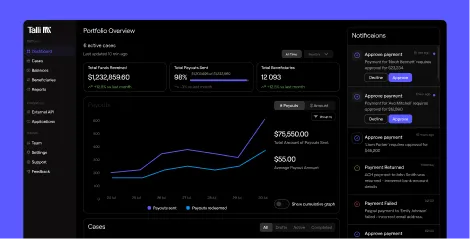
The evidence is overwhelming: organizations that transition from checks to real-time digital payments reduce fraud exposure from 63% to just 2%. Claims administrators face a critical decision point as fraudsters increasingly target settlement distributions with sophisticated BEC, check fraud, and impersonation schemes. The path forward requires embracing modern payment infrastructure with integrated fraud prevention capabilities built into every transaction workflow. Talli's AI-driven payment platform combines secure settlement payment methods, digital wallet integration, and real-time tracking with comprehensive compliance verification including KYC, OFAC screening, and W-9 collection. Complete fund segregation preserves QSF ownership while real-time dashboards provide total visibility over delivery, completion, and engagement throughout the distribution lifecycle. Banking services provided by Patriot Bank, N.A., Member FDIC, ensure institutional-grade security for every disbursement.
Frequently Asked Questions
What are the most common types of payment fraud affecting legal payouts?
Check fraud and business email compromise each affect 63% of organizations, making them the leading fraud categories. Wire transfer fraud impacts 30% of organizations, while ACH debit fraud affects 38%. Legal payouts face heightened risk due to large payment amounts, complex multi-party workflows, and vulnerable claimant populations who may not recognize fraud attempts.
How does AI contribute to more effective fraud prevention in claims administration?
AI-powered fraud detection analyzes transaction patterns in real-time to identify anomalies before funds are disbursed. With nearly universal fraud exposure and deep-fake attempts emerging as new threats, static rule-based systems cannot keep pace. AI adapts to evolving fraud tactics while reducing false positives that delay legitimate payments.
What compliance measures are critical for preventing payment fraud in settlements?
Essential compliance measures include KYC verification, OFAC screening, W-9 collection, and complete audit trails. Only 66% of organizations have fully implemented BEC prevention policies, leaving significant gaps. Fund segregation and real-time monitoring provide additional protection layers required for fiduciary compliance in settlement administration.
Can secure payment solutions improve both fraud prevention and claimant satisfaction?
Absolutely. Real-time payments experienced only 2% fraud incidence compared to 63% for checks, while also delivering faster claimant access to funds. Digital payment options eliminate mail theft risks affecting 23% of check fraud cases. Claimants receive secure links via SMS or email, requiring no account creation while maintaining comprehensive security.
How does Talli ensure fund security and prevent fraud during the disbursement process?
Talli automates and safeguards every claims payout with KYC, OFAC, W-9 collection, fraud mitigation, and audit logs built into the platform. Complete fund segregation preserves QSF ownership while simplifying reporting. Real-time dashboards provide total visibility over delivery, completion, and engagement throughout the distribution lifecycle.