.svg)


.svg)
Vendor due diligence separates organizations that protect sensitive settlement data from those that become breach statistics. With 98.3% of organizations with third-party vendor relationships having worked with a vendor that experienced a breach in the past two years, the question isn't whether your vendors pose risks—it's whether you've identified and mitigated them. For claims administrators and settlement teams handling legal payout compliance, a systematic vendor assessment process protects claimant data, ensures regulatory adherence, and prevents costly operational disruptions that can derail disbursement timelines.
Key Takeaways
- 98.3% of organizations with third-party vendor relationships have worked with a vendor that experienced a breach in the past two years
- An estimated 62% of network intrusions originate from third-party vendors, making vendor assessment critical for security
- High-risk vendor assessments typically require an estimated 6-8 hours per vendor while low-risk reviews take 1-2 hours
- Automation platforms reduce manual vendor review time by around 80% compared to spreadsheet-based processes
- It's best practice to request SOC 2 reports issued within the last 12 months to ensure current security controls
- Mid-market compliance automation platforms cost an estimated $15,000-$50,000 annually but deliver rapid ROI through breach prevention
Understanding the Fundamentals of Vendor Security and Compliance Due Diligence
Vendor due diligence is a systematic evaluation process that assesses third-party vendors' security practices, compliance status, financial stability, and operational reliability. For legal tech companies handling settlement disbursements, this process ensures vendors meet regulatory requirements while protecting sensitive claimant information.
The assessment framework covers multiple domains:
- Security posture – Data encryption, access controls, incident response capabilities
- Regulatory compliance – GDPR, CCPA, PCI-DSS adherence based on data handled
- Financial stability – Vendor viability and business continuity assurance
- Operational reliability – Uptime guarantees, disaster recovery, support responsiveness
Claims administrators face heightened scrutiny because payment processors and data storage vendors directly handle PII, bank account details, and settlement fund information. A vendor security assessment evaluates whether third-party providers meet your organization's security standards before and during business relationships.
Establishing a Robust Vendor Risk Management Framework
Building a sustainable framework requires cross-functional coordination and risk-based prioritization. The most effective programs classify vendors into tiers based on data access, operational criticality, and regulatory impact.
Risk-Based Vendor Tiering
Categorize vendors to allocate assessment resources efficiently:
- High-risk vendors – Payment processors, cloud storage providers, and any vendor handling settlement funds or claimant PII. Require comprehensive assessments and annual reviews.
- Medium-risk vendors – Legal research tools, communication platforms, and analytics providers with limited data access. Biennial assessments suffice.
- Low-risk vendors – Office suppliers and peripheral services without data access. Basic verification every three years.
This tiered approach ensures deep reviews focus on vendors representing the highest risk while streamlining low-risk assessments.
Cross-Functional Team Assembly
Effective due diligence requires stakeholders from multiple departments:
- Legal – Contract review, liability assessment, regulatory compliance verification
- IT/Security – Technical security assessment, penetration testing review, architecture analysis
- Finance – Financial stability analysis, credit rating review, insurance verification
- Compliance – OFAC screening, KYC verification, audit log requirements
Designate a process owner to coordinate activities and maintain accountability across departments.
Key Areas of Security Assessment in Vendor Due Diligence
Technical security evaluation forms the core of vendor assessment. A comprehensive security checklist covers critical security domains.
Essential Security Verification Areas
Your assessment should verify:
- Data encryption standards – AES-256 for data at rest, TLS 1.2+ for data in transit
- Access control mechanisms – Role-based permissions, MFA enforcement for admin accounts
- Network security architecture – Firewall configurations, intrusion detection systems
- Incident response capabilities – Documented procedures, notification timeframes, remediation processes
- Vulnerability management – Regular penetration testing, patch management cadence
- Backup and recovery – Encryption of backups, retention policies, recovery time objectives
It's best practice to request SOC 2 Type II reports issued within the last 12 months. Older certifications may signal gaps in security controls that could expose your organization to breach risk.
For settlement administration teams, vendors handling funds require additional verification of fraud mitigation capabilities and transaction monitoring systems.
Ensuring Compliance: Regulatory and Legal Considerations
Compliance verification extends beyond security to encompass regulatory requirements specific to your industry and data types. Legal settlement administration demands attention to multiple frameworks.
Applicable Regulatory Frameworks
Depending on your operations, verify vendor compliance with:
- GDPR – Required when handling EU claimant data in international settlements
- CCPA/CPRA – Mandatory for California resident data in class action distributions
- PCI-DSS – Essential when payment processors handle card data
- State privacy laws – Emerging regulations across multiple jurisdictions
The legal sector includes ABA Model Rules requiring lawyers to protect client confidentiality, extending to vendor management practices.
QSF and Fund Segregation Requirements
For claims administrators, vendors involved in settlement fund handling must support:
- Complete fund segregation capabilities
- QSF ownership preservation
- Audit trail documentation for regulatory reporting
- Real-time fund flow visibility
Verify vendors can produce compliance documentation demonstrating adherence to settlement-specific requirements.
Conducting Effective Compliance Audits and Assessments
Systematic audit processes transform vendor evaluation from ad-hoc reviews to repeatable, defensible assessments. A due diligence checklist approach ensures consistent coverage across all vendor evaluations.
Assessment Process Steps
Execute assessments following this sequence:
- Send standardized questionnaires – Use frameworks like SIG or CAIQ to reduce vendor fatigue
- Request documentation – SOC 2 reports, ISO 27001 certificates, financial statements, insurance policies
- Review responses systematically – Score against predetermined criteria
- Validate independently – Cross-reference vendor claims with third-party security ratings
- Document findings – Create comprehensive assessment reports with risk scores
- Make documented decisions – Approve, conditionally approve with remediation plan, or reject
High-risk vendor assessments typically require an estimated 6-8 hours while medium-risk reviews take 3-4 hours and low-risk verifications complete in 1-2 hours.
Evidence Validation Techniques
Don't rely solely on vendor self-attestation. Validate claims through:
- Third-party security rating services that scan vendor infrastructure
- Public breach databases for incident history
- Financial credit ratings from independent agencies
- Customer references from similar-scale organizations
Mitigating Risks: Strategies for Vendor Management
Risk mitigation extends beyond assessment to active management throughout the vendor relationship. Identified risks require documented remediation plans with accountability and timelines.
Contract Protections
Negotiate contractual safeguards including:
- SLA guarantees – Uptime requirements, incident notification timeframes
- Audit rights – On-site inspection capabilities, documentation access
- Insurance requirements – Minimum cyber liability coverage ($5M+ for high-risk vendors)
- Termination clauses – Exit procedures, data return/destruction protocols
- Breach notification requirements – Maximum 24-48 hours for critical incidents
Conditional Approval Framework
When vendors show promise but have gaps, implement conditional approvals:
- Document specific deficiencies requiring remediation
- Set clear timelines (typically 60-90 days for critical issues)
- Schedule follow-up verification before full approval
- Define consequences for missed deadlines
This approach balances operational needs with security requirements, particularly for vendors offering unique capabilities.
Leveraging Technology for Streamlined Due Diligence
Manual vendor assessment processes break down at scale. Organizations managing dozens of vendors need automation to maintain assessment quality while controlling costs.
Automation Platform Capabilities
Modern platforms deliver:
- AI-powered questionnaire completion – Pre-fill responses based on historical data
- Automated evidence collection – Direct integration with vendor systems
- Continuous monitoring – Real-time alerts for security incidents or compliance lapses
- Risk scoring algorithms – Quantified assessments enabling objective comparisons
- Integration with security ratings – External validation of vendor claims
Automation reduces manual vendor review time by around 80% while improving detection speed by approximately 60% compared to relying on vendor self-reporting.
Platform Selection Criteria
Evaluate automation solutions against:
- Compliance framework support (SOC 2, ISO 27001, GDPR)
- Integration capabilities with existing systems
- Vendor count limits and pricing tiers
- Security certifications of the platform itself
- Implementation complexity and support availability
Continuous Monitoring and Vendor Relationship Management
Initial due diligence represents the starting point, not the finish line. Vendor risk management requires ongoing oversight throughout the relationship lifecycle.
Monitoring Frequency by Risk Tier
Establish reassessment schedules based on vendor classification:
- High-risk vendors – Annual comprehensive reviews plus quarterly check-ins
- Medium-risk vendors – Biennial full assessments
- Low-risk vendors – Reviews every three years unless circumstances change
Configure automated alerts for:
- Security incidents affecting vendor systems
- Compliance certification expirations
- Financial stability changes (credit downgrades, leadership changes)
- Operational issues exceeding SLA thresholds
Relationship Management Best Practices
Build vendor relationships that support ongoing transparency:
- Establish quarterly business reviews for critical vendors
- Create clear escalation paths for security concerns
- Maintain open communication channels beyond contract management
- Document all significant interactions for audit purposes
Best Practices for Documenting and Reporting Due Diligence
Comprehensive documentation serves dual purposes: supporting current decisions and providing audit evidence. Maintain systematic records for vendor management oversight.
Documentation Requirements
Maintain systematic records including:
- Completed assessment questionnaires with vendor responses
- Supporting documentation (certificates, reports, policies)
- Risk scoring calculations and methodology
- Decision documentation with approval signatures
- Remediation plans and completion verification
- Communication logs for significant interactions
Audit Trail Standards
Structure documentation to support regulatory audits:
- Sequential file numbering for version control
- Timestamp all entries and updates
- Preserve original documents alongside any modifications
- Maintain minimum seven-year retention for compliance records
- Implement access controls limiting document modification
Future-Proofing Your Vendor Due Diligence Program
The threat landscape evolves continuously. Best practices in risk management demand adaptive frameworks that anticipate emerging challenges.
Emerging Considerations
Prepare your program for:
- Fourth-party risk – Assess your vendors' vendors, particularly for critical data handling
- AI and automation risks – Evaluate vendor AI systems for bias, accuracy, and security
- Regulatory expansion – Monitor state privacy law developments affecting settlement operations
- Supply chain attacks – Verify vendor software supply chain security practices
Why Talli Strengthens Your Vendor Due Diligence Standards
When evaluating payment platforms for settlement disbursement, Talli exemplifies the security and compliance characteristics your due diligence process should verify.
Talli's platform delivers built-in compliance capabilities that simplify vendor assessment:
- KYC, OFAC, and W-9 collection – Verification processes embedded in the platform eliminate manual compliance tracking
- Complete fund segregation – Dedicated accounts for every settlement preserve QSF ownership and simplify regulatory reporting
- Fraud mitigation and audit logs – Comprehensive transaction monitoring with full audit trails for compliance documentation
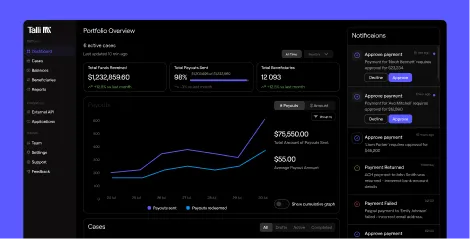
- Real-time dashboard visibility – Monitor every payout status, completion rate, and fund flow for total operational control
- Banking services through Patriot Bank, N.A., Member FDIC – Regulated financial infrastructure supporting compliant disbursement
For claims administrators conducting vendor due diligence, Talli provides the OFAC screening and compliance automation that reduces your organization's risk exposure while accelerating settlement distribution timelines.
The platform handles compliance complexity so your team can focus on claimant experience rather than regulatory tracking. Whether processing 1,000 or 100,000 recipient payments, Talli's infrastructure scales without compromising security controls or audit capabilities.
Frequently Asked Questions
What is the primary goal of vendor due diligence for security and compliance?
The primary goal is systematically evaluating third-party vendors to ensure they meet your organization's security standards, regulatory requirements, and operational reliability thresholds before and during business relationships. For legal settlement administrators, this means verifying that payment processors, data storage providers, and other vendors adequately protect claimant PII, settlement funds, and sensitive case information while maintaining compliance with applicable regulations like GDPR, CCPA, and PCI-DSS.
How often should vendor security and compliance assessments be conducted?
Assessment frequency should align with vendor risk classification. High-risk vendors handling sensitive data or critical operations require annual comprehensive reviews with quarterly monitoring check-ins. Medium-risk vendors warrant biennial assessments, while low-risk vendors without data access need verification every three years. However, any material change in vendor circumstances—such as ownership changes, security incidents, or scope expansion—should trigger immediate reassessment regardless of scheduled timing.
What are common challenges in performing vendor due diligence?
Organizations frequently encounter vendor questionnaire fatigue, where providers fail to respond to lengthy assessments. Using standardized frameworks like SIG or CAIQ reduces this friction. Internal team silos create duplicate efforts and inconsistent evaluations—address this through designated process ownership and shared platforms. Many smaller vendors lack SOC 2 or ISO 27001 certifications, requiring alternative evidence evaluation or conditional approvals with certification timelines. Manual processes break down at scale, necessitating automation investment.
What role does continuous monitoring play in vendor risk management?
Continuous monitoring bridges the gap between point-in-time assessments, detecting issues that emerge between formal reviews. Automated monitoring platforms provide real-time alerts for security incidents, compliance certification expirations, financial stability changes, and operational issues. This approach delivers approximately 60% faster incident detection compared to relying on vendor self-reporting and enables proactive risk mitigation before issues escalate into breaches or compliance violations affecting your operations.
How does Talli support compliance in financial payouts for legal settlements?
Talli embeds compliance directly into the disbursement workflow through automated KYC verification, OFAC screening, and W-9 collection. The platform maintains complete fund segregation with dedicated accounts for every settlement, preserving QSF ownership while simplifying regulatory reporting. Built-in fraud mitigation, comprehensive audit logs, and real-time visibility into fund flows ensure claims administrators maintain compliance without manual tracking. Banking services provided by Patriot Bank, N.A., Member FDIC deliver regulated financial infrastructure supporting compliant settlement distribution at any scale.