.svg)


.svg)
When a bankruptcy trustee needs to disburse $50 million to 100,000 claimants within a court-ordered deadline, every minute of system downtime represents more than inconvenience—it can increase fiduciary risk and create court-compliance exposure. Real-time payout providers often target 99.99%+ availability (SLA/SLO varies by provider and scope) through sophisticated infrastructure strategies that process millions of transactions daily with low latency designed for real-time execution. Modern claims payout platforms like Talli deliver this reliability while maintaining complete compliance and visibility for legal settlement administrators.
Key Takeaways
- Enterprise payment platforms maintain 99.99% to 99.999% uptime through multi-region redundancy and automated failover systems
- Multi-region redundancy significantly reduces payment failures compared to single-region deployments
- The RTP Network processed 114 million transactions in Q3 2025 with zero scheduled downtime, providing a high-availability benchmark for real-time payment rails
- Automated reconciliation reduces manual work significantly while improving accuracy for claims administrators
- Intelligent payment routing helps avoid the 12-15% of transaction failures that occur from issues beyond merchant control
Why Is Uptime Critical for Real-Time Payouts?
Payment system availability directly determines whether claimants receive funds within court-mandated timelines or face extended delays. For claims administrators managing legal settlements, high-volume payouts demand infrastructure that never fails during critical disbursement windows.
- Court-ordered deadlines Settlement distribution timelines leave zero margin for system failures during payout execution.
- Fiduciary responsibility Trustees and administrators bear legal obligations to disburse funds promptly and accurately.
- Claimant financial pressure Recipients often face immediate needs for medical bills, utilities, or other expenses that compound during delays.
- Reputational consequences Failed payments erode trust between law firms, administrators, and the claimants they serve.
- Regulatory scrutiny Courts and regulators examine disbursement records, making system reliability a compliance requirement. (Source)
What Does 99.99% Uptime Actually Mean?
Enterprise uptime standards translate directly into allowable downtime per year. A 99.99% uptime guarantee permits only 52 minutes of total downtime annually, while 99.999% allows just 5 minutes. For settlement administrators processing thousands of payments within narrow windows, even brief outages can cascade into missed deadlines and compliance violations.
How Do Providers Build Robust Infrastructure for Reliability?
High-availability payment systems rely on architectural decisions made before the first transaction ever processes. Scalable payment systems require deliberate design choices that prioritize resilience over cost efficiency.
- Multi-region deployment Data centers distributed across geographic zones ensure localized failures never impact the entire system.
- Active-active failover Both primary and secondary systems process transactions simultaneously, eliminating switchover delays during incidents.
- Microservices architecture Independent service components fail in isolation without cascading to other system functions.
- Load balancing Traffic distribution across multiple servers prevents any single point from becoming overwhelmed.
- Database replication Real-time data synchronization across regions ensures no transaction records are lost during failures. (Source)
How Does Geographic Redundancy Prevent Service Interruptions?
Multi-region architectures distribute payment processing across physically separated data centers. When one region experiences issues—whether network problems, power failures, or natural disasters—traffic automatically routes to healthy regions. Payment platforms using this approach maintain service continuity even during major infrastructure events.
What Makes Scalable Architectures Handle Peak Demands?
Legal settlements often require processing tens of thousands of payments within hours rather than days. Auto-scaling infrastructure automatically provides additional computing resources during volume spikes, then scales down during quiet periods. One case study demonstrated processing 3 million transactions within 8 hours while serving 5 million mobile users and maintaining 99.741% uptime.
Talli powers payouts at any size—whether 1,000 or 100,000 recipients—without sacrificing speed or control. This scalability comes from infrastructure designed specifically for the burst-processing patterns common in settlement disbursements.
What Monitoring Systems Detects Problems Before They Cause Outages?
Proactive detection prevents the majority of potential outages by identifying degradation before it affects transactions. Settlement dashboards provide the visibility that administrators need to maintain confidence in system performance.
- Real-time health checks Continuous automated tests verify each system component functions correctly.
- Anomaly detection AI-powered monitoring identifies unusual patterns that may indicate emerging problems.
- Performance analytics Transaction latency and throughput metrics reveal degradation before failures occur.
- Automated alerting Immediate notifications reach operations teams when metrics exceed defined thresholds.
- Synthetic transactions Test payments continuously validate end-to-end system functionality. (Source)
How Does AI Enable Predictive Uptime Maintenance?
Machine learning models analyze historical performance data to predict potential failures hours or days before they occur. This predictive capability allows operations teams to address issues during low-volume periods rather than during critical disbursement windows. Real-time monitoring systems reduce incident response time significantly, transforming reactive firefighting into proactive maintenance.
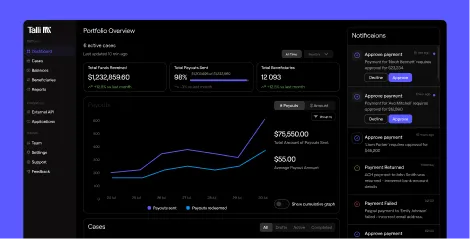
Talli's real-time dashboard provides total control and visibility, allowing claims administrators to monitor delivery, completion, and engagement of every payout. This transparency ensures administrators know exactly where every dollar sits throughout the disbursement lifecycle.
How Does Security and Compliance Protect System Availability?
Security incidents represent one of the leading causes of payment system downtime. Compliance in payouts requires infrastructure that prevents attacks while maintaining the verification processes that regulators mandate.
- KYC verification Identity confirmation prevents fraudulent claims from consuming system resources and triggering investigations.
- OFAC screening Sanctions list verification ensures compliance while preventing transactions that could trigger regulatory action.
- W-9 collection Automated tax documentation gathering streamlines year-end reporting without manual intervention.
- Fraud mitigation Real-time transaction analysis identifies suspicious patterns before funds leave the settlement account.
- Audit logs Comprehensive transaction records support regulatory examinations without requiring system downtime for data extraction. (Source)
How Do Security Measures Prevent System Disruptions?
Cyberattacks and fraud attempts can overwhelm payment systems, causing downtime even when infrastructure functions correctly. Payment security implements multiple defensive layers—encryption, access controls, and continuous monitoring—that prevent malicious activity from impacting legitimate transactions.
Why Does Compliance Integration Enhance Reliability?
Compliance failures trigger manual review processes that slow disbursements and create system backlogs. Automated compliance screening eliminates these bottlenecks by validating each transaction against regulatory requirements in real-time. Talli automates and safeguards every claims payout with KYC, OFAC, W-9 collection, fraud mitigation, and audit logs built into the platform.
Why Do Seamless Integrations and Flexible Payment Options Matter?
Payment rail diversity directly impacts system reliability. When one payment method experiences issues, alternative rails maintain disbursement capability. Legal payout compliance requires flexibility that accommodates diverse claimant needs while maintaining operational continuity.
- ACH transfers Bank-to-bank payments provide reliable delivery for claimants with established banking relationships.
- Prepaid cards Card-based options serve unbanked and underbanked claimants who cannot receive direct deposits.
- Digital wallets Modern payment apps meet claimant preferences for mobile-first financial management.
- Gift cards Retail-focused options provide immediate purchasing power for specific use cases.
- Multiple acquirer relationships Routing flexibility across payment processors prevents single-point-of-failure scenarios. (Source)
How Does Payment Rail Diversity Improve Success Rates?
Single-rail dependency creates systemic risk when that payment method experiences outages or high rejection rates. Intelligent routing across multiple payment rails prevents system-wide failures while optimizing for cost and speed based on transaction characteristics.
Talli enhances customer experience with secure settlement payment methods, digital wallet integration, and flexible options that let claimants pick what works best for them. This flexibility translates to higher redemption rates and fewer failed payments.
How Does Dedicated Support Maintain Operational Continuity?
Technology alone cannot guarantee uptime without human expertise to address complex issues. Dedicated support teams provide the rapid response capability that automated systems cannot fully replicate.
- 24/7 availability Round-the-clock coverage ensures issues receive attention regardless of when they occur.
- Incident response protocols Documented procedures accelerate problem resolution during critical situations.
- Escalation paths Clear chains of responsibility prevent issues from stalling in organizational gaps.
- Proactive communication Status updates keep administrators informed during incidents. (Source)
How Do Smart Reminders Keep Claimants Engaged?
System reliability extends beyond payment processing to claimant communication. Failed deliveries often result from outdated contact information or missed notifications rather than technical failures. Smart reminder systems across email, SMS, and other channels help claimants complete the payout process quickly while reducing the support burden on administrators.
Talli provides dedicated customer support combined with smart reminders that help claimants complete payouts fast—translating to higher take-up rates and less time spent chasing recipients.
What Role Do Banking Partnerships and Regulatory Compliance Play?
Financial services regulation requires payment platforms to maintain relationships with licensed banking partners. These partnerships provide the regulatory foundation that enables reliable fund movement while protecting claimant assets.
- FDIC insurance Bank-held funds receive federal deposit insurance protection up to applicable limits.
- QSF account management Settlement Fund structures preserve legal ownership while enabling efficient disbursement.
- Complete fund segregation Dedicated accounts for each settlement prevent commingling and simplify reporting.
- Regulatory examination readiness Compliant infrastructure supports audits without operational disruption.
- Licensed payment facilitation Appropriate licensing ensures transactions process within regulatory frameworks.
Why Does FDIC-Insured Banking Matter for Settlement Funds?
Claimant funds held pending disbursement require protection against institutional failures. Banking services provided by FDIC member institutions ensure settlement funds receive appropriate safeguards. Talli's banking services are provided by Patriot Bank, N.A., Member FDIC, ensuring every dollar held for claimants maintains federal deposit insurance protection.
How Do QSF Structures Support Reliable Disbursements?
Qualified Settlement Funds require specific handling to maintain tax treatment and legal ownership structures. Fund segregation with dedicated accounts for each settlement preserves QSF ownership, simplifies reporting, and ensures legal compliance throughout the disbursement lifecycle. Talli supports this complete fund segregation automatically.
How Does High Uptime Transform Claims Administration Efficiency?
Reliable payment infrastructure creates compound benefits across the entire claims administration workflow. Claims team efficiency improves dramatically when administrators can trust that systems will perform as expected.
- Reduced manual intervention Automated reconciliation reduces manual work significantly, freeing staff for higher-value activities.
- Faster settlement cycles In many cases, digital disbursement can compress timelines from days/weeks to same-day delivery, depending on claimant selection and verification steps when systems process payments reliably on first attempt.
- Lower payment failure rates Multi-region redundancy can reduce payment failures, reducing reprocessing overhead.
- Improved claimant satisfaction Rapid, reliable payments enhance the overall settlement experience for recipients.
- Court deadline confidence Predictable system performance allows administrators to commit to disbursement timelines.
How Do Reliable Systems Enable Weeks-to-Minutes Processing?
Traditional settlement disbursements require multiple manual steps—check printing, mailing, recipient deposit, and bank clearing—that consume weeks of elapsed time. Digital platforms compress this timeline to minutes by eliminating physical logistics and processing transactions instantly.
Talli helps claims administrators meet tight deadlines without losing control over compliance or claimant experience. The platform's real-time dashboard provides full transparency on completion rates, fund flows, and payout status—turning settlement administration from a multi-week ordeal into a same-day operation.
What Visibility Do Modern Platforms Provide?
Real-time dashboards display every transaction's status, from initiation through claimant receipt. This visibility enables administrators to identify and address issues immediately rather than discovering problems days later through reconciliation reports. Intelligent routing optimization helps avoid the 12-15% of transaction failures that occur from issues beyond merchant control while improving overall success rates.
Frequently Asked Questions
How Do Payment Platforms Test Failover Systems Without Affecting Live Transactions?
Enterprise platforms conduct regular chaos engineering exercises that simulate failures in isolated environments. These controlled tests validate that automated failover mechanisms activate correctly and that secondary systems can handle full production loads. Organizations conducting quarterly failover drills experience significantly fewer actual outages than those relying solely on theoretical disaster recovery plans.
What Service Level Agreements Should Claims Administrators Expect?
Enterprise payment platforms typically offer SLAs guaranteeing 99.99% uptime with financial penalties for failures to meet commitments. These agreements should specify response times for different incident severities, escalation procedures, and service credit calculations. The RTP Network sets the industry standard by maintaining 100% availability with zero scheduled downtime.
How Long Does Migration from Legacy Systems to Modern Platforms Take?
Migration complexity varies based on transaction volume and existing system customization. Organizations processing over 1 million transactions monthly typically require several months for full migration, including parallel running periods that validate new system performance before legacy system decommissioning.
What Happens to Transactions in Progress During a System Failover?
Well-designed payment platforms implement idempotency controls that prevent duplicate transactions during failover events. In-flight transactions either complete on the original system or safely transfer to backup infrastructure without creating duplicate payments or lost transactions. Event-driven architectures maintain transaction state across system boundaries to ensure consistency.
How Do Payment Platforms Handle International Settlement Disbursements?
Cross-border payments require additional infrastructure including SWIFT connectivity, currency conversion capabilities, and compliance with multiple jurisdictions' regulations. Enterprise platforms typically maintain data residency controls that keep EU data in EU regions for GDPR compliance while routing international payments through appropriate correspondent banking relationships.