.svg)


.svg)
Standardizing financial reporting for legal payouts remains one of the most challenging operational hurdles facing courts, claims administrators, and auditors today. Court staff face a significant burden manually compiling data for legislators and researchers, with inefficiency compounding across jurisdictions using incompatible systems. The National Open Court Data Standards (NODS) framework now enables numerous states to achieve consistent reporting and streamlined data requests. For settlement administrators managing fund distributions, transparency in settlement distribution becomes critical when courts, auditors, and compliance teams need standardized data to verify case outcomes and ensure accurate payouts.
Key Takeaways
- Court data standardization through NODS covers seven case categories including criminal, civil, domestic relations, juvenile, traffic, probate, and mental health
- Implementation typically requires several months to over a year with phased rollout across jurisdictions
- Implementation costs vary significantly depending on jurisdiction size and complexity
- Standardized reporting enables faster response times to legislative data requests through automated reporting
Understanding Current Financial Reporting Challenges in Legal Contexts
Courts and claims administrators face a fragmented reporting landscape where inconsistent data definitions undermine transparency and compliance. When one jurisdiction defines "case disposition" differently than another, cross-jurisdictional comparisons become meaningless. This inconsistency directly impacts settlement administration, where accurate case outcome data determines disbursement eligibility.
The core challenges affecting financial reporting include:
- Incompatible data systems across jurisdictions using different case management platforms
- Manual compilation processes consuming staff resources on routine requests
- Inconsistent terminology making cross-court comparisons unreliable
- Limited audit trails creating compliance vulnerabilities
- Delayed reporting cycles preventing real-time decision-making
The NCSC developed NODS specifically to address these challenges, providing standardized definitions and formats that courts can map to their existing systems without replacing their case management infrastructure.
Key Components of Effective Financial Reporting
Effective legal financial reporting requires several foundational elements working together. Fund distribution should be tracked from settlement approval through final disbursement, with each transaction logged for audit purposes.
Essential reporting components include:
- Standardized data element definitions ensuring consistent interpretation
- Real-time tracking capabilities for fund flows and completion rates
- Automated audit logs capturing every transaction
- Digital wallet integration for modern payment methods
- Compliance verification checkpoints throughout the settlement lifecycle
Your reconciliation processes must align with these standardized frameworks to ensure accurate financial reporting across all stakeholders.
Implementing Standardized Reporting Types for Enhanced Oversight
Defining Essential Reporting Categories
Legal payout reporting falls into distinct categories, each serving specific oversight functions. Understanding these categories helps administrators build comprehensive reporting frameworks that satisfy courts, auditors, and compliance teams simultaneously.
Disbursement Reports track every payment from fund allocation through recipient confirmation. These reports capture payment method, timing, amount, and recipient verification status.
Compliance Reports document adherence to regulatory requirements including KYC verification, OFAC screening, and W-9 collection, as applicable.. Pew recommends standardizing these reports across jurisdictions to enable meaningful comparisons.
Audit Reports provide independent verification of fund handling, transaction accuracy, and compliance adherence. These reports should maintain complete audit trails from initial funding through final distribution.
Transaction Logs capture granular detail on every fund movement, supporting forensic review when questions arise. Comprehensive logging directly supports legal payout compliance requirements.
Best Practices for Structuring Standardized Reports
Structuring reports for multiple stakeholders requires balancing detail with accessibility. Courts need verification of proper fund handling, administrators need operational metrics, and auditors need complete transaction histories.
Report structuring best practices include:
- Hierarchical organization moving from summary to detail levels
- Consistent formatting across all report types
- Automated generation reducing manual compilation errors
- Version control tracking report modifications
- Role-based access limiting sensitive data exposure
Organizations implementing dedicated accounts for every settlement simplify reporting while ensuring legal compliance throughout the disbursement lifecycle.
Streamlining Audit Reporting for Courts and Administrators
Automating Audit Trails for Greater Efficiency
Manual audit trail creation introduces errors and consumes resources that could support claimant services. Automation transforms audit reporting from a burden into a strategic advantage.
Automated audit capabilities should include:
- Real-time transaction logging capturing every fund movement
- KYC verification records documenting identity confirmation
- OFAC screening results with timestamp and outcome
- W-9 collection status for tax compliance
- Fraud mitigation triggers flagging suspicious patterns
Your compliance framework should integrate these automated capabilities to meet regulatory expectations.
Ensuring Transparency and Accountability
Transparency in audit reporting builds stakeholder confidence and reduces compliance friction. When courts, administrators, and auditors access consistent data, disputes decrease and processing accelerates.
Accountability mechanisms include:
- User-level activity tracking identifying data entry patterns
- Supervisor review workflows before data finalization
- Exception reporting highlighting anomalies for investigation
- Periodic quality audits validating ongoing accuracy
- Stakeholder access portals enabling self-service verification
Achieving Compliance with Reporting Standards
Integrating Standards into Local Reporting Practices
Adopting standardized reporting requires mapping existing data fields to common definitions without disrupting ongoing operations. The NODS framework specifically addresses this challenge by allowing courts to maintain existing case management systems while standardizing output.
COSCA provides mapping tools that align local data fields with national standards. This approach preserves institutional knowledge while enabling cross-jurisdictional comparability.
Integration steps include:
- Data inventory assessment documenting current field definitions
- Gap analysis identifying differences from standard definitions
- Mapping documentation creating translation tables
- Validation testing confirming accurate conversion
- Parallel reporting verifying consistency before transition
The Role of Technology in Meeting Reporting Requirements
Technology enables compliance at scale by automating repetitive tasks and enforcing consistency. Compliance automation can deliver 43% productivity gains while improving accuracy.
Technology capabilities supporting compliance include:
- Automated data validation at point of entry
- Drop-down menus replacing free-text fields
- Real-time error checking preventing invalid entries
- Batch processing for high-volume transactions
- API integration connecting disparate systems
Modern platforms help reduce settlement fraud risks that plague manual processes.
Leveraging Technology for Reporting Efficiency and Accuracy
Modern Tools for Expediting Court Reporting
Digital platforms transform reporting from periodic batch processes into continuous real-time visibility. The shift from annual reporting cycles to live dashboards enables proactive management rather than reactive correction.
The Justice Counts initiative demonstrates how technology standardizes metrics across entire criminal justice systems, extending beyond courts to police, jails, corrections, and supervision. This comprehensive approach helps ensure consistent data throughout the justice continuum.
Technology investments should prioritize:
- AI-driven data capture reducing manual entry requirements
- Voice-to-text capabilities for narrative documentation
- Real-time dashboards providing instant visibility
- Electronic filing integration connecting court records
- Secure data exchange protecting sensitive information
Your settlement dashboards should provide similar real-time visibility into payout operations.
Boosting Accuracy with AI and Automation
Automation reduces human error while accelerating processing speed. AI-driven distribution systems can process thousands of transactions with consistency impossible to achieve manually.
Accuracy improvements through automation include:
- Consistent application of business rules
- Automated reconciliation catching discrepancies immediately
- Pattern recognition identifying potential fraud
- Predictive analytics forecasting completion rates
- Exception management routing issues for human review
Building a Robust Compliance Program for Legal Settlements
Key Elements of Compliance in Legal Payouts
Compliance in settlement distribution requires layered controls addressing regulatory requirements, data security, and operational integrity. Each layer reinforces the others, creating defense-in-depth against compliance failures.
Essential compliance elements include:
- Complete fund segregation preserving QSF ownership
- KYC verification confirming recipient identity
- OFAC screening ensuring sanctions compliance
- W-9 collection meeting tax reporting requirements
- Fraud mitigation controls preventing unauthorized access
The OFAC compliance requirements demand particular attention given severe penalties for violations.
Protecting Sensitive Data in Settlement Distributions
Settlement data often includes personal financial information, medical records in healthcare cases, and other sensitive details requiring protection. Data security must be built into reporting systems rather than added as an afterthought.
The Florida Courts established data exchange standards specifically addressing security and confidentiality provisions. Their framework balances transparency with protection of sensitive information.
Data protection measures include:
- Encryption for data at rest and in transit
- Access controls limiting exposure to authorized users
- Audit logging tracking all data access
- Data classification identifying sensitivity levels
- Retention policies governing data lifecycle
Driving Higher Payout Redemption and Claimant Satisfaction
Strategies for Improving Claimant Engagement
Standardized reporting supports higher redemption rates by enabling targeted outreach to claimants who haven't completed the payout process. When administrators can identify completion bottlenecks, they can address them proactively.
Engagement strategies supported by standardized data include:
- Smart reminders across email, SMS, and other channels
- Completion rate tracking identifying drop-off points
- Payment method preferences matching claimant needs
- Customer support escalation for stuck claims
- Progress dashboards keeping claimants informed
Your claimant satisfaction metrics depend on timely, accurate communication enabled by standardized reporting.
The Impact of Seamless Payouts on Satisfaction
Claimant experience directly correlates with redemption rates. When payouts are confusing, delayed, or require excessive documentation, claimants abandon the process. Standardized reporting enables the operational consistency that supports seamless payouts.
Satisfaction drivers include:
- Flexible payment options including digital wallets and prepaid cards
- No account creation required for receiving funds
- Real-time status visibility reducing inquiry volume
- Rapid fund delivery once verification completes
- Clear communication about next steps
Empowering Legal Teams with Real-time Control and Visibility
Harnessing Data for Informed Decision-Making
Real-time dashboards transform raw data into actionable intelligence. Rather than waiting for monthly reports, administrators can monitor operations continuously and intervene when issues emerge.
The Bureau of Justice Assistance documented how policymakers increasingly rely on data dashboards to inform criminal justice decisions. This shift from periodic reporting to continuous visibility represents a fundamental change in operations management.
Decision-support capabilities include:
- Payout status monitoring across all active campaigns
- Completion rate analytics identifying trends
- CRM integration syncing data across systems
- Forecasting models predicting resource needs
- Exception alerts flagging issues requiring attention
Understanding your claims payout metrics enables data-driven operational improvements.
Gaining Comprehensive Control Over Fund Distribution
Complete visibility into fund flows enables administrators to meet tight deadlines without sacrificing compliance. When every dollar is tracked from initial funding through final distribution, stakeholder confidence increases.
Control mechanisms include:
- Distribution campaign creation with defined parameters
- Payout status tracking at individual and aggregate levels
- Completion rate monitoring against benchmarks
- Fund flow visualization showing movement patterns
- Stakeholder reporting providing appropriate detail levels
Why Talli Delivers Superior Standardized Reporting for Legal Payouts
While standardized frameworks like NODS address court data consistency, settlement administrators need platforms that translate those standards into operational reality. Talli provides the AI-driven payment infrastructure that makes standardized reporting practical.
Talli's platform addresses the core challenges of standardized reporting through:
- Complete Fund Segregation: Dedicated accounts for every settlement preserve QSF ownership while simplifying reporting and ensuring legal compliance throughout the disbursement lifecycle
- Built-in Compliance Verification: KYC, OFAC, W-9 collection, fraud mitigation, and audit logs are integrated into every transaction, eliminating compliance gaps
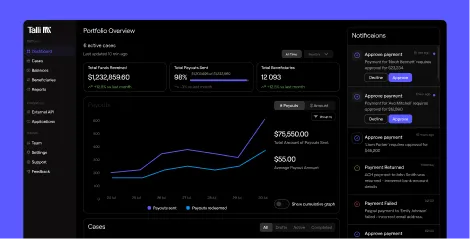
- Real-time Dashboard: Monitor delivery, completion, and engagement in real time with built-in reporting for teams and stakeholders
- Reconciliation and Reporting: Full transparency on completion rates and fund flows, with real-time payout data syncing to your CRM
- Flexible Payment Options: Claimants choose their preferred payment method, including digital wallets and prepaid cards, increasing redemption rates
Banking services are provided by Patriot Bank, N.A., Member FDIC, ensuring funds remain protected throughout the distribution process. The Easy Prepaid Mastercard is issued by Patriot Bank, N.A., pursuant to a license from Mastercard International.
For administrators managing high-volume distributions, Talli processes whether it's 1,000 or 100,000 recipients with the same compliance rigor. Smart reminders across email, SMS, and other channels help claimants complete the payout process quickly, delivering what used to take weeks in minutes.
Frequently Asked Questions
What is standardized reporting for legal payouts, and why is it important?
Standardized reporting establishes consistent definitions, formats, and processes for documenting legal fund distributions. It matters because inconsistent reporting creates audit vulnerabilities, compliance risks, and operational inefficiencies. Court staff facing significant data compilation burdens can redirect those resources to claimant services through standardized, automated reporting.
How long does it take to implement standardized reporting for settlement administration?
Implementation typically requires several months to over a year depending on existing infrastructure, data quality, and scope. Organizations with strong IT capacity and clean data can implement faster, while complex multi-jurisdictional implementations require more time. Phased approaches starting with high-priority data elements reduce initial time-to-value.
What compliance requirements are critical when standardizing financial reporting for settlements?
Critical requirements include KYC verification confirming recipient identity, OFAC screening ensuring sanctions compliance, W-9 collection meeting tax reporting obligations, complete fund segregation preserving QSF ownership, and comprehensive audit logs documenting every transaction. Failure to meet these requirements can trigger penalties and legal liability.
How can standardized reporting improve claimant experience and redemption rates?
Standardized reporting enables targeted outreach to claimants who haven't completed the payout process. When administrators can identify where claimants drop off, they can address those specific barriers. Organizations implementing flexible payment options and smart reminders through standardized systems see improved completion rates.
What are the benefits of complete fund segregation in legal payment systems?
Complete fund segregation maintains dedicated accounts for every settlement, preserving QSF ownership while simplifying reporting and ensuring legal compliance. This approach helps prevent commingling of funds across settlements, enables accurate interest allocation, simplifies regulatory reporting, and provides clear audit trails for each distribution. Fund segregation also protects claimant funds if the administrator faces financial difficulties.