.svg)


.svg)
Verifying hundreds of thousands of claimants for class action settlements demands automated identity verification that can maintain legal compliance and fraud prevention. Manual verification of 250,000 claimants would require over 100 FTE-weeks and delay payouts by 6-12 months. Modern KYC/KYB platforms use AI-powered document verification, biometric checks, and sanctions screening to achieve 80-95% automation rates for individual claimants while maintaining full compliance audit trails. Settlement administrators who implement these systems can reduce processing costs significantly compared to manual verification teams.
Key Takeaways
- Automated KYC platforms verify ID documents from 195+ countries for diverse claimant populations
- Risk-based segmentation enables 95%+ automation for low-risk individual claimants while flagging high-risk entities for enhanced review
- Implementation typically requires 4-12 weeks depending on complexity and integration requirements
- Cost per verification averages around $0.10-$0.50 for individuals versus $50-$100 for manual processing
- Perpetual KYC reduces ongoing monitoring from 105 hours to 10 minutes per customer through continuous automated screening
- Enterprise KYB platforms access 600M+ company records for verifying institutional claimants and Ultimate Beneficial Owners
Understanding KYC/AML Compliance in Class Action Settlements
Know Your Customer (KYC) and Anti-Money Laundering (AML) requirements create mandatory verification obligations for settlement administrators disbursing funds. These regulations require identity verification, sanctions screening, and documentation collection before releasing payments to claimants.
The compliance framework for class action payouts includes:
- OFAC Sanctions Screening: Real-time checks against OFAC lists plus additional watchlists (some vendors advertise screening across thousands of datasets) to prevent payments to sanctioned individuals or entities
- W-9 Collection: Tax documentation requirements for US-based claimants receiving payments above IRS thresholds
- KYB for Business Entities: Verification of corporate claimants including Ultimate Beneficial Owner (UBO) identification
- Audit Trail Requirements: Immutable logs of all verification decisions for regulatory reporting
Understanding OFAC screening becomes critical when processing large settlement distributions. Non-compliance risks include regulatory penalties, reputational damage, and potential legal liability for the settlement administrator.
The Challenges of Identity Verification for Large-Scale Payouts
Mass claimant verification creates unique operational challenges that manual processes cannot address efficiently. Settlement administrators face several critical pain points when verifying high volumes of claimants.
Volume and Scalability Issues
Processing 100,000+ claimants through manual verification would require months of work and substantial staffing costs. The average manual KYC process takes 15-30 minutes per individual, making large settlements operationally impossible without automation.
Data Quality Problems
Claimants frequently submit incomplete or inconsistent information. Names on identification documents may not match claim forms exactly. Address formats vary widely. These inconsistencies trigger false positives that require manual review and slow processing.
Fraud Risk Exposure
Class action settlements attract fraudulent claims including:
- Duplicate submissions under slightly different names
- Identity theft using stolen personal information
- Synthetic identities combining real and fabricated data
- Fraud rings coordinating multiple false claims
Without robust verification, settlement funds leak to illegitimate claimants while valid claimants face delays.
Leveraging Technology for Efficient KYC & KYB Verification
Modern AI-driven platforms transform identity verification from a bottleneck into a competitive advantage. These systems combine multiple verification methods to achieve high accuracy with minimal friction.
Core Technology Components
Automated KYC platforms deploy several verification layers:
- Document Verification: AI-powered OCR extracts and validates data from ID documents globally
- Biometric Checks: Facial recognition matches selfies to ID photos with liveness detection
- Database Cross-Reference: Verification against government records, credit bureaus, and other authoritative sources
- Sanctions Screening: Real-time checks against PEP lists, watchlists, and adverse media
Risk-Based Segmentation
Not all claimants require the same verification intensity. Risk-based approaches apply appropriate scrutiny levels:
Low-Risk Claimants (80% of volume): Basic ID verification plus selfie match enables auto-approval in under 2 minutes.
Medium-Risk Claimants (15%): Additional address verification and sanctions screening with automated or flagged review.
High-Risk Claimants (5%): Full enhanced due diligence including source of funds and manual compliance review.
This segmentation achieves 85-95% automation rates while concentrating manual resources on genuine risk cases.
Business Verification (KYB) for Corporate Claimants
Securities settlements and other cases involving institutional claimants require KYB processes that verify:
- Company registration and legal standing
- Ultimate Beneficial Owner identification
- Ownership structure analysis
- Authorized signatory verification
Enterprise platforms access 600M+ company records and ownership registries to automate corporate verification that would otherwise require extensive manual research.
Streamlining Fund Distribution and Preventing Fraud with Robust KYC
Effective KYC processes directly impact fund distribution efficiency and fraud prevention outcomes. Integration between verification and payment systems creates seamless workflows.
Verification-to-Payment Workflows
Optimized data flows connect verification results to payout approval:
- Claimant submits information through settlement portal
- Claims system sends data to KYC platform via API
- Platform performs verification and returns approval status
- Approved claimants auto-populate in payment queue
- Payment processor disburses funds through selected method
This integration eliminates manual handoffs and reduces processing time from weeks to days.
Fraud Prevention Mechanisms
Automated verification catches fraud that manual review would miss:
- Duplicate Detection: Graph analytics identify related claims sharing addresses, devices, or behavioral patterns
- Velocity Checks: Flags unusual submission patterns indicating coordinated fraud
- Document Authenticity: AI detects altered or fabricated identification documents
- Cross-Settlement Screening: Identifies serial fraudsters across multiple class actions
Fraud rates vary widely by case and channel, so controls should be designed for both routine fraud and worst-case surges—protecting settlement funds while minimizing friction for legitimate claimants.
Enhancing Claimant Experience Through Seamless Verification
Verification processes significantly impact claimant experience and ultimately redemption rates. Friction during verification causes abandonment, leaving funds unclaimed.
Mobile-First Design
Most claimants access settlement portals from mobile devices. Effective verification platforms provide:
- Camera-based document capture with real-time quality feedback
- Guided selfie capture for biometric matching
- Auto-fill from extracted document data
- Progress indicators showing completion status
Reducing Friction Points
Common verification obstacles and solutions:
Document Quality Issues: Provide clear examples of acceptable photos with automatic rejection feedback enabling immediate re-submission.
Name Matching Problems: Implement fuzzy matching algorithms that handle minor variations between documents and claim forms.
Technical Failures: Enable session persistence so claimants can resume interrupted verifications without starting over.
Language Barriers: Multi-language support for diverse claimant populations in multi-jurisdictional settlements.
Streamlined verification reduces abandonment rates and increases the percentage of claimants who complete the payout process.
Meeting Tight Deadlines: Speed and Visibility in Payout Operations
Settlement administrators operate under court-mandated deadlines that make processing speed critical. Real-time dashboards provide the visibility needed to meet these deadlines.
Accelerated Processing Timelines
Automated KYC delivers dramatic time savings:
- Individual Verification: Often minutes for automated checks (when documents are high quality and risk is low) versus 15–30 minutes or more for manual review
- Batch Processing: 1,000-10,000+ verifications per hour depending on platform capacity
- Settlement Timeline: Significant reduction in overall timeline versus manual verification methods
Processing that once took weeks now takes minutes when verification workflows are properly automated.
Operational Visibility
Real-time dashboards enable proactive management:
- Throughput Metrics: Monitor verification volume and processing rates
- Exception Tracking: Identify manual review backlogs before they impact deadlines
- Completion Rates: Track claimant progress through verification funnel
- Compliance Alerts: Flag regulatory issues requiring immediate attention
This visibility allows administrators to allocate resources dynamically and address bottlenecks before they cause delays.
Boosting Redemption Rates with Flexible Payout Options and Smart Reminders
Verification completion directly impacts redemption rates. Claimants who abandon verification never receive their settlement payments.
Flexible Payment Methods
Offering multiple payout options increases completion rates:
- Digital Wallets: Instant delivery without bank account requirements
- Prepaid Cards: Physical or virtual cards for immediate spending
- ACH/Direct Deposit: Traditional bank transfers for those who prefer them
- Gift Cards: Retail options for claimants without banking relationships
Flexible options ensure claimants can receive funds through their preferred method, removing barriers to completion.
Smart Follow-Up Communications
Automated reminders drive incomplete verifications to completion:
- Initial Outreach: Secure links via SMS or email requiring no account creation
- Progress Reminders: Targeted messages for claimants who started but didn't complete
- Alternative Channels: Multi-channel outreach across email, SMS, and other touchpoints
- Deadline Alerts: Urgency messaging as claim windows approach closing
Smart follow-ups significantly improve the percentage of claimants who complete verification and receive their payments.
Complete Fund Segregation and Regulatory Adherence
Qualified Settlement Funds require strict fund segregation and compliance documentation throughout the disbursement lifecycle.
Dedicated Account Structures
Proper fund management requires:
- Separate Settlement Accounts: Dedicated accounts for each settlement preserving QSF ownership
- Clear Audit Trails: Every transaction documented with timestamps and authorization records
- Reconciliation Reporting: Real-time visibility into fund flows and completion rates
- Regulatory Documentation: Compliance records available for court reporting and audits
Perpetual KYC for Ongoing Compliance
Traditional KYC performs one-time verification at onboarding. Perpetual KYC provides continuous monitoring that catches post-verification changes:
- Sanctions list additions after initial screening
- Adverse media alerts about verified claimants
- Material changes in business entity status
- Updated risk scores based on new information
This continuous monitoring reduces the periodic review burden from 105 hours to 10 minutes per customer while maintaining a stronger compliance posture.
Why Talli Simplifies KYC/KYB for Class Action Payouts
While multiple verification platforms exist, Talli delivers purpose-built solutions for claims administrators managing class action settlement distributions.
Talli's AI-driven payment platform provides comprehensive compliance automation including:
- Integrated KYC, OFAC, and W-9 Collection: All verification requirements handled within a single platform with fraud mitigation and audit logs baked in
- Complete Fund Segregation: Dedicated accounts for every settlement preserving QSF ownership and simplifying regulatory reporting
- Flexible Payout Options: Claimants choose their preferred payment method—digital wallets, prepaid cards, or gift cards—with no bank account required
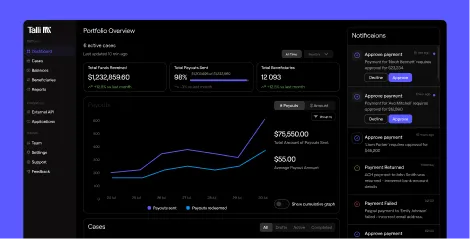
- Real-Time Dashboard: Total control and visibility over completion rates, fund flows, and payout status
- Smart Reminders: Automated follow-ups across email, SMS, and other channels to help claimants complete verification fast
Unlike generic KYC platforms requiring custom integration, Talli connects verification directly to payout processing. Claimants receive a secure link via SMS or email, verify their identity, select their payment method, and get paid—all without creating accounts or downloading apps.
The platform handles settlements of any size, whether 1,000 or 100,000 recipients, with the compliance infrastructure and operational visibility claims teams need. Banking services are provided by Patriot Bank, N.A., Member FDIC, with the Easy Prepaid Mastercard issued pursuant to a license from Mastercard International.
For claims administrators seeking to reduce distribution timelines, increase redemption rates, and maintain bulletproof compliance, Talli offers the purpose-built solution the industry requires.
Frequently Asked Questions
What is the difference between KYC and KYB in class action payouts?
KYC (Know Your Customer) applies to individual claimants and involves verifying identity documents, biometric matching, and sanctions screening. KYB (Know Your Business) applies to corporate or institutional claimants and requires verifying company registration, identifying Ultimate Beneficial Owners, and confirming authorized signatories. Securities class actions with institutional investors typically require comprehensive KYB verification accessing company records and ownership registries, while consumer class actions primarily use individual KYC processes.
How long does it take to implement automated KYC for a class action settlement?
Implementation timelines range from 4-12 weeks depending on complexity. Simple individual claimant verification with standard integrations can launch in 4-6 weeks. Complex implementations involving KYB for corporate claimants, multiple jurisdictions, or custom workflows may require 8-12 weeks. Pilot testing with sample verifications should be completed before full-scale deployment to validate workflow accuracy.
What automation rate can we expect for claimant verification?
With properly configured risk-based segmentation, settlement administrators can achieve 80-95% automation rates for individual claimants. Low-risk verifications auto-approve in under 3 minutes. The remaining 5-20% requiring manual review typically involve documentation issues, sanctions screening hits, or complex verification scenarios. Corporate claimant verification (KYB) generally achieves lower automation rates of 60-80% due to complex ownership structures.
How much does automated KYC cost compared to manual verification?
Automated verification costs an estimated $0.10-$0.50 per check for individuals and $2-$5 for business entities, plus platform fees typically ranging from $50,000-$150,000 annually depending on volume. Manual verification costs $50-$100 per claimant when accounting for labor, error correction, and processing time. For a 250,000 claimant settlement, automation can materially reduce verification labor and exception-handling costs versus fully manual review—especially when most low-risk claimants are approved automatically—a significant cost reduction with faster completion times.
Can claimants without bank accounts still complete verification and receive payments?
Yes. Modern payout platforms support multiple disbursement methods including digital wallets, prepaid debit cards, and gift cards that require no traditional bank account. Claimants verify their identity through the standard process, then select their preferred payment method. This flexibility is critical for reaching unbanked populations and maximizing redemption rates across diverse claimant demographics.