.svg)


.svg)
Scaling multi-party claims disbursement requires automated coordination of complex approval workflows where traditional paper checks create average 30-60 day delays waiting for joint account holders and lienholders to physically sign and deposit payments together. Modern legal payout platforms eliminate these bottlenecks through digital approval workflows that reduce processing time to about 3 days while cutting transaction costs from $2.05-$10 per claim to just $0.85-$1.58, transforming settlements that previously took 12-18 months into 90-120 day distributions at massive scale.
Key Takeaways
- Multi-party claims with joint policyholders or lienholders experience approximately 20% reissue rates using paper checks due to coordination failures
- Digital disbursement platforms reduce processing time by up to 3X while decreasing error rates 60-80%
- Class action participation rates remain under 10% with traditional paper distribution methods
- Uncashed check tracking costs $150 per check, adding millions to large settlement administrative expenses
- AI-powered duplicate detection and identity verification reduce fraudulent claims by 40% in an environment where payment fraud surged 19,000%
- Digital payment redemption rates increase 200-400% compared to traditional check distribution
Understanding the Challenges of Multi-Party Claims Disbursement
Complex settlements involving multiple recipients create coordination bottlenecks that manual processes cannot handle efficiently. When settlement agreements require approval from joint account holders, lienholders, or split payments between claimants and attorneys, traditional paper checks become operational nightmares.
The core challenges include:
- Manual approval coordination - Physical signatures from all parties required before deposit
- Geographic distribution barriers - Parties in different locations unable to meet at banks
- Processing time delays - Average 44 days from claim to payment with traditional methods
- High error rates - Manual data entry creates 19.3% error rates in health insurance claims
- Fraud vulnerability - 63% of payment fraud targets paper check disbursements
- Administrative cost burden - 40% of adjuster time consumed by administrative tasks
These inefficiencies compound dramatically at scale. The 3M earplug litigation involving 250,000 cases demonstrates how traditional systems cannot process this volume effectively. Each case requires unique settlement tier calculations, attorney fee deductions, and payment splits—a complexity that would take 2-3 years with manual distribution.
Leveraging Technology for Efficient Payment Processing in Claims
Benefits of an AI-Driven Payment Platform
AI-driven ppayment platforms fundamentally restructure how claims administrators handle multi-party distributions. These systems automate the entire disbursement lifecycle from eligibility verification through payment delivery and tax reporting.
Modern platforms deliver measurable improvements:
- Processing speed increases - Up to 3X faster resolution than manual methods
- Error reduction - 60-80% decrease in processing errors through automation
- Labor cost savings - 40-65% fewer staff required for distribution
- ROI achievement - Early adopters report 195-300% ROI within 18 months
- Cost reduction - Transaction costs drop from $2.05-$10 to $0.85-$1.58 per claim
These platforms handle multi-party payment orchestration by coordinating approval workflows where all parties must digitally authorize before disbursement. The first party selects the depositor and provides account information, while others approve via email link without requiring physical presence.
Split payment functionality automatically divides single claims among multiple recipients based on settlement formulas. For mass tort settlements with tiered injury severity levels, platforms configure payment formulas once and process thousands of claims automatically.
Automating Fund Distribution
Automation transforms weeks-long processes into same-day executions. Digital platforms eliminate the physical constraints that make paper check distribution inherently slow.
Key automation capabilities include:
Batch Processing: Handle thousands of payments simultaneously through cloud-scalable infrastructure. Parallel processing capabilities mean 100,000-claimant settlements distributed in months rather than years.
Real-time Validation: Up to 89% reduction in payment errors through instant account verification before processing. Systems detect closed accounts, invalid routing numbers, or mismatched beneficiary names immediately.
Intelligent Routing: Payments automatically select optimal rails based on cost, speed, and recipient preferences. ACH for domestic transfers, wire for international, prepaid cards for unbanked populations—all determined algorithmically.
Compliance Verification: KYC checks, OFAC screening, and W-9 collection occur during claim verification rather than at payment time. This front-loading prevents bottlenecks that delay distributions.
Platforms also manage qualified settlement funds through dedicated FBO accounts that preserve QSF ownership while simplifying reporting.
Ensuring Compliance and Security in Large-Scale Payouts
Dedicated Accounts for Settlement Management
Fund segregation requirements for legal settlements demand specialized banking infrastructure. Complete fund segregation ensures each settlement maintains dedicated accounts, preventing commingling issues.
Qualified Settlement Funds under IRS Section 468B require specific account structures:
- FBO accounts - Designated beneficiary structure for tax compliance
- FDIC insurance - Banking services through regulated institutions
- Multi-settlement management - Separate virtual accounts for concurrent distributions
- Real-time reconciliation - Instant balance tracking and transaction reporting
- Court-approved protocols - Account structures meeting judicial oversight
Automated Compliance Checks
Compliance automation eliminates manual verification processes that create bottlenecks. Rather than staff manually checking each claimant against OFAC lists, modern platforms integrate these requirements into automated workflows.
Essential compliance automation includes:
KYC Verification: Government ID scanning, SSN validation, and address verification occur during claimant onboarding. Digital verification reduces onboarding from days to hours.
OFAC Screening: Every payment routes through automated OFAC screening against the U.S. Treasury’s sanctions lists. Real-time database checks prevent prohibited transactions.
W-9 Collection: Tax documentation collection integrated into claim submission portals. Systems block payments exceeding thresholds until W-9s are complete.
1099 Generation: Automated tax form generation when annual payments exceed $600 reporting thresholds. Platforms track cumulative payments per claimant across settlements.
Fraud Detection: AI-powered duplicate detection and identity verification flag suspicious claims. With fraudulent claims rising dramatically, automated risk scoring protects settlement funds.
Enhancing Claimant Experience with Flexible Payment Methods
Providing Choice for Claimants
Payment method flexibility directly impacts redemption rates and claimant satisfaction. Forcing ACH-only distribution excludes the 5-7% of US households without bank accounts.
Comprehensive payment options include:
- ACH transfers - Lowest cost for banked populations
- Prepaid cards - Immediate access for unbanked claimants
- Digital wallets - PayPal, Venmo, or Cash App for instant availability
- Wire transfers - International or high-value distributions
- Paper checks - Fallback option when needed
Platforms offering multiple payment methods report 25-35% higher satisfaction scores. Digital wallet integration particularly benefits younger claimants who prefer app-based financial management.
Streamlined Access to Funds
Claimant-facing portals eliminate traditional friction points. Rather than navigating complex forms and waiting for mailed checks, digital platforms compress the sequence into minutes.
The streamlined process works as follows:
- Secure notification - Claimants receive SMS or email with unique claim link
- Identity verification - Two-factor authentication confirms legitimate recipient
- Payment method selection - Choose from available options
- Account information - Provide details only once
- Instant confirmation - Real-time status updates
No account creation or app downloads required. This convenient phone-based experience reduces abandonment rates significantly.
Smart reminders across email and SMS help claimants complete the payout process quickly. Multi-channel communications increase completion rates 40-60% compared to single-channel approaches.
Achieving Speed and Visibility in Fund Distribution
Real-Time Insights for Claims Administrators
Traditional paper check distribution operates as a black box. Real-time dashboards transform this opacity into complete visibility.
Modern platforms provide instant access to:
- Payment status tracking - Pending, delivered, claimed, or failed
- Completion rate metrics - Overall percentages with demographic breakdowns
- Fund flow monitoring - Total disbursed versus remaining balance
- Engagement analytics - Link click rates and portal access timing
- Failure diagnostics - Specific reasons for unsuccessful payments
This total transparency enables proactive management. When completion rates lag in specific groups, administrators can adjust strategies immediately.
Accelerating the Payout Process
Speed becomes a competitive advantage in claims administration. Claims completed in 10 days achieve 762-point satisfaction scores compared to 595 points for 31+ day claims.
Digital platforms compress timelines through:
Same-Day Payment Delivery: ACH transfers settle in 1-3 business days, while instant payment rails enable same-day availability.
Bulk Processing: Upload thousands of claimant records via CSV or API, configure workflows once, and initiate mass distributions simultaneously.
Automated Approvals: Multi-party workflows that required coordinating physical signatures across weeks now resolve in 1-3 days through digital authorization links.
For securities fraud settlements traditionally requiring 12-18 months, digital distribution cuts timelines to 90-120 days.
Optimizing Payouts for Any Scale
Handling High-Volume Settlements
Scale creates unique challenges that simple payment processors cannot address. A 1,000-claimant settlement operates fundamentally differently than a 100,000-claimant distribution.
High-volume platforms must provide:
- Cloud scalability - Infrastructure automatically expanding
- Parallel processing - Thousands of simultaneous transactions
- Batch management - Phased rollouts for validation
- Load balancing - Distributed systems preventing failures
- Performance monitoring - Real-time capacity tracking
The 3M earplug MDL with 250,000 cases demonstrates these requirements. Digital platforms handle this volume in 6-12 months through automated batch processing.
Solution Flexibility for Varied Needs
Different settlement types require different platform capabilities. Securities fraud cases need broker transaction data integration. Consumer privacy settlements require specific data protection protocols.
Flexible platforms accommodate variations through:
Configurable Workflows: Custom business rules for settlement-specific requirements without code development.
API Integration: Connect with existing case management systems (Clio, Filevine) through REST APIs.
White-Label Branding: Customizable claimant portals displaying law firm logos and colors. Branded experiences increase trust and completion rates.
International Capabilities: For cross-border settlements, platforms supporting 120+ countries and 35+ currencies handle compliance across jurisdictions.
Integrating Banking Services for Secure Payouts
The Role of Trusted Financial Partnerships
Payment platform capabilities depend on underlying banking relationships. Platforms cannot issue prepaid cards or maintain segregated settlement accounts without partnerships with regulated financial institutions.
Critical banking infrastructure includes:
- FDIC-insured accounts - Protecting settlement funds through federal insurance
- Prepaid card issuance - Licensed relationships enabling card distribution
- ACH origination - Direct Federal Reserve access
- Wire transfer capabilities - SWIFT network connectivity
- Regulatory compliance - Banking partners maintaining required licenses
Leading platforms partner with established institutions to provide these services while enabling specialized payment functionality.
Benefits of Insured Banking Services
FDIC insurance becomes particularly important for large settlements where fund balances may exceed standard coverage limits before distribution.
Additional banking benefits include:
Regulatory Oversight: Partnered banks undergo regular examinations by federal regulators, providing assurance that compliance programs meet legal standards.
Payment Network Access: Mastercard and Visa licensing agreements enable prepaid card issuance.
Multi-Currency Management: International banking relationships enable foreign exchange transactions and SWIFT transfers necessary for cross-border settlements.
Why Talli Transforms Multi-Party Claims Disbursement
While numerous payment platforms exist, Talli delivers comprehensive solutions specifically designed for legal settlements requiring multi-party coordination, QSF compliance, and court-supervised distribution.
Talli provides purpose-built features:
AI-Powered Fraud Detection: Automated duplicate detection and identity verification reduce fraudulent claims by 40%. Risk scoring flags suspicious claims before processing.
Complete Fund Segregation: Dedicated accounts for every settlement preserve QSF ownership while ensuring legal compliance. FBO account structures meet IRS requirements automatically.
Multi-Party Approval Workflows: Handle complex scenarios involving joint account holders, lienholders, and attorney fee splits through digital authorization sequences. What previously took 30-60 days completes in about 1-3 days
Flexible Payment Options: Claimants choose from ACH, prepaid Mastercard cards, digital wallets, or wire transfers. No bank account required.
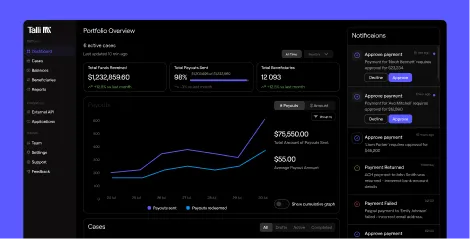
Real-Time Dashboard: Total visibility into completion rates and payment status enables proactive management.
Compliance Automation: KYC, OFAC screening, W-9 collection, and 1099 generation happen automatically.
Scalable Infrastructure: Handle 1,000 to 100,000+ claimants with the same platform.
Unlike generic payment processors, Talli understands the specific requirements of legal settlement administration—from court reporting formats to claimant communication protocols.
For organizations managing mass tort distributions, class action settlements, or insurance claims requiring multi-party coordination, Talli provides the automation and compliance infrastructure needed for efficient scaling.
Frequently Asked Questions
How long does platform implementation take for multi-party settlements?
Standard implementations typically take 30-90 days for comprehensive setups including data migration, workflow configuration, and staff training. However, urgent court-mandated deadlines can compress timelines to 2-3 weeks with dedicated resources. Implementation complexity depends on settlement size, integration requirements with existing case management systems, and multi-party approval workflow complexity. Simple CSV-based distributions launch within 1-2 weeks.
What is the cost difference between paper checks and digital disbursement?
Traditional paper check distribution costs $2.05-$10 per claim including printing, mailing, and processing, plus an additional $150 per uncashed check for tracking. Digital platforms reduce costs to $0.85-$1.58 per claim—a 2-6X reduction. For a 10,000-claimant settlement, this creates net savings of $240,000-$341,000. Early adopters report 195-300% ROI within 18 months.
How do digital platforms handle multi-party approvals?
Digital platforms solve multi-party coordination through sequential approval workflows. The first party receives a notification link, selects the depositor, and provides account information. The system then sends approval links to remaining parties who authorize digitally without physical presence. All parties approve independently via email or SMS—no login required. This reduces average coordination timelines to 1-3 days while eliminating estimated 20% reissue rates common with paper checks.
Can claimants without bank accounts receive payments?
Yes, digital platforms specifically address the 5-7% of US households without bank accounts through prepaid cards and digital wallet options. Claimants can receive funds via prepaid Mastercards or Visa cards, providing immediate access without traditional bank accounts. Digital wallets like PayPal, Venmo, or Cash App offer alternatives with instant availability. This flexibility is critical for maximizing redemption rates.
What compliance requirements do digital platforms automate?
Modern platforms automate KYC verification through government ID scanning, OFAC screening against sanctioned entities, W-9 collection for tax compliance, and 1099 generation when payments exceed $600. Platforms supporting Qualified Settlement Funds provide dedicated FBO accounts in accordance with IRS Section 468B requirements. Audit logs create records for court reporting while fraud detection flags duplicate claims.