.svg)


.svg)
Comprehensive data compiled from extensive research on modern settlement distribution and legal payout transformation
Key Takeaways
- Processing time reductions are now measured in minutes, not days — Post-trade processing has dropped from 12 hours to just 2 hours (an 83% reduction), while blockchain-based settlements complete in under 3 minutes compared to 3-5 business days for traditional wire transfers
- Global payment volumes continue accelerating — Cross-border payments are projected to reach $320 trillion by 2032, up from $194.6 trillion in 2024, creating urgent demand for faster settlement distribution
- Traditional settlement methods generate billions in failures — European markets alone recorded over €20 trillion in settlement failures in 2023, with Clearstream reporting €9 trillion (7.5% of volume) and Euronext recording €11 trillion (6.3% of volume)
- Affirmation deadlines remain a critical challenge — As many as 3 in 10 trades risk missing affirmation deadlines under T+1 requirements, while only 69% of trades would have met cut-off deadlines before implementation improvements
- Real-time payment adoption is expanding globally — More than 70 countries have now adopted real-time payment systems, with leading processors achieving 99.3% straight-through processing rates
- Class action settlement values are rising significantly — Average settlement value in H1 2025 reached $56 million, a 27% increase from inflation-adjusted figures in 2024, totaling $5.2 billion across 136 global settlements
- Digital infrastructure investments are accelerating — 87% of firms have identified changes needed for T+1 preparation, while 52% intend to use tokenized assets as collateral from 2026
Understanding the Standard Settlement Processing Timeline
1. Post-trade processing time has dropped from 12 hours to 2 hours under T+1
The transition to T+1 settlement cycles has fundamentally transformed processing timelines across capital markets. The post-trade operations window has shrunk from about 12 hours to about 2 hours—an ~83% reduction in elapsed time available for post-trade processing. This compression directly benefits claims administrators and legal payout teams who can now complete fund distributions faster than ever before. Source: Finantrix
2. Capital markets representing over 60% of global market capitalization now operate on T+1
Markets comprising 60% of global market capitalization have transitioned to T+1 settlement, establishing new speed expectations across the financial ecosystem. This shift creates pressure on claims administrators still relying on traditional multi-day processing methods to adopt modern claims payout infrastructure. Source: Blott - T+1 Settlement
3. Global cross-border payments are projected to reach $320 trillion by 2032
Cross-border payment volumes are growing rapidly, projected to increase from $194.6 trillion in 2024 to $320 trillion by 2032. This growth amplifies the need for efficient settlement processing infrastructure capable of handling increasing transaction volumes without proportional increases in processing time. Source: J.P. Morgan - 2025 Trends
4. Traditional wire transfers require 3-5 business days versus under 3 minutes for blockchain
The performance gap between legacy and modern settlement infrastructure is stark. While traditional cross-border bank transfers can take 3–5 business days in many corridors, blockchain-based transfers can settle in minutes under typical network conditions. This comparison illustrates why claims administrators are increasingly exploring digital payment alternatives. Source: BVNK - Blockchain Payments
The Impact of Slow Settlement Processing on Claimants and Administrators
5. ETF settlement fails account for up to 40% of all settlement failures
Certain asset categories experience disproportionately high failure rates. ETF settlement failures can account for up to 40% of all settlement failures, indicating that complexity in underlying assets directly correlates with processing delays. This pattern extends to legal settlements where complex multi-party distributions face similar challenges. Source: Securities Finance Times
6. 96% of institutions cite inventory issues as the primary cause of settlement failures
Research from the Plato Study reveals that 96% of institutions interviewed identified inventory issues as the main reason for settlement failures. This finding underscores the importance of proper fund segregation and reconciliation processes in preventing payout delays. Source: TD Securities - T+1
7. Only 43% of Swift payments are credited to final accounts within one hour
Even when cross-border payments move quickly between banks, local processing and posting steps can delay when funds become available to the end recipient. This gap between arrival and availability demonstrates where traditional banking infrastructure creates friction for claimants waiting for funds. Source: Financial Stability Board
8. Average 14,418 transactions remained unsettled at end of each settlement day in 2021
European settlement data reveals that an average of 14,418 transactions remained unsettled by the end of each settlement day in 2021. Each unsettled transaction represents potential claimant frustration and administrative follow-up work that consumes team resources. Source: ICMA - Settlement Efficiency
9. J.P. Morgan achieves 99.3% straight-through processing rate across $10 trillion daily
Major financial institutions demonstrate that near-perfect processing rates are achievable at scale. J.P. Morgan moves over $10 trillion on 60 million transactions across more than 200 countries daily while maintaining a 99.3% straight-through processing rate, proving automation principles work at institutional scale. Source: J.P. Morgan - 2025 Trends
10. More than 70 countries have adopted real-time payment systems
Global adoption of real-time payment infrastructure continues accelerating, with more than 70 countries now operating real-time payment systems. This expansion creates expectations among claimants for immediate fund access that traditional check-based settlement methods cannot meet, driving digital wallet adoption. Source: J.P. Morgan - 2025 Trends
11. Stablecoins processed $32 trillion in transactions in 2024
Digital payment infrastructure handled massive volumes in 2024, with stablecoins processing $32 trillion in transactions. This demonstrates that modern payment rails can handle settlement volumes at any scale—a capability increasingly applied to legal payout administration through platforms designed for high-volume recipient distributions. Source: Visa On-Chain Analytics
12. 50.6% of Swift payments completed the entire settlement process within one hour in 2024
In 2024, 50.6% of wholesale cross-border payments completed end-to-end processing within one hour. While this represents improvement, it also indicates that nearly half of payments still require longer processing, highlighting opportunities for platforms enabling instant digital payouts. Source: Financial Stability Board
13. 92% of wholesale cross-border payments settled in one day through Swift
In 2024, 92% of wholesale cross-border payments completed end-to-end processing within one day. For claims administrators, this benchmark establishes the standard for what modern settlement infrastructure should achieve when processing distributions through digital wallet payments accessible immediately. Source: Financial Stability Board
Key Factors Influencing Accelerated Settlement Processing
14. 60% of GPI payments reach beneficiary banks within 30 minutes
Around 60% of Swift GPI payments reach the beneficiary bank within 30 minutes, demonstrating that speed is achievable within existing infrastructure. Modern claims platforms leverage these advancements while adding claimant-friendly features like SMS and email secure links that require no account creation. Source: Thunes - Swift GPI
15. 87% of firms have identified changes needed to prepare for T+1
According to an FCA industry poll in July 2025, 87% of firms have identified specific changes required to prepare for T+1 settlement requirements. This widespread recognition of necessary improvements creates urgency for claims administrators to evaluate their own processing infrastructure. Source: FCA - T+1 Settlement
16. 35% of cross-border messages on Swift currently use T+1 instructions
T+1 settlement instructions currently account for 35% of cross-border messages on the Swift network, with projections indicating this will rise to 70% by 2030. This trajectory confirms that faster processing is becoming the norm rather than the exception, reinforcing the value of expedited legal payouts. Source: SIX Group - Post-Trade Forum
17. Stablecoin supply has grown from $5 billion to $305 billion in five years
The stablecoin market has experienced explosive growth, expanding from $5 billion to $305 billion in supply over five years. This 6,000% increase reflects market confidence in digital payment infrastructure—confidence that extends to digital-first approaches to settlement distribution. Source: BVNK - Blockchain Payments
18. 52% of firms intend to use tokenized assets as collateral from 2026
More than half of firms (52%) plan to begin using tokenized assets as collateral starting in 2026, according to The Value Exchange research. This shift toward digital asset infrastructure aligns with technology approaches bringing similar modernization to legal payout workflows. Source: SIX Group - Post-Trade Forum
Ensuring Compliance and Security During Rapid Payouts
19. Nearly 95% of transactions meet affirmation criteria by the 9:00 PM ET cutoff post-T+1
Following T+1 implementation, nearly 95% of transactions meet affirmation criteria by the 9:00 PM ET cutoff on trade date. This improvement from pre-implementation levels demonstrates that faster processing and compliance can coexist when proper infrastructure integrates KYC, OFAC, W-9 collection, and audit logs. Source: DTCC - T+1 Report
20. NSCC Clearing Fund decreased by $3 billion (23%) from T+2 to T+1
The transition to T+1 settlement reduced the NSCC Clearing Fund by an average of $3.0 billion, representing a 23% decrease. This reduction demonstrates that faster settlement actually decreases systemic risk—a principle that applies equally to legal settlement distributions. Source: DTCC - T+1 Report
21. Average CNS Fail Rate maintained at 2.12% post-T+1 implementation
The average CNS Fail Rate for July 2024 was 2.12%, consistent with T+2 settlement rates. This stability demonstrates that accelerating processing timelines does not necessarily increase failure rates when proper infrastructure provides OFAC screening and verification protocols. Source: DTCC - T+1 Report
22. DTC non-CNS fails rate averaged 3.31% in July 2024
The average DTC non-CNS failure rate held at 3.31% in July 2024, consistent with T+2 settlement averages. Maintaining stable failure rates during the transition to faster processing validates that speed and accuracy are not mutually exclusive when supported by appropriate technology infrastructure. Source: DTCC - T+1 Report
23. 3 in 10 trades risk missing affirmation deadlines under T+1 requirements
Copper Research identified that as many as 3 in 10 trades risk missing affirmation deadlines under T+1 requirements. This deadline pressure emphasizes the importance of automated verification workflows that eliminate manual bottlenecks causing missed deadlines in traditional settlement administration. Source: Securities Finance Times
Real-Time Visibility: Monitoring Settlement Progress and Completion Rates
24. European settlement efficiency averages 94.5% in volume terms
T2S European settlement infrastructure achieves an average efficiency rate of 94.5% in volume terms. While this represents strong performance, the remaining 5.5% failure rate at European scale translates to significant absolute numbers, highlighting the value of real-time dashboards enabling immediate intervention. Source: ICMA - Settlement Efficiency
25. Overnight settlement accounted for 52.63% of overall volume
More than half of settlement volume (52.63%) occurs through overnight processing. For claimants expecting rapid access to funds, this reliance on overnight cycles creates unnecessary delays that real-time tracking and instant notification capabilities can eliminate. Source: AFME - T+1 Report
26. Only 69% of trades would have met T+1 affirmation cut-off as of late 2023
Prior to implementation improvements, only 69% of trades would have met the T+1 affirmation cut-off deadline. This gap highlights how legacy processes create compliance risks that modern platforms address through automation enabling teams to monitor completion rates centrally. Source: Securities Finance Times
27. 50% of APAC customers' equity instructions settle in North America with 90% of messages arriving after trade date
Cross-border timing creates significant challenges, with 50% of APAC customers' equity instructions settling in North America while 90% of related SWIFT messages arrive after the trade date. This timing mismatch illustrates why claims team efficiency benefits from 24/7 visibility platforms. Source: Blott - T+1 Settlement
Scaling Payouts: Efficiently Managing Large Volume Settlements
28. Global securities class action settlements reached $5.2 billion across 136 settlements in 2024
The scale of class action settlements continues growing, with global securities class action settlements reaching $5.2 billion across 136 settlements worldwide in 2024. Distributing these funds efficiently to potentially hundreds of thousands of claimants requires infrastructure built for high-volume payouts. Source: Broadridge - Global Securities
29. Average settlement value in H1 2025 was $56 million, a 27% increase
Average settlement value in the first half of 2025 reached $56 million, representing a 27% increase from inflation-adjusted $44 million in 2024. Rising settlement values increase the stakes for efficient distribution, making platforms capable of handling mass payouts essential for administrators. Source: NERA via Cooley
30. $5.7 trillion in cross-border payments processed through stablecoins in 2024
Estimates of stablecoin-enabled cross-border flows in 2024 reached $5.7 trillion, demonstrating that digital payment rails can handle institutional-scale transaction volumes. This capability translates directly to processing and tracking payouts faster—whether handling 1,000 or 100,000 recipient distributions. Source: BVNK - Blockchain Payments
31. Stablecoins could reach 20% share of global cross-border payments by 2030
Projections indicate stablecoins could capture 20% of the global cross-border payments market by 2030. This trajectory toward digital payment dominance aligns with technology approaches positioning early adopters of digital disbursement platforms ahead of industry transformation. Source: BVNK - Blockchain Payments
32. T+1 implementation freed approximately $750 billion annually for broker-dealers
The shift to T+1 settlement freed approximately $750 billion annually for broker-dealers through reduced clearing fund requirements. This capital efficiency demonstrates the financial benefits of accelerated settlement—benefits that extend to claims administrators who can reduce operational costs. Source: Phoenix FSC - T+1
33. Total cross-border payments projected to reach $250 trillion by 2027
Cross-border payment volumes are projected to reach $250 trillion by 2027, representing a $100 trillion increase from 2017. This growth trajectory underscores why scalable settlement infrastructure has become essential for any organization managing fund distributions at scale. Source: Visa - Cross-Border Movement
Talli: Transforming Settlement Processing from Weeks to Minutes
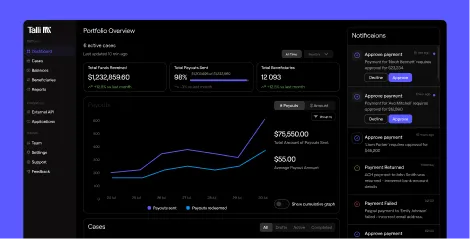
Talli's AI-driven payment platform applies automation principles specifically to legal settlement payouts, enabling claims teams to process distributions in real-time. The platform delivers instant payouts through digital wallet integration, meeting claimant expectations for immediate fund access that traditional check-based methods cannot achieve. Talli brings digital payment infrastructure capabilities to legal payout administration, powering payouts whether serving 1,000 or 100,000 recipients.
The platform eliminates traditional banking delays by enabling instant digital payouts that claimants can access immediately through secure links delivered via SMS or email. Recipients select their preferred payment method without creating accounts or providing bank information, dramatically increasing redemption rates compared to check-based distributions. Talli's real-time tracking capabilities provide total control and visibility over every payout status, enabling immediate intervention when issues arise.
Talli integrates KYC, OFAC screening, W-9 collection, fraud mitigation, and audit logs directly into every payout workflow. The platform supports complete fund segregation for every settlement, preserving QSF ownership and simplifying reporting throughout the disbursement lifecycle while meeting tight deadlines without losing control over compliance in payouts or claimant experience. Banking services provided by Patriot Bank, N.A., Member FDIC.
Moving Forward with Faster Settlement Processing
Claims administrators seeking to reduce settlement processing timelines should assess current payout processes by measuring time from fund receipt to claimant access, identifying manual verification bottlenecks, calculating failure and retry rates, and tracking claimant support inquiries related to payment status. Implementing technology for faster results requires adopting digital payment rails that bypass traditional banking delays, deploying automated KYC and verification workflows, integrating real-time dashboards for payout monitoring, and enabling multiple payment options to increase redemption rates.
When evaluating platform capabilities, administrators should verify complete fund segregation to preserve QSF ownership, confirm OFAC screening and fraud mitigation are built-in, ensure audit logs support compliance reporting, and test scalability with expected distribution volumes. Modern settlement infrastructure addresses each of these requirements, automating and safeguarding every claims payout while maintaining compliance and delivering superior claimant experience.
Frequently Asked Questions
How quickly can modern platforms process a settlement payment?
Modern digital disbursement platforms transform what used to take weeks into minutes. While traditional wire transfers require 3-5 business days and many Swift payments take over an hour to reach final accounts, digital platforms enable instant payouts through secure links delivered via SMS or email. Claimants can select their preferred payment method and receive funds without creating accounts or providing bank information.
What security measures ensure compliance during fast payouts?
Leading platforms integrate KYC, OFAC screening, W-9 collection, fraud mitigation, and audit logs directly into every payout workflow. These systems support complete fund segregation for every settlement, preserving QSF ownership and simplifying reporting throughout the disbursement lifecycle. Banking services are typically provided by FDIC member institutions.
Can claimants choose their preferred payment method?
Yes. Modern platforms deliver claimants a secure link via SMS or email where they select their preferred payment method from available options and receive payment without needing a bank account. This flexibility increases redemption rates by removing barriers that cause claimants to abandon traditional check-based distributions.
How do administrators track the status of all payouts in real-time?
Advanced platforms provide real-time dashboards offering total control and visibility over every distribution. Administrators can create payout campaigns, track individual payout status, monitor completion rates, and sync data to CRM systems. Built-in reporting enables transparent stakeholder communication throughout the settlement process.
Are modern platforms suitable for both small and large-scale settlement distributions?
Yes. Modern platforms are built to power payouts at any size, whether distributing to 1,000 or 100,000 recipients. Their infrastructure handles the transaction volumes demonstrated in global payment networks while providing the compliance controls and claimant experience features essential for legal settlement administration.