.svg)


.svg)
Multi-party settlements involve coordinating payments, compliance checks, and documentation across dozens—sometimes thousands—of claimants, defendants, and stakeholders. Traditional methods relying on spreadsheets and paper checks create bottlenecks that delay payments and increase error rates. Modern AI-driven payment platforms can compress settlement processing from 9-15 days to 2-5 days while cutting operational costs by 40-60% through automated document processing, compliance verification, and payment distribution.
Key Takeaways
- Cloud platforms reduce settlement processing time from 9-15 days to 2-5 days through end-to-end automation
- About 73% of firms report using cloud-based legal tools, according to the American Bar Association’s legal tech survey, making cloud familiarity increasingly common.
- Traditional document management consumes 15-20% of operational costs that cloud systems drastically reduce
- Document retrieval drops from 2-3 days to instant access with cloud-based record management
- Built-in KYC, OFAC screening, and W-9 collection eliminate compliance bottlenecks that traditionally delayed payments
- The value of the 10 largest U.S. class-action settlements alone exceeded $70 billion in 2025, highlighting the massive scale of funds being administered
Understanding the Complexity of Multi-Party Settlements
Multi-party settlements present unique administrative challenges that single-party cases never encounter. Mass torts, class actions, and multi-defendant litigation require precise coordination across plaintiffs, defense counsel, insurance carriers, lien holders, and settlement administrators—each with their own documentation requirements and payment timelines.
The complexity stems from several interconnected factors:
- Multiple stakeholder coordination requiring synchronized approvals and authorizations
- Allocation calculations that must account for varying claim values and settlement tiers
- Lien resolution with Medicare, Medicaid, and private insurers
- Compliance verification for each claimant including identity checks and tax documentation
- Payment distribution across different methods based on claimant preferences
56% of legal professionals report that reaching pre-trial settlements has become more difficult, making efficient settlement processing even more critical when agreements are achieved. When settlements finally close, administrators face the pressure of tight court-ordered deadlines while managing documentation for thousands of individual claimants.
Traditional methods relying on email chains and spreadsheets create what industry professionals call "inbox archaeology"—endless searching through communications to track signatures, authorizations, and payment confirmations. This manual approach introduces errors that can invalidate settlement agreements and expose firms to malpractice claims.
The Role of Cloud Platforms in Streamlining Legal Payouts
Cloud platforms centralize settlement administration into unified systems that eliminate the coordination chaos of traditional methods. Rather than managing separate spreadsheets, email threads, and document repositories, administrators access everything through a single dashboard with real-time status updates.
How Cloud Technology Simplifies Fund Distribution
Modern cloud platforms integrate directly with case management systems and financial databases, enabling dynamic data integration that automatically validates settlement figures against source records. This eliminates manual data entry errors that historically plagued multi-party distributions.
Key simplification features include:
- Centralized claimant databases with complete payment history and documentation
- Automated allocation calculations using pre-defined formulas and tier structures
- Digital signature collection with secure links and completion tracking
- Integrated payment processing supporting multiple disbursement methods
- Real-time fund flow monitoring showing exactly where every dollar sits
The shift from physical to cloud-based record management transforms accessibility. Settlement administrators can retrieve any document instantly rather than waiting 2-3 days for physical file retrieval.
Automating the Payout Process for Multi-Party Cases
Automation addresses the bottleneck of manual processing that bogs down traditional settlement administration. AI-powered platforms handle document generation using jurisdiction-specific templates with conditional logic for complex scenarios like minor plaintiffs and Medicare liens.
Sam Dolce, Attorney and VP at Milestone, notes that "modern settlement administration solutions are revolutionizing the way mass tort settlements are distributed through technology and automation," transforming traditionally manual, paper-based processes into streamlined digital workflows.
Automation capabilities that matter most:
- Batch payment processing handling hundreds of disbursements simultaneously
- Automated compliance checks running before every payment releases
- Smart document routing directing files to appropriate reviewers based on case type
- Exception handling flagging issues for human review without stopping other payments
- Audit trail generation documenting every action for court reporting
Enhancing Compliance and Security in Multi-Party Settlements
Settlement administrators face strict regulatory requirements that create significant liability exposure. Manual compliance verification introduces delays and errors that cloud platforms eliminate through automation.
Ensuring Regulatory Adherence with Cloud Solutions
Cloud platforms build KYC, OFAC, and W-9 collections directly into settlement workflows. Systems automatically block payments exceeding tax thresholds until documentation is complete and perform real-time database checks against U.S. Treasury sanctions lists.
Critical compliance automation includes:
- Government ID scanning and SSN validation during claimant onboarding
- Real-time OFAC screening preventing prohibited transactions without manual intervention
- Automated W-9 collection when payments exceed $600 thresholds
- Cumulative payment tracking across multiple settlements for accurate tax reporting
- Form 1099 generation with direct IRS submission capabilities
Understanding compliance requirements helps administrators implement appropriate controls. Cloud systems maintain comprehensive audit trails with timestamps for every action, satisfying court oversight requirements while simplifying regulatory reporting.
Protecting Against Fraud in Settlement Disbursements
Settlement fraud has exploded as bad actors target the increasing volume of class action and mass tort distributions. Cloud platforms deploy multiple layers of protection that manual processes cannot match.
Fraud mitigation strategies built into modern platforms include:
- Identity verification matching claimant information against multiple databases
- Duplicate detection identifying attempts to submit multiple claims
- Address validation confirming payment destinations are legitimate
- Behavioral analytics flagging suspicious claim patterns
- Secure payment rails with encryption and access controls
Vitaliy Dorum, Senior Vice-President at Wells Fargo, explains that cloud services enable "multi-party computation which we believe is a fundamental building block for secure solutions" in financial operations—principles directly applicable to settlement processing security.
Improving Claimant Experience with Digital Payment Solutions
Claimant satisfaction directly impacts redemption rates and, ultimately, the success of settlement distributions. Poor experiences lead to abandoned claims, uncashed checks, and frustrated communications.
Convenience for Claimants: Digital Wallets and Flexible Options
Modern platforms offer multiple payment methods so claimants can choose what works best for their situation:
- Digital wallet deposits for immediate access to funds
- Direct ACH transfers to existing bank accounts
- Prepaid debit cards for claimants without bank relationships
- Retail gift cards for smaller settlements
- Traditional checks for those who prefer paper
This flexibility matters because many claimants lack traditional banking relationships. Platforms that require bank accounts exclude significant portions of eligible recipients, dragging down completion rates.
Driving Payout Completion with Smart Reminders and Support
Incomplete payouts represent a persistent challenge in settlement administration. Claimants forget to submit documentation, miss deadlines, or abandon the process when they encounter friction.
Cloud platforms address these issues through:
- Automated SMS and email reminders at strategic intervals
- Progress tracking showing claimants exactly what steps remain
- Mobile-optimized interfaces enabling completion from any device
- Self-service portals for 24/7 access to status information
- Responsive support channels resolving issues before they cause abandonment
These features directly impact settlement claimant satisfaction and drive higher redemption rates compared to traditional paper-based methods.
Gaining Total Visibility and Control Over Payouts
Settlement administrators need complete visibility into fund flows, completion rates, and potential issues—information that spreadsheet-based tracking cannot provide reliably.
Leveraging Real-Time Dashboards for Payout Management
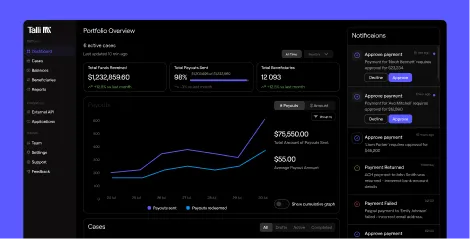
Real-time settlement dashboards transform how administrators manage distributions. Instead of compiling status reports from multiple sources, they access unified views showing:
- Completion rates by settlement tier, payment method, and time period
- Fund balances across segregated accounts with reconciliation status
- Pending actions requiring administrator attention
- Communication metrics tracking reminder effectiveness
- Compliance status highlighting verification gaps
These dashboards enable proactive management rather than reactive problem-solving. Administrators identify bottlenecks before they cascade into delays and can demonstrate progress to courts and stakeholders with verified data.
Integration with existing CRM systems ensures payout data syncs automatically, eliminating manual data entry and maintaining single sources of truth for client records.
Speeding Up Payouts: From Weeks to Minutes
Time-to-payment directly impacts claimant satisfaction and firm reputation. Delays frustrate recipients and generate support inquiries that consume administrative resources.
Accelerating the Settlement Lifecycle with Cloud Technology
Cloud platforms compress every phase of settlement processing:
Document retrieval
- Traditional timeline: 2–3 days
- Cloud-enabled timeline: Instant
Verification reviews
- Traditional timeline: 3–5 days
- Cloud-enabled timeline: 1–2 days
Approval workflows
- Traditional timeline: 4–7 days
- Cloud-enabled timeline: 1–3 days
Total processing
- Traditional timeline: 9–15 days
- Cloud-enabled timeline: 2–5 days
The ability to reduce settlement distribution timelines from weeks to days creates competitive advantages for firms handling time-sensitive distributions. Courts increasingly expect efficient administration, and claimants compare their experiences against other settlements they've participated in.
For high-volume settlements, these time savings compound dramatically. Processing 100,000 claimants at traditional speeds creates backlogs that extend distributions for months. Cloud automation maintains consistent throughput regardless of volume.
Scaling Payout Operations for Any Size Settlement
Settlement volumes vary enormously—from small personal injury cases with a handful of claimants to massive class actions involving millions of recipients. Platforms must handle both extremes without requiring different systems or processes.
Cloud architecture provides inherent scalability that on-premise solutions cannot match:
- Elastic infrastructure expanding automatically during high-volume periods
- Parallel processing handling thousands of payments simultaneously
- Consistent performance regardless of settlement size
- No hardware limitations constraining throughput capacity
Leading enterprise platforms like Epiq have managed over $36 billion in settlement funds for the top 100 U.S. class actions, demonstrating the scale cloud systems can achieve. However, the same platforms serve smaller settlements equally well, with pricing models that scale appropriately.
Integrating Cloud Platforms into Existing Legal Workflows
Successful cloud adoption requires thoughtful integration with existing systems rather than wholesale replacement of established workflows.
Key integration considerations:
- API connectivity enabling data exchange with case management systems
- Single sign-on reducing password fatigue and security risks
- Data migration transferring historical records without loss
- Training programs ensuring staff can utilize new capabilities
- Phased rollouts minimizing disruption to ongoing settlements
About 73% of law firms already use cloud-based software, indicating that most organizations have experience with cloud tools. Settlement-specific platforms build on this familiarity rather than requiring entirely new skill sets.
Modern platforms support API access that enables integration even for teams without deep technical expertise. Pre-built connectors handle common integrations while custom APIs address unique requirements.
Choosing the Right Cloud Solution for Your Multi-Party Settlements
Selecting a settlement administration platform requires evaluating multiple factors beyond headline features:
Compliance capabilities matter most for firms handling regulated distributions. Verify that platforms include automated KYC, OFAC screening, tax reporting, and audit trail generation—not as add-ons but as core functionality.
Payment flexibility determines whether claimants can actually receive their funds. Platforms supporting only bank transfers exclude unbanked populations and reduce overall redemption rates.
Scalability evidence demonstrates whether the platform can handle your largest potential settlements. Request case studies showing successful high-volume distributions.
Integration depth affects how much manual work remains after implementation. Deep integrations with existing systems eliminate duplicate data entry and reconciliation requirements.
Support quality becomes critical during complex distributions. Evaluate response times, available channels, and whether dedicated account management is available.
Why Talli Makes Multi-Party Settlements Easier
Talli delivers comprehensive capabilities specifically designed for claims administrators and legal teams managing complex multi-party distributions.
The platform automates and safeguards every claims payout with features including:
- Complete fund segregation with dedicated accounts for every settlement, preserving QSF ownership and simplifying reporting
- Built-in compliance with KYC, OFAC, W-9 collection, fraud mitigation, and audit logs integrated into every workflow
- Flexible payment options including digital wallets, prepaid Mastercard, ACH transfers, and retail gift cards—no bank account required
- Real-time dashboards providing total visibility into completion rates, fund flows, and payout status
- Smart reminders across email and SMS to drive higher redemption rates
- Scalable architecture handling distributions from 1,000 to 100,000+ recipients
Unlike generic payment processors, Talli was built specifically for the claims industry. The platform understands the unique requirements of legal settlements—from court reporting obligations to QSF tax compliance—and addresses them without workarounds or manual processes.
Banking services are provided by Patriot Bank, N.A., Member FDIC. The Easy Prepaid Mastercard is issued by Patriot Bank, N.A., Member FDIC, pursuant to a license from Mastercard International.
For teams seeking to increase settlement redemption rates while maintaining compliance and reducing administrative burden, Talli provides the automation infrastructure needed for efficient multi-party settlement management.
Frequently Asked Questions
What are the main challenges in managing multi-party settlements?
The primary challenges include coordinating documentation across multiple parties, maintaining compliance with KYC/OFAC/tax requirements, managing complex allocation calculations, and processing payments for large numbers of claimants efficiently. Traditional methods using spreadsheets and email create version control problems and introduce errors that can invalidate agreements. 56% of legal professionals report that pre-trial settlements have become more difficult, making efficient administration even more critical when agreements are reached.
How do cloud platforms enhance the security of legal payouts?
Cloud platforms deploy multiple security layers including real-time OFAC screening against U.S. Treasury sanctions lists, identity verification matching claimant information against databases, duplicate claim detection, and encrypted payment rails. Modern platforms also use multi-party computation and confidential computing to protect sensitive data. Comprehensive audit trails document every action for court review and regulatory compliance.
How quickly can funds be disbursed using a cloud platform?
Cloud platforms compress settlement processing from 9-15 days to 2-5 days by automating document retrieval, verification reviews, and approval workflows. Document retrieval alone drops from 2-3 days to instant access. For individual payments, digital disbursement methods like ACH and digital wallets provide same-day or next-day delivery compared to weeks for traditional paper checks.
Can cloud platforms improve claimant satisfaction during the settlement process?
Yes, significantly. Cloud platforms offer flexible payment options including digital wallets, prepaid cards, and direct deposits that let claimants choose their preferred method. Smart reminders via SMS and email help claimants complete the process without abandoning their claims. Self-service portals provide 24/7 access to status information, reducing support inquiries while keeping claimants informed throughout the distribution.
Is it difficult to integrate a new payment platform with existing legal software?
Modern cloud platforms are designed for integration with existing systems. About 73% of law firms already use cloud-based legal tools, providing familiarity with cloud interfaces. Most settlement platforms offer API connectivity and pre-built connectors for common case management systems. Phased implementation approaches allow firms to migrate ongoing settlements gradually rather than requiring immediate wholesale adoption.