.svg)


.svg)
A $50 million settlement distribution can fail when it hits unexpected peak concurrency—something a disciplined pilot and stress test is designed to uncover early. Organizations with pilot methodologies achieve significantly higher implementation success rates, while Automated testing improves repeatability and coverage, helping teams catch defects/regressions earlier—while targeted manual testing still matters for edge cases and usability. For claims administrators managing high-volume payouts, comprehensive stress testing isn't optional—it's the difference between smooth fund distribution and regulatory nightmares that destroy claimant trust and invite court scrutiny.
Key Takeaways
- Organizations with pilot methodologies achieve higher implementation success rates than those with ad-hoc approaches
- Proper stress testing prevents significant costs in production failures including downtime, remediation, and reputation damage
- Test at peak load, then push beyond it (commonly 2–3× anticipated peak) to validate headroom and failure modes——under-testing (e.g., stopping at 50% of anticipated peak) can miss bottlenecks that only appear at scale
- Comprehensive pilot programs typically require 4-12 weeks depending on platform complexity and transaction volume
- Automated testing significantly reduces transaction errors compared to manual validation processes
- One study found fintechs increased average investment by ~6.6× after graduating from a regulatory sandbox
Understanding the Vital Role of Pilot Testing for Disbursement Platforms
Pilot testing validates your disbursement platform's ability to handle real-world settlement distributions before full-scale deployment. For legal settlement platforms, this means ensuring secure, compliant fund distribution to thousands of claimants across multiple payment methods while maintaining audit trails and meeting regulatory requirements.
The core components of effective pilot testing include:
- Functional validation ensuring payment workflows execute correctly
- Integration testing verifying connections with banking systems and compliance tools
- Performance benchmarking establishing baseline metrics for transaction throughput
- Security audits identifying vulnerabilities before production exposure
- User acceptance testing confirming administrator and claimant experiences meet requirements
Without systematic pilot testing, claims teams risk deploying platforms that fail under real-world conditions. Payment-provider sandboxes often differ from production and may not simulate real clearing/settlement behavior; document all sandbox gaps and validate critical flows in production-like conditions when allowed.
Why Stress Testing is Crucial for Reliable Legal Payout Platforms
Stress testing pushes your disbursement platform beyond normal operating parameters to identify breaking points before they affect live settlements. This differs from standard functional testing by deliberately overloading system resources to measure resilience under duress.
The Impact of High-Volume Disbursements
Many payment platforms hit bottlenecks during high-volume transaction periods—thresholds that seem distant until a major settlement triggers simultaneous payment requests. Database performance degrades with complex queries, payment gateway connections timeout, and reconciliation processes stall.
Critical stress testing metrics include:
- Transaction throughput under peak load conditions
- Latency measurements for end-to-end payment processing
- Error rates when system resources are constrained
- Recovery time after simulated failures
- Resource utilization across infrastructure components
Ensuring Compliance Under Duress
Compliance systems must maintain accuracy even when processing volumes spike dramatically. KYC verification, OFAC screening, and fraud detection algorithms require dedicated stress testing to ensure they don't become bottlenecks or—worse—fail silently under load.
Multi-region payment infrastructure protecting against $110 million in revenue exposure demonstrates how resilience engineering prevents catastrophic failures during peak processing windows.
Key Components of a Robust Stress Testing Plan for Disbursement Software
Designing Realistic Load Scenarios
Effective stress tests mirror actual settlement distribution patterns rather than artificial uniform loads. Consider payment method distribution, geographic spread of claimants, and typical submission timing curves when designing test scenarios.
Essential test scenario elements:
- Batch processing simulations replicating actual settlement file sizes
- Concurrent user loads matching projected claimant portal traffic
- Payment rail diversity testing ACH, digital wallets, prepaid cards, and checks simultaneously
- Edge cases including failed transactions, duplicate submissions, and partial completions
- Regional variations accounting for timezone-based access patterns
Selecting the Right Performance Metrics
Quantifiable metrics enable objective pass/fail decisions and provide baseline data for ongoing monitoring. Performance testing for financial apps requires tracking numerous KPIs to ensure comprehensive coverage.
Priority metrics for disbursement platforms:
- Transactions per second (TPS) sustained under load
- 95th percentile response times for critical operations
- Error rates by transaction type and payment method
- Queue depth for asynchronous processing systems
- Database connection pool utilization
Executing Pilot Tests: Best Practices for Payment Systems
Simulating Real-World Payment Flows
Start with a small percentage of projected transaction volume (typically 10-15%) during initial pilot phases, gradually increasing load as issues are identified and resolved. This phased approach prevents overwhelming teams with simultaneous failures.
Implementation sequence for payment system pilots:
- Week 1-2: Establish test environment mirroring production payment flows
- Week 3-4: Execute functional tests with synthetic claimant data
- Week 5-8: Run stress tests at escalating volume levels
- Week 9-10: Analyze results, implement fixes, and retest critical failures
- Week 11-12: Document findings and prepare deployment roadmap
Common execution pitfalls to avoid:
- Insufficient test data complexity: Synthetic data must reflect real-world variations in payment preferences, transaction amounts, and edge cases
- Ignoring third-party limitations: Payment gateway test environments often lack production features—document and account for these gaps explicitly
- Testing during off-peak hours only: Ensure tests run during periods matching actual settlement distribution schedules
Monitoring and Analyzing Test Results in Real-Time
Real-time dashboards provide immediate visibility into test execution, enabling rapid response to emerging issues. Configure alerts for threshold breaches across all critical metrics before beginning stress tests.
Tailoring Stress Tests for Small Business Payment Platforms
Smaller claims administrators face resource constraints that require creative approaches to comprehensive testing. Cost-effective strategies can achieve comparable validation without enterprise budgets.
Balancing Scope and Budget for Small Business Needs
Prioritize testing based on risk assessment rather than attempting comprehensive coverage with limited resources. Focus intensive testing on:
- Highest-volume payment methods used by your claimant population
- Compliance-critical workflows including fraud detection and regulatory screening
- Integration points with external systems most likely to fail
- Recovery procedures ensuring business continuity during outages
Open-source tools like JMeter provide capable load testing without subscription costs, though they require significant setup time and experienced QA resources for effective implementation.
Leveraging Cloud-Based Testing Solutions
Cloud testing platforms eliminate infrastructure provisioning while providing scalable load generation. Most providers offer pay-per-use pricing that reduces costs for organizations with intermittent testing needs.
Beyond Functionality: Integrating Compliance and Security into Pilot Tests
Assessing Data Integrity and Segregation
Fund segregation verification ensures settlement funds remain properly isolated throughout the disbursement lifecycle. Test scenarios must validate that compliance requirements are maintained even under system stress.
Critical compliance test scenarios:
- KYC verification accuracy under high submission volumes
- OFAC screening completeness without false negative increases
- W-9 collection workflows maintaining data integrity
- Audit trail completeness capturing all transaction events
- QSF ownership preservation through fund segregation validation
Simulating Fraud Scenarios
Fraud prevention testing validates that detection algorithms maintain accuracy during peak processing. Inject known fraud patterns into test data to verify identification rates don't degrade under load.
Security testing must include:
- Penetration testing of claimant portals and administrator interfaces
- Vulnerability assessments across all system components
- Data encryption validation for information in transit and at rest
- Access control verification ensuring role-based permissions function correctly
Analyzing Results and Reporting for Disbursement Platform Pilot Tests
Interpreting Performance Metrics
Raw metrics require context for meaningful interpretation. Compare results against industry benchmarks, historical performance data, and stated platform specifications to identify genuine concerns versus acceptable variations.
Automated testing frameworks help build regulatory confidence by making tests more repeatable, traceable, and verifiable.
Result analysis framework:
- Severity classification categorizing issues by business impact
- Root cause analysis identifying underlying system weaknesses
- Remediation prioritization based on risk and effort assessment
- Regression risk evaluation ensuring fixes don't introduce new issues
Communicating Findings to Stakeholders
Executive summaries must translate technical findings into business implications. Focus on:
- Compliance readiness for court approval submissions
- Risk exposure from identified vulnerabilities
- Timeline impact of required remediation work
- Cost implications of proceeding versus addressing issues
Transparency in settlement distribution extends to testing documentation—stakeholders need clear visibility into platform validation activities.
How Talli Simplifies Disbursement Platform Reliability
While numerous payment platforms exist, Talli delivers purpose-built solutions for claims administrators managing settlement distributions at scale.
Talli's AI-driven payment platform addresses the exact challenges pilot testing aims to prevent:
- High-volume processing capability designed to support high-volume payouts—from thousands to large-scale distributions
- Built-in compliance automation with KYC, OFAC, W-9 collection, and fraud mitigation baked into every transaction
- Complete fund segregation preserving QSF ownership and simplifying reporting throughout the disbursement lifecycle
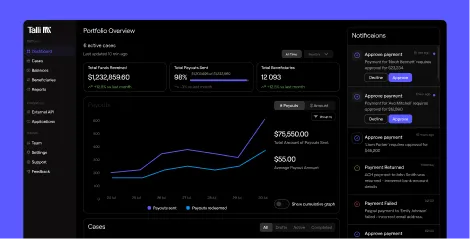
- Real-time dashboards providing total control and visibility over payout status and completion rates
- Flexible payment options including digital wallets, prepaid cards, and direct deposits—no bank account required for claimants
Banking services provided by Patriot Bank, N.A., Member FDIC.
For claims teams seeking platforms that have already undergone rigorous validation, Talli eliminates the uncertainty of unproven disbursement systems while providing the compliance infrastructure and automation that modern settlement administration demands.
Frequently Asked Questions
What is the primary goal of pilot testing a disbursement platform?
Pilot testing validates that your disbursement platform can handle real-world settlement distributions before full deployment. The primary goal is identifying system weaknesses, performance bottlenecks, and compliance gaps in a controlled environment where failures don't affect actual claimants. Organizations with pilot methodologies achieve higher implementation success rates because they catch issues before production impact.
How does stress testing differ from other types of software testing?
Stress testing deliberately pushes systems beyond normal operating parameters to identify breaking points, while functional testing verifies correct behavior under standard conditions. Load testing measures performance at expected volumes, but stress testing exceeds those volumes (typically by 3-5x projected peak load) to reveal hidden weaknesses. For disbursement platforms, this means testing transaction throughput, error handling, and recovery procedures when resources are intentionally constrained.
What kind of data volume should we prepare for stress testing a payment system?
Prepare synthetic test data at 3-5x your projected peak transaction volume to ensure meaningful stress test results. Most platform failures occur when organizations test at only half of expected load and then encounter real-world spikes. For a settlement distribution targeting 25,000 claimants, prepare test data for 75,000-125,000 transactions with realistic variations in payment methods, transaction amounts, and geographic distribution.
How long does comprehensive pilot testing typically take?
Comprehensive pilot testing for disbursement platforms typically requires 4-12 weeks depending on platform complexity, transaction volume, and integration requirements. Simple ACH-only systems with fewer than 10,000 claimants may complete in 4-6 weeks, while multi-rail payment platforms handling 100,000+ recipients often require the full 12-week timeline including environment setup, test execution, remediation, and documentation phases.
What are common pitfalls to avoid when running pilot tests for financial platforms?
The most common pitfalls include testing with unrealistic data that doesn't reflect actual claimant behavior, relying on payment gateway sandboxes that lag behind production features, insufficient load testing volume, and excluding stakeholders beyond technical teams. Pilots that exclude ops, support, finance, and compliance often miss workflow, documentation, and usability issues. Additionally, pilots under 4 weeks rarely expose integration timing issues, batch processing bugs, or edge-case failures that emerge during actual settlement distributions.