.svg)


.svg)
The shift from paper checks to card-based and digital payment solutions has transformed how law firms and claims administrators distribute settlement funds. With the vast majority of class action claimants now choosing digital payment options over checks, understanding which cards and platforms support litigation disbursements is essential for modern settlement administration.
Key Takeaways
- Traditional prepaid cards (U.S. Debit Card, Visa Payroll) serve narrow government and employer use cases but lack litigation-specific features
- The Easy Prepaid Mastercard, issued by Patriot Bank, N.A., Member FDIC, provides flexible fund access for claimants without bank accounts
- Gift cards issued by InComm and distributed by Talli offer targeted payout options with broad merchant acceptance
- Digital wallet integration enables near-instant fund delivery compared to days or weeks for paper checks
- Modern platforms achieve significantly higher payment success rates compared to traditional checks
- Real-time dashboards provide complete visibility into payout status, completion rates, and fund flows
- Platforms like Talli power payouts at any size—whether 1,000 or 100,000 recipients
Why Are Traditional Settlement Payment Methods Falling Behind?
The legal industry's reliance on paper checks and wire transfers has created substantial inefficiencies that modern card-based solutions address. Settlement administrators face mounting pressure to deliver funds faster while maintaining compliance.
- Paper check costs Physical checks cost an estimated $3-$8 per payment when factoring in printing, postage, and processing.
- Lower redemption rates Traditional checks experience lower redemption rates, meaning a substantial portion of payments go unredeemed.
- Fraud exposure Treasury/FinCEN and the FBI/USPIS have warned that mail-theft-related check fraud is rising, with hundreds of millions reported in suspicious activity tied to this pattern, exposing firms to significant financial risk.
- Extended timelines What used to take weeks with traditional methods now takes minutes with digital alternatives.
The claims industry has responded to these challenges by adopting multi-modal payment ecosystems that include prepaid cards, digital wallets, and instant transfer options.
How Has Digital Disbursement Adoption Changed?
Settlement administrators have embraced digital payment methods at an unprecedented rate. Digital disbursement adoption has grown significantly in recent years, with more settlements using digital platforms annually.
What Prepaid Debit Cards Work for Litigation Disbursements?
Prepaid debit cards provide a flexible solution for claimants who need immediate fund access without traditional banking relationships. Several card types serve distinct disbursement needs.
- The Easy Prepaid Mastercard Issued by Patriot Bank, N.A., Member FDIC, pursuant to a license from Mastercard International, this card enables claimants to access settlement funds immediately without bank account requirements.
- U.S. Debit Card The federal government's payment card serves agency disbursements with chip-based security and consumer protections for fraud, loss, and errors, though access is limited to government programs.
- Visa Payroll Cards Employer payroll programs use these cards for recurring payments, but they lack integration with legal case management systems.
- True Link Visa Controlled-spending cards serve special needs trusts and vulnerable populations but charge $12/month and don't integrate with settlement administration workflows.
Why Do Prepaid Cards Increase Redemption Rates?
Flexible payout options ensure more claimants complete the process. When claimants can choose prepaid cards, redemption rates increase substantially because recipients don't need bank accounts. Millions of Americans lack access to traditional banking, making prepaid cards essential for inclusive fund distribution.
What Benefits Do Claims Administrators Gain?
Prepaid card integration through platforms like Talli provides administrators with:
- Immediate fund delivery confirmation
- Reduced check reissuance costs
- Lower administrative overhead for payment tracking
- Simplified reporting for reconciliation
How Do Gift Cards Serve Settlement Distribution Needs?
Gift cards offer targeted disbursement options when claimants prefer merchant-specific payments or when settlement terms allow for non-cash alternatives.
- InComm-issued gift cards Gift Cards are issued by InComm and distributed by Talli, offering redemption at participating merchants as specified in the accompanying terms and conditions.
- Mastercard-branded options Mastercard and the Mastercard Brand Mark are registered trademarks of Mastercard, providing broad merchant acceptance.
- Digital distribution Recipients receive secure links via SMS or email with no accounts to create, streamlining the redemption process.
What Makes Gift Cards Enhance Claimant Experience?
Gift cards provide convenience and choice that traditional payment methods cannot match. The claimant experience improves when recipients can:
- Select from multiple merchant options
- Receive funds digitally without physical card delays
- Access funds immediately upon activation
- Avoid check cashing fees common at retail locations
What Digital Wallet and Card-Linked Options Exist for Modern Claimants?
Digital wallets and card-linked payment methods have become the preferred choice for settlement recipients. Modern platforms offer multiple channels for instant fund delivery.
- ACH transfers typically complete in 1–3 business days (often next business day), with fees commonly around $0.20–$1.50 per transaction (sometimes lower at scale).
- Direct-to-debit Instant transfers to existing Visa/Mastercard debit cards deliver funds in seconds.
- Digital wallets Venmo and PayPal integration provides 1-2 business day delivery for recipients who prefer mobile payment platforms.
- Treasury’s Digital Pay supports fast digital payouts, and Treasury has added FedNow support to enable instant payments for participating institutions.
Why Does Payment Choice Matter?
Claimants pick what payment method works best for their situation. When platforms offer a broad "pay menu," a significant majority of recipients choose instant options when available—demonstrating strong demand for speed over traditional methods.
How Does Talli Enable Payment Flexibility?
Talli enhances customer experience with secure settlement payment methods and digital wallet integration. Claimants receive a secure link via SMS or email, choose their preferred payment method, and get paid—no accounts to create, no bank account required.
How Do Platforms Ensure Compliance and Security in Card-Based Disbursements?
Card-based disbursement systems must meet rigorous compliance standards that protect both administrators and recipients. The explosion in settlement fraud has made security non-negotiable.
- KYC verification Know Your Customer protocols verify recipient identity before fund release.
- OFAC screening Office of Foreign Assets Control compliance ensures payments don't reach sanctioned individuals or entities.
- W-9 collection Automated tax documentation gathering supports 1099 reporting requirements.
- Fraud mitigation Real-time screening helps detect and prevent fraudulent claims that exhibit significant indicators of fraud.
- Audit logs Complete transaction documentation satisfies regulatory review requirements.
What Fund Segregation Protections Exist?
Complete fund segregation is essential for legal compliance. Talli supports dedicated accounts for every settlement, preserving QSF ownership, simplifying reporting, and ensuring legal compliance throughout the disbursement lifecycle. Banking services provided by Patriot Bank, N.A., Member FDIC.
How Has Fraud Risk Changed for Settlement Administrators?
Fraudulent claims have increased substantially in recent years, making fraud prevention tools mandatory rather than optional. Modern platforms deploy ClaimScore integration, duplicate payment detection, email domain verification, and international blocking to protect settlement funds.
What Real-Time Tracking and Reporting Features Matter Most?
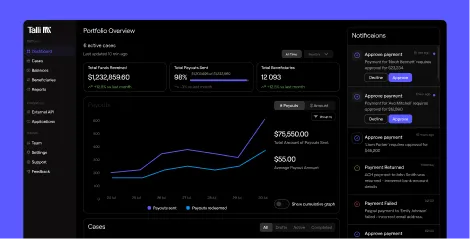
Claims administrators need complete visibility into disbursement status to meet court deadlines and satisfy stakeholder reporting requirements. Real-time dashboards have transformed settlement administration.
- Payout status monitoring Track every disbursement from initiation through claimant receipt in real time.
- Completion rate analytics Monitor what percentage of eligible claimants have successfully received funds.
- Fund flow visibility See every dollar with full transparency on where settlement funds stand at any moment.
- CRM integration Sync real-time payout data to existing case management systems automatically.
- Stakeholder reporting Generate court-ready reports documenting distribution progress and compliance.
How Does Talli's Dashboard Provide Control?
Talli's real-time dashboard enables total control and visibility for claims teams. Administrators can create payout distribution campaigns, track every payout status, and monitor completion rates—all from a single interface. The platform allows monitoring of delivery, completion, and engagement in real time with built-in reporting for teams and stakeholders.
How Do Smart Follow-Ups Boost Redemption Rates?
Unredeemed settlement funds represent a significant problem for administrators. Smart communication strategies drive higher completion rates and reduce unclaimed amounts.
- Multi-channel reminders Smart reminders across email, SMS, and more help claimants complete the payout process fast.
- Automated sequences Scheduled follow-ups reach unresponsive recipients without manual intervention.
- Personalized messaging Targeted communications address specific barriers preventing redemption.
- Deadline awareness Timely notifications ensure claimants don't miss payment windows.
What Results Can Administrators Expect?
Higher take-up rates with smart follow-ups translate directly to more successful distributions. The approach means less chasing and more redemptions—a seamless experience for every claimant.
Unrivaled customer support combined with automated reminders addresses the reality that some claimants still prefer traditional methods, ensuring no recipient gets left behind.
Can Card-Based Systems Scale for Mass Tort and Class Action Cases?
Large-scale settlements require platforms capable of handling substantial recipient volumes without sacrificing speed or compliance. High-volume payouts demand specialized infrastructure.
- Volume capacity Modern platforms process 100,000+ recipients per settlement while maintaining compliance controls.
- Simultaneous processing Multiple payment channels operate concurrently to accelerate distribution timelines.
- Batch and real-time options Administrators choose between bulk processing and individual disbursements based on case needs.
- Elastic infrastructure Cloud-based systems scale automatically during peak distribution periods.
How Does Talli Handle Large Settlements?
Talli powers payouts at any size—whether it's 1,000 or 100,000 recipients. The platform enables administrators to launch, fund, and track payouts faster than ever without losing control. Built for teams that need compliance, speed, and total visibility, Talli transforms mass payout operations that previously required extensive manual effort.
What Cost Savings Come With Scale?
For large-scale settlements, digital disbursements deliver substantial savings. Traditional approaches involving check printing, postage, and reissuance can cost significantly more than digital platform fees, transaction costs, and reconciliation—representing substantial cost reduction through digital methods.
Frequently Asked Questions
What types of cards support litigation disbursements?
Settlement administrators can use prepaid debit cards like The Easy Prepaid Mastercard (issued by Patriot Bank, N.A., Member FDIC), InComm-issued gift cards, and card-linked digital wallet transfers. Government programs use specialized cards like the U.S. Debit Card, while controlled-spending options like True Link serve specific populations requiring spending guardrails.
How does Talli ensure security and compliance?
Talli automates and safeguards every claims payout with built-in KYC, OFAC screening, W-9 collection, fraud mitigation, and comprehensive audit logs. Complete fund segregation supports dedicated accounts for every settlement, preserving QSF ownership and ensuring legal compliance. Banking services provided by Patriot Bank, N.A., Member FDIC.
Can claimants choose their payment method?
Yes. Claimants receive a secure link via SMS or email, select what payment method works best for their situation—including prepaid cards, digital wallets, ACH transfers, or direct-to-debit options—and get paid. No bank account is required, and no accounts need to be created.
What are the benefits of prepaid cards?
Prepaid and gift cards eliminate the lower redemption rates associated with paper checks, provide immediate fund access for unbanked recipients, and reduce administrative costs significantly. Recipients also avoid check cashing fees that can consume a portion of settlement amounts.
What happens if a payment fails?
Modern platforms achieve high payment success rates with self-service recovery options for failed cases. Claimants can update their information through secure portals, and automated retry logic attempts alternative delivery methods. Paper checks remain available as a fallback for recipients who prefer traditional methods.