.svg)


.svg)
Traditional settlement processing takes 4-6 weeks in best-case scenarios, with paper checks costing $8 per transaction compared to just $0.045 for digital alternatives. Modern digital payment platforms can compress these timelines to same-day delivery while reducing administrative costs by up to 99%. For settlement administrators and recipients alike, understanding how to measure and optimize time-to-cash has become essential for improving redemption rates, reducing operational overhead, and ensuring claimants receive their compensation faster.
Key Takeaways
- Traditional settlement processing takes 4-6 weeks on average in best-case scenarios for uncomplicated cases
- Only 53 cents of every tort dollar reaches actual claimants, with 47% consumed by administrative and litigation costs
- Paper checks cost $8 per transaction versus $0.045 for real-time digital payments—up to 99.4% cost reduction
- AI automation reduces settlement processing time by up to 80%, cutting distribution timelines from 15-30 days to 3-5 business days
- Mass tort allocation typically requires 6-12 months post-settlement approval for individual claim processing
- 92% of consumers use digital payments, yet nearly 80% of personal injury settlements still use paper checks
Understanding Time-to-Cash: What It Is and Why It Matters for Settlement Recipients
Time-to-cash measures the elapsed period from settlement approval to when funds become available in a recipient's account. For settlement recipients—many facing financial hardship from the underlying claim—this metric directly impacts their ability to cover medical bills, lost wages, or other expenses tied to their legal matter.
The standard timeline from settlement approval to payment spans 4-6 weeks under traditional processes. This includes:
- Release form signing: 1-2 weeks for document execution
- Insurance company processing: 2-6 weeks for payout authorization
- Lien negotiations: 2-6 weeks for Medicare and third-party resolutions
- Fee calculations: Additional time for attorney disbursements
The financial impact extends beyond recipient inconvenience. The U.S. tort system delivers only 53% of settlement funds to actual claimants, with 47% absorbed by litigation costs, administrative expenses, and attorney fees.
Mapping Your Settlement Journey: Identifying Bottlenecks in the Payout Process
Understanding where delays occur allows administrators and recipients to address specific friction points rather than accepting lengthy timelines as inevitable.
Common Bottleneck Categories
Document Verification Delays: Manual review of claim eligibility, identity verification, and supporting documentation creates processing queues. 58% of companies still manually reconcile accounts, spending over 2 hours per payment rail on tasks automation could reduce to 10-15 minutes.
Payment Method Limitations: Paper checks require printing, mailing, delivery, deposit, and clearing—each step adding days to the timeline. Uncashed check tracking costs an estimated $7-$20 per check in administrative overhead.
Compliance Processing: KYC verification, OFAC screening, and tax document collection add necessary but time-consuming steps. Without automation, these processes create serial dependencies where each step must complete before the next begins.
Communication Gaps: Recipients who don't respond to payment notifications or provide incomplete information extend timelines significantly. Poor communication channels compound delays when claimants can't easily check status or resolve issues.
For mass tort cases, individual allocation processes add 6-12 months after global settlement approval. This allocation phase involves injury assessment, documentation review, and tier assignment through court-appointed neutrals—complexity that demands proper automation infrastructure.
Leveraging Digital Solutions for Faster Settlement Payouts
Digital payment infrastructure has matured to the point where same-day settlement distribution is achievable for most cases. The technology exists—adoption remains the primary barrier.
Payment Method Comparison
ACH Transfers: 1-3 business day settlement with costs typically under $1 per transaction. Same Day ACH grew 45.3% year-over-year, processing 33.6 billion payments worth $86.2 trillion in 2024.
Real-Time Payments (FedNow/RTP): Settlement in under 20 seconds at $0.045 per transaction. These rails enable instant fund availability that matches modern consumer expectations.
Prepaid Cards: Same-day virtual delivery with immediate spending capability. Recipients without bank accounts gain access to funds without traditional banking barriers.
Digital Wallets: Instant transfers to platforms recipients already use, eliminating friction from new account creation or unfamiliar payment methods.
Despite these alternatives, nearly 80% of personal injury settlements still use paper checks. This gap between available technology and actual practice represents massive untapped efficiency potential for administrators willing to modernize.
Optimizing Communication and Transparency to Accelerate Fund Release
Recipient response time directly impacts time-to-cash. When claimants don't respond to payment notifications, provide incomplete information, or fail to select payment methods, administrators face extended timelines regardless of their internal efficiency.
Multi-Channel Engagement Strategies
Effective communication programs use multiple touchpoints:
- SMS notifications with secure payment links for immediate action
- Email confirmations with detailed instructions and status updates
- Automated reminders triggering at optimal intervals based on response patterns
- Real-time dashboards allowing recipients to track their payment status independently
Organizations implementing automated reminder systems report significant redemption rate improvements—directly translating to faster overall settlement completion and reduced escheatment obligations.
Transparency matters equally. When recipients can see exactly where their payment stands in the process, they're more likely to complete required actions promptly. Real-time settlement dashboards eliminate the uncertainty that causes recipients to contact support or simply disengage from the process.
Ensuring Compliance and Security in Expedited Payment Processes
Speed cannot compromise compliance. Settlement administrators face strict regulatory requirements that protect both recipients and the integrity of fund distribution.
Core Compliance Requirements
KYC Verification: Identity confirmation prevents fraud and ensures funds reach legitimate claimants. Automated verification reduces processing time from days to minutes while maintaining accuracy.
OFAC Screening: Office of Foreign Assets Control checks verify recipients aren't sanctioned individuals or entities. OFAC compliance requirements apply to all disbursements regardless of amount.
W-9 Collection: Tax identification number capture enables proper 1099 reporting. Missing TINs trigger backup withholding requirements that complicate distributions.
QSF Management: Qualified Settlement Fund regulations require complete fund segregation to preserve tax-advantaged structure. Dedicated accounts for each settlement simplify reporting and ensure legal compliance throughout the disbursement lifecycle.
Audit Trail Documentation: Every payment decision, approval, and disbursement must be traceable for court reporting and potential regulatory review.
Automation addresses compliance requirements without creating bottlenecks. AI-powered systems handle screening, verification, and documentation collection in parallel rather than sequentially—maintaining rigor while compressing timelines.
Choosing Flexible Payout Options to Suit Your Needs
Payment choice directly impacts redemption rates and recipient satisfaction. Forcing claimants into a single payment method—particularly paper checks—creates unnecessary barriers that extend time-to-cash and reduce overall settlement completion.
Payment Method Accessibility
Different recipients have different needs:
- Direct deposit (ACH): Preferred by recipients with established banking relationships who want funds in their primary account
- Prepaid debit cards: Essential for unbanked or underbanked recipients who lack traditional accounts
- Digital wallets: Convenient for recipients comfortable with mobile payment platforms
- Gift cards: Useful for smaller settlements where immediate spending access matters more than fund flexibility
The key insight: no bank account should be required for settlement payment access. Approximately 4.2% of American households are unbanked, with millions more underbanked. Flexible payout options ensure these populations can participate fully in settlements without facing additional barriers.
Offering choice also improves speed. Recipients who select their preferred method are more likely to complete the payment process quickly, reducing follow-up requirements and accelerating overall distribution timelines.
Measuring Key Financial Metrics for Settlement Performance
What gets measured gets improved. Settlement administrators who track specific time-to-cash metrics can identify optimization opportunities and quantify the impact of process improvements.
Essential KPIs for Time-to-Cash
Average Processing Time: Measure elapsed days from settlement approval to fund availability in recipient accounts. Segment by settlement type, payment method, and complexity tier to identify patterns.
Redemption Rates: Track the percentage of eligible claimants who successfully receive payment. Higher redemption rates indicate efficient processes and effective communication.
Cost Per Disbursement: Calculate total administrative expense divided by successful payments. Include staff time, technology costs, payment processing fees, and escheatment handling.
Error Rates: Monitor failed payments, returned funds, and required corrections. Automation typically achieves 92% error reduction compared to manual processing.
First-Attempt Success Rate: Measure payments that complete successfully without requiring intervention. Higher rates indicate clean data and effective recipient communication.
Organizations tracking these metrics consistently report 30-43% cost reductions and 40% satisfaction improvements through data-driven optimization.
Maximizing Claimant Experience with Seamless and Speedy Payouts
Recipient expectations have shifted dramatically. With 92% of consumers using digital payments and 75% expecting real-time processing, multi-week settlement timelines create satisfaction gaps even when traditional benchmarks are met.
Experience Design Principles
Minimal Friction: Recipients should receive secure links via SMS or email with no accounts to create. Every additional step reduces completion rates.
Clear Communication: Status updates at each process stage eliminate uncertainty and reduce support inquiries. Proactive notification outperforms reactive inquiry handling.
Payment Choice: Let claimants select the method that works best for their situation. Forced payment methods create barriers that extend timelines.
Responsive Support: When issues arise, quick resolution prevents minor problems from becoming major delays. Dedicated support for settlement recipients demonstrates commitment to their experience.
The comparison matters: claimants experience instant payments in virtually every other financial context—Venmo transfers, online refunds, direct deposits. Settlement payments that take weeks feel antiquated by comparison, regardless of historical norms.
The Future of Settlement Payouts: AI and Automation for Unprecedented Speed
AI-powered settlement processing represents the most significant opportunity for time-to-cash improvement. Rather than accelerating existing inefficient processes, automation fundamentally restructures how disbursements work.
Transformation Capabilities
Intelligent Document Processing: AI extracts and validates information from claim documents, eligibility determinations, and tax forms without manual review. Processing that requires hours completes in seconds.
Automated Compliance Checks: OFAC screening, KYC verification, and W-9 validation run automatically as claims process. Parallel execution eliminates sequential bottlenecks.
Predictive Analytics: Machine learning identifies potential issues before they cause delays—flagging incomplete submissions, likely addressing problems, or fraud indicators for proactive resolution.
Scalable Processing: Handle 1,000 or 100,000 recipients with the same infrastructure. Automation maintains consistent performance regardless of volume spikes.
Organizations implementing AI automation report 85% faster processing speeds, reducing distribution timelines from 15-30 days to 3-5 business days. Same-day processing becomes achievable for 78% of routine cases when manual bottlenecks are eliminated.
As one insurance industry expert noted: "The future claims handler is no longer confined to traditional practices but is at the forefront of integrating AI, digital tools, and advanced analytics."
Why Talli Accelerates Time-to-Cash for Settlement Recipients
While multiple payment platforms exist, Talli delivers purpose-built solutions specifically designed for legal settlement distribution—addressing the unique compliance, scale, and recipient experience requirements that generic payment processors miss.
Talli's AI-driven platform offers:
- Complete Fund Segregation: Dedicated accounts for every settlement preserve QSF ownership and simplify reporting throughout the disbursement lifecycle
- Built-In Compliance: KYC, OFAC screening, W-9 collection, fraud mitigation, and audit logs integrated into every workflow—not bolted on as afterthoughts
- Flexible Payment Options: Easy Prepaid Mastercard®, digital wallets, ACH transfers, and gift cards ensure every recipient can access funds regardless of banking status
- Smart Follow-Ups: Automated reminders across email and SMS help claimants complete the payout process fast, improving redemption rates
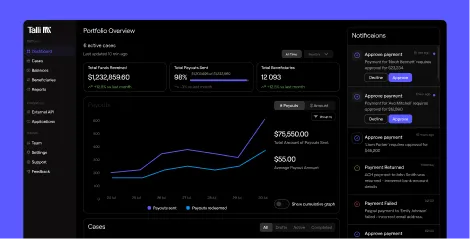
- Real-Time Dashboard: Total visibility into completion rates, fund flows, and payout status with CRM synchronization
- Elastic Infrastructure: Power payouts at any size—whether 1,000 or 100,000 recipients
Banking services are provided by Patriot Bank, N.A., Member FDIC. The Easy Easy Prepaid Mastercard® is issued by Patriot Bank, N.A., Member FDIC, pursuant to a license from Mastercard International.
For settlement administrators seeking to compress time-to-cash from weeks to days while maintaining complete compliance visibility, Talli provides the infrastructure that transforms what used to take weeks into a process that takes minutes.
Frequently Asked Questions
What is 'Time-to-Cash' specifically in the context of legal settlements?
Time-to-cash measures the elapsed period from settlement approval to when funds become available in a recipient's account. Unlike case duration metrics that track filing to settlement, time-to-cash focuses specifically on the post-approval disbursement period. Traditional processes require 4-6 weeks for this phase, while digital platforms can reduce it to 1-5 business days depending on payment method and recipient response time.
How can I proactively prevent delays in receiving my settlement funds?
Recipients can accelerate their payments by responding promptly to payment notifications, providing complete and accurate information on first submission, selecting digital payment methods (ACH or prepaid cards) rather than paper checks, and ensuring contact information remains current throughout the process. Delays often stem from incomplete documentation, unresponsive recipients, or payment method limitations rather than administrator processing time.
Are there secure digital payment options for settlements if I don't have a traditional bank account?
Yes. Modern settlement platforms offer prepaid debit cards, digital wallet transfers, and gift cards that require no traditional bank account. These options provide immediate fund access while maintaining the same security and compliance standards as direct deposit. Approximately 4.2% of American households are unbanked, making alternative payment methods essential for equitable settlement distribution.
What role does compliance play in speeding up or slowing down settlement payouts?
Compliance requirements including KYC verification, OFAC screening, and W-9 collection are mandatory for all disbursements. Without automation, these checks create serial bottlenecks where each step must complete before the next begins. Platforms with integrated compliance automation run these checks in parallel, maintaining regulatory rigor while dramatically reducing processing time. Manual compliance processes can add days or weeks; automated processes complete in minutes.
How do automated payment platforms ensure data privacy and security during the payout process?
Secure payment platforms implement multiple protection layers: encrypted data transmission, SOC 2 Type II certification for data security controls, PCI-DSS compliance for card-based disbursements, and comprehensive audit trails documenting every action. Recipients typically access payment portals through secure links sent via SMS or email, eliminating the need to create accounts or store sensitive credentials. Fund segregation practices ensure settlement funds remain protected throughout the distribution lifecycle.